The State of Freemium 2026: Conversion Rates, Revenue Share, and Failure Modes
2026 freemium benchmarks: median 8% conversion, AI tools 15-20%, trial vs freemium tradeoffs and how to avoid the freemium death spiral.
In 2026, freemium models are both more effective and more challenging to manage. Here's what you need to know:
- Median Conversion Rates: Freemium SaaS products convert 8% of free users to paid, with AI-native tools performing better at 15–20%.
- Free Trials Dominate: 57% of products now use free trials, compared to 26% sticking with traditional freemium.
- Cost Challenges: Rising AI and infrastructure costs are driving some companies into the "Freemium Death Spiral", where free user support outweighs revenue.
- High-Performing Models: Credit card-required trials have the highest conversion rates (30%), but free trials and reverse trials (8–12%) offer better signup rates.
- Revenue Insights: Freemium-acquired users have 42% lower churn and 3.2x higher lifetime value than those from sales-led models.
To succeed, companies must balance free and paid features, optimize onboarding to highlight value quickly, and avoid common pitfalls like overly generous free tiers or requiring credit cards too early. Freemium works best when users encounter natural upgrade triggers tied to their success.
Freemium vs. Free Trial: Which Will Grow Your SaaS Faster? | SaaS Pricing Fundamentals
Freemium Conversion Rates: 2026 Benchmarks
What the Numbers Mean
In 2026, the median free-to-paid conversion rate for B2B SaaS products sits at 8% [9]. However, the top-performing products outpace the lowest quartile by as much as tenfold [9].
What qualifies as a "good" conversion rate can vary significantly by product category. For freemium models, a 3–5% conversion rate is respectable, while 8–12% places you among the best [9]. AI-native products are raising the bar, with leading offerings achieving conversion rates of 15–20% - almost double those of traditional SaaS tools [9]. Project management platforms are ahead of the pack with a 5.8% average conversion rate, whereas HR tech lags behind at just 1.9% [6]. Developer-focused tools also trail, converting at nearly half the rate of non-developer SaaS products, averaging around 5% [7].
"Project management tools convert 2.4x better via freemium than HR tech, proving that product category dictates optimal free strategy more than pricing genius."
– Mewayz Editorial Team [6]
Free Trials vs. Freemium: How to Improve Conversion Rates
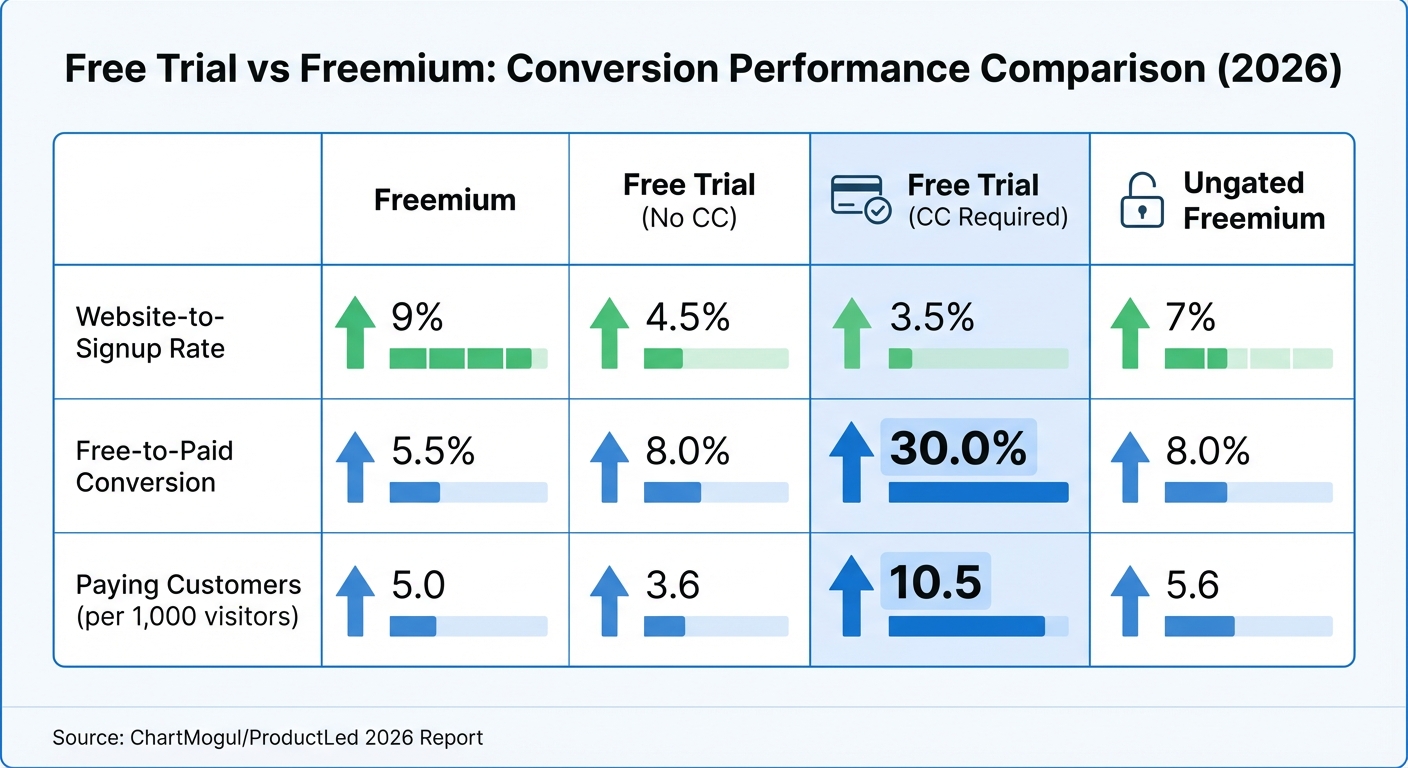
When comparing free trial and freemium models, user behavior varies widely. Freemium models typically lead to higher signup rates, with about 9% of website visitors signing up - double the 4.5% seen with free trials [3]. However, free trial users often convert to paying customers at a higher rate once they engage.
Here’s how the models stack up:
| Model Type | Website-to-Signup | Free-to-Paid Conversion | Paying Customers (per 1,000 visitors) |
|---|---|---|---|
| Freemium | 9% | 5.5% | 5.0 |
| Free Trial (No CC) | 4.5% | 8.0% | 3.6 |
| Free Trial (CC Required) | 3.5% | 30.0% | 10.5 |
| Ungated Freemium | 7% | 8.0% | 5.6 |
(Source: ChartMogul/ProductLed 2026 Report [1])
Requiring a credit card upfront during a trial has a dramatic impact. These trials boast a median conversion rate of 30% - over five times higher than trials without credit card requirements [9]. Top performers in this category can achieve rates of 50–60%, but the tradeoff is a lower initial signup rate of about 3.5% [9].
A newer approach, the reverse trial model, is also gaining traction. Here, users start with a 14-day premium experience and are downgraded to a free tier if they don’t convert. This method achieves conversion rates between 8–12% [2].
Trial Length and Credit Card Requirements
The trial length plays a key role in user engagement. A 14-day trial has become the standard for 62% of SaaS products [9], while seven- and 30-day trials each account for just 14% of the market [7]. Two weeks seems to strike the right balance between urgency and giving users enough time to evaluate the product.
First impressions matter immensely. About 55% of cancellations happen on Day 0, and 40–60% of users never log in again after their initial session [8]. If users don’t experience the product’s core value quickly, the trial length becomes irrelevant.
"40–60% of people who start a free trial never log in a second time. They sign up, poke around, and vanish."
– Samuel Hulick, Founder, UserOnboard [8]
While requiring a credit card can boost conversion rates, it also creates a barrier that may deter casual users. To counter this, many companies send reminder emails about seven days before the trial ends, which can help reduce refund requests and improve retention [9].
Ultimately, the most successful SaaS products focus on achieving activation milestones during the trial period. Users who complete 3–5 key actions - like connecting a platform, running their first scan, or inviting a teammate - are three to five times more likely to convert than those who don’t [2]. These high-intent users, often referred to as Product-Qualified Leads, represent the best opportunities for conversion, regardless of whether they started with a trial or freemium model.
How Freemium Models Generate Revenue
Revenue Per Install: Freemium vs. Paywalls
Freemium models come with a tradeoff: higher signup rates but lower upfront revenue per user. While freemium products typically convert about 9% of website visitors into signups, they only generate around 5 paying customers per 1,000 visitors. In contrast, models requiring credit card trials convert 10.5 paying customers per 1,000 visitors [3]. This difference has significant revenue implications.
Here’s an example: A company with an average revenue per user (ARPU) of $29 and a 3.5% conversion rate would need approximately 82,000 monthly active users to hit $1 million in annual recurring revenue (ARR) [4]. However, serving that many free users comes with hefty infrastructure and support costs, which can sometimes outweigh the revenue generated by paying customers. This challenge is often referred to as the "Freemium Death Spiral."
"If your 'Cost to Serve' a free user exceeds $1.00 per month and your conversion rate is only 1%, you are effectively paying $100/month just to host the free users for every one paid user you get."
– Calcix Research Team [4]
For micro-SaaS businesses, the math can get even tougher. Free users often make up 82% of the user base but account for 68% of support tickets, all while contributing no revenue [10]. This creates a "support tax", forcing companies to calculate a breakeven conversion rate - the minimum percentage of paying users needed to offset the costs of supporting the free tier.
While freemium models may struggle with immediate revenue, the long-term value of converting free users can make a significant difference.
Lifetime Value in Freemium Models
Although freemium models generate less upfront revenue, converted users often bring higher long-term value. These users tend to have 42% lower churn rates and 3.2x higher lifetime value compared to customers acquired through other methods. Why? Because they’ve already integrated the product into their workflows before deciding to pay [6]. For example, freemium-acquired customers often achieve a net revenue retention (NRR) of 127%, compared to 109% for sales-led cohorts [5].
Freemium conversions also lead to expansion revenue. Once converted, these users have a 68% chance of adding more seats within six months [6]. This is especially impactful for B2B products with network effects, where free users act as a low-cost engine for acquiring paid accounts. Single-user signups often evolve into team-wide deployments, driving growth from the bottom up.
A great example of this dynamic is CloudMetrics, a B2B analytics platform. Between 2022 and 2024, the company shifted from a free-trial model to a hybrid freemium approach. By combining feature gating with usage limits, they increased their annual recurring revenue from $1.2 million to $14.8 million and boosted their free-to-paid conversion rate from 3.8% to 7.4% [5]. The key to this success? Personalized conversion triggers that nudged users to upgrade at the exact moment they hit key usage limits tied to their success.
For freemium businesses, maintaining a healthy lifetime value to customer acquisition cost (LTV:CAC) ratio - ideally 3:1 - is critical [4]. Companies that succeed focus on "sticky features" like data storage and integrations that grow in value over time. This ensures that once users convert, they’re more likely to stay. Strong B2B SaaS companies typically maintain an ARPU of $25–$50, while top-tier performers exceed $120 [4].
What Makes Freemium Work
Effective freemium models rely on smart strategies to engage users and drive conversions, with a focus on leveraging user behavior and product design.
Network Effects and Word-of-Mouth Growth
Freemium thrives when a product becomes more useful as more people use it, especially in B2B SaaS tools with collaboration features. For instance, when one team member adopts a tool, they often invite others to join, creating a natural growth loop.
The numbers tell the story: accounts with three or more team members convert at a rate of 7.4%, compared to just 2.1% for solo users [6]. This explains why products like Slack and Zoom have built their growth strategies around team-based network effects. As teams grow, these tools become essential, and usage-based limits - like message history or meeting time - serve as effective prompts for paid upgrades.
Take Slack, for example. Between 2017 and 2019, Slack implemented a 10,000-message searchable history limit. For teams with 10 or more active users, this limit typically became a pain point within 1–3 months of use. The result? A conversion rate of 30–40% for these teams, propelling Slack from 37,000 to 88,000 paid customers in just two years [5].
Zoom followed a similar path in March 2020. During a surge in demand, the company imposed a 40-minute cap on group meetings. This limit was carefully chosen - it was just below the average meeting length of 45 minutes, nudging users toward paid plans. In just four months, Zoom skyrocketed from 10 million to 300 million daily participants [5].
The takeaway? Align usage limits with real-world team workflows. When users naturally bump into these limits, upgrading feels like the next logical step, not a forced decision.
While network effects are crucial for organic growth, fine-tuning the balance between free and paid features is just as important.
Balancing Free and Paid Features
Getting the free tier right is a balancing act. Offer too much, and users won't see a reason to upgrade. Offer too little, and they'll leave before discovering the product's value. The most effective freemium models use a mix of feature restrictions and usage caps to encourage conversions [5].
"The free version can't just be a glorified demo. It needs to solve real problems while creating natural expansion points." – Software Pricing Partners [11]
The goal is to provide enough value to hook users while ensuring they'll eventually hit a meaningful limitation. For instance, a project management tool might allow unlimited projects but restrict team size to three members, or it might offer full functionality but limit file storage. This approach ensures users experience the product's benefits while encountering a constraint that nudges them toward upgrading.
A great example is Mewayz, which found success between January 2025 and February 2026 by offering a "free forever" tier with 208 modules. This was enough to solve real problems, but advanced features were reserved for paid plans. Teams typically integrated 3–7 modules before naturally upgrading, leading to a 4.2% conversion rate across 138,421 users - all achieved with zero marketing spend [6].
Another powerful tactic is the reverse trial, where users start with premium features and later experience the free version. This approach taps into loss aversion, making users more likely to convert once they've experienced the full product [4][2].
The key is creating what experts call "productive friction." Your free tier should provide real value but include limitations that encourage users to upgrade without causing frustration [12]. When done right, users feel ready to take the next step, not like they've hit a dead end.
Common Freemium Mistakes
Freemium strategies can fail when the free offering overshadows the value of paid plans. Just like with conversion tactics or revenue models, optimizing your pricing strategy is essential for a successful freemium approach. The biggest pitfalls often stem from misunderstandings about what drives - or prevents - users from upgrading.
Requiring Credit Cards Too Early
Asking for credit card details upfront can be a double-edged sword. While it might increase the percentage of trial users who convert to paid plans, it drastically reduces overall signups. For example, requiring a credit card can cut signups in half - from 90 to 45 per 1,000 visitors - resulting in just 3.6 paying customers instead of 5 [2][9]. This happens because every additional step in the signup process, like entering billing information or verifying details, decreases conversion rates by roughly 10% per extra click [4].
Now, pair this with another common issue: offering a free tier that’s too generous.
Free Tiers That Undermine Paid Plans
A frequent misstep in freemium models is creating a free tier that meets too many of the user’s needs. When the free plan fully satisfies users, they have no reason to upgrade. This creates what some call a "permanent population of satisfied free users" who see no value in paying [12].
"When your free tier is too good, it does not create a pipeline of future paid users. It creates a permanent population of satisfied free users who have no economic incentive to ever upgrade." – Atticus Li, Revenue & Experimentation Leader [12]
Slack’s original free tier, which capped message history at 10,000 messages, rarely prompted small teams to upgrade. Similarly, PagerDuty limited its free plan to five seats, a deliberate choice that aligned with the smallest team size needed to experience the product’s scheduling benefits [13]. If your annual conversion rate dips below 5%, it might mean your free tier is too generous. On the flip side, if users abandon the product before reaching its core value, your free plan may be too restrictive.
Poor Onboarding That Loses Users
Onboarding is the linchpin for converting trial users. Studies show that 40–60% of trial users disappear within 24 hours if they don’t experience the product’s "aha moment" [2]. If users don’t reach key value within the first two minutes, it’s a red flag that your activation process needs immediate attention [2]. Every additional form field or unnecessary click in the onboarding flow reduces conversion rates by about 10% [4].
Companies like Dropbox and Calendly have tackled this challenge by designing onboarding experiences around a single, clear activation moment - such as uploading a first file (Dropbox) or scheduling a first meeting (Calendly) [14]. If fewer than 50% of users complete the setup process, it’s a sign that they’re being asked to do too much before they can see the product’s value. On the other hand, users who hit the "aha moment" early are three to five times more likely to convert [2][14]. This highlights just how crucial effective onboarding is for boosting conversions and building long-term success.
Striking the right balance in free tiers and perfecting onboarding are both critical to creating a freemium model that drives steady growth.
Key Takeaways
Freemium success in 2026 hinges on delivering quick value to users, maintaining a well-balanced free and paid tier structure, and carefully analyzing the costs of offering a free tier. While the median conversion rate for freemium models is 8%, top-performing companies surpass this by focusing on activating users within the first two minutes and leveraging behavioral triggers instead of time-based nudges [2][3].
Blended models that combine feature-gating with usage limits consistently outperform single-approach strategies. For instance, CloudMetrics saw their conversion rate jump from 3.8% to 7.4% after adopting this hybrid approach [5]. Similarly, the reverse trial method - offering 14 days of premium access before switching users to the free tier - taps into loss aversion psychology and can significantly drive conversion rates [4][2].
However, the biggest challenge remains avoiding the "Freemium Death Spiral." This occurs when the cost of supporting free users exceeds the revenue generated from paying customers. To prevent this, calculate your breakeven conversion rate by comparing the cost of serving free users to the revenue generated per paying customer [4].
As Wes Bush, CEO and Founder of ProductLed, advises:
"Focus on your user's outcome and challenges rather than debating free trial versus freemium." – Wes Bush [3]
Aligning your freemium strategy with long-term unit economics is essential. Freemium-acquired customers often achieve 127% net revenue retention, compared to 109% for sales-led customers, making the initial investment in free users worthwhile when managed effectively [5]. The trick lies in helping users reach their "aha moment" quickly, setting meaningful usage limits that encourage upgrades, and offering enough value in the free tier to keep them engaged - without giving away so much that they never feel the need to pay. By avoiding common pitfalls, you can ensure sustainable growth driven by sound unit economics.
FAQs
Should I choose freemium or a free trial?
Choosing between freemium and a free trial comes down to understanding your product, audience, and objectives.
Free trials tend to drive higher conversion rates - usually around 2%-5%, with top-tier products reaching as high as 15%. They create urgency for users to act and allow them to experience the full value of your product within a limited timeframe.
On the other hand, freemium models generally see conversion rates of 1%-3%. However, they excel at growing a larger user base, especially if your product benefits from strong network effects or continues to deliver value to free users over time.
How do I avoid the freemium death spiral?
To steer clear of the freemium death spiral, it's crucial to design your free tier in a way that motivates users to upgrade rather than keeping them content forever. If the free tier offers too much, you risk creating a pool of users who never feel the need to convert to paid plans.
Instead, aim to deliver value right away while strategically showcasing premium features. Use well-placed friction points to highlight what users are missing out on. The goal is to attract users with the free tier but also make the advantages of upgrading impossible to ignore.
What should my free tier limit first?
When designing free tier limits, aim to strike a balance between offering value and encouraging users to upgrade. Here are a few common strategies to consider:
- Feature Restrictions: Limit access to certain features, such as integrations or advanced tools, to entice users to explore premium options.
- Usage Caps: Set boundaries on usage, like the number of projects, storage space, or API calls, to introduce scarcity.
- Support Limitations: Offer basic support for free users while reserving priority or advanced support for paid plans.
The key is to ensure that your free tier delivers the product’s "Aha!" moment - the point where users clearly see its core value. This gives them a taste of what your product can do without providing the entire experience upfront. Tailor these limits to fit your product’s strengths and audience needs, so you can drive upgrades while keeping your business sustainable.
Related reading
- When to Offer SaaS Discounts
- Freemium vs Free Trial: Key Differences for SaaS
- Best Practices for Transitioning SaaS Growth In-House
- Localized Pricing Guide For SaaS Growth
- SaaS Pricing Experiments: How to Test Price Changes Without Killing Revenue
Useful tools & services
Locate the constraint in your funnel
Map the transitions so you can choose the next investigation or improvement.
Use the funnel templateNeed help choosing the next change? Explore CRO consulting.
Keep improving your conversion work.
Subscribe for practical ideas on diagnosing conversion problems, planning experiments, and choosing your next improvement.
No spam. Unsubscribe anytime.