our cac is climbing; who can redesign our saas pricing page using data-driven ux research?
Analyze user behavior and run data-driven UX tests to simplify pricing, personalize plans, and lower SaaS CAC.
Your pricing page might be killing your conversions - and your CAC (Customer Acquisition Cost) is paying the price.
If your CAC is climbing despite marketing and sales efforts, your pricing page could be the bottleneck. Here’s why:
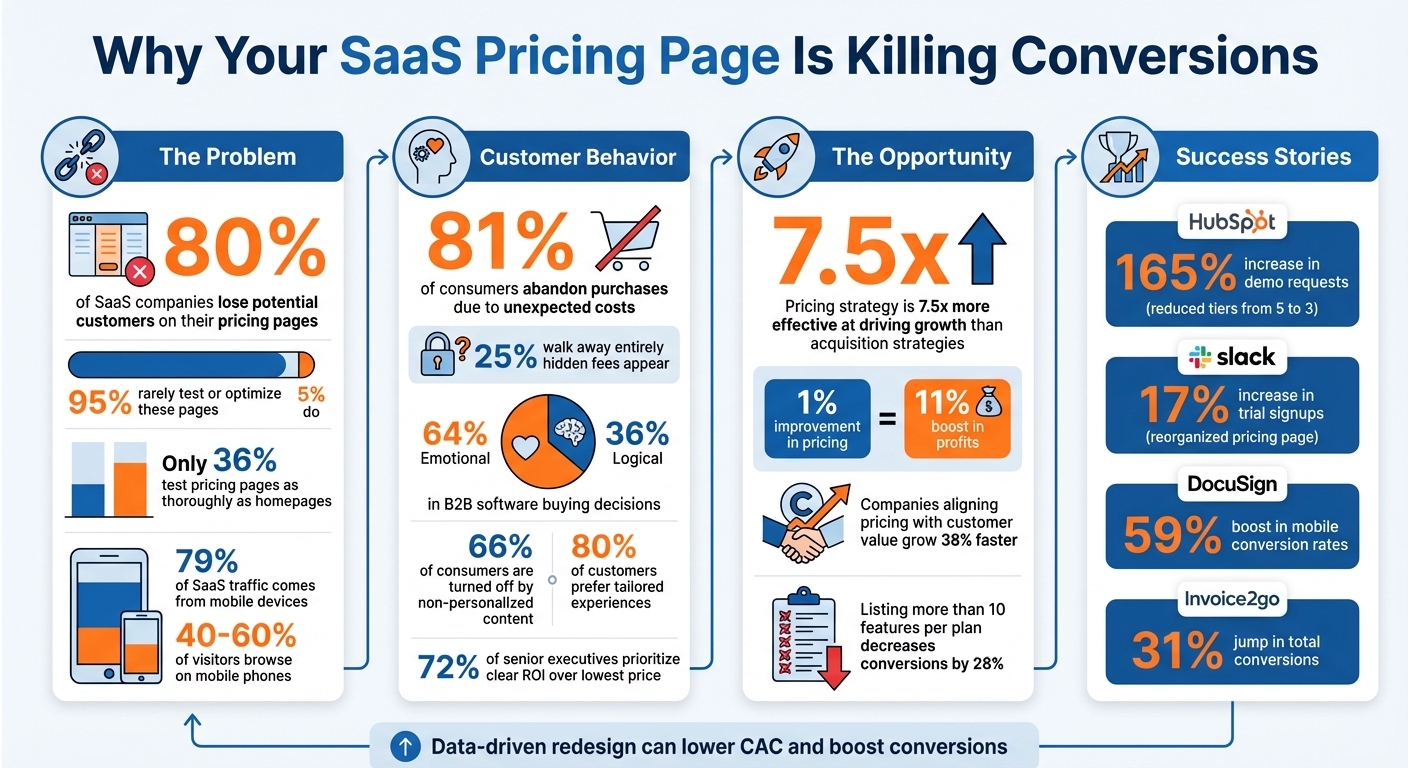
- 80% of SaaS companies lose potential customers on their pricing pages.
- 95% rarely test or optimize these pages, despite their critical role in conversions.
- A poorly designed pricing page increases bounce rates, confuses prospects, and wastes ad spend.
The fix? A data-driven redesign. By analyzing user behavior, simplifying layouts, and addressing buyer concerns, SaaS companies can lower CAC and boost conversion rates.
Key steps include:
- Simplify your pricing structure: Too many options or cluttered designs drive users away.
- Focus on outcomes, not features: Tie features to clear benefits like time saved or ROI.
- Personalize for customer segments: Tailor messaging to solo users, SMBs, or enterprises.
Companies like HubSpot and Slack have seen conversion boosts of 17%-165% by making data-backed changes to their pricing pages. If your CAC is rising, it’s time to stop guessing and start testing.
Common Problems in SaaS Pricing Pages
Confusing Messaging and Weak Value Statements
Steer clear of technical jargon and vague claims on your pricing page. For example, listing features like "Premium Support" or "Advanced Analytics" without explaining their real-world benefits leaves potential customers in the dark. Did you know that B2B software buying decisions are 64% emotional and 36% logical [2]? Yet, many pricing pages come across as dry technical spec sheets, focusing on features instead of the results those features deliver.
Instead, emphasize outcomes. For instance, rather than just mentioning "Automated Reconciliation", explain that it can save users 10 hours per week. This approach resonates with decision-makers - 72% of senior executives say that demonstrating a clear return on investment matters more than simply offering the lowest price [2]. If your messaging doesn’t tie features to tangible benefits, you risk losing valuable leads.
Transparency is equally important. Hidden fees are a deal-breaker for many buyers. In fact, 81% of consumers cite unexpected costs as a reason for abandoning a purchase, with 25% walking away entirely when such fees pop up [2][3]. Whether it’s implementation charges, usage-based add-ons, or mandatory annual billing, failing to disclose these costs upfront erodes trust.
But messaging is only part of the equation. How you structure and present your pricing page visually is just as critical.
Bad Layout and Visual Design
A cluttered pricing page can overwhelm potential customers. Massive comparison tables and endless bullet points often do more harm than good. Research shows that listing more than 10 features per plan can decrease conversion rates by 28% [7].
Simplification is key. Streamlining your pricing tiers can significantly improve user experience. For example, reducing the number of pricing options has been shown to increase demo requests and mobile conversions [1][2].
Don’t forget about mobile users - 40–60% of visitors are browsing on their phones [3][5]. DocuSign tackled this by optimizing their pricing page for mobile, using touch-friendly call-to-action buttons and a cleaner information hierarchy. The result? A 59% boost in mobile conversion rates [2].
Ignoring Different Customer Types
Even with refined messaging and design, it’s essential to cater to the diverse needs of your audience. Different customer segments - like a solo freelancer versus a large enterprise - have unique priorities. If your pricing page doesn’t address these differences, you’re missing opportunities. In fact, 66% of consumers are turned off by content that doesn’t feel personalized [8].
Personalization isn’t just a nice-to-have; it drives loyalty. Eighty percent of customers prefer tailored experiences, and 70% value recognition of their specific needs [8]. But many SaaS pricing pages fall short, relying on generic tier names like "Basic", "Pro", and "Premium." These labels don’t help users understand which plan is right for them. A better approach? Use persona-driven names like "Starter", "Growth", and "Scale" to make it clear who each plan is designed for [6].
Take Invoice2go as an example. By testing different pricing structures and simplifying their layout, they reduced clutter and improved clarity, achieving a 31% jump in total conversions [3]. When you funnel all visitors through the same generic presentation, you lose the chance to connect with specific customer segments.
Addressing these challenges lays the groundwork for a data-informed redesign that can lower your customer acquisition costs (CAC).
Using Data-Driven UX Research to Fix Your Pricing Page
Why Data Matters in UX Redesign
When it comes to improving your pricing page, relying on assumptions instead of data can be costly. Data-driven UX research helps pinpoint where and why potential customers drop off. Here's the reality: 95% of SaaS companies rarely test their pricing pages in meaningful ways [4]. That’s a huge oversight, especially since a solid pricing strategy can be 7.5 times more effective at driving growth than acquisition strategies [4].
Analytics tools can show where users abandon the process, while heatmaps reveal which parts of your page grab attention and which are ignored. Customer interviews can uncover if your pricing feels unclear, too high, or disconnected from the value customers expect. And here’s a big one: 79% of SaaS traffic comes from mobile devices, yet many companies still rely on desktop-first designs that don’t translate well to smaller screens [4]. This mismatch explains why mobile conversion rates often lag behind desktop, wasting valuable acquisition dollars.
"Pricing is the exchange of value. If you don't understand the value, you can't possibly get the price right." - Monetizely [9]
Shockingly, only 36% of companies test their pricing pages as thoroughly as their homepages or landing pages [2]. That’s a missed opportunity, especially when a 1% improvement in pricing can lead to an average 11% boost in profits [9][11]. Without research, decisions are based on guesswork instead of evidence. By using data, you can take a focused approach to redesigning your pricing page and addressing the real issues.
The Data-Driven Redesign Process
To realign your pricing strategy, start with a deep dive into your data. Begin by auditing internal metrics like win/loss reasons, conversion rates, and churn patterns. Identify which plans see the most churn or which features customers rarely use [10].
Next, study your competitors. Tools like the Wayback Machine can show how their pricing structures have changed over time. The goal isn’t to copy but to understand the market landscape and spot opportunities [10]. Then, conduct willingness-to-pay research using methods like the Van Westendorp Price Sensitivity Meter. This approach helps you determine if your pricing is too high (causing drop-offs) or too low (potentially signaling poor quality) [9][12].
Once you’ve gathered insights, test your hypotheses with A/B testing before making widespread changes. For example, in 2025, HubSpot reduced their pricing tiers from five to three, which led to a 165% increase in demo requests [2]. Similarly, Slack reorganized their pricing page to focus on use cases rather than technical specs, resulting in a 17% increase in trial signups for their Business+ plan [2]. These weren’t guesses - they were data-backed experiments.
For mobile optimization, DocuSign prioritized touch-friendly buttons and vertical stacking, achieving a 59% increase in mobile conversion rates without negatively affecting desktop performance [2]. These results came from identifying specific user pain points and addressing them with targeted solutions.
Metrics to Measure After Redesign
After launching your redesigned pricing page, track key metrics to ensure it’s hitting the mark. Keep an eye on:
- Customer Acquisition Cost (CAC)
- Trial-to-paid conversion rates (aim for over 20% in B2B SaaS [7])
- Average Revenue Per User (ARPU)
- Support ticket volume related to pricing questions
Pay close attention to how customers interact with your plans. Is your mid-tier plan - the one often positioned as the “target” option - attracting the right percentage of users? Monitor upgrade and downgrade trends: if too many customers downgrade within 90 days, your messaging might still need work [13].
Support ticket trends are also telling. A drop in pricing-related inquiries suggests your page is clearer, while a spike could mean you’ve introduced new confusion [7].
Finally, measure long-term indicators like Net Dollar Retention (NDR) and Customer Lifetime Value (LTV). A redesign that boosts short-term conversions but increases churn later isn’t a success. Companies that align their pricing with customer value grow 38% faster than those using arbitrary pricing models [9]. The goal isn’t just to convert more customers - it’s to attract the right ones who stick around.
How Artisan Strategies Redesigns SaaS Pricing Pages
Our Embedded, Test-and-Iterate Method
At Artisan Strategies, we embed ourselves directly into your team, taking on the role of a fractional growth lead. We treat your pricing page as a vital revenue engine, constantly refining it for better results. Our process starts with a three-day Revenue Leak Review, where we identify the three biggest leaks in your funnel. From there, we use tools like Van Westendorp, Gabor-Granger, and Conjoint analysis to uncover willingness-to-pay ranges and pinpoint feature-value tradeoffs.
Once we’ve zeroed in on the issues, we collaborate with your team through weekly revenue syncs to design, prioritize, and analyze experiments. We don’t just hand over vague suggestions - we provide actionable deliverables like copy, wireframes, and detailed implementation checklists so your team can act quickly. By applying psychological strategies like Anchoring (showcasing your highest-tier plan first) and Decoy Pricing (making your target plan the most appealing option), we guide customer decision-making effectively. To ensure experiments don’t backfire, we establish "guardrails" upfront, such as churn thresholds (e.g., a maximum increase of 50 basis points) and limits on support ticket volume. Most clients notice measurable conversion improvements within 1–2 weeks of implementing their first experiment. These systematic steps lead to real, data-backed progress.
Results We've Delivered for SaaS Companies
Our track record speaks for itself. In one 2024 project (Internal Case CC-002), we revamped a checkout flow, boosting completed signups from 32% to 47% - a 47% relative increase in conversions. In another project (Internal Case RE-003), we introduced a new pricing structure that drove subscription revenue up by 40% year-over-year, adding $748,000 in annualized revenue growth. For yet another client, our pricing experiments revealed premium packaging opportunities that contributed over $400,000 in ARR - all without resorting to heavy discounts or risking brand perception.
"When Joe cut our nine-step signup to three, retention 5×'d and we stopped burning $60k every month on ads that weren't converting. He sees the revenue system end-to-end." - COO, AdTech marketplace [14]
We back our work with a money-back guarantee, tied to specific KPI improvements like a +10% trial-to-paid conversion rate within 60 days. Whether you start small with the $800 Revenue Leak Review to uncover quick wins or go all-in with the $5,000/month Accelerator for sustained growth, our mission remains the same: launch experiments, measure outcomes, and refine until your CAC drops and your revenue climbs.
Conclusion: Lower Your CAC with a Better Pricing Page
Key Takeaways for Pricing Page Redesign
Your pricing page isn't just another part of your website - it's a critical tool that directly impacts your customer acquisition costs (CAC). When you refine your messaging, eliminate points of friction, and structure your pricing tiers around what your buyers truly value, you can stop wasting ad spend on visitors who abandon your site at the final hurdle. Despite its importance, only 36% of companies rigorously test their pricing pages like they do their homepages[2]. Yet, optimized pricing strategies have been shown to boost profit margins by an average of 11%[2].
A great example of this approach is HubSpot, which simplified its pricing structure by reducing tiers from five to three. The result? A 165% jump in demo requests[2]. These kinds of results don’t happen by chance - they come from treating your pricing page as a system to test, analyze, and continuously improve.
Next Steps for SaaS Companies
What should you do now? Start with an audit of your pricing page. Look for issues like vague value propositions, an overwhelming number of tiers, hidden fees, or a poor mobile experience. If you’re unsure where to begin, consider working with Artisan Strategies. Their $800 Revenue Leak Review offers a quick, three-day deep dive into your funnel, highlighting the biggest leaks and opportunities for improvement. For a more hands-on approach, their $5,000/month Accelerator embeds a fractional growth expert into your team to run five or more experiments per month. They even back it with a money-back guarantee tied to measurable KPIs, such as achieving a +10% trial-to-paid conversion rate within 60 days.
Your pricing page is either driving your growth or holding it back - there’s no in-between.
Optimizing Your Software Pricing Page for Results with Vova Feldman
FAQs
How can redesigning our SaaS pricing page help lower Customer Acquisition Cost (CAC)?
A data-driven redesign takes the guesswork out of improving your pricing page. By diving into user behavior and employing tools like analytics and A/B testing, you can pinpoint problem areas, fine-tune essential elements, and create a smoother experience that naturally leads more visitors to become paying customers.
This method doesn’t just help boost conversion rates - often by an impressive 35–50% - it also stretches your marketing dollars further by directly reducing your Customer Acquisition Cost (CAC). The end result? A pricing page that efficiently transforms traffic into revenue.
How can we optimize our SaaS pricing page to improve customer acquisition costs (CAC)?
To make your SaaS pricing page more effective and lower your customer acquisition cost (CAC), focus on a simple, intuitive layout. A tiered structure with 3–4 pricing plans works well, and you can guide users by emphasizing the most popular choice. Adding social proof - like customer testimonials or trust badges - helps build trust. Also, include a monthly/annual toggle (set to annual by default) to encourage longer commitments.
Consider offering a free trial or a money-back guarantee to lower the barriers for new users. Use psychological pricing strategies, such as decoy pricing, rounded numbers, or ending prices in .99, to make your pricing appear more appealing. Leaving out dollar signs can also soften how prices are perceived. Limited-time offers can create urgency and motivate quicker decisions.
Finally, regularly test and refine your page with A/B or multivariate testing. Pay close attention to metrics like conversion rates, churn, and ARPU. By continuously tweaking based on data, you can ensure your pricing page remains effective and competitive.
Why is it important to tailor pricing pages for different customer segments?
Tailoring your pricing page means presenting offers that align with each customer segment's willingness to pay and perceived value. This strategy not only boosts revenue and profit margins but also enhances customer satisfaction by meeting unique needs and expectations.
Relying on a one-size-fits-all pricing model often results in missed opportunities - some customers may feel overlooked, and potential revenue can slip through the cracks. By personalizing your approach, you create a dynamic experience that connects with a diverse range of customers.
Related reading
- When to Offer SaaS Discounts
- Freemium vs Free Trial: Key Differences for SaaS
- Best Practices for Transitioning SaaS Growth In-House
- Localized Pricing Guide For SaaS Growth
- SaaS Pricing Experiments: How to Test Price Changes Without Killing Revenue
Useful tools & services
Locate the constraint in your funnel
Map the transitions so you can choose the next investigation or improvement.
Use the funnel templateNeed help choosing the next change? Explore CRO consulting.
Keep improving your conversion work.
Subscribe for practical ideas on diagnosing conversion problems, planning experiments, and choosing your next improvement.
No spam. Unsubscribe anytime.