The Reactivation Playbook: How to Win Back Churned SaaS Customers
Win back churned SaaS customers by diagnosing why they left, using the 30‑day window, and running personalized, low‑friction campaigns.
Churn happens. But here’s the good news: bringing back lost customers can cost 3x to 25x less than finding new ones. Plus, reactivated users often stick around longer and spend more.
The key? Understand why they left and address those reasons directly.
Here’s a quick breakdown of how to turn churned customers into loyal ones again:
- Segment them: Group by how long they’ve been gone, their value, and why they left.
- Focus on timing: The first 30 days after churn is your best window for success.
- Tailor your approach: Match your outreach to their specific reason for leaving (e.g., pricing, missing features, or low usage).
- Track results: Measure reactivation rates, revenue regained, and how many churn again.
Put simply: personalization beats generic outreach every time. A targeted email addressing their exact pain point can convert up to 5x better than a generic “we miss you” message.
Want to win churned customers back? Start by fixing what made them leave.
How to Reduce Churn and Get More Lost Customers Back - with Baird Hall
Understanding Churn: Types and Causes
To develop effective recovery strategies, it's essential to understand the reasons behind customer churn. Churn isn't one-size-fits-all - it varies in causes and impact. Knowing why customers leave is the key to creating a reactivation plan that works. These patterns of churn provide the foundation for targeted strategies.
Types of Churn in SaaS
Churn in SaaS typically falls into three categories:
-
Voluntary churn happens when customers actively decide to leave. This might be due to pricing issues, a poor fit with the product, or missing features. Winning these customers back means addressing their specific concerns head-on.
-
Involuntary churn occurs without the customer’s intent. It’s often the result of failed payments due to expired cards, insufficient funds, or bank declines. Since customers may not even realize they’ve churned, the focus here is on reducing payment friction and making it easy for them to update their payment details.
-
Silent disengagement involves customers who don’t formally cancel but gradually stop using the product. These users are high-risk and often go unnoticed until their activity drops significantly [12].
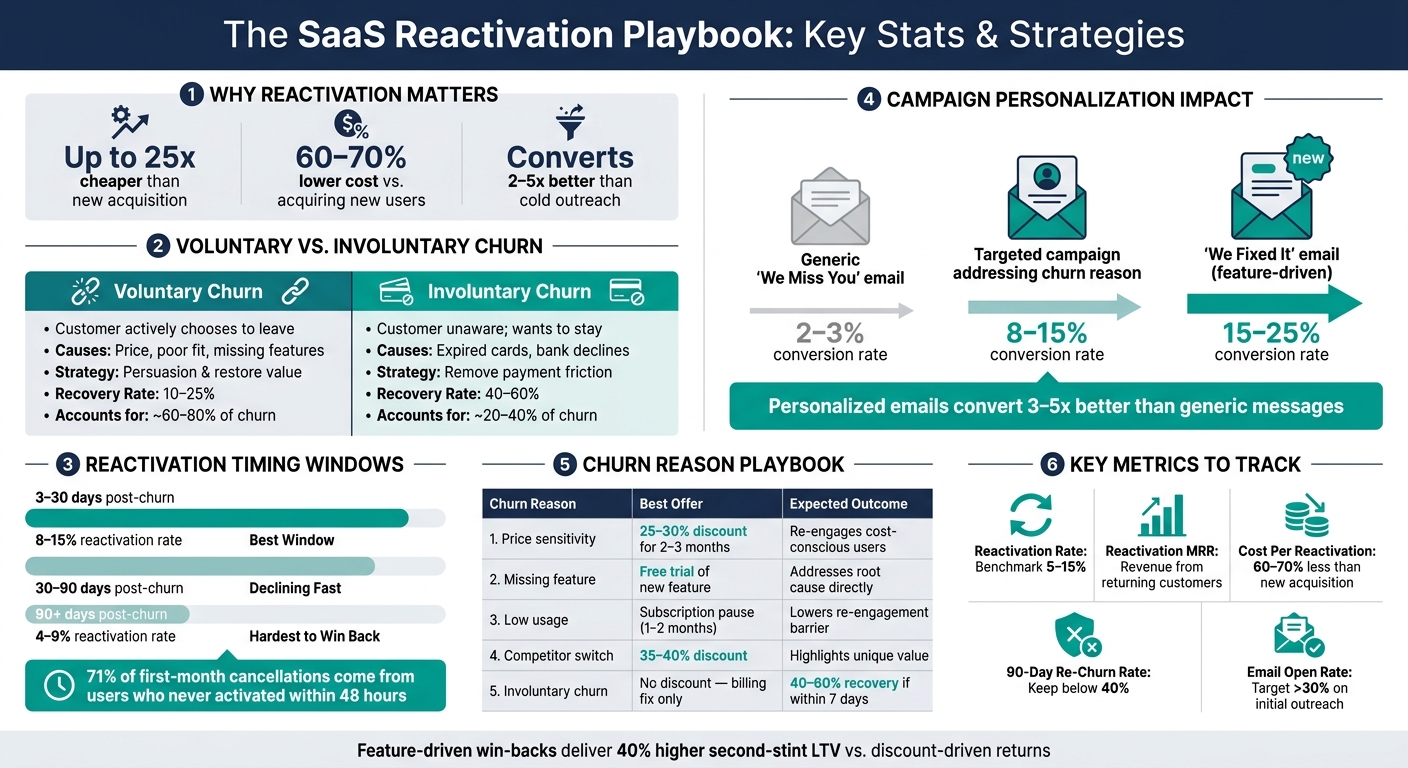
Each type of churn requires a unique approach. For example, involuntary churn - which can account for 20% to 40% of total SaaS churn - is surprisingly common but also highly recoverable. Optimized systems for handling failed payments can recover 40% to 60% of these customers, and retrying failed charges at the right time can recover 63% of them [9][10].
Here’s a quick comparison of voluntary and involuntary churn:
| Voluntary Churn | Involuntary Churn | |
|---|---|---|
| Customer intent | Actively choosing to leave | Unaware; wants to stay |
| Primary causes | Price concerns, poor fit, missing features | Expired cards, bank declines, insufficient funds |
| Strategy focus | Persuasion and restoring value | Removing payment friction |
| Recovery rate | 10–25% via win-back campaigns | 40–60% via dunning systems |
How to Find Out Why Customers Left
Understanding why customers churn starts with capturing their reasons at the moment of cancellation. In-app cancellation surveys are particularly effective. These short surveys, triggered when a customer clicks "cancel", can achieve response rates of 70–90%, compared to just 5–15% for follow-up emails [11]. Keeping the survey simple with a few clear options - like "Too expensive", "Missing a feature", or "Not using it enough" - helps maximize responses.
"The highest-converting reactivation moment is the cancellation flow itself, not a follow-up email sequence." - Churnkey [4]
When customers leave without completing a survey, usage data and support tickets can provide valuable clues. Tools like Intercom or HubSpot can help identify patterns, such as frequent support requests, declining logins, or users who didn’t hit key activation milestones. For instance, 71% of first-month cancellations come from users who never activated within the first 48 hours [13].
For involuntary churn, payment processors like Stripe offer useful insights. Decline codes can guide tailored recovery messages, and timing retries to align with common paydays can improve success rates [9].
Once you’ve identified the reasons behind churn, the next step is to segment and prioritize churned customers for targeted win-back campaigns.
Building a Reactivation Strategy: Segmentation and Prioritization
To bring churned customers back, you need a strategy tailored to their specific circumstances. By understanding why customers left and focusing on those worth pursuing, you can maximize your reactivation efforts.
How to Segment Churned Customers
Churned customers can be grouped based on three main factors: customer value (like LTV or ACV), engagement before cancellation, and reasons for leaving. These insights help determine their importance, the effort required to win them back, and whether their departure can be addressed.
- Recently churned (3–30 days): These customers are still deciding. They often left due to minor issues like billing problems, onboarding struggles, or momentary frustrations. This group offers the best chance for reactivation, with success rates averaging 8–15% during this window [5].
- Long-lapsed (90+ days): These customers require a compelling reason to return, such as a major product improvement or a standout offer. Reactivation rates drop significantly here, averaging just 4–9% [5].
- Active until cancellation: Customers who stayed engaged until the end are more likely to return. Their departure often stems from a specific, solvable issue [7].
- New users who left early: These users didn’t experience the product’s full value. They’re harder to win back and typically don’t justify high investment.
"The window matters more than the message. A customer who cancelled 6 days ago is in a fundamentally different state than one who cancelled 6 months ago." - RetentionCheck [1]
Once you’ve segmented your customers, the next step is deciding where to focus your resources.
How to Prioritize Reactivation Campaigns
After segmentation, use a High/Medium/Low priority model to focus on accounts with the best reactivation potential. Consider factors like LTV, engagement levels, and whether the churn reason can be addressed.
| Priority | Segment Criteria | Outreach Approach |
|---|---|---|
| High | High LTV + high engagement + solvable reason (e.g., a newly added feature) | Personal outreach by an account manager within 3–7 days [1][7] |
| Medium | Medium LTV + high engagement, or high LTV + low engagement | Semi-automated campaigns with some personalization; focus on the 30-day window [7] |
| Low | Low LTV, low engagement, or involuntary churn | Fully automated email sequences; one-click billing fixes for payment failures [7][5] |
Focusing on addressable churn reasons is critical, regardless of account size. For example, if a customer left because of a missing feature that’s now available, reaching out after the update can lead to reactivation rates as high as 15–25% [5].
Avoid defaulting to discounts unless pricing was the stated reason for cancellation. Offering discounts indiscriminately sets a bad precedent, encouraging customers to cancel just to get a deal. Plus, it doesn’t address the root cause of their departure and can hurt your profit margins [1][14].
"The key variable is not the offer, it is whether the specific reason for cancellation has been addressed." - RetentionCheck [1]
How to Design Win-Back Campaigns That Work
The success of your win-back campaigns depends on how well you tailor your message and offer to the specific reasons customers left. Generic "we miss you" emails only convert 2–3% of the time, but when campaigns directly address why a customer churned, conversion rates jump to 8–15% [8]. That’s a 3× to 5× improvement - proof that personalization pays off. By using segmentation insights to craft targeted campaigns, you can turn understanding into action.
Playbooks for Common Churn Reasons
Different churn reasons require different strategies. Here’s how to approach the most common scenarios:
| Churn Reason | Recommended Offer | Messaging Strategy |
|---|---|---|
| Price sensitivity | 25–30% discount for 2–3 months | Highlight the financial incentive and make reactivation easy. |
| Missing feature | Free trial of the new feature | Share when the feature launched and link directly to the changelog. |
| Low usage | Subscription pause (1–2 months) | Emphasize quick wins and lower the effort needed to re-engage. |
| Competitor switch | Strongest offer (35–40% off) | Acknowledge their switch without being defensive, and highlight your unique value. |
| Involuntary churn | No discount - billing fix only | Frame it as a "paused account" and provide a one-click link to update billing. |
For involuntary churn, such as failed payments, treat the issue as a billing resolution. Reassure customers their data is secure and offer a simple way to update payment details. If contacted within the first 7 days, reactivation rates can soar to 40–60% - much higher than for voluntary churn [1].
When customers leave due to a missing feature, product updates can serve as the perfect reactivation hook. Avocode provides a great example: after launching a significant speed update, they targeted churned users who had cited performance issues. The campaign focused on the update itself as the reason to return [2].
"Matching the campaign type to the specific churn reason... is the single variable that separates a successful reactivation program from a failed one." - Churnkey [4]
Choosing Channels and Structuring Outreach
Once you’ve segmented your audience, the next step is selecting the right outreach channels. Email is the backbone of most win-back campaigns, but for high-value accounts, you’ll need a more comprehensive approach. A multi-channel sequence over 2–3 weeks works well, such as:
- Day 1: Email
- Day 4: LinkedIn connection request
- Day 6: LinkedIn direct message
- Days 7–21: Retargeting ads
- Final step: A "breakup" email
LinkedIn connection requests, for example, have a 22% acceptance rate [7], making them a valuable tool in B2B campaigns.
For lower-value accounts, automation is key. Use structured email sequences tied to key reactivation windows. For example:
- Offer a 20–25% discount at 30 days
- Increase to 35–40% at 90 days
- Go up to 50% off or a free month at 180 days [8]
The 30-day mark is especially effective, with conversion rates averaging 8–15% as customers notice the product’s absence but haven’t fully committed to an alternative [5].
One often-overlooked detail is the importance of frictionless reactivation links. Tokenized, one-click links with pre-applied discounts and loaded payment methods can double completion rates [8]. Every additional step in the reactivation process reduces conversions, while removing steps can boost completion rates by 15–25% [5].
Measuring Results and Improving Over Time
Once you've set up your win-back campaigns, the next step is to track their performance and refine your approach based on what you learn.
Key Metrics to Track
Tracking the right metrics is essential for steering your win-back campaigns in the right direction. Focus on these key areas: reactivation rate, reactivation MRR, and cost per reactivation.
The reactivation rate measures how many churned customers you successfully bring back. A healthy range is 5–15%, which serves as a benchmark for your campaign's effectiveness [1][5]. Reactivation MRR (Monthly Recurring Revenue) highlights the revenue impact of those returning customers, while cost per reactivation shows how efficiently you're running your campaigns. This cost is calculated by dividing the total campaign spend by the number of reactivated customers. Interestingly, reactivating an old customer generally costs 60–70% less than acquiring a new one [6].
Another critical, yet often overlooked, metric is the 90-day re-churn rate - the percentage of reactivated customers who leave again within three months. If this number exceeds 40%, it signals that your campaign is addressing surface-level issues rather than the deeper reasons for churn [5].
"A customer who returns at a discount and churns again three months later is not a win-back success. Track win-back cohort retention at 90 and 180 days to measure real recovery." - RetentionCheck [1]
Additionally, keep an eye on email open rates (aim for over 30% on initial outreach) and spam complaint rates (keep these under 0.1%) [7]. These early indicators provide insight into how well your message is resonating before you see conversion results.
While metrics give you the numbers, customer feedback reveals the "why" behind the results.
Using Customer Feedback to Improve Campaigns
Customer feedback is a goldmine for understanding why customers left and how you can win them back. Surveys integrated into the cancellation process often achieve a 60–80% completion rate, far outperforming follow-up email surveys, which typically see just 10–20% participation [15]. This makes in-app cancellation feedback an invaluable tool.
Once you gather feedback, categorize it into common themes like pricing, missing features, or service quality. Pay close attention to issues driving 30% or more of cancellations - these require immediate action. Problems affecting 15–30% should be addressed within the next quarter [15].
"Cancellation feedback is the most direct signal you will ever get from your market. A customer sat down, decided to leave, and told you why." - Brian Farello, Founder, RetentionCheck [15]
One of the most effective ways to act on this feedback is through a "We Fixed It" email. For example, if a customer left due to a missing feature and you’ve since added it, reaching out with that specific update can boost conversion rates to 15–25% [5]. This approach often outperforms generic win-back offers.
How to Iterate on Your Reactivation Playbook
Improving your win-back campaigns isn’t a one-and-done process. Regular reviews and updates are crucial for staying effective. A good rhythm includes weekly operational checks to fine-tune execution, monthly reviews to evaluate revenue outcomes, and quarterly strategic reviews to assess the overall direction [16].
A/B testing should also play a central role in your quarterly reviews. Experiment with subject lines, discount levels (e.g., 20% vs. 40%), and messaging approaches like "We fixed it" versus "Limited-time offer" [6][5]. Personalized emails that address a customer’s specific cancellation reason perform significantly better, converting at 3–5x the rate of generic "We miss you" messages [5][1]. Specificity is always worth testing.
It’s also smart to separate discount-led returns from full-price returns in your reporting. Customers who return for a discount often churn again once the promotion ends. On the other hand, feature-driven win-backs tend to bring back customers with 40% higher second-stint LTV compared to those who return for discounts [3]. This distinction helps you decide which tactics to scale and which to reconsider.
Conclusion: Key Takeaways for Winning Back Churned Customers
Bringing back churned customers requires a thoughtful and focused strategy. Broad, generic messages simply won’t work. Instead, start with understanding why customers left, then segment them based on their value and intent. Timing is just as critical - leveraging the 30-day window for reactivation can significantly boost your chances of success. Combining precise timing with tailored messaging lays the foundation for an effective approach.
Personalization outperforms discounts. Campaigns that address the specific reasons a customer left can convert 3–5 times better than generic outreach efforts [1]. Meanwhile, reducing friction is crucial - every extra step in the process can slash conversion rates by as much as 25% [5]. And don’t forget, re-churn is the ultimate test. If a customer returns but leaves again within 90 days, it’s a clear sign the underlying issue wasn’t resolved.
Reactivating churned customers is also highly cost-effective. It costs 60–70% less than acquiring new users and converts 2–5 times better [6]. These numbers highlight why maintaining a strong reactivation playbook is one of the smartest growth strategies for SaaS teams.
Final Thoughts
Reactivation isn’t a one-and-done effort - it’s an ongoing process. Teams that incorporate cancellation feedback into their product development and regularly test new messaging approaches see the best results. The focus shouldn’t just be on the number of customers recovered but on the quality of those recoveries.
"Churned customers represent one of your highest-value acquisition channels. They already know your product, they've experienced your value, and they often left for fixable reasons." - Tara Minh, Senior Operations & Growth Strategist [6]
As customer needs change and products evolve, so must your reactivation strategies. The companies that succeed are those that constantly ask questions, experiment, and refine their processes. This commitment to continuous improvement is what separates businesses that recover churned customers effectively from those that lose them again and again.
FAQs
Which churned customers should we try to win back first?
Focusing on customers who canceled recently - ideally within the last 30 to 90 days - can yield better results for reactivation efforts. Many cancellations during this timeframe happen due to temporary setbacks, like payment problems or minor workflow disruptions. Targeting those within 30 days is particularly effective, as campaigns in this window tend to achieve the best outcomes. However, once 180 days have passed, the chances of reactivating these customers drop significantly.
What’s the best time to reach out after someone cancels?
The best time to reach out to a customer after they cancel is within 30 days. Specifically, the sweet spot tends to be between 7 and 30 days. Campaigns launched during this period often perform better because the customer’s memory of your service is still fresh, making them more likely to re-engage.
How can we stop reactivated customers from churning again?
To keep reactivated customers from leaving again, focus on keeping them engaged and meeting their unique needs. Use tactics like personalized outreach, targeted campaigns, and segmentation based on why they left in the first place. Pay attention to engagement signals, like how often they use your product, and take proactive steps to reconnect with them before they lose interest. These strategies can help customers feel appreciated and stay committed, lowering the chances of them churning again.
Related reading
- How your acquisition strategy influences your conversion rate
- How to A/B test pricing as a boostrapped company
- Upsell vs. Cross-Sell Metrics: Key Differences
- Digital Marketing Services
- What Is Strategy Consulting? (And when to hire a consultant to do it for you)
Useful tools & services
Understand which customers and revenue you lose
Calculate customer and revenue churn for the same period before choosing a retention intervention.
Use the churn calculatorNeed help choosing the next change? Explore CRO consulting.
Keep improving your conversion work.
Subscribe for practical ideas on diagnosing conversion problems, planning experiments, and choosing your next improvement.
No spam. Unsubscribe anytime.