Your SaaS Has a Retention Problem, Not an Acquisition Problem
Reduce churn by improving onboarding, tracking NRR and customer health, and acting on feedback to grow SaaS revenue sustainably.
Your SaaS business might be attracting new customers, but if they’re leaving just as quickly, you’re facing a retention issue - not an acquisition one. Here’s why retention matters more:
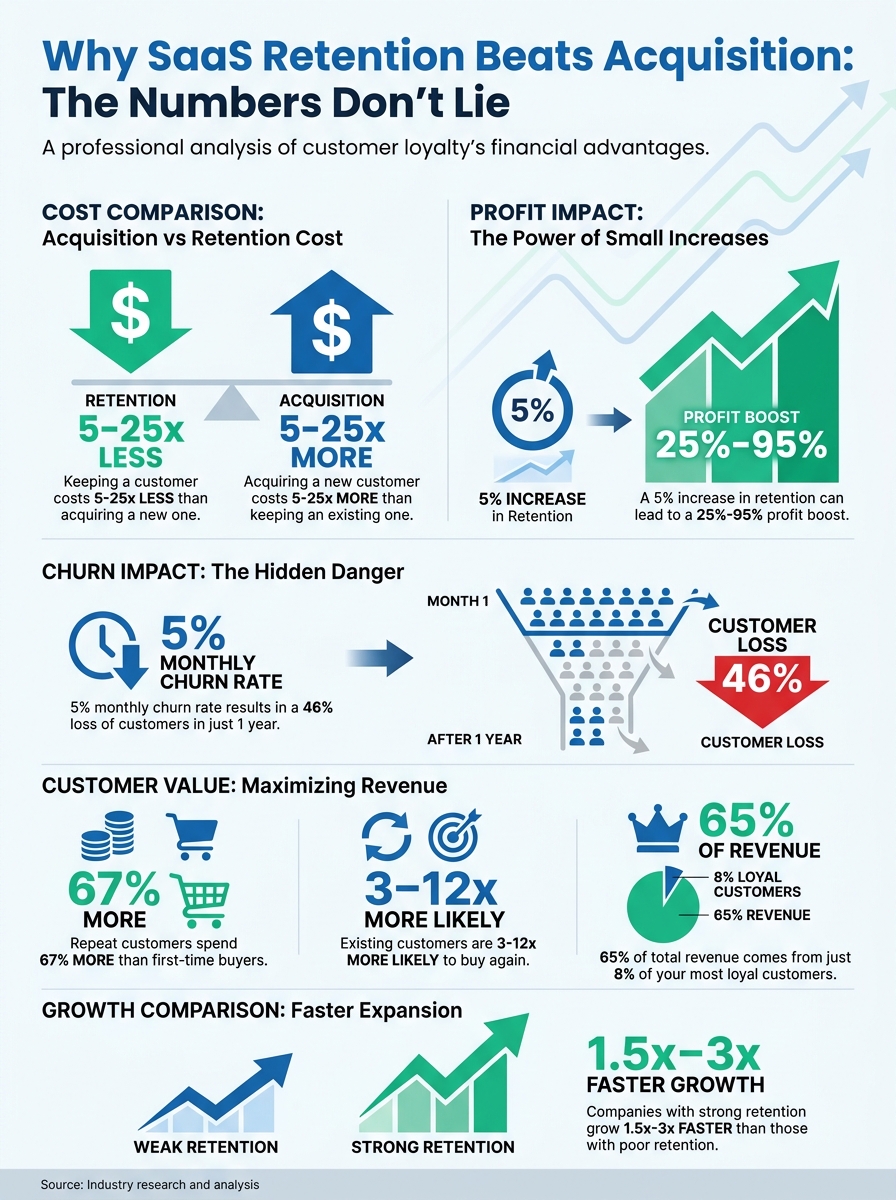
- Retention is cheaper: Keeping a customer costs 5–25x less than acquiring a new one.
- Retention drives profits: A 5% increase in retention can boost profits by 25%–95%.
- Churn adds up fast: A 5% monthly churn rate means losing 46% of customers in a year.
- Existing customers are more valuable: They spend 67% more and are 3–12x more likely to buy again.
Focusing on retention improves lifetime value, reduces acquisition costs, and ensures sustainable growth. The key? Fix churn by improving onboarding, tracking metrics like Net Revenue Retention (NRR), and acting on customer feedback. Retention isn’t optional - it’s the backbone of long-term success.
SaaS retention strategies
Why Retention Beats Acquisition in SaaS
The logic behind retention is straightforward: keeping a customer is far more cost-effective than acquiring a new one. When you bring in new customers, you're paying upfront for future revenue that isn't guaranteed. But when you retain a customer, you're earning ongoing revenue with little to no extra expense. This is why retention is such a powerful driver of sustainable growth in SaaS.
Lower Churn Increases Lifetime Value
Customer lifetime value (CLV) depends on three factors: average revenue, gross margin, and how long a customer sticks around. Retention directly impacts this equation by extending the customer's lifespan. If you double a customer's subscription period from 12 to 24 months, you automatically double their lifetime value - without spending more on acquiring them [5].
Moreover, retained customers tend to spend more over time. Repeat customers spend 67% more than first-time buyers [1]. They upgrade their plans, add new features, and expand their usage. In fact, top-performing SaaS companies generate 20% to 40% of their annual revenue from upsells and cross-sells [5]. But these opportunities only arise when customers stick around long enough to see the value of investing more in your product.
The numbers tell a compelling story. Around 65% of a company's revenue often comes from just 8% of its most loyal customers [1]. These aren't casual users - they're the ones who have integrated your product into their daily workflows, upgraded their plans, and become champions for your brand. Losing these customers means more than a hit to your monthly recurring revenue; it also wipes out future growth opportunities from upsells and expansions. With acquisition costs rising, the advantages of retention become even clearer.
Customer Acquisition Costs Keep Rising
While retention expenses remain relatively stable, the cost of acquiring new customers continues to climb. Factors like market saturation, growing competition, and the ease of switching providers - thanks to AI-powered comparison tools and review platforms - are pushing customer acquisition costs (CAC) higher every year [1]. Competing for the same keywords, audiences, and features means more money spent for fewer results.
Retention offers a stark contrast. Existing customers are much easier to convert for additional purchases. The table below highlights how churn rates vary by product price point, illustrating the challenges of maintaining profitability through acquisition:
| Product Price Point (Monthly) | Annual Churn Rate |
|---|---|
| Under $10 | 40% |
| $10–$30 | 37% |
| $100–$1,000 | 30% |
| Above $10,000 | 15% |
Retention isn't just a nice-to-have - it's essential. Businesses with strong retention rates grow 1.5x to 3x faster than those with weak retention [6]. Each extra month a customer stays adds recurring revenue with minimal additional costs, creating a compounding effect on your growth. By focusing on retention, you not only stabilize your revenue but also reduce the pressure of ever-increasing acquisition expenses.
How to Find and Fix Retention Problems
If you want to fix retention issues, you need to measure them first. The reality? Less than 30% of SaaS companies track activation or retention metrics at the product level in a structured way [14]. That means most businesses lack the data they need to understand why customers leave. The upside is that retention problems often leave clear patterns in your data - you just have to know where to look.
Combine Analytics with Customer Feedback
Analytics tell you what users do, while feedback explains why they do it. Together, these insights help you identify where your product falls short and take action before customers churn. This approach not only diagnoses problems but also gives you clear steps to reduce churn.
Track These Retention Metrics
Start with these key metrics:
- Customer churn rate: This shows how many accounts you’re losing, but it’s only the surface.
- Net Revenue Retention (NRR): This is the gold standard because it factors in upgrades and downgrades. An NRR above 100% means your existing customers generate more revenue over time, even if some accounts cancel [7][9].
- DAU/MAU ratio: Divide daily active users by monthly active users to measure stickiness. A ratio above 50% is solid, while anything under 20% signals infrequent use and a higher risk of churn [7].
Cohort analysis is another powerful tool. By grouping customers based on their signup date, you can track how retention changes over time. For example, RetentionFlow’s VP of Product, Sarah Martinez, discovered that users who skipped the onboarding wizard churned at 67%, compared to just 12% for those who completed it. Simplifying the wizard from 12 steps to 4 increased completion rates from 23% to 67%. Within 90 days, monthly churn dropped from 7.2% to 3.9%, saving an estimated $150,400 in annual revenue [11].
"We knew churn was high. We didn't know why. Cohort analysis revealed the onboarding wizard was our problem - users who didn't finish it churned at 5.6x the rate of those who did." - Sarah Martinez, VP Product, RetentionFlow [11]
Don’t wait for cancellations to act. Look for early warning signs like declining login frequency, reduced feature use, or lower Customer Health Scores. Build a health score using a mix of data: 40% from usage patterns, 20% from support interactions, 10% from payment history, and 10% from NPS. This creates a dynamic risk indicator that can guide proactive outreach [7][4].
Use Customer Feedback to Find Problems
Only 1 in 26 unhappy customers will actually complain; the rest just leave [8][13]. That silence makes it crucial to actively gather feedback at key moments.
For qualitative insights, try in-app microsurveys after critical events, like completing onboarding or resolving a support ticket [13]. For high-value accounts that cancel, conduct exit interviews with open-ended questions like, “What could we have done differently to keep you?” [9]. While 33% of churned users cite “price” as their reason for leaving, this often masks deeper issues like perceived value or poor product-market fit [12].
Segment feedback by Monthly Recurring Revenue (MRR) or Lifetime Value (LTV) to focus on your most valuable customers rather than the loudest ones [13]. AI tools can help by clustering unstructured feedback - like support tickets or survey responses - into themes such as UI confusion or missing integrations [8]. Closing the loop by updating customers when their feedback leads to changes not only builds trust but also encourages re-engagement [13].
Apply Product Analytics to Improve Retention
Customer feedback is only half the picture. Product analytics can reveal what’s happening during user journeys. For example, tracking multi-session journeys helps identify friction points, see which features drive engagement, and spot when usage starts to drop off [14]. A critical metric here is Time to Value (TTV) - the time it takes for a user to achieve their first meaningful outcome. Reducing TTV by 20% has been linked to a 15% boost in 90-day retention [14].
Correcto’s experience highlights this. By analyzing their Chrome extension onboarding, they found friction points that delayed users from realizing value. Allowing immediate access to core features - rather than requiring a long setup - boosted activation rates from 17.4% to 53.5% in eight months. This led to a 30-day retention rate of 64.3% and a 90-day retention rate of 46.4% [10].
Similarly, Lindywell discovered that the first 48 hours were crucial for retaining users on their wellness platform. By simplifying login and onboarding, they improved activation by 47%, reduced churn by 183%, and increased three-month retention by 45.6% [10].
Finally, track feature adoption to see how "power users" engage with specific functionalities compared to others [11][14]. Watch for behaviors that predict churn - like a 50% drop in login frequency, a sudden halt in using a key feature, or team members being removed from an account. Acting on these signals before customers cancel not only fixes retention issues but also sets a foundation for long-term revenue growth.
Proven Ways to Improve Retention
Once you've identified retention challenges, the next step is turning those insights into actionable strategies.
Build a Better Onboarding Experience
A smooth onboarding process that quickly delivers the "aha moment" is a cornerstone of retention success [16]. For instance, Slack saw a 93% retention rate when users sent 2,000 messages within 30 days [22], while Loom found long-term engagement tied to users sharing their first video [15]. These moments create an immediate sense of value that keeps users coming back.
Minimize any friction that delays a user's activation. Data shows that if users remain inactive for 72 hours, there's a 90% chance they'll churn, with 75% abandoning within the first week [23][17]. A hybrid onboarding process - combining automated tools with at least one human interaction - can boost satisfaction to 73%, compared to just 41% for fully automated methods [17]. For higher-value accounts (Annual Contract Value above $15,000), proactive human check-ins are worth the investment. Meanwhile, automated sequences work well for lower-value accounts [17]. Tailoring onboarding by user roles also helps eliminate unnecessary friction, rather than relying on a one-size-fits-all approach [20].
"One of the most important pieces here is providing visibility to everyone. Very often, I see companies that are operating on the sense that they have visibility into that onboarding process, but the customer never sees it."
- William Stevenson, Founder, Onboard.io [19]
Personalize Customer Communication
Personalized communication is essential for keeping users engaged, especially once you've identified churn signals through analytics. Generic emails simply don't cut it - 80% of customers expect personalization, and behavior-based triggers can boost engagement by 4.5x [1][17]. Instead of waiting for churn signals to act, build communication strategies that consistently reinforce the value of your product and encourage deeper usage [18].
Some key email types to include in your retention strategy are:
- Monthly value reports summarizing key metrics.
- Milestone celebrations for achievements or anniversaries.
- Periodic check-ins with genuine, personalized messages.
- Feature discovery prompts to highlight new tools or updates.
- Engagement loops like activity digests to keep users connected [18].
If a customer suggests a feature that you later implement, sending a personalized update can foster loyalty by creating a sense of ownership [20]. Re-engagement campaigns are another effective tool, helping recover 15% to 25% of at-risk users [21]. And don't overlook automated dunning processes - they can cut involuntary churn by 40% to 50%, reducing overall churn by 10% to 30% [23].
Provide Support Before Problems Happen
Proactive support can make a huge difference in retention by addressing potential issues before they escalate. According to one study, 41% of churned customers said they felt unsupported, with no one reaching out or explaining where to get help [23].
Start by implementing customer health scoring, which combines data like product usage, support interactions, and billing status to flag at-risk accounts 30 to 90 days in advance [21]. Use your CRM to set alerts for when a customer's health score dips below a certain threshold [20]. Automate nudges if users haven't completed core actions within 48 hours, and send weekly value receipts to remind them of your product's ROI [23]. During cancellation flows, offering a lower-tier plan or a "pause" option can help retain price-sensitive users who still value your core features [23]. Finally, centralize feedback by creating a shared channel - like a #churn-intel Slack channel - to make exit survey insights and cancellation reasons easily accessible to your product and engineering teams [23].
"I think customer success is truly an organization that owns customer obsession across all aspects. Because to me, customers are the heartbeat of the org."
How to Measure Retention Success
Key Metrics to Monitor
Understanding how to measure retention success starts with tracking the right metrics. Metrics like Net Revenue Retention (NRR) and Gross Revenue Retention (GRR) are essential for gauging revenue performance. Companies like Snowflake and Datadog set the bar high, maintaining NRR rates above 130% - a testament to the power of expansion revenue. Achieving an NRR over 100% means your business has the potential to grow even without acquiring new customers[7][25]. For GRR, the gold standard is 95% or higher, a benchmark for world-class performance[7].
To evaluate product engagement, the DAU/MAU ratio is a key indicator. For B2B companies, a ratio above 20% signals strong stickiness. If you're looking to dive deeper into churn and product stickiness, revisit the earlier section on retention metrics.
It's also important to differentiate between account retention and revenue retention. For instance, you might retain 95% of your accounts but still lose 20% of your revenue if high-value customers downgrade or leave altogether[7][4]. A Customer Health Score, which combines factors like usage, support interactions, and payment history, can help you identify at-risk accounts 30 to 90 days before they churn[7][24]. Additionally, distinguishing between voluntary churn (customers canceling) and involuntary churn (payment failures) is crucial, as the latter often makes up 20% to 40% of total churn[4].
"Real retention is about creating customers who are engaged, expanding, and evangelizing." - UserJot[7]
Align Your Teams Around Retention
Once you've defined these metrics, the next step is integrating them into your team's workflow. Surprisingly, many growth teams still allocate 80% of their budget to acquisition and only 20% to retention, even though acquiring a new customer can cost 5 to 25 times more than retaining one[5]. To address this imbalance, assign specific retention responsibilities to your teams:
- Customer Success: Focus on logo retention, health scores, and NPS.
- Product: Prioritize feature adoption, usage metrics, and Time to Value.
- Finance: Oversee revenue retention, LTV, and unit economics[7].
Incorporating retention into your incentive structures is key. For example, sales teams should earn commissions on renewals and expansions, not just new deals[7]. When expansion revenue contributes 20% to 40% of your annual revenue, it’s a sign your teams are prioritizing long-term customer relationships[5].
To ensure alignment, create a feedback loop where product teams receive direct customer input, and Customer Success can see how their insights influence product development. This collaboration can lead to significant gains - a 5% increase in customer retention can drive profits up by 25% to 95%[5].
Finally, analyze retention metrics by cohort, plan type, and industry to pinpoint underperforming segments. For example, customers on annual plans tend to churn at about half the rate of those on monthly subscriptions[26].
Conclusion
Retention challenges and strategies highlight a striking reality: acquiring new customers is 5 to 25 times more expensive than keeping existing ones. Meanwhile, improving retention by just 5% can lead to a profit increase of 25% to 95% [1]. On the flip side, even a seemingly small 5% monthly churn rate can snowball into losing 46% of your customer base over a year [4]. Simply pouring money into acquiring new customers won't solve the problem - ignoring retention undermines sustainable growth.
Your current customers are more than just numbers; they hold the key to your business's success. They spend 67% more than first-time buyers, and a mere 8% of your most loyal customers typically account for 65% of your revenue [1]. These figures underscore why focusing on retention is not just smart - it’s essential.
Customer loyalty has dropped from 77% in 2022 to 69% in 2024 [1], and with lower switching costs, customers now have more choices than ever [3]. This makes it critical to give them compelling reasons to stay with your brand.
To make retention your competitive edge, focus on proven strategies: improve onboarding, keep a close eye on customer health, and ensure your support processes are seamless. Shifting from an acquisition-first mindset to a retention-first approach isn’t just a smart move - it’s a necessity. The real question isn’t whether you should prioritize retention, but whether you can afford not to. By making retention a priority now, you set the stage for long-term, profitable growth.
FAQs
What’s a “good” churn rate for my pricing tier?
A "good" annual churn rate for SaaS businesses generally lands between 5% and 7%, though this can depend on how the rate is calculated. Some experts argue that an even better range is 3% to 5% annually, especially for top-performing companies. However, churn rates often differ based on factors like industry and pricing tiers. This means it's crucial to measure your churn rate against businesses in the same niche to get a more accurate benchmark.
Which retention metric should I prioritize first: NRR, GRR, or DAU/MAU?
When evaluating the health and growth potential of your SaaS business, Net Revenue Retention (NRR) should be your starting point. This metric provides a straightforward view of how effectively your company retains existing customers while also growing revenue from them.
NRR doesn't just measure retention - it reflects upsells, cross-sells, and churn. That makes it a key indicator of long-term stability and growth. Prioritizing NRR gives you a clear sense of whether your current customer base is thriving or shrinking, which is essential for sustained success.
How do I find my product’s “aha moment” and shorten time to value?
To pinpoint your product’s “aha moment,” start by examining user behavior. Look for the specific action that strongly links to long-term retention - whether it’s creating a project, importing contacts, or something else unique to your product. Once you’ve nailed down this key action, the next step is to guide users toward it as quickly as possible.
Streamlining your onboarding process is crucial here. The faster users reach that moment of core value, the shorter their time to value becomes. This not only enhances their experience but also significantly improves retention rates. By focusing on delivering your product’s core value early on, you set the stage for a lasting, positive impact.
Related reading
- How your acquisition strategy influences your conversion rate
- How to A/B test pricing as a boostrapped company
- Upsell vs. Cross-Sell Metrics: Key Differences
- Digital Marketing Services
- What Is Strategy Consulting? (And when to hire a consultant to do it for you)
Useful tools & services
Turn the idea into a growth decision
Define the audience, constraint, owner, and success check in a practical plan.
Use the growth strategy templateNeed help choosing the next change? Explore CRO consulting.
Keep improving your conversion work.
Subscribe for practical ideas on diagnosing conversion problems, planning experiments, and choosing your next improvement.
No spam. Unsubscribe anytime.