B2B SaaS Free Trial Length: 7 vs 14 vs 30 Days and What the Data Shows
Compare 7-, 14-, and 30-day B2B SaaS trials; match length to time-to-value and prioritize engagement in the first 72 hours.
Which free trial length works best for B2B SaaS? It depends on your product's complexity and time-to-value (TTV). Here's what the data reveals:
- 7-day trials: Best for simple tools with a TTV under 48 hours. They create urgency and achieve a median 24% conversion rate. However, they often lead to higher churn - 80% of users churn within three months.
- 14-day trials: Ideal for most B2B SaaS products. They balance urgency and exploration, with a 19% median conversion rate and 22% better retention than 7-day trials.
- 30-day trials: Suitable for complex products needing integrations or team approvals. While retention can improve for engaged users, conversion rates drop to 14%, and support costs rise by 18%.
Key takeaway: 90% of users decide within the first 5 days, regardless of trial length. Align your trial length to about twice your product's TTV and focus heavily on user engagement during the first 72 hours.
| Trial Length | Median Conversion | Activation Rate | Retention Impact | Best For |
|---|---|---|---|---|
| 7 Days | 24% | 64% | Lower retention | Simple tools, fast TTV |
| 14 Days | 19% | 72% | Higher retention | Most B2B SaaS |
| 30 Days | 14% | 58% | Moderate | Complex, high-touch products |
Tip: Experiment with A/B testing and consider conditional extensions (e.g., adding extra days for engaged users) to find what works best for your audience. Even a 1% improvement in conversion rates can increase revenue by 15% per trial cohort.
::: @figure 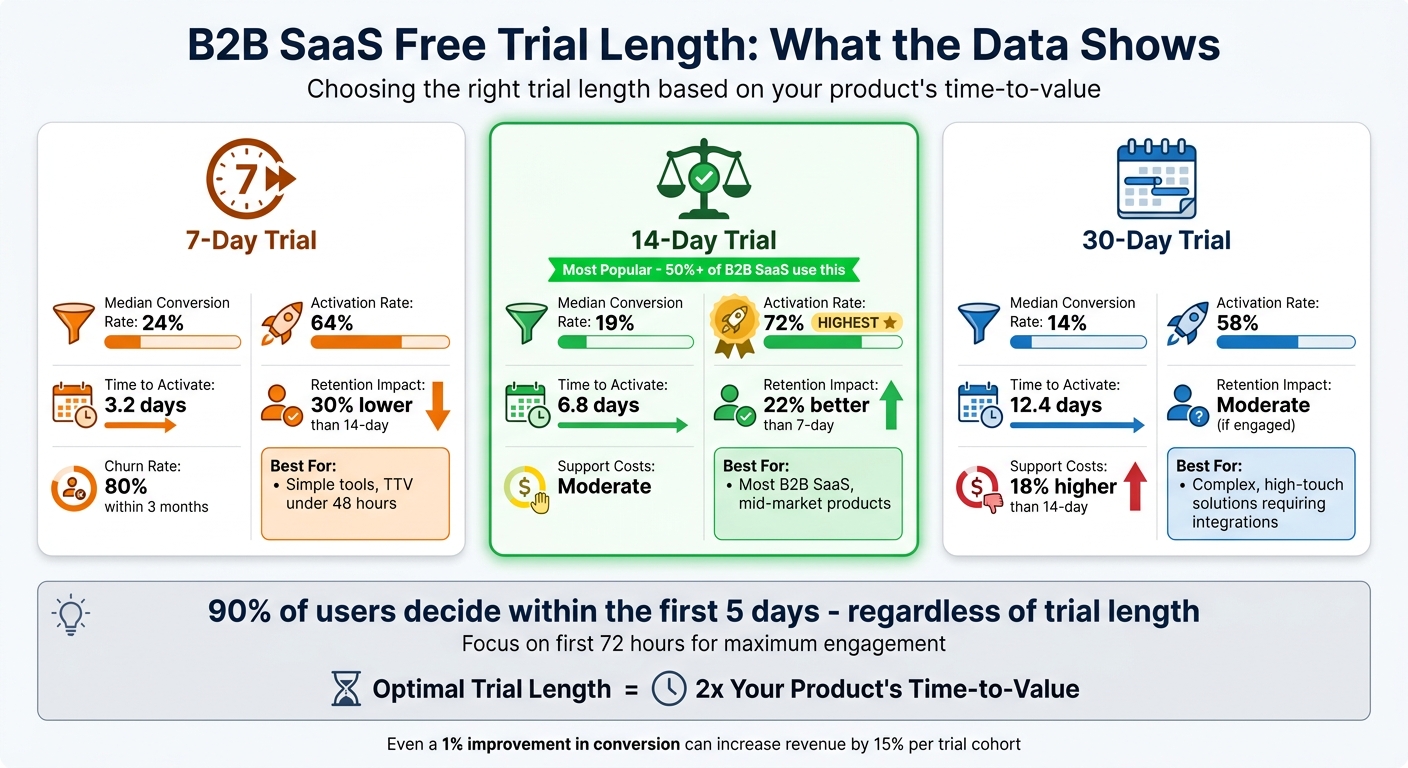 :::
:::
How Long Should Your Free Trial Period Be
::: @iframe https://www.youtube.com/embed/arXspdtT6hI :::
1. 7-Day Free Trial
A 7-day trial works well for straightforward SaaS products that deliver value quickly. The limited timeframe creates a sense of urgency, encouraging users to dive in right away. However, this urgency can backfire for complex B2B products that need more time for setup, team approvals, or integrations.
Conversion Rates
When it comes to conversion rates, the length of the trial should match the complexity of the product. For simpler SaaS offerings, 7-day trials perform well, achieving a 12.4% conversion rate, which is higher than both 14-day (11.8%) and 30-day (8.2%) trials [1]. In fact, the median conversion rate for 7-day trials across all products is 24%, making it the most effective trial length overall [2].
However, for more complex B2B SaaS products, the story changes. Here, 7-day trials lag with a conversion rate of just 4.8%, compared to 11.2% for 14-day trials [1]. The key difference? Time-to-value. If your product takes more than three days to showcase its main benefit, a 7-day trial often falls short [1][4].
User Engagement
The shorter trial period encourages users to engage quickly. A study of 5,400 signups found that 7-day trials achieved a 64% activation rate, with users taking an average of 3.2 days to activate [1]. Interestingly, users who interact with core features within the first three days are four times more likely to convert than those who don’t [3].
This urgency forces product teams to focus on the essentials, cutting out unnecessary onboarding steps and spotlighting the product’s core value [6]. But there’s a tradeoff: the rush to engage can overwhelm users, leading to an increase in support tickets as they scramble for answers [4]. While fast activation is encouraging, it can sometimes come at the expense of long-term user satisfaction.
Customer Retention
Quick conversions don’t always translate to long-term success. In fact, 7-day trials often lead to higher churn rates. B2B SaaS companies see 30% lower retention with 7-day trials compared to 14-day ones [4]. Additionally, 80% of users who convert after a 7-day trial tend to churn within the first three months [4].
The reason is straightforward: users may feel pressured to commit before fully understanding or integrating the product. On the other hand, converters from 14-day trials have 22% better retention after 12 months compared to those from 7-day trials [4].
Cost of Acquisition (CAC) Impact
Short trials can reduce CAC by speeding up conversions, but this advantage can be offset by the increased need for support. The real savings come when trial lengths are tailored to the product. For simple products with minimal onboarding, a 7-day trial keeps costs low. For more complex products, offering an automated option to extend the trial - like a "Request 14 Days" button - can strike a balance by giving engaged users the time they need to finalize decisions or secure approvals [4].
2. 14-Day Free Trial
More than half of B2B SaaS companies choose a 14-day trial period [2]. This duration strikes the right balance - giving users enough time to explore the product while maintaining the sense of urgency needed to encourage conversions. For moderately complex products, where time-to-value ranges between 3 and 7 days, a 14-day trial consistently outperforms shorter or longer options.
Conversion Rates
The average trial-to-paid conversion rate for 14-day trials is 19% [2]. This sits between the 24% median for 7-day trials and 14% for 30-day trials. In an A/B test involving 5,400 users (1,800 per cohort), the 14-day trial achieved an 11.2% conversion rate - more than doubling the 4.8% rate for 7-day trials and far exceeding the 6.4% for 30-day trials [1]. The 14-day group also recorded a 72% activation rate, with users typically activating by Day 6.8. In comparison, the 30-day group had a 58% activation rate [1].
Interestingly, conversion rates tend to peak between Day 8 and Day 10 [2]. This timing aligns with when users have had enough exposure to integrate the product into their workflow but still feel the urgency to act before the trial ends.
Data suggests that your trial length should be roughly twice your product's time-to-value [1]. For example, if users need about 7 days to experience the product's benefits, a 14-day trial provides enough time to build momentum without losing engagement.
User Engagement
The 14-day trial format leads to the highest activation rates among all trial lengths, reaching 72% [1]. By comparison, 7-day trials achieve a 64% activation rate, and 30-day trials lag behind at 58%. On average, users activate on Day 6.8 [1], hitting their "aha moment" right in the middle of the trial period. This timing is crucial - users who experience value early in the trial are far more likely to convert. The 14-day structure offers enough time for users to reach these milestones naturally, without feeling rushed or losing interest.
"Your free trial's length matters less than what happens inside it. Shorter trials with urgency cues outperform 30-day trials by 71% - but only when users reach their aha moment before the clock runs out." - Customer.io [6]
Take VoiceDrop as an example. In 2025, this B2B communication platform boosted its trial-to-paid conversion rate from 12% to 57% in just 30 days. They achieved this by reducing their time-to-first-value from 45 minutes to 8 minutes and introducing behavioral payment triggers that nudged users to upgrade after hitting key milestones [2].
High engagement during the trial also sets the stage for better long-term retention.
Customer Retention
One of the standout benefits of 14-day trials is their impact on long-term retention. Users converting from a 14-day trial are 22% more likely to stay after 12 months compared to those from 7-day trials [4]. The additional week allows users to fully understand the product, set up integrations, invite team members, and secure internal approvals. This deeper engagement fosters a stronger commitment, as opposed to the rushed decisions often seen with shorter trials.
In B2B settings, 7-day trials can create a sense of urgency that leads to quicker conversions but often results in 30% lower retention rates compared to 14-day trials [4]. The extra week in a 14-day trial lets users explore multiple use cases and develop habits, which translates into better long-term results. In fact, 60% of SaaS companies using 14-day trials report improved Net Revenue Retention (NRR) compared to other trial lengths [4].
Cost of Acquisition (CAC) Impact
The strong conversion and engagement rates associated with 14-day trials also contribute to a more favorable Cost of Acquisition (CAC). Support costs during a 14-day trial are about 18% lower than during 30-day trials [4], although they are slightly higher than for 7-day trials due to the extended engagement period. However, this small increase in support costs is offset by better conversion rates for complex products and significantly improved retention.
Additionally, the structured onboarding process that a 14-day trial encourages helps users reach value quickly, which directly impacts customer lifetime value. The trial duration is also well-suited to accommodate typical B2B buying cycles, such as procurement approvals, IT reviews, and team decision-making, without risking user disengagement.
3. 30-Day Free Trial
When looking at 30-day trials, the challenges become more apparent, especially when the trial period stretches beyond the product's natural time-to-value. While a 30-day trial might seem like a generous offer, only 15% of B2B SaaS companies use this model. The data tells a clear story: median conversion rates drop as the trial length increases - 24% for 7-day trials, 19% for 14-day trials, and just 14% for 30-day trials [2].
Conversion Rates
In one A/B test involving 5,400 users, the 30-day trial group had a conversion rate of only 6.4% [1]. The extended trial period often backfires, as users delay engagement and eventually forget about the trial altogether. According to Athenic Blog, 30-day trials have an activation rate of 58%, with users taking an average of 12.4 days to activate - nearly double the 6.8 days seen in 14-day trials [1]. Conversion rates for 30-day trials typically hit their peak between Days 18 and 22 [2].
"A 30-day trial with the same slow onboarding is a longer period of non-use, not more conversion opportunity. What changes behavior is faster time-to-value, not more time." - Pulseahead [3]
For products with complex onboarding - think enterprise solutions like Salesforce or SAP - a 30-day trial can make sense. These systems often involve data integration, approvals from multiple stakeholders, and IT security checks [1] [5]. For most other products, though, shorter trials with a sense of urgency tend to perform up to 71% better in conversion efficiency [2]. The delay in activation during 30-day trials not only drags down conversion rates but also makes it harder to sustain user interest.
User Engagement
The numbers show that only 4% of users fully engage with a 30-day trial, and 70% of churn happens after Day 10 [4]. That initial excitement often fizzles out, with users putting off the product until "later" - which often turns into "never." Interestingly, users in 30-day trials tend to respond better to feature-based promotions, like updates about new AI tools, rather than price-based offers [7]. However, the struggle to keep users engaged during such a long trial period directly impacts long-term customer retention.
Customer Retention
While 30-day trials may struggle with immediate conversions, they can lead to stronger long-term retention for highly complex products [4] [7]. The extra time allows users to integrate the software into their workflows, building habits that reduce "regret churn" after they commit to a subscription. That said, this benefit hinges on active engagement during the trial. Proactive onboarding strategies - like sending a reactivation email if a user goes inactive for 72 hours - are essential to keeping users on track [4].
Cost of Acquisition (CAC) Impact
From a financial perspective, 30-day trials are more expensive. They come with 18% higher support costs per user compared to 14-day trials [4]. The longer sales cycle also increases overall CAC, as it takes more time and effort to turn a lead into a paying customer [4]. Additionally, the extended trial period often attracts low-intent users - those who are curious but have no real intention of buying. This puts extra pressure on customer success teams and support resources. To avoid these pitfalls, it’s crucial to align your trial length with your product’s actual time-to-value, rather than defaulting to 30 days because it seems generous [1].
Pros and Cons
When it comes to selecting the right trial length for your product, it’s all about balancing acquisition and retention goals. Each trial length has its strengths and weaknesses, and the best choice often depends on how quickly users can experience the value of your product.
7-day trials are great for creating urgency while keeping customer acquisition costs and support efforts low. However, there’s a catch: 80% of users who convert during a 7-day trial churn within three months [4]. This approach works best for straightforward tools with a time-to-value (TTV) under 48 hours. But for more intricate products requiring integrations or buy-in from multiple stakeholders, the short window can hurt retention - rates are 30% lower compared to 14-day trials [4].
14-day trials strike a balance that works well for most B2B SaaS companies. These trials boast the highest activation rate at 72% [1], and users who convert during this period show 22% better retention compared to those on shorter trials [4]. The two-week window provides enough time for users to explore the product without significantly increasing support costs or lengthening the sales cycle.
30-day trials are a better fit for complex products that require more time for training, integration, or procurement approvals. However, they come with trade-offs: engagement often lags, support costs are 18% higher per user compared to 14-day trials [4], and the extended sales cycle can drive up customer acquisition costs. Still, for products that need deeper involvement, the longer trial can help boost retention among those who convert.
Here’s a breakdown of the key metrics for each trial length:
| Trial Length | Median Conversion | Activation Rate | Time to Activate | Retention Impact | CAC Impact | Ideal For |
|---|---|---|---|---|---|---|
| 7 Days | 24% [2] | 64% [1] | 3.2 days [1] | 30% lower than 14-day [4] | Lowest (fastest cycle) | Simple tools, TTV under 48 hours |
| 14 Days | 19% [2] | 72% [1] | 6.8 days [1] | 22% higher than 7-day [4] | Moderate | Most B2B SaaS, mid-market |
| 30 Days | 14% [2] | 58% [1] | 12.4 days [1] | Moderate (if engaged) | Highest (18% more support) [4] | Complex, high-touch solutions |
One thing stands out: 90% of B2B SaaS users make their purchase decision within the first five days, regardless of how long the trial lasts [4]. Extending the trial doesn’t necessarily increase conversions - it just prolongs periods of inactivity. The key is to align your trial length with about twice your product’s TTV and focus heavily on the first 72 hours. That’s when users are most likely to engage and commit.
Conclusion
There’s no universal answer to the perfect trial length, but there’s definitely an ideal fit for your product. If your tool provides value within 48 hours, a 7-day trial creates the urgency needed to prompt quick decisions. For most B2B SaaS products with a time-to-value of 3–7 days, a 14-day trial offers a balanced approach - long enough for users to explore, but short enough to avoid delays. For more complex platforms requiring integrations, training, or input from multiple stakeholders, a 30-day trial gives users the flexibility they need, even if it means sacrificing some conversion rates initially.
Interestingly, most users form their decisions within the first five days [4], regardless of how long the trial lasts. This makes the first 72 hours critical for engagement. Instead of focusing solely on extending trial periods, align the trial length to roughly double your product's time-to-value [1] and ensure the onboarding process is seamless.
Experimentation is key. Try comparing a 14-day trial to your current 30-day version to evaluate conversion and 90-day retention rates. Use A/B testing and conversion rate optimization to fine-tune trial lengths and introduce behavioral triggers to boost conversions by as much as 67% [2]. Pay close attention to activation rates - users who interact with core features within the first three days are four times more likely to convert than those who don’t [3].
You might also want to explore conditional extensions. For instance, start with a 14-day trial and offer an extra 3–7 days to users who achieve specific milestones. This strategy maintains urgency while giving committed users a little extra time. Remember, even a 1 percentage point increase in trial-to-paid conversions can lead to 15% more revenue per cohort [3]. Small changes can lead to significant results, especially when they align with your broader user engagement goals.
FAQs
::: faq
How do I calculate my product’s time-to-value (TTV)?
To figure out your product’s time-to-value (TTV), you need to measure how long it takes for users to hit their "aha moment" - the point where they clearly see the core value your product offers. Start by tracking the time from when a trial begins to when users complete specific actions that showcase this value. Analytics tools can help you monitor user behavior during this period. Make sure your trial length is long enough for users to reach this critical milestone. :::
::: faq
What should I do in the first 72 hours to boost trial conversions?
The first 72 hours of a free trial are crucial. To increase conversions, it's all about grabbing users' attention early and showing them why your product is worth their time. Here’s how to make those hours count:
-
Send targeted onboarding emails: Use these emails to showcase your product’s core features and benefits. Keep them clear, concise, and focused on the value users can gain right away.
-
Offer personalized guidance: Whether it’s through tutorials, walkthroughs, or direct support, help users navigate your product and see its potential quickly.
-
Track user activity: Pay attention to how users interact with your product. If you notice inactivity or roadblocks, step in with timely assistance to re-engage them.
The goal is simple: help users experience the value of your product as soon as possible. This initial connection often makes the difference when it comes to converting trial users into paying customers. :::
::: faq
When should I use conditional trial extensions?
Conditional trial extensions can be a great way to give users a little extra time to explore your product. This can be particularly helpful if their trial period ends before they’ve had a chance to fully understand its benefits or if they’re actively engaged and on the verge of becoming paying customers. When used thoughtfully, these extensions can support potential buyers while increasing your trial-to-paid conversion rates. :::
Related reading
- How your acquisition strategy influences your conversion rate
- How to A/B test pricing as a boostrapped company
- Upsell vs. Cross-Sell Metrics: Key Differences
- Digital Marketing Services
- What Is Strategy Consulting? (And when to hire a consultant to do it for you)
Useful tools & services
Go deeper than any blog post.
The full system behind these articles—frameworks, diagnostics, and playbooks delivered to your inbox.
No spam. Unsubscribe anytime.