When to Hire a Fractional Growth Lead (and When to DIY)
Decide whether to hire a fractional growth lead or run growth in-house based on ARR, churn, team gaps, and cost vs. ROI.
Should you hire a fractional growth lead or stick with a DIY approach? Here’s the quick answer:
- Hire a fractional growth lead if your SaaS company is generating $2M–$10M ARR, growth has plateaued, and your team lacks senior-level expertise. They provide part-time, hands-on leadership at a lower cost than full-time executives ($8,000–$25,000/month vs. $150,000–$300,000/year).
- DIY growth if you’re pre-product-market fit, have fewer than 1,000 users, or generate under $1M ARR. Founders should lead growth at this stage to validate strategies and metrics.
Key Considerations:
- Flatlining Metrics: Stagnant revenue, high churn (>7%), or rising CAC without matching LTV? Consider external help.
- Team Gaps: If your team lacks strategic oversight to align product, marketing, and sales, a fractional lead can fill the gap.
- Budget Constraints: Fractional leads cost 60–70% less than full-time hires and ramp up in weeks, delivering faster results.
DIY works best for early-stage companies still experimenting. Fractional leads excel when scaling requires expertise and speed.
Signs You Need to Hire a Fractional Growth Lead
Flat or Declining Growth Numbers
If your revenue has plateaued or started to dip, it’s a sign that your current strategy isn’t working. 70% of small businesses face this challenge within three to five years [5]. You might notice strong signup numbers, but users fail to reach the critical "first value" moment - the point where they truly see the benefit of your product. Or perhaps your churn rate has climbed past 7%, which is concerning for B2B SaaS companies [4][6].
Another red flag is skyrocketing customer acquisition costs (CAC). If CAC jumps by 180% but lifetime value doesn’t follow suit, something’s off [6]. Meanwhile, your founder may be stuck spending over 20% of their time on tactical marketing tasks instead of focusing on steering the company [5]. When growth slows, teams often abandon structured testing in favor of random tactics, leading to overspending just to maintain current revenue levels. These issues often point to deeper problems with team structure and strategy.
Missing Skills on Your Team
Growth challenges aren’t always about numbers - they’re often about team dynamics. Even if your team is great at execution, they might lack the strategic oversight needed to connect the dots. For example, 90% of product-led growth efforts fail when there’s no unified system linking activation and retention [2]. You might notice this when pricing decisions drag on without clear data, or when product, marketing, and sales teams are working toward entirely different objectives.
"Most 'experienced' sales leaders come from traditional software, not subscription models... 90% of SaaS hiring failures happen because founders hire for traditional B2B skills, not SaaS-specific competencies." - Chintankumar Maisuria, Founder, The Growth Elements [7]
These gaps become glaring when you’re spending on ads but can’t track return on ad spend due to missing technical infrastructure for attribution. If no one is pulling together insights from sales, product, and customer success to create a cohesive go-to-market strategy, that’s not just a skill gap - it’s a leadership gap.
Can't Afford a Full-Time Senior Hire
Balancing your budget with the need for growth can be tricky. Hiring a full-time senior leader is a big financial commitment, and the hiring process itself can take 6-9 months [2].
This is where fractional growth leads shine. They cost 60-70% less than full-time hires, typically ranging from $8,000 to $25,000 per month, without the added costs of benefits or equity [1]. Even better, you can bring them on board in weeks instead of months. The financial risk is much lower since you can assess their impact over 3-12 months before deciding on a permanent hire [1][2].
What You Get from a Fractional Growth Lead
Better Onboarding and User Retention
One of the first things a fractional growth lead focuses on is improving your onboarding flow. And for good reason - boosting customer retention rates by just 5% can increase profits by 25% to 95% [8]. Even small tweaks to how you welcome new users can have a massive impact on your bottom line.
The work here is practical and results-driven. A fractional lead will rebuild your activation process to help users reach their "Aha! moment" faster. For example, simplifying a 9-step signup process into just 3 screens can dramatically improve retention. In fact, rethinking the first-run experience has been shown to increase trial-to-paid conversions by 22% [2]. It’s all about designing onboarding flows that deliver your product’s core value as quickly and effectively as possible.
Testing That Drives Results
Once onboarding is optimized, fractional growth leads shift their focus to systematic testing. Unlike random tactics, they run carefully planned experiments across your entire funnel. They don’t waste time, either - most fractional leads hit the ground running and are fully operational within 30 days [3]. This fast, methodical approach often delivers results far beyond what internal teams achieve.
Take TripMaster in 2025, for example. By working with a fractional lead, they implemented a revenue-first testing framework aimed at improving intent targeting and conversions. The result? $504,758 in Net New ARR within a year - an impressive 650% ROI [3]. Similarly, Playvox saw a 10× reduction in cost per lead after restructuring accounts and refining negative keywords [9]. These aren’t lucky breaks - they’re the outcome of disciplined, expert-led experimentation.
Higher Revenue Through Pricing and Lifecycle Work
Beyond onboarding and testing, fractional growth leads drive revenue by fine-tuning SaaS pricing strategies and lifecycle management. They don’t rely on endless debates or guesswork. Instead, they run structured pricing experiments and build systems that keep users engaged longer. For instance, clarifying value tiers and upgrade paths often leads to a 15-18% increase in expansion revenue [2]. One pricing optimization project even delivered $748,000 in annualized revenue expansion.
With their expertise, fractional growth leads bring clarity and precision to areas that are often overlooked, ensuring your business captures every possible opportunity for growth.
How a Fractional CMO Can 10X Your B2B SaaS Growth | Ultimate Guide
When to Handle Growth Yourself
Fractional growth leads can be a great asset during periods of stagnation, but for early-stage SaaS companies, founder-driven growth often works best. At this stage, hands-on involvement allows founders to directly oversee experiments and track progress as metrics begin to take shape.
You Have Fewer Than 1,000 Users
If your company is pre–product–market fit and generating less than $1 million in ARR, it’s crucial for founders to own the growth process until the funnel becomes more predictable[10]. At this point, your Ideal Customer Profile (ICP) might still be evolving, and the conversion funnel can be inconsistent. Founders are in the best position to adapt quickly to customer feedback, making them more effective than external consultants who might rely on rigid playbooks. Generally, founders should maintain control over marketing strategies until the business reaches around $1 million to $2 million in ARR[10].
"If you don't have a channel that reliably produces signups, don't pay someone to 'do marketing.' Pay for output you can measure." - 3L3C.ai[10]
While routine tasks like managing social media or repurposing content can be delegated, strategic decisions - such as refining your positioning, messaging, and channel priorities - should stay in-house.
Your Founder Knows Marketing
If you, as the founder, bring marketing expertise to the table, you’re in a strong position to lead growth efforts internally. Your focus should be on identifying and validating one channel that consistently delivers results before scaling it further[12]. For example, if your customer acquisition cost (CAC) remains below $2,500 while driving steady signups, you’ve likely found a reliable growth channel[11]. Instead of jumping between tactics, prioritize building sustainable strategies that deliver compounding benefits over time[12].
Your Metrics Look Healthy
When your metrics are strong, it’s a good sign that your current in-house approach is working. Here are some healthy benchmarks to assess your progress:
| Metric | Healthy Benchmark | What It Means |
|---|---|---|
| Net Revenue Retention (NRR) | Above 100% | Growth driven by existing customers[13][15] |
| LTV to CAC Ratio | 3:1 or higher | Efficient customer acquisition[13][15] |
| CAC Payback Period | Under 12 months | Quick recovery of acquisition costs[13][14] |
| Gross Margin | 75%–80% or higher | Strong unit economics[13][15] |
| Churn Rate | 5%–7% or lower | High customer retention[13] |
Metrics like an NRR above 100% and retention rates exceeding 85% indicate that you’re not dealing with a “leaky bucket” problem. In such cases, your focus should shift to maintaining and fine-tuning what’s already working. Additionally, if the CEO spends less than 20% of their time on tactical marketing tasks, it’s a sign that the current internal structure is both effective and efficient[5]. These benchmarks help clarify when keeping growth efforts in-house is the right move.
How to Decide: Hire or DIY?
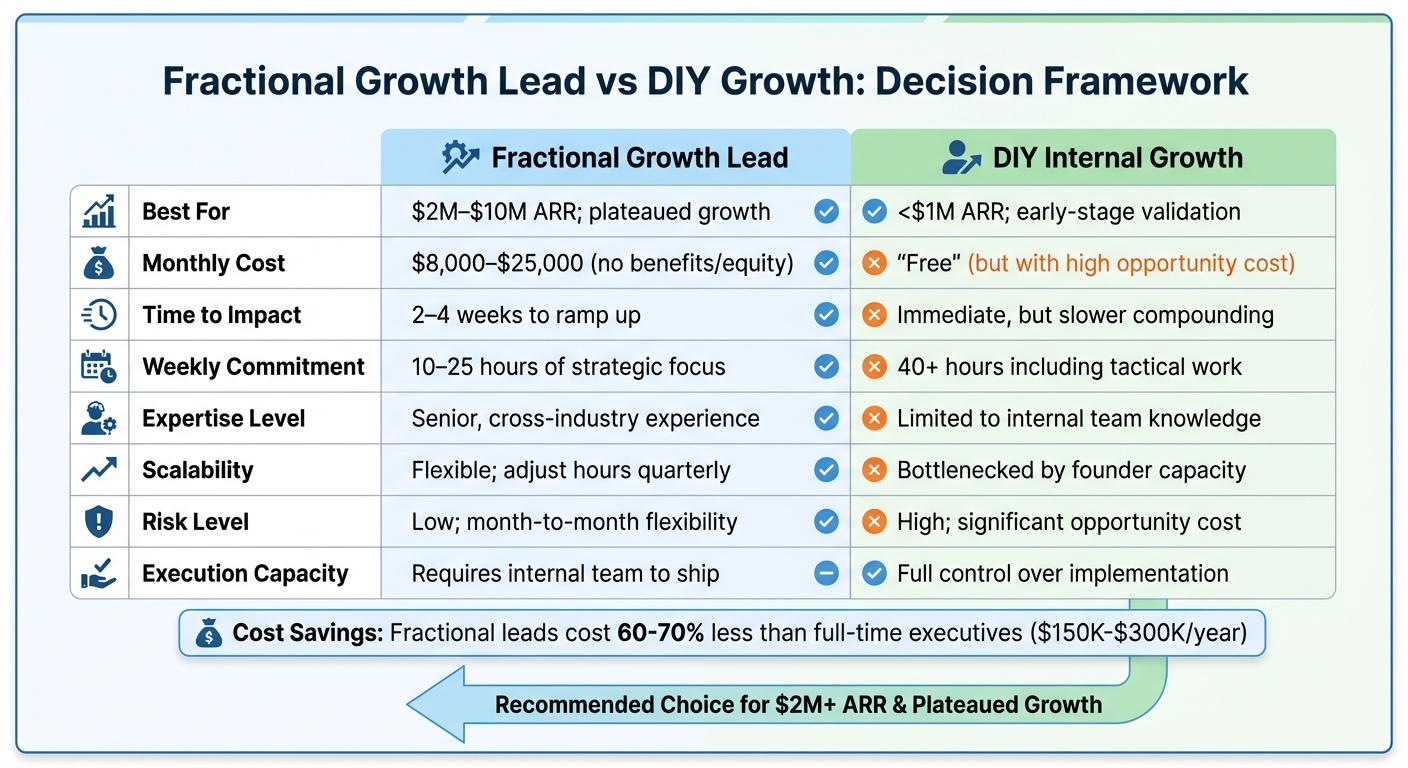
If you're facing growth challenges, deciding whether to hire a fractional growth lead or stick with DIY strategies can feel like a pivotal choice. The right path depends heavily on your current business stage and available resources.
Review Your Growth Numbers
Start by diving into your core metrics. For example, check your CAC payback period - how long it takes to recover customer acquisition costs. If this is longer than industry norms, it could point to inefficiencies in your growth funnel. Similarly, aim for an LTV to CAC ratio of at least 3:1; anything less might signal trouble scaling sustainably[4].
Here are some healthy SaaS benchmarks to consider:
- Trial-to-paid conversion rate: 15%–25%
- Monthly churn rate: Less than 7%[4]
If your conversion rate is under 15%, the issue might lie in your conversion process rather than traffic volume. And if churn exceeds 7%, focus on retention strategies before scaling your acquisition efforts.
Your ARR stage also plays a significant role. Companies earning $2 million to $10 million ARR often hit a growth plateau, where founder-driven efforts no longer yield the same results[2]. This is the "fractional-ready" stage where external expertise can make a big impact. On the other hand, if your ARR is below $1 million, it might make more sense to keep growth efforts in-house until your funnel stabilizes.
If inefficiencies show up in your metrics, consider running internal experiments first before hiring outside help.
Try DIY First with Small Tests
Before committing to a hire, try focusing on one high-impact area, like onboarding or pricing, and run a 30-day A/B test[4]. If small adjustments yield noticeable improvements, it might signal that you're ready for a fractional growth lead to amplify those results[2].
Also, calculate the true cost of DIY. Track the time you spend on growth tasks for a week. For instance, if you dedicate 10 hours weekly at an effective rate of $150 per hour, that's roughly $6,000 per month[16]. Compare that to the typical cost of a fractional growth lead, which ranges between $8,000 and $25,000 per month[1]. If growth tasks are pulling you away from core responsibilities like product development or sales, outsourcing may be the smarter choice.
"Hire too late, and problems compound until you're burning cash to maintain current revenue. Hire too early, and you're paying for expertise your company isn't ready to implement."
– Bhakti Chadhaa, ProductLed[2]
Before you bring in any growth leader, ensure your tracking systems are in place. Metrics like activation (users completing a core action), trial-to-paid conversion, and feature adoption should already be measurable[2]. Without these, even the best strategies won't deliver results.
Hire vs. DIY Comparison
Here’s a quick breakdown of the two approaches to help guide your decision:
| Factor | Fractional Growth Lead | DIY Internal Growth |
|---|---|---|
| Best For | $2M–$10M ARR; plateaued growth | <$1M ARR; early-stage validation |
| Monthly Cost | $8,000–$25,000 (no benefits/equity)[1] | "Free" (but with high opportunity cost)[16] |
| Time to Impact | 2–4 weeks to ramp up[3] | Immediate, but slower compounding |
| Weekly Commitment | 10–25 hours of strategic focus[1] | 40+ hours including tactical work |
| Expertise Level | Senior, cross-industry experience[1] | Limited to internal team knowledge |
| Scalability | Flexible; adjust hours quarterly[2] | Bottlenecked by founder capacity[16] |
| Risk Level | Low; month-to-month flexibility[3] | High; significant opportunity cost |
| Execution Capacity | Requires internal team to ship[3] | Full control over implementation |
The decision comes down to your current capacity and expertise. If your founder-led efforts and metrics are delivering results, stick with DIY for now. But if you're ready to scale faster and need a strategic boost, a fractional growth lead could be the answer.
Conclusion
Choosing between a fractional growth lead and a DIY growth strategy depends largely on where your business stands. If you're still pre-product-market fit or generating less than $1M ARR, a DIY approach is often the better choice. This stage is all about validating your product, gaining a deep understanding of your customers, and setting up basic tracking systems for activation and conversion[2]. These core elements are far more critical than diving into conversion rate optimization too early.
However, as your growth metrics start to stagnate, it might be time to bring in external expertise. When your ARR hits the $2M to $10M range, founder-led growth efforts often lose steam, and the absence of senior-level growth expertise can begin to hurt your progress[2]. A fractional growth lead can step in with proven strategies and take ownership, often at 60%–70% less cost than hiring a full-time executive[1]. This makes it an appealing option for scaling businesses, but it’s essential to ensure your foundational systems are ready first.
Before hiring, take a close look at your tracking systems. Can you accurately identify activated users or pinpoint where users drop off in your funnel? If you can't connect early user behavior to revenue forecasts, it's better to focus on strengthening these systems before bringing in external leadership[2]. Keep in mind that fractional leads provide high-level strategy but don't handle day-to-day operations.
As your business grows and early strategies start to limit progress, it's vital to reassess your growth approach. Use clear metrics and strategic checkpoints to evaluate whether your current path aligns with your long-term objectives. Successful companies know when to adjust their growth models to meet evolving needs.
FAQs
What should I prepare before hiring a fractional growth lead?
Before bringing on a fractional growth lead, make sure you've nailed down your product-market fit and are actively monitoring key metrics such as activation, conversion, and retention. It's crucial to have a clear understanding of your customers and their Jobs To Be Done (JTBD) - what problems they need your product to solve.
Set up basic analytics to track performance, pinpoint specific growth challenges you're facing, and evaluate whether your team is prepared to collaborate effectively. These foundational steps will pave the way for a smoother onboarding experience and help you get the most out of your fractional growth lead.
How do I measure ROI from a fractional growth lead?
To calculate ROI effectively, focus on key metrics such as revenue growth, reduction in customer acquisition costs, or pipeline improvements. Then, compare these outcomes to the associated costs.
Here’s the formula you’ll use:
ROI = ((Value Generated - Cost of Investment) / Cost of Investment) × 100
Let’s break it down with an example:
If an initiative brings in $500,000 in revenue and costs $120,000, the ROI would be about 317%. This means the investment delivered over three times its cost in value.
How do I choose the right fractional growth lead for my SaaS?
To find the right fractional growth lead, start by determining if your SaaS company is post-product-market fit and experiencing growth hurdles. This approach is particularly effective for businesses with an ARR between $2–10 million. Fractional leaders are a great choice when you need flexible, high-level expertise to tackle key metrics like retention or monetization, without committing to a full-time hire.
Make sure their skills and experience match your specific challenges. Also, consider whether their typical part-time availability (10–20 hours per week) aligns with your current resource and budget constraints. If your needs require full-time support, a permanent hire might be a better option.
Related reading
- How your acquisition strategy influences your conversion rate
- How to A/B test pricing as a boostrapped company
- Upsell vs. Cross-Sell Metrics: Key Differences
- Digital Marketing Services
- What Is Strategy Consulting? (And when to hire a consultant to do it for you)
Useful tools & services
Turn the idea into a growth decision
Define the audience, constraint, owner, and success check in a practical plan.
Use the growth strategy templateNeed help choosing the next change? Explore CRO consulting.
More of the right people
New articles on this, by email.