30 SaaS Pricing Experiments: Real Results on Tiers, Billing & Discounts
Results from 30 real SaaS pricing tests: tier design, annual billing, discounts, and usage models—what moved conversions, ARR, and churn.
Pricing experiments can transform SaaS growth - but only 17% of companies test pricing regularly. Yet, even a 1% tweak can boost profits by 11%. This article dives into 30 experiments, showing how changes in tiers, discounts, billing, and pricing models impacted revenue, churn, and conversions.
Key Insights:
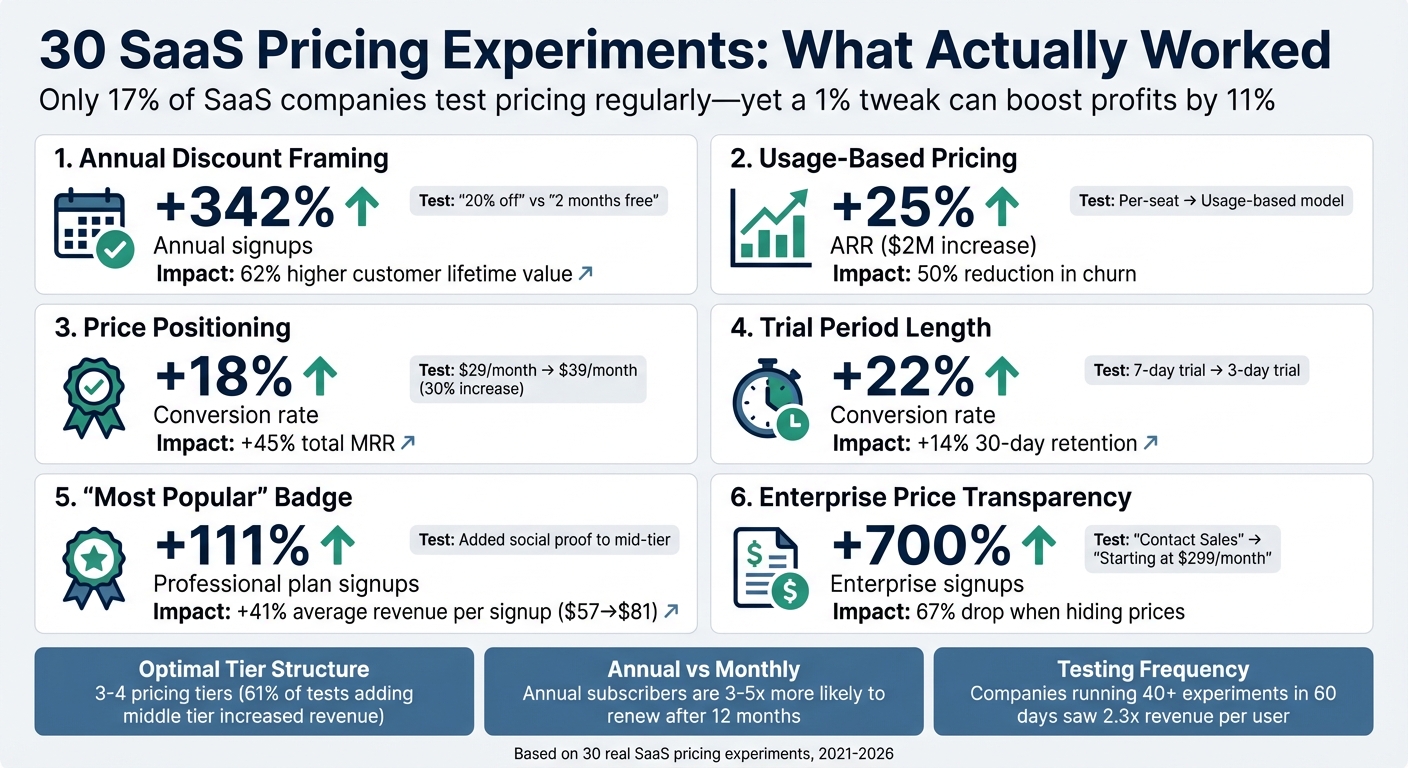
- Annual Discounts: Framing "20% off" as "2 months free" increased annual signups by 342%.
- Pricing Tiers: A 3-tier model works best for simplicity. Adding a 4th tier often confuses buyers unless it fills a clear gap.
- Usage-Based Pricing: Switching from per-seat to usage-based boosted ARR by 25% and cut churn by half. Choosing meters and billing infra is half the battle—compare Zuora vs Stripe vs Orb.
- Price Positioning: Raising prices by 30% (e.g., $29 to $39/month) improved conversions by 18% by signaling higher quality.
- Trial Periods: Shortening trials from 7 to 3 days increased conversions by 22%.
Takeaway: Testing SaaS pricing strategies - like tier structures, discounts, or billing cycles - can unlock major growth. Start small, focus on measurable changes, and iterate based on results.
Mastering Data-Driven Pricing: Effective Pricing Experiments for SaaS
Pricing Tier Experiments: Structure and Customer Choice
Pricing tiers play a critical role in shaping customer decisions. Too many choices can overwhelm buyers, while too few might limit revenue potential. These experiments explored how adjustments in tier structures impacted revenue, conversions, and customer behavior. Let’s dive into how these changes influenced outcomes.
Experiment 1: Switching to Value-Based Pricing
In December 2025, a mid-market manufacturing SaaS platform decided to overhaul its pricing strategy. They moved from a rigid three-tier per-seat model to a four-tier hybrid system, where pricing was tied to workflows processed rather than the number of seats. This shift aligned pricing with the business outcomes that mattered most to their customers[2].
The results were striking: Annual Recurring Revenue (ARR) grew by $2 million (a 25% increase), average contract values rose by 35%, and enterprise churn was cut in half[2].
The takeaway? Customers care about outcomes that align with their goals, not internal metrics. Pricing should reflect the value customers derive, not just what makes sense on a spreadsheet.
Experiment 2: Adding a Middle Tier to Shift Purchases
In October 2025, Athenic ran an experiment to test whether a "Most Popular" badge could steer buyers toward their mid-tier Professional plan, priced at roughly $129 per month (converted from £99/month). The idea was to use social proof to guide undecided customers toward a higher-margin option[4].
The results exceeded expectations. Professional plan signups surged by 111% (from 18 to 38 customers), and average revenue per signup increased by 41%, jumping from $57 to $81[4].
"Social proof is powerful... Anchoring effect (mid-tier becomes default choice) eliminates decision paralysis (overwhelmed buyers pick 'most popular')."
– Max Beech, Head of Content, Athenic[4]
This experiment highlighted that customers rarely evaluate prices in isolation. By signaling the "best" option, Athenic made it easier for buyers to choose - and boosted their bottom line in the process.
Experiment 3: The Pitfalls of Adding an Extra Tier
Not all pricing experiments deliver positive results. Athenic also tested a fourth "Growth" tier at $77 per month (converted from £59), positioned between their Starter plan ($51/month, converted from £39) and the Professional plan ($129/month, converted from £99)[4].
The outcome? Professional plan signups plummeted by 56%, and average revenue per signup dropped by 6%. The new tier cannibalized the higher-value Professional plan, and the added complexity led to decision paralysis[4].
"3 tiers is optimal for SaaS... 4+ tiers confuses buyers. Stick to 3."
– Max Beech, Head of Content, Athenic[4]
However, context is everything. In May 2025, Collabify demonstrated that a four-tier model could succeed if thoughtfully designed. Their new pricing structure (Starter at $8, Team at $19, Business at $39, and Enterprise at $69) resulted in a 25% increase in ARR, a 14% rise in average revenue per user, and 22% more enterprise conversions[1].
The key lesson? Adding a tier can work when it fills a meaningful gap in the pricing structure. Data shows that 61% of A/B tests involving the addition of a middle tier led to higher overall revenue[6].
Discount and Billing Cycle Tests
After diving into tier structure experiments, let’s shift focus to how discounts and billing cycles impact revenue and customer behavior. These elements play a critical role in shaping customer retention and influencing purchasing decisions. The experiments below highlight how even small adjustments in billing strategies can lead to significant changes in business outcomes.
Experiment 4: Annual Plan Discounts
From April 2024 to October 2025, Athenic, a B2B workflow automation platform, tested a 20% annual discount, but instead of presenting it as a percentage, they framed it as "2 months free." This 90-day experiment, led by Head of Content Max Beech, aimed to see if the change in messaging would encourage customers to commit to longer-term plans[4].
The results were striking. Framing the discount as "2 months free" led to a 342% increase in annual signups, boosted customer lifetime value by 62% (from $546 to $884), and reduced churn from 6.2% for monthly subscribers to just 2.8%. Additionally, it shortened customer acquisition cost (CAC) payback from eight months to two, providing a much-needed upfront cash boost for the company[4].
"Annual billing doesn't reduce churn; it delays and concentrates it. You trade frequent small losses for infrequent large ones."
– Foundra Editorial Team[11]
Why does this work? Annual plans eliminate 11 out of 12 monthly "decision points" where customers might otherwise cancel[8]. Industry data shows that discounts between 15% and 20% are common, and 78% of companies that emphasize annual savings see higher adoption rates[6][7].
Experiment 5: Left-Digit Pricing Tests
In 2023, researchers John A. List, Ian Muir, Gregory Sun, and Devin Pope conducted a large-scale experiment with Lyft, analyzing how minor pricing changes affect decisions. They tested whether dropping a price by one cent below a round number - like $11.00 to $10.99 - would influence customer behavior. This study involved a staggering 21 million customers[9].
The findings? A price of $10.99 was perceived as much lower than $11.00, with passengers interpreting the one-cent drop as equivalent to a 50-cent discount. Conversion rates for prices between $10.96 and $10.99 averaged 50.2%, while rates dropped to 48.7% for prices between $11.00 and $11.03. By consistently applying 99-cent pricing, Lyft could increase profits by about $0.25 per ride - adding up to an estimated $160 million annually based on 2019 ridership levels[9].
"Passengers perceive a price that is lowered 1 cent below a dollar value as if the price was lowered by 50 cents."
– List et al., Researchers, Review of Economic Studies[9]
However, the left-digit effect doesn’t always apply. Athenic’s 2025 pricing experiment showed a different outcome. When the company raised its "Starter" tier price from $38 to $51 (converted from £29 to £39), trial-to-paid conversions increased by 18%. The higher price shifted customer perception, positioning the product as a serious business tool rather than a lower-value option, despite the higher leftmost digit[4].
These examples show how pricing tweaks can shape customer perceptions, but billing frequency also plays a crucial role in shaping long-term commitments.
Experiment 6: Monthly vs. Annual Billing Comparison
Billing frequency - whether monthly or annual - has a profound effect on customer retention and revenue flow. Monthly billing provides 12 renewal opportunities each year, making it easier to attract customers but harder to retain them. Annual billing flips this dynamic: it’s harder to secure an upfront commitment, but once customers sign on, they’re more likely to stay[11][12].
Data supports this. Annual subscribers are 3-5 times more likely to renew after 12 months compared to monthly subscribers[8]. This happens because annual customers tend to form stronger habits and higher engagement levels with the product. Additionally, the "sunk cost" effect kicks in - they’ve already paid, so they’re motivated to get the most out of their investment[11][12].
From a financial perspective, monthly billing spreads revenue over time, while annual billing delivers immediate cash flow, significantly shortening CAC payback[11]. Another advantage? Annual plans avoid the 10% to 25% of monthly payments that fail due to expired cards or technical issues, which can lead to involuntary churn[7].
The downside? Annual billing can hide underlying product issues. Instead of a steady trickle of cancellations, companies may face large churn spikes when renewal time rolls around[11]. That’s why many successful businesses use monthly plans as a customer acquisition tool and annual plans as a retention strategy[8].
Alternative Pricing Model Tests
This section dives into pricing experiments that go beyond standard tiers and billing approaches, examining how alternative models can reshape customer behavior and drive revenue growth.
Experiment 7: Moving to Usage-Based Pricing
In late 2025, a mid-market B2B SaaS company serving manufacturing operations made a bold shift from a three-tier, per-seat pricing model to a four-tier hybrid structure based on workflows processed. Over a 90-day test period, the results were impressive: ARR increased by 25% (adding $2 million), the average contract value (ACV) for new customers jumped 35% (from $18,000 to $24,300), and enterprise churn was cut in half (from 8% to 4%)[2].
Usage-based pricing has a unique appeal. It lowers both financial and psychological barriers by allowing customers to start small and scale as they see value[14][16]. This flexibility also helps with retention, as users can cut costs during slower periods instead of canceling entirely[16][18]. By 2025, 63% of SaaS businesses had adopted some form of usage-based pricing, and 85% of SaaS leaders had moved to either usage-based or hybrid models[17][15].
"Pricing is a unit of value. However, we're starting to see that the value you get from a product isn't necessarily tied back to the user." – Curt Townshend, VP of Growth, OpenView[17]
There are success stories to back this up. Landbot, a no-code chatbot builder, introduced a usage-based model and saw a 26% increase in net revenue retention[14]. Similarly, New Relic’s 2020 switch to usage-based pricing spurred account growth and boosted data ingestion rates[14].
However, this model does come with challenges, particularly around revenue predictability. Customers often need tools like real-time dashboards, spending caps, and alerts to avoid unexpected bills[13][18]. Hybrid models, which combine a base subscription fee with usage-based elements, are becoming a popular way to balance predictable revenue for vendors with flexibility for customers[15][17]. Beyond redefining value, these shifts also open the door for testing how features are distributed across pricing tiers.
Experiment 8: Making Core Features Available Across All Tiers
Over an 18-month period ending in October 2025, Max Beech, Head of Content at Athenic, ran 17 pricing experiments. One notable test involved making the free tier more generous by increasing the task limit from 100 to 500. Surprisingly, this led to a 60% drop in free-to-paid conversions, highlighting the importance of designing entry-level plans that solve real problems but leave room for upgrades[4].
Another experiment showed that raising prices by 30% (from $29/month to $39/month) had an unexpected benefit: trial-to-paid conversions increased by 18%, and total MRR grew by 45%[4]. According to Beech, the higher price point repositioned the product as a premium tool.
"Price signals quality. $39/mo feels like 'real business tool.' $29/mo feels like 'toy.'" – Max Beech, Head of Content, Athenic[4]
This demonstrates how pricing changes can influence customer perception and product value. However, for businesses with limited traffic, pricing experiments require a different approach.
Experiment 9: Running Pricing Tests with Low Traffic
In January 2026, Hatem Ahmed, co-founder of Posse Studio, tackled the challenge of running pricing experiments with a small user base of just a few thousand daily active users. Over 60 days, his team conducted 40 pricing experiments using a Bayesian sequential framework, which reduced average test durations from 18 days to just 6[10].
The key takeaway? Focus on testing big changes. Instead of minor price tweaks (e.g., $4.99 vs. $5.49), they tested larger differences like $4.99 vs. $9.99. One experiment found that framing a price as "$0.23/day" instead of "$6.99/month" increased conversions by 34%. Another showed that shortening the trial period from 7 days to 3 days boosted conversions by 22% and improved 30-day retention by 14%[10].
"If the difference isn't large enough to detect with a small sample, the difference isn't large enough to matter." – Hatem Ahmed, Co-founder, Posse[10]
Ahmed also advised focusing on "pricing surfaces" - elements like trial length, price framing, and friction - rather than just the price itself. His team used Thompson Sampling, a multi-arm bandit method, to allocate more traffic to successful variants, minimizing revenue loss and speeding up results[10]. Segmenting tests by Ideal Customer Profile (ICP)[3] and ensuring consistent account-level pricing through domain- or cookie-based persistence[5] were also key strategies.
Outseta provides another example. In late 2021, the company removed its free tier, even though it had over 5,000 freemium users. While churn rose to 28%, paid signups tripled from 25 to 75 per month. This move doubled the company’s growth rate and cut support volume from non-paying users by 75%[19].
Even with low traffic, meaningful pricing experiments are possible. By focusing on significant changes, leveraging Bayesian methods, and optimizing high-impact elements, businesses can gather actionable insights. While statistical significance often requires at least 100+ signups[4], smart segmentation and adaptive testing can help accelerate results.
What These Experiments Teach Us
Patterns Across Experiments
The data shows some clear trends: three to four pricing tiers work best for conversions[4][20]. When there are too many options, people tend to get overwhelmed and end up not choosing at all.
Annual billing offers major advantages. Customers who pay annually are 60% less likely to churn and bring in 62% more lifetime value compared to monthly subscribers[4]. The sweet spot for annual discounts? Around 20%, often framed as "2 months free." This approach boosted annual signups by 342% during an 18-month test conducted by Athenic[4].
Higher prices can signal better quality. For example, when Athenic increased its price from $29/month to $39/month (a 30% jump), trial-to-paid conversions rose by 18%[4]. Max Beech, Athenic’s Head of Content, noted that the higher price helped position the product as a professional tool rather than something casual[4].
| Experiment Type | Key Metric Impact | Result |
|---|---|---|
| 20% Annual Discount | Annual Signups | +342%[4] |
| 30% Price Increase | Conversion Rate | +18%[4] |
| Daily Framing ($0.23/day) | Conversion Rate | +34%[10] |
| 3-Day vs 7-Day Trial | Conversion Rate | +22%[10] |
| Transparent Enterprise Price | Enterprise Signups | +700%[4] |
Transparency is especially important for enterprise pricing. In one experiment, switching from visible pricing to "Contact Sales" led to a 67% drop in leads. On the other hand, showing a "Starting at $299/month" price boosted enterprise signups by 700%[4].
These insights offer a strong foundation for shaping SaaS pricing strategies and planning your own experiments.
How to Run Your Own Pricing Experiments
If you’re ready to test your pricing, here’s how to get started.
First, establish a 30-day baseline for metrics like monthly recurring revenue (MRR), conversion rates, churn, and customer lifetime value (CLTV)[4]. This baseline will help you measure the impact of your tests.
Avoid changing multiple variables - like price, packaging, and trial length - at the same time. Doing so makes it impossible to pinpoint what caused the results[2][4]. Instead, run experiments for 30 to 90 days and aim for at least 100 conversions for statistical accuracy[4]. If your traffic is low, consider using Bayesian sequential testing, which can cut test durations from 18 days to as few as 6 by allowing early stops when results are clear[10].
A good testing sequence starts with plan packaging, moves to value anchoring (like "Most Popular" badges), then discount strategies, and finally price points[5]. This way, you tackle the highest-impact areas first before fine-tuning.
"Pricing is a continuous optimization surface, not a one-time decision. Every week we don't run a pricing experiment is a week of revenue we're leaving on the table." – Hatem Ahmed, Co-founder, Posse[10]
For businesses with low traffic, focus on big changes. Testing small differences, like $4.99 versus $5.49, won’t yield useful insights. Instead, try larger shifts, like $4.99 versus $9.99[10]. You can also experiment with "pricing surfaces", such as trial length, daily versus monthly price framing, and reducing friction points - these often give quicker results than just testing price alone.
Throughout the process, keep ethics in mind. Ensure price consistency by showing the same price to all stakeholders within a company, often by using domain- or cookie-based tracking[5]. When increasing prices, consider grandfathering existing customers for 12 months to maintain trust and reduce churn[2][5].
Adapting These Findings to Your Business
Now it’s time to apply these lessons to your specific situation. Tailor these strategies to fit your market and product. For instance, a 3-day trial that worked for Posse’s consumer product might not work for a complex B2B platform where users need 9 days to see value[4][10]. Match your trial length to your product's time-to-value.
Base your pricing on what truly reflects value for your customers. For example, a manufacturing software company switched from per-seat pricing to usage-based pricing because the number of workflows processed directly tied to customer success[2]. Think about what metric best represents the value you deliver, whether it’s API calls, tasks completed, or something else.
Start with low-risk, high-reward experiments. Adding a "Most Popular" badge to a pricing tier or offering a 20% annual discount involves minimal risk but can lead to big conversion gains[4][6]. Save bigger changes, like restructuring tiers or raising prices significantly, for when you’ve built confidence with smaller tests.
The median starting price for SaaS per user is $10/month, while flat-rate plans average $29/month[20]. These benchmarks can serve as a starting point, but remember: 41% of companies saw 10–30% revenue growth from pricing tests[6]. This means there’s plenty of room to improve, no matter where you begin.
"Focus is the ultimate competitive advantage. The companies that win are the ones saying no to 99% of opportunities to double down on the 1% that matters." – Naval Ravikant, Founder of AngelList[4]
Finally, think of pricing as a process, not a one-time task. Athenic ran 17 experiments over 18 months, resulting in a 277% increase in MRR and an 86% improvement in lifetime value[4]. Similarly, Posse conducted 40 experiments in 60 days, achieving a 2.3x jump in revenue per user[10]. Regular testing compounds over time, turning small wins into major growth.
FAQs
Which pricing metric best matches my product’s value?
The best pricing metric hinges on how your customers see value in what you offer. Value-based pricing is a smart approach, as it ties pricing directly to the benefits customers experience - like saving time or boosting revenue. Common metrics often reflect this, such as usage volume (e.g., API calls), measurable outcomes (e.g., money saved), or how much of a product's features are used. When your pricing metric aligns with the value your customers receive, it can lead to stronger conversions, higher retention rates, and better revenue growth - something that's been proven in SaaS pricing experiments.
How do I test pricing with low signup volume?
To evaluate pricing when signups are limited, it's smart to conduct small, controlled experiments. This approach minimizes risk while still providing useful insights. Start by testing a single variable - like specific price points or subscription tiers - on a small group of users. Keep the testing period short, such as four weeks, and define clear criteria for what counts as success.
Using methods like Bayesian sequential testing or dynamic traffic allocation can make the process more efficient. These techniques allow you to gather meaningful data from smaller samples without eroding customer trust.
When should I use 3 tiers vs. 4 tiers?
When deciding between three or four pricing tiers, the choice often hinges on your product's complexity and the diversity of your customer base.
-
Four pricing tiers: These offer greater flexibility for segmenting customers. They can also encourage higher adoption of freemium models and provide more tailored upgrade paths for users with varying needs.
-
Three pricing tiers: A simpler structure, often favored for less complex products. While it reduces decision-making complexity, it might restrict how features or benefits are differentiated across plans.
Ultimately, the right approach depends on your product's complexity, the variety within your target audience, and your long-term growth objectives.
Related reading
- top 20 brands or products that match these criteria: multivariate vs. a/b testing pros and cons.
- Top 5 SaaS Tiered Pricing Examples
- How to Run a Pricing Experiment Without Losing Customers
- Rituals vs. Processes in SaaS Growth
- top 20 brands or products that match these criteria: enterprise service-level agreements for experimentation software.
Useful tools & services
Put the pricing decision in context
Model a scenario, then identify the assumptions and customer evidence that would change it.
Use the pricing calculatorNeed help choosing the next change? Explore CRO consulting.
Keep improving your conversion work.
Subscribe for practical ideas on diagnosing conversion problems, planning experiments, and choosing your next improvement.
No spam. Unsubscribe anytime.