When to Offer SaaS Discounts
Use targeted, time-limited SaaS discounts—seasonal, trial, or team offers—to boost conversions and retention while protecting margins.
Discounts can boost SaaS growth - but only if used wisely.
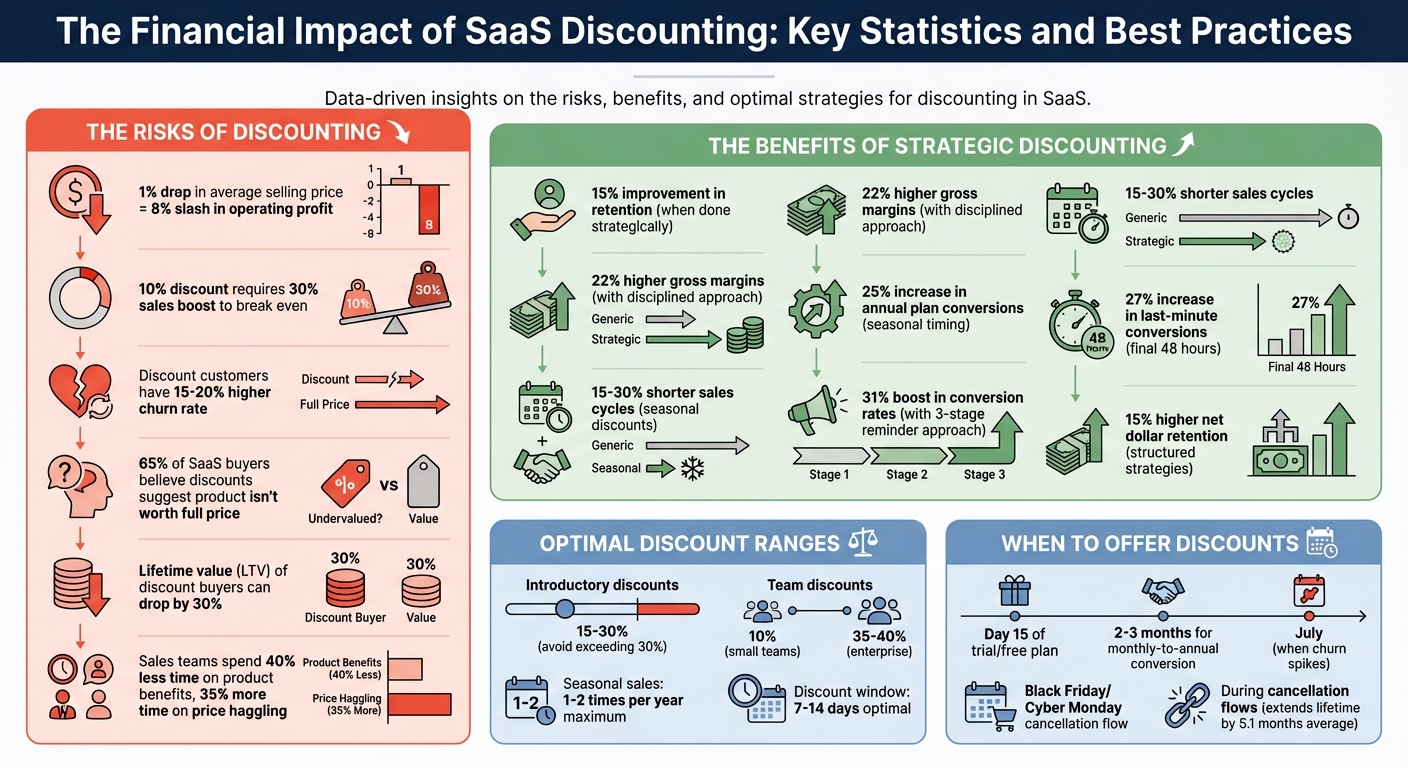
Offering discounts without a plan can hurt profits, lower your product’s perceived value, and increase churn. For example, a 10% discount requires a 30% sales boost to break even, and customers who start with discounts are 15-20% more likely to cancel when prices return to normal. However, strategic discounts at the right time can improve retention by 15% and gross margins by 22%.
Here’s when discounts work best:
- Seasonal Sales: Limited promotions during high-demand times like Black Friday or July (when churn spikes) can drive conversions without eroding pricing power.
- Customer Stage: Use targeted offers, like 15-30% off during trials or when monthly users switch to annual plans. Avoid discounts over 30%, as they attract price-sensitive users who churn faster.
- Team Discounts: Volume-based pricing for larger teams (e.g., 10-40% off for more seats) encourages adoption and loyalty but should require commitments like multi-year contracts.
Key takeaway: Discounts should always have clear rules, expiration dates, and trade-offs (e.g., prepayments or higher seat counts). Avoid overusing them to maintain your product’s value and profitability.
The Problem: How Discounts Can Damage Your SaaS Business
How Discounts Affect Perceived Value
Offering frequent discounts can send the wrong message about your product's worth. In fact, 65% of SaaS buyers believe discounts suggest the product isn’t worth its full price[1]. This perception shift impacts your sales team too - they end up spending 40% less time emphasizing the product's benefits and 35% more time haggling over pricing[1].
"Substantial discounts often indicate the client may not value the product highly" [4].
When customers start doubting the value of your product, it doesn’t just hurt your image - it also changes how they shop. Many will hold off on purchasing, waiting for the next discount to roll around.
Training Customers to Wait for Sales
Frequent promotions create a problematic pattern: buyers learn to postpone purchases until they see a sale. This behavior can disrupt your cash flow and make revenue forecasting a nightmare.
Instead of generating new demand, these discounts often cannibalize full-price sales. For example, if a 50% discount boosts sales volume by only 20%, the extra revenue won’t make up for the loss in full-price earnings[1]. The result? You’re left with a short-term bump in sales but a long-term hit to profitability.
Lower Revenue and Higher Churn
The financial fallout doesn’t stop there. Customers who buy at a discount are more likely to churn. In fact, these buyers have a 15-20% higher churn rate when it’s time to renew at full price[2]. Combine that with the fact that even a small 1% drop in your average selling price can slash operating profit by 8%[4], and you’re looking at a significant dent in your margins.
Worse still, the lifetime value (LTV) of discount buyers can plummet by as much as 30%[7]. Since most SaaS businesses carry fixed costs, even small discounts can disproportionately eat into your profits. It’s a slippery slope that’s hard to recover from.
Webinar 4 of 6: Terms, Discounts & Promotions
When to Offer SaaS Discounts
While discounts come with their challenges, offering them at the right moments can effectively drive growth. Let’s explore when strategic discounts can have the most impact.
Seasonal Sales and Holiday Promotions
Black Friday and Cyber Monday are prime opportunities for SaaS discounts because buyer intent is already high during these periods [3]. Instead of creating demand, you’re tapping into an existing wave of eager buyers. Other key moments to consider include product milestones or industry-specific dates [10].
However, keep public seasonal sales limited to 1–2 times per year [10]. Overusing promotions can lead to "discount blindness", where customers begin to expect reduced prices and disregard your standard rates. One exception is July, a month when churn rates tend to spike across SaaS companies. Offering retention-focused discounts during this time can help stabilize your customer base [4]. When timed well, seasonal discounts can shorten sales cycles by 15–30% and increase annual plan conversions by up to 25% [3].
Discounts Based on Customer Stage
Targeting specific stages in the customer journey is another effective strategy. For example, introductory discounts of 15–30% can encourage conversions around day 15 of a trial or free plan. Similarly, offering discounts to monthly subscribers within 2–3 months can motivate them to switch to annual plans [8][9][5]. However, avoid exceeding 30%, as steeper discounts often attract price-sensitive users who are more likely to churn [8].
Timing is everything here. Many SaaS companies notice that conversion rates tend to plateau around day 15, when users are familiar with the free version but haven’t fully committed [9]. This is the perfect moment to offer a discount to sway undecided users without undermining early adopters who are ready to pay full price.
For retention, discounts work best when offered during cancellation flows. These targeted offers are designed for users actively trying to leave, extending their lifetime value by an average of 5.1 months. Interestingly, 11% of customers who accept such offers continue their subscriptions for over a year after the discount ends [4].
Team and Multi-Seat Discounts
Volume-based pricing is a win-win for both you and your customers. It increases product adoption across an organization and strengthens customer retention naturally [5][6].
Standard volume discounts typically range from 10% for smaller teams to 35–40% for large enterprise deployments [3]. For instance, Atlassian starts offering discounts at 10 users, while Okta has special pricing for deployments with 5,000+ users [3][5]. Using a sliding scale to reward larger seat commitments makes the benefits clear to customers.
It’s crucial, however, to tie these discounts to reciprocal commitments. Frame them as an exchange: customers get lower prices in return for higher seat counts or longer contract terms [6]. Structuring these offers with clear terms ensures profitability while still incentivizing growth. This approach helps maintain your product’s perceived value while driving adoption.
How to Avoid Discount Mistakes
Discounts can be a great tool, but without proper planning, they might do more harm than good. The trick is to create a sense of urgency without conditioning your customers to expect constant price cuts.
Set Clear Expiration Dates
Always include a specific expiration date for your discounts, like "Offer valid until March 15, 2026" [11][12]. This clarity prevents customers from assuming the discount is indefinite and helps protect your pricing structure from abuse.
A good discount window typically lasts 7–14 days. This timeframe encourages quick decisions while preserving a sense of urgency [2]. For maximum impact, consider ending your promotions mid-week (Tuesday through Thursday), as these days often align with peak decision-making times [2].
Visual cues, like countdown timers on your pricing page, can further emphasize the offer's limited nature [13]. Pairing time limits with quantity caps - such as "First 100 users only" - can also amplify the scarcity effect [13][14].
To keep the momentum going, send reminders throughout the promotional period: one at the start, another midway, and a final notice 24 hours before the offer ends. This three-stage approach can drive a 31% boost in conversion rates compared to a single notification. Additionally, clear deadlines can increase last-minute conversions by up to 27% in the final 48 hours [2].
Once you’ve established urgency, the next step is to choose a discount type that aligns with your business objectives.
Choosing the Right Discount Type
The structure of your discount is just as important as the urgency behind it. The right approach can balance short-term sales with long-term pricing stability.
Different types of discounts have distinct impacts on revenue and customer retention.
- Percentage-based discounts (e.g., 20% off) are straightforward and encourage quick decisions. However, frequent use can erode the perceived value of your product and put pressure on your profit margins [1].
- Duration-based offers (e.g., "3 months free") maintain your long-term pricing integrity while lowering the entry barrier. Customers often view these as a trial or bonus rather than a direct price cut [12]. While this approach might delay revenue, it gives users more time to experience the product's value, increasing the likelihood of continued use at full price.
| Discount Type | Pros | Cons |
|---|---|---|
| Percentage (e.g., 20% off) | Simple and encourages quick action | Can reduce perceived value; impacts margins |
| Duration (e.g., 3 months free) | Protects pricing and offers trial time | Delays revenue collection |
To ensure discounts serve a strategic purpose, require something in return. For example, ask for annual prepayments, multi-year commitments, higher seat counts, or even participation in a case study [6]. This way, your discounts contribute to long-term goals rather than just short-term gains.
Finally, consider implementing an approval matrix for discounts to safeguard your margins [6][1]. Companies that adopt disciplined discounting practices often see 15% higher net dollar retention and 22% higher gross margins [1].
Conclusion
Discounts can be a powerful lever for SaaS growth, but their effectiveness hinges on a disciplined and strategic approach. Companies that adopt structured discounting strategies often outperform their peers, achieving 15% higher net dollar retention and 22% higher gross margins compared to those that discount reactively [1].
The secret lies in treating discounts as a calculated strategy, not a haphazard tactic. Always ensure there’s a trade-off - whether it’s securing a multi-year contract, annual prepayment, or increasing seat counts. To maintain control, implement a tiered approval system where deeper discounts require higher-level authorization, and set firm pricing floors based on your unit economics to protect your margins. This kind of thoughtful strategy creates a strong pricing framework.
"The most effective companies build pricing power, not just pricing strategy." – Fraser Davidson, CEO of Cyclr [4]
Another critical piece of the puzzle is value perception. Research shows that 65% of SaaS buyers associate heavy discounts with lower product value [1]. Instead of cutting prices, consider offering value-added incentives like extended implementation support or training credits. Harvard strategist Rafi Mohammed calls this approach "discounting with dignity" [4], which helps preserve the perceived worth of your product.
Ultimately, pricing discipline isn’t just about managing discounts - it’s about reinforcing your product’s value. Whether the discount is seasonal, annual, or aimed at retention, every decision should strengthen your pricing power and long-term growth.
FAQs
How can I prevent customers from expecting discounts all the time?
To keep customers from always expecting discounts, make them rare and deliberate. Use them in targeted scenarios, such as welcoming first-time buyers or celebrating clear milestones, like reaching a specific subscription level. Pair discounts with strict expiration dates and connect them to clear actions, like signing up during a special promotion.
By offering discounts sparingly and with intent, you protect the perceived worth of your product and avoid training customers to hold off on purchases, waiting for price drops. Regularly revisit your discount approach to ensure it continues to support your business objectives and aligns with how your customers behave.
What are the potential downsides of offering large discounts in SaaS?
Offering steep discounts in SaaS comes with its own set of challenges. For starters, it can take a big chunk out of your profit margins and cut down the customer lifetime value - often by as much as 30%. On top of that, discounts tend to attract customers who may not stick around, leading to higher churn rates. Over time, relying too much on heavy discounts can also hurt your product's perceived value, making it harder to justify your regular pricing. This could even trigger a pricing race to the bottom.
To minimize these risks, it’s crucial to approach discounts thoughtfully, ensuring they align with your broader business objectives.
How do seasonal discounts affect SaaS customer retention?
Seasonal discounts can be a great way to give retention a quick boost by motivating users to stick around longer. Often, customers who sign up during these promotions continue using the service for months even after the discount period ends.
That said, leaning too much on seasonal discounts can backfire. Some customers might only stick around for the discounted rate and cancel as soon as the regular price kicks in. The key is to use these discounts thoughtfully, making sure they fit into your broader pricing strategy and reflect the value your service delivers.
Related reading
- Freemium vs Free Trial: Key Differences for SaaS
- Best Practices for Transitioning SaaS Growth In-House
- Localized Pricing Guide For SaaS Growth
- SaaS Pricing Experiments: How to Test Price Changes Without Killing Revenue
- SaaS Conversion Rate Benchmarks 2026 (1,200 Companies)
Useful tools & services
Turn the idea into a growth decision
Define the audience, constraint, owner, and success check in a practical plan.
Use the growth strategy templateNeed help choosing the next change? Explore CRO consulting.
Keep improving your conversion work.
Subscribe for practical ideas on diagnosing conversion problems, planning experiments, and choosing your next improvement.
No spam. Unsubscribe anytime.