The SaaS Founder's Guide to Usage-Based Pricing (Without Scaring Off Customers)
Pick a clear value metric, prevent bill shock, and roll out usage-based pricing without losing customers.
Usage-based pricing is becoming the go-to model for SaaS companies in 2026. Why? It aligns pricing with how customers actually use a product, ensuring they only pay for the value they receive. This approach has helped companies like Snowflake and Twilio achieve impressive net revenue retention rates (158% and 155%, respectively). However, it’s not without challenges - like unpredictable bills and customer anxiety.
Here’s what you’ll learn:
- Why usage-based pricing works: It supports growth by scaling revenue with customer success.
- How to build a SaaS pricing strategy and choose the right value metric: Charge based on what customers care about, like API calls or tasks completed.
- Pricing models to consider: Hybrid (base fee + usage), volume-tiered, and credit-based structures balance flexibility with stability.
- How to avoid “bill shock”: Use spending caps, real-time dashboards, and proactive alerts to build trust.
- Steps for a smooth rollout: Test with small groups, communicate changes clearly, and monitor results.
What Usage-Based Pricing Is and Why It Works
What is Usage-Based Pricing?
Usage-based pricing, also known as consumption-based billing, charges customers based on how much they actually use a product rather than a fixed monthly fee. Instead of paying for access or a set number of seats, customers are billed for measurable activities like API calls, processed data, tokens consumed, or completed transactions [8]. Think of it like an electricity bill - customers only pay for what they use, whether their consumption is low or high.
With the basics covered, let’s dive into why SaaS companies are increasingly drawn to this model.
Why SaaS Companies Use Usage-Based Pricing
By 2026, 74% of software providers are expected to adopt usage-based pricing. Companies using this approach have seen revenue grow 1.5 times faster, with public companies trading at 50% higher revenue multiples [2][4][9].
This pricing model reduces friction throughout the customer journey. New users can start small, often at little to no cost, and experience the product's value before scaling their spending [10]. As customers grow and their usage increases, revenue naturally expands without requiring renegotiations or upselling.
"Usage-based pricing transforms customer success from a department into the core business model." – Tomasz Tunguz, Redpoint Ventures [9]
It also offers flexibility for customers, allowing them to pay less during slow periods. This flexibility contributes to churn rates that are 22% lower than those seen with flat-rate pricing [7]. Companies like Snowflake and Twilio have achieved impressive Net Revenue Retention rates of 158% and 155%, respectively, by letting revenue grow in sync with customer usage. Additionally, the rise of AI has made this model even more relevant. When compute costs vary widely - where one user consumes thousands of tokens and another millions - flat-rate pricing risks either undercharging or alienating smaller customers [4].
While this model supports growth and aligns well with customer needs, it does come with its own set of challenges.
Common Concerns and How to Address Them
One major concern is revenue unpredictability. Since income fluctuates with customer activity, forecasting becomes more difficult [11].
A popular solution is the hybrid model, which combines a base subscription fee with usage-based charges. This ensures a revenue floor while still allowing for growth. Companies using this approach report median growth rates of 21%, striking a balance between flexibility and stability [6].
Another issue is "bill shock", where unexpected charges lead to higher churn rates. To counter this, companies can implement spending caps, real-time usage dashboards, and automated alerts to warn customers when they’re nearing their limits [5].
"Bill shock is a product problem. Spend caps, in-product usage visibility, and proactive notifications should ship with your pricing." – Stripe [5]
Some worry about usage suppression, where customers intentionally limit their use to save money. This can be addressed with volume-tiered pricing - offering lower per-unit costs as usage increases - and committed-use discounts, which provide financial predictability for customers while securing revenue for the company [5].
Finally, implementing real-time metering, accurate billing, and automated invoicing adds complexity [11]. However, these systems are essential for ensuring that revenue scales alongside customer success.
How to Choose the Right Value Metric
What is a Value Metric?
A value metric is essentially what you charge for - it represents how customers experience the value of your product. Think of it as the connection between your product's functionality and what your customers genuinely care about. For example, if you run an email automation platform, you might charge based on "emails sent" or "contacts managed" rather than technical metrics like "server hours used" or "database queries executed."
The right value metric grows alongside your customers' success. If a customer's usage doubles, the benefits they receive - and their willingness to pay - should naturally increase, too. This approach helps your revenue scale with your customers, eliminating the need for uncomfortable upsell discussions or contract changes.
"Getting your value metric right is arguably the single most important pricing decision you'll make." – Jo Johansson, Alguna [13]
Examples of Value Metrics That Work
The best value metric depends on your product type. Here are some examples:
- Consumption-based metrics: Ideal for technical tools and infrastructure. These include metrics like API calls, gigabytes stored, or tokens processed. For instance, OpenAI charges per million tokens, which directly reflects the AI processing customers use.
- Workflow-based metrics: These focus on completed tasks or processes. If you're offering a document processing tool, you might charge per document summarized or per invoice processed - aligning costs with the work customers value most.
- Outcome-based pricing: This is gaining traction for products that deliver measurable results. Instead of billing for activity, you charge for outcomes - like resolved support tickets or qualified leads. For example, Intercom charges per resolved ticket, tying pricing to what support teams care about.
Another popular approach is the credit-based model, which has seen 126% year-over-year growth, particularly in AI applications [6]. Credits simplify billing by acting as a single, spendable currency that hides technical details, making it easier for customers to budget.
The key takeaway? Your value metric should align with what drives success for your customers.
Matching Your Metric to Customer Success
Your value metric should be simple enough for a non-technical buyer to estimate their monthly bill within 20% accuracy using basic data. If your CFO can't model it in Excel in under 10 minutes, it's probably too complicated [12].
Avoid metrics that penalize behaviors you want to encourage. For example, if you're building a collaboration tool, charging per message sent might discourage usage. Similarly, stay away from abstract technical units, like "compute credits", that customers can’t easily understand or control.
When choosing your value metric, evaluate it against these five criteria: value alignment, simplicity, measurability, predictability, and expansion potential. The metric that scores highest across all five is usually the best fit. When you get this right, your pricing becomes a driver of growth rather than a source of friction.
What is Usage Based Pricing for SaaS?
How to Build Pricing Models Customers Will Accept
Once you’ve nailed down your value metric, the next step is creating pricing models that align with both usage patterns and customer success.
4 Usage-Based Pricing Models to Consider
Your pricing structure should reflect your value metric. One straightforward option is per-unit flat pricing, where every unit costs the same no matter how much is consumed. This model is ideal for products with consistent usage patterns, making it easy for customers to predict their expenses [2].
Another option is volume-tiered pricing, which rewards higher usage by reducing the per-unit cost as consumption increases. For instance, you might charge $0.01 per unit for the first 10,000 units, then drop the rate to $0.008 for the next 90,000 units [2][6]. Once a customer reaches a new tier, the lower rate applies to all units.
The hybrid subscription plus overages model is widely used - 61% of SaaS companies incorporate it [6]. This approach combines a base monthly fee for a set amount of usage with additional charges for extra consumption. Companies using this model have seen a median revenue growth rate of 21% [6][14].
Lastly, committed use discounts are tailored for enterprise clients who need predictable budgets. Customers commit to a minimum spend or usage level in exchange for lower per-unit rates [2][15].
Let’s explore how to address pricing concerns while ensuring customers feel secure.
How to Prevent Bill Shock and Pricing Anxiety
Unexpected charges can quickly damage customer trust. A 2026 report found that 78% of IT leaders had encountered surprise fees on SaaS bills due to consumption-based pricing [16]. To avoid this, it’s crucial to integrate safeguards into your pricing model.
One effective measure is spending caps, which allow customers to set a maximum monthly budget. Once they hit the limit, you can either pause services or notify them to approve additional usage [2][6].
Another tool is proactive alerts. Notify customers when they reach 50%, 80%, and 100% of their typical usage or included limits [6][4]. These alerts give them the chance to adjust their usage or upgrade their plan before being hit with unexpected charges. Pair this with a real-time usage dashboard that shows current consumption, estimated monthly costs, and past usage trends [4][3].
For new users, offering trial credits - typically between $5–$10 - can ease them into the product without financial risk [2][15]. This not only reduces entry barriers but also provides valuable insights into their usage habits.
Next, we’ll look at how a well-designed pricing page can enhance customer confidence.
How to Design a Clear Pricing Page
A transparent pricing page builds trust and helps potential customers estimate their costs before committing. Start by clearly defining your value metric. For example, if you charge "per API call", break it down in simple, non-technical terms [15][17]. Reinforce this clarity by explaining the measurement units prominently on the page.
Include an interactive pricing calculator to let prospects explore different scenarios. For example, a slider showing monthly email volumes can clarify costs [2][6]. Additionally, display sample bills for various usage levels - such as Small, Medium, and Enterprise - to set clear expectations [2].
Transparency is key. Show the exact per-unit rates, highlight volume discounts, and explain what happens if customers exceed their plan limits. If you’re using a hybrid model, separate the base subscription fee from the usage charges. This level of detail helps reduce objections.
"The goal is zero surprise bills." - Duke Vu, CEO, Fungies.io [4]
How to Roll Out Usage-Based Pricing Without Losing Customers
Switching to usage-based pricing requires careful planning to avoid alienating your customer base. Rushing the transition can lead to disastrous results - some fintech startups experienced churn rates as high as 40% in a single quarter after rolling out consumption billing without sufficient testing [18]. Once you've identified the right value metric, the next hurdle is implementing the new pricing model without damaging customer trust. These four steps will guide you through a smooth rollout, keeping your customers on board.
Step 1: Analyze Usage Data to Pinpoint the Right Metric
Start by running shadow billing for two to three cycles. This involves simulating invoices while customers remain on their current rates. It’s a low-risk way to uncover edge cases and predict revenue impact [18].
Make sure your event-level data is accurate and reliable. Aggregated analytics or reconstructed server logs won’t cut it [18]. The metric you choose should be easy for customers to understand. For instance, "documents processed" is a straightforward example that ensures clarity during the transition [1][5]. Keep in mind that aligning on the right metric can take time - about 80% of companies spend at least a quarter on this step alone [1].
Step 2: Test the Waters with a Small Group
Before introducing the new model to your entire customer base, test it on new signups only for 60 to 90 days [5]. This controlled approach allows you to gather clean data on conversion rates and early retention without disrupting existing customers. Use a cohort test to compare these new users against a control group still on flat-rate pricing. Focus on metrics like average revenue per user (ARPU) and early retention [18].
Another option is a hybrid pilot, where you add usage as an overage component to current subscriptions. This ensures a revenue baseline while testing how customers respond to usage-based charges [18]. Track progress at key milestones: Day 30 for system stability, Day 60 for behavioral changes and support ticket volume, and Day 90 for net revenue retention (NRR) and lifetime value (LTV) impact [18].
Step 3: Communicate Changes Clearly to Customers
Once the new model has been validated, prioritize transparent communication with your customers. Roll out changes gradually: start with new customers, then offer an opt-in migration for engaged users, and finally transition the rest of your customer base in phases [5]. Give existing customers at least six months' notice before mandatory changes, and honor current pricing for annual subscribers until their renewal date [5].
Prepare three key communication tools:
- Detailed announcement emails: Include the new metric, per-unit rate, effective date, and an estimated bill.
- Comprehensive FAQ pages: Explain metric definitions, provide pricing tables, and share example bills.
- Customer Success Manager scripts: Equip your team to explain usage trends and the benefits of the new pricing model [5].
For mid-market customers, consider offering comparison tools that show historical spending alongside projected costs under the updated model [18].
"Transitioning your base is less about enforcing a new price and more about resetting the value conversation. Do it gradually, with structure, and you will earn the trust of your customers."
– James D. Wilton, CEO and Senior Partner, Monevate [1]
Encourage early adoption by offering temporary discounts or bonus credits to legacy customers who switch voluntarily [5]. For those facing significant cost increases, provide transition credits to ease the adjustment over one or two billing cycles [5].
Step 4: Monitor Results and Fine-Tune Your Approach
Closely track performance during the first 90 days of the rollout. At 30 days, confirm that usage events are being recorded accurately with no gaps or errors [18]. By 60 days, assess any changes in customer behavior, such as shifts in product usage or an increase in billing-related support tickets [18]. At the 90-day mark, evaluate the economic impact by comparing NRR and LTV trends against historical data [18].
Combine quantitative metrics - like ARPU, usage growth, and churn - with qualitative feedback from surveys and support interactions [18]. Use this data to refine your strategy, whether that means adjusting tier thresholds, tweaking your value metric, or improving how you communicate usage details. This iterative process ensures your pricing model evolves in line with customer needs and drives revenue growth based on real value.
Comparing Different Usage-Based Pricing Models
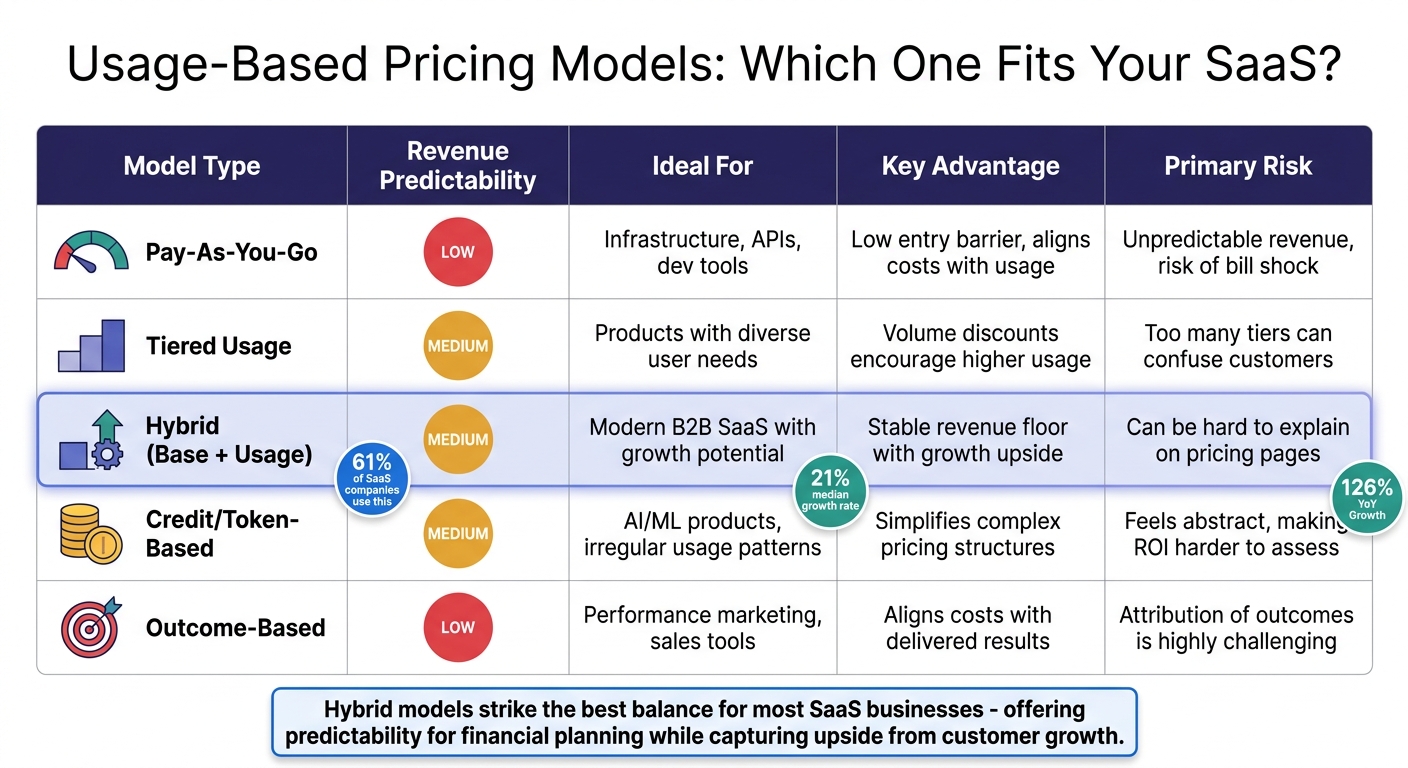
Let’s take a closer look at how different usage-based pricing models stack up against each other. Picking the right one is crucial for balancing steady revenue with the potential for growth. Each approach caters to unique business needs and customer behaviors.
Hybrid pricing, which combines a base fee with usage charges, has become a popular choice for many companies. It offers a steady revenue floor while allowing businesses to benefit as customers grow. Companies using this model report a median growth rate of 21%, far outpacing the 13% seen in pure subscription models [20][14]. The logic is simple: the base fee ensures consistent income, while usage-based charges capture additional revenue as customers expand their usage.
On the other hand, pure pay-as-you-go models lower the barrier to entry but can lead to unpredictable revenue streams. Companies like Snowflake and Twilio have shown the potential of this model, boasting net revenue retention rates of 158% and 155%, respectively [6]. However, the trade-off is revenue volatility, which can be challenging to manage.
Credit-based pricing, often used in AI products, has grown 126% year-over-year [6][20]. This model simplifies complex costs, like those associated with computing, by using prepaid credits. While it provides customers with budget certainty, it requires careful tracking of credit usage, adding some operational complexity.
Here’s a quick comparison of the main attributes of these models:
Pricing Model Comparison Table
| Model Type | Revenue Predictability | Ideal For | Key Advantage | Primary Risk |
|---|---|---|---|---|
| Pay-As-You-Go | Low | Infrastructure, APIs, dev tools | Low entry barrier, aligns costs with usage | Unpredictable revenue, risk of bill shock [6][21] |
| Tiered Usage | Medium | Products with diverse user needs | Volume discounts encourage higher usage | Too many tiers can confuse customers [6][21] |
| Hybrid (Base + Usage) | Medium | Modern B2B SaaS with growth potential | Stable revenue floor with growth upside | Can be hard to explain on pricing pages [6][19] |
| Credit/Token-Based | Medium | AI/ML products, irregular usage patterns | Simplifies complex pricing structures | Feels abstract, making ROI harder to assess [6][20] |
| Outcome-Based | Low | Performance marketing, sales tools | Aligns costs with delivered results | Attribution of outcomes is highly challenging [6][20] |
"Traditional per-seat pricing breaks when the value of your product doesn't scale with headcount."
– Dan Layfield, Growth at Codecademy [6]
Among these, hybrid models seem to strike the best balance for most SaaS businesses. They offer the predictability needed for financial planning while capturing the upside of customer growth. If your product has usage patterns that vary but your customers also need a degree of budget certainty, this model could be a great starting point. Understanding these nuances will help you choose the pricing strategy that aligns with both your growth goals and customer expectations.
Conclusion
Usage-based pricing connects your revenue to the value your customers receive, creating a pathway for growth as they thrive. The challenge lies in ensuring customers feel informed, comfortable, and in control of their bills.
The trend is undeniable: by 2026, 75% of software providers are expected to adopt usage-based models [5], with hybrid pricing models achieving a median growth rate of 21% [6]. Success in this approach depends on how thoughtfully you design the billing experience. Transparency and clear enforcement rules are just as critical as the revenue itself in building trust.
"The moment a customer hits their limit or receives their bill is when pricing becomes personal. Design these moments with care. Your billing cadence, enforcement rules, and transparency don't just affect revenue; they shape trust." – Chargebee [1]
To get started with usage-based pricing, focus on a value metric that customers can easily understand and anticipate before signing up. Add features like spending caps, real-time usage dashboards, and automated alerts at critical usage points (50%, 80%, and 100%). Introduce these changes gradually - start with new customers, and then offer existing users the option to migrate. Avoid "bill shock" by treating it as a product issue that needs solving, not a customer problem [5]. When your pricing aligns with customer success, you create the foundation for long-term growth.
Companies excelling with usage-based pricing aren't just increasing revenue - they're building loyalty by aligning their success with their customers' outcomes. As your customers grow, your revenue grows too, delivering on the promise of this pricing model and driving sustained growth through 2027 [5].
While your pricing strategy may evolve with your product and market, one principle remains constant: prioritize your customers, and the revenue will naturally follow.
FAQs
How do I pick a usage metric customers won’t game or avoid?
When selecting a usage metric, aim for one that ties directly to the value your product provides, is straightforward to track, and difficult to manipulate. Metrics such as API calls, data volume, or transaction counts are excellent choices. These metrics represent actual usage and are less susceptible to manipulation compared to more adjustable metrics like the number of user seats or contact lists. By focusing on clear, measurable metrics, you can reduce the risk of users gaming the system or finding ways to avoid fair usage tracking.
What should I build in-product to prevent surprise bills?
To help customers avoid unexpected charges in a usage-based pricing model, it's essential to integrate in-product features that promote clarity and visibility. Some effective tools include real-time usage tracking, alerts, and soft limits that notify users when they're nearing their usage thresholds. Additionally, incorporating usage estimators and providing clear, detailed billing information directly within the product can keep users informed. These measures not only minimize surprise bills but also build trust in your pricing approach.
How do I migrate existing customers without hurting churn?
To help current customers transition to usage-based pricing while keeping churn rates low, it's best to take a gradual approach. Begin by implementing this pricing model for new customers. Then, slowly introduce it to existing customers, giving them the choice to opt in rather than forcing the change.
Make sure to avoid surprises - unexpected charges, unclear invoices, or service disruptions can all erode trust. Instead, focus on clear communication and transparent billing. A well-thought-out plan is essential for maintaining customer confidence and ensuring the transition happens smoothly without creating unnecessary frustration.
Related reading
- Zuora vs Stripe vs Orb (2026): Usage-Based Billing for SaaS
- Usage-Based Pricing for SaaS: When It Works and When It Backfires
- what pricing models should i expect from ai-driven bi platforms that track real-time product metrics?
- Should You Add Enterprise Pricing? A Revenue-Impact Calculator for SaaS
- How to Price Your SaaS Product When You Have No Competitor Data
Useful tools & services
Put the pricing decision in context
Model a scenario, then identify the assumptions and customer evidence that would change it.
Use the pricing calculatorNeed help choosing the next change? Explore CRO consulting.
Keep improving your conversion work.
Subscribe for practical ideas on diagnosing conversion problems, planning experiments, and choosing your next improvement.
No spam. Unsubscribe anytime.