How to Price Your SaaS Product When You Have No Competitor Data
Price your SaaS without competitor benchmarks using value-based pricing: quantify outcomes, build tiers, test pricing, and track LTV/CAC.
Figuring out how to price your SaaS product without competitor data can be challenging, but focusing on your product's value to customers is key. Here's a quick summary of the approach:
- Avoid Guesswork: Many SaaS companies rely on random pricing, leading to underpricing and missed revenue opportunities.
- Use Value-Based Pricing: Set prices based on the outcomes your product delivers (e.g., time saved, revenue gained, or risks reduced). Aim for 10–20% of the total value it creates.
- Understand Customer Needs: Conduct interviews and surveys to identify pain points and the benefits your product provides. Use tools like the Van Westendorp Price Sensitivity Meter to gauge acceptable price ranges.
- Create Pricing Tiers: Offer 3–4 tiers that align with customer needs and value metrics. Structure them to appeal to different segments while maintaining clear price gaps.
- Test and Refine: Use A/B testing to validate pricing, track key metrics like ARPU and LTV, and adjust based on customer behavior and feedback.
Even a 1% improvement in pricing can boost profits by up to 12.7%. Pricing is an ongoing process - focus on customer value and data-driven adjustments to maximize revenue and growth.
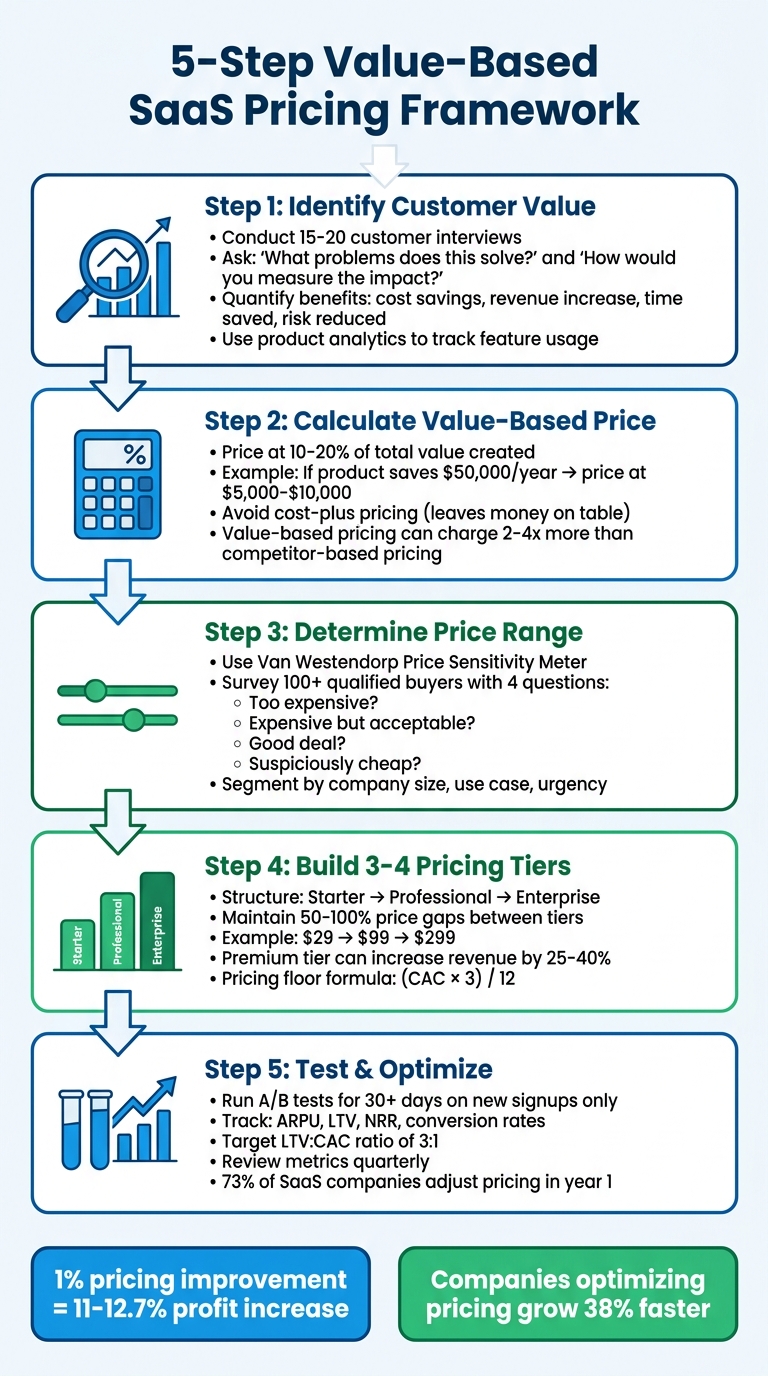
How Value-Based Pricing Works
What Value-Based Pricing Means
Value-based pricing means setting your price based on the results your product delivers, not on how much it costs to make or what competitors charge. The focus is on measurable outcomes like saving time, increasing revenue, or reducing risks for your customers [6].
This method works because it ties your pricing directly to the success of your customers. When implemented effectively, it can allow you to charge 2 to 4 times more than cost-plus or competitor-based pricing strategies [6]. Cost-plus pricing often treats your product as just another commodity, while competitor-based pricing can lead to underpricing, especially if your product offers superior benefits [9][11].
A good rule of thumb is to price your product at 10% to 20% of the total value it creates for your customer [6][8]. For instance, if your product saves a company $50,000 a year in labor costs, pricing it between $5,000 and $10,000 makes sense. This leaves the customer with a net benefit of $40,000 to $45,000, making the investment worthwhile. To successfully use this strategy, you need to pinpoint the outcomes your customers value the most.
Finding the Outcomes Your Customers Care About
To make value-based pricing work, start by identifying what your customers currently rely on - like spreadsheets, manual tasks, or other tools - before they use your product. The difference between these alternatives and the benefits your product provides reveals its true value [10][3].
Conduct interviews with 15–20 customers to uncover the specific benefits they experience. Ask questions such as, "What problems does this solve for your business?", "How would you measure the impact?", and "What would happen if you didn’t have this tool anymore?" [12][13]. This helps you quantify benefits like cost savings, increased revenue, time efficiency, and reduced risk.
For intangible benefits, use proxy metrics like avoided fines, fewer errors, or minimized downtime [13][7]. Also, analyze your product's usage data. For example, if 90% of users skip a complex dashboard but heavily rely on an auto-sync feature, that feature is likely your main value driver [10].
Using Buyer Personas to Estimate What Customers Will Pay
Running Customer Interviews and Surveys
To understand what different types of customers might pay, focus on their specific needs and challenges. Not every customer values your product the same way - a startup founder with an urgent problem may be willing to spend more than a team exploring a less critical upgrade [15][18].
Start by conducting interviews with potential buyers. Instead of directly asking, "What would you pay?", try this question:
"How much is this problem costing you right now in terms of time, money, or lost opportunities?"
This approach shifts the discussion to the actual impact on their business. Follow up with, "What happens if this issue continues through the next quarter?" to gauge how urgent the problem feels to them. You can also ask who in their company would need to approve the budget, which gives insight into how they measure return on investment (ROI) [15].
For a broader approach, surveys can help. The Van Westendorp Price Sensitivity Meter is a useful tool here, asking respondents four key questions to identify a price range:
- At what price is the product too expensive?
- At what price is it expensive but still acceptable?
- At what price is it a good deal?
- At what price does it seem suspiciously cheap?
Aim to gather responses from at least 100 qualified buyers. This sample size helps keep your margin of error below 20% [16].
By combining these insights, you can link customer pain points to pricing strategies that make sense to them.
Connecting Pain Points to Pricing Metrics
Once you've collected interview and survey data, the next step is to match customer pain points with measurable pricing metrics. Organize customers into segments based on factors like company size, use case, and urgency [15][16]. Different segments will have different challenges and budgets.
Each segment's pain point should correspond to a value metric - a measurable unit that reflects the value your product delivers. For example:
- If your product saves time, calculate the value as the number of hours saved multiplied by the employee's hourly rate [14][18].
- If it helps recover lost revenue, measure the benefit as the additional sales gained [18].
- For risk reduction, estimate the value by factoring in avoided fines or downtime costs [14][18].
Research shows that companies aligning their pricing with value metrics grow 38% faster than those using arbitrary pricing models [16]. Use these metrics to create pricing tiers that address varying levels of pain or urgency. Each tier should offer solutions tailored to progressively more critical or complex problems [14].
Creating and Testing Pricing Tiers
Building 3-4 Pricing Tiers Based on Value
When creating pricing tiers, it's important to focus on customer value while keeping the options simple. Stick to 3–4 tiers; offering too many choices can confuse potential customers and hurt your conversion rates. Research shows that every 10 additional pricing combinations can lower conversions by about 1.5% [1], and moving from three to four plans can reduce conversions by up to 25% [19].
This is where the "Goldilocks Effect" comes into play. People often avoid the cheapest and most expensive options, settling instead on the middle choice, which feels "just right" [20]. To take advantage of this, structure your tiers around customer pain points. For instance:
- A Starter tier for individuals or small teams
- A Professional tier for small to mid-sized businesses
- An Enterprise tier for larger companies needing custom solutions and extra support [5][19][20]
Pricing gaps between tiers are equally crucial. Aim for a 50–100% price difference to prevent one tier from cannibalizing another [20]. For example, a SaaS company targeting early-stage B2B customers might price its tiers at $29 for Starter, $99 for Growth, and $299 for Pro [5]. Each tier should reflect increasing value tied to your chosen metric, whether that's per user, project, or usage level [5][19].
Adding a premium, high-priced tier can also be a smart move. This "anchor" option leverages the decoy effect, encouraging customers to see the lower tiers as more attractive. It can even increase revenue per customer by 25–40% compared to flat-rate pricing models [4][20]. At the same time, ensure your pricing floor is sustainable. Use this formula:
(Customer Acquisition Cost × 3) / 12, which helps maintain a healthy 3:1 Lifetime Value to Customer Acquisition Cost ratio [19].
Once your tiers are set, the next step is testing them.
Using A/B Tests to Validate Your Pricing
After defining your pricing tiers, A/B testing is the best way to validate them. This method compares conversion rates, revenue, and churn between different pricing setups, providing reliable data without seasonal distortions that can affect sequential tests [17][21].
Run your tests for at least 30 days or one full sales cycle, splitting traffic evenly between your current pricing and the new version [17][19]. Focus exclusively on new signups to avoid confusing existing customers or creating service issues [17][22]. To measure success, calculate revenue per trial using this formula:
Conversion % × Price [19].
Beyond initial conversion rates, keep an eye on long-term metrics like Average Revenue Per User (ARPU), Lifetime Value (LTV), and Net Revenue Retention (NRR) to fully understand the impact of your pricing changes [17][22]. If you're testing higher prices, consider grandfathering existing customers on their current plans for 6–12 months. This approach helps preserve goodwill and reduces churn [19][20].
Companies that regularly revisit and refine their pricing strategies often see significant benefits. For example, businesses that optimize pricing systematically report 25% faster growth rates, and 98% of SaaS companies that focus on pricing adjustments see positive revenue results within a year [17].
"A mere 1% improvement in pricing strategy can yield an 11% increase in profits - significantly higher than the impact of similar improvements in acquisition or retention efforts." - Price Intelligently [17]
Using Your Own Data to Improve Pricing Over Time
Tracking Which Features Customers Actually Use
Once you've validated customer value, it's time to leverage your internal data to refine pricing strategies. Product analytics tools like Amplitude, Mixpanel, or Heap can help track how customers interact with your product. These insights reveal which features customers truly value, helping you align pricing with their willingness to pay.
Start by calculating correlation coefficients to examine the relationship between feature adoption and customer plan levels. Features with strong correlations to higher-tier plans could be positioned as premium offerings, while features with lower correlations might be bundled into entry-level plans. Companies that excel in feature tracking often see 20% higher retention rates, and those leveraging segment-level analytics experience 25% greater revenue growth compared to those relying solely on aggregate data [23].
"The SaaS companies that win aren't the ones with the most features - they're the ones that build exactly the right features for each customer segment they serve." - Tomasz Tunguz, Redpoint Ventures [23]
Segment your usage data by factors like industry, company size, or user role to uncover trends. For instance, if enterprise clients consistently use a reporting feature that smaller businesses overlook, it might make sense to restrict that feature to a higher pricing tier. Pay attention to pricing signals as well - if trial-to-paid conversion rates exceed 20% or sales teams report no objections to pricing, you might be underpricing your product.
This detailed feature analysis sets the stage for evaluating key financial metrics.
Monitoring Key Metrics Like LTV, CAC, and ARPU
To determine whether your pricing strategy is effective, focus on three critical metrics: Lifetime Value (LTV), Customer Acquisition Cost (CAC), and Average Revenue Per User (ARPU). Calculate ARPU by dividing your Monthly Recurring Revenue by the number of active paying customers [24]. For LTV, divide ARPU by your monthly churn rate, and aim for an LTV:CAC ratio of at least 3:1 [19][24][25].
If your business has steady deal flow, review these metrics quarterly [2][1]. Break down ARPU by pricing tier and customer cohort to identify which plans drive the most revenue and how price adjustments influence your bottom line without relying on new customer acquisition [26][27]. Keep an eye on Net Revenue Retention (NRR) to gauge expansion revenue. Usage-based pricing models often achieve NRR rates of 115–120%, outperforming seat-based models, which typically range from 105–110% [27].
Pricing optimization is a powerful growth lever - it’s four times more effective than acquisition and twice as effective as retention [1]. Even small adjustments can have a big impact: a 1% improvement in pricing can lead to an 11% boost in profits [27]. The data you need is already at your fingertips - you just need to put it to work.
Mastering Value Based Pricing for SaaS Products
Conclusion
Setting prices without relying on competitor data allows you to develop a pricing strategy that focuses on the real value your product delivers. Consider measurable outcomes like time saved, increased revenue, or cost reductions - and aim to price your product at 10–20% of the economic value it provides [1][28].
Validate your assumptions by creating detailed buyer personas and conducting customer interviews. Then, implement a three-tier pricing model: "Good, Better, Best." This approach helps you cater to different customer needs and budgets while leaving room for ongoing adjustments. Test these tiers with actual prospects, keeping an eye on objection rates. If objections fall below 15%, it could be a sign that your product is priced too low [4][19]. Remember, pricing isn’t static - 73% of successful SaaS companies adjusted their pricing within their first year [5].
Use your product data - such as LTV:CAC ratios and conversion rates - to fine-tune your pricing strategy over time. Tracking these metrics regularly ensures your pricing evolves alongside your business. Even a 1% improvement in pricing can increase profits by 11–12.7%, making pricing adjustments far more impactful than customer acquisition efforts [1][29].
"Pricing is a dial, not a plaque." - Patrick Campbell, Founder of ProfitWell [3]
Think of pricing as an ongoing experiment rather than a one-time decision. Companies that succeed are those that adapt their pricing as they learn more about what their customers value most. By embracing this iterative approach, you can build a pricing strategy that drives long-term success.
FAQs
How do I calculate my product’s dollar value to a customer?
To figure out your product's dollar value, center your calculations on measurable outcomes and the return on investment (ROI) it provides. Pinpoint specific metrics that demonstrate value, such as time saved or improved efficiency. For instance, if your SaaS helps a finance manager save 10 hours each month, and their time is worth $100 an hour, that translates to $1,000 in monthly value per user. Use this figure to establish a price that reflects the ROI your customers receive.
What value metric should I price on for my SaaS?
To set effective pricing for your SaaS product, focus on a value metric that directly ties to the main benefit your product delivers. This could be:
- Number of users: Ideal for tools like team collaboration or project management platforms.
- Contacts: Works well for CRM or email marketing software.
- Usage-based metrics: Examples include API calls, storage space, or transactions - perfect for products where usage scales with customer needs.
The goal? Make your pricing structure reflect how customers experience value. When customers can clearly see the connection between what they’re paying for and the results they’re getting, it’s much easier for them to justify the expense.
When should I raise prices, and how do I do it safely?
If your current pricing is lower than what customers believe your product is worth - or if data shows you could boost revenue without losing many customers - it might be time to adjust your prices. To make this shift smoothly, consider testing pricing changes through value-based pricing, gathering customer feedback, or running structured experiments.
Make sure your value metric - the way you measure and charge for value - aligns with what matters most to your customers. When increasing prices, do so gradually and keep a close eye on customer reactions and churn rates. Also, it's a good idea to regularly review your pricing strategy to ensure it stays in step with market trends and customer expectations.
Related reading
- Zuora vs Stripe vs Orb (2026): Usage-Based Billing for SaaS
- Usage-Based Pricing for SaaS: When It Works and When It Backfires
- what pricing models should i expect from ai-driven bi platforms that track real-time product metrics?
- Should You Add Enterprise Pricing? A Revenue-Impact Calculator for SaaS
- SaaS Growth Model Spreadsheet Template (Free): MRR, Churn, CAC & LTV
Useful tools & services
Put the pricing decision in context
Model a scenario, then identify the assumptions and customer evidence that would change it.
Use the pricing calculatorNeed help choosing the next change? Explore CRO consulting.
More from each customer
New articles on this, by email.