what pricing models should i expect from ai-driven bi platforms that track real-time product metrics?
Compare subscription, usage-based, and tiered pricing for AI-driven BI that tracks real-time product metrics, with pros, risks, and guidance to choose.
AI-driven BI platforms typically use three pricing models: subscription-based, usage-based, and tiered pricing. Each model caters to different needs, from predictable costs to flexibility for fluctuating workloads. Here's a quick breakdown:
- Subscription-based: Fixed monthly/annual fee per user. Costs range from $13 to $25 per user/month. Ideal for stable usage but may have feature limits, like data refresh caps.
- Usage-based: Pay-as-you-go, billed per query or resource use (e.g., $0.10/query). Offers flexibility but risks unexpected charges during usage spikes.
- Tiered pricing: Structured plans with fixed limits for users, data, and features. Starting at $13/user/month, it balances predictability with scalability but requires plan upgrades if limits are exceeded.
Each model has its advantages and risks, so choosing the right one depends on your business size, data needs, and budget flexibility.
1. Subscription-Based Pricing
Subscription-based pricing works on a fixed monthly or annual fee per user or workspace. For instance, ThoughtSpot Essentials starts at $25.00 per user per month (billed annually), while Power BI Pro is priced at $14.00 per user per month (also billed annually) [1][2]. The main draw? It gives you a clear picture of your monthly expenses, making budgeting straightforward.
Cost Predictability
The biggest advantage here is the certainty it offers. You won’t be caught off guard by surprise charges at the end of the month because your costs remain steady, no matter how much you use the platform. This consistency makes it easier to plan your finances and allocate funds to other business priorities with confidence [8].
"Subscription models... ensure predictable, recurring revenue streams. This predictability allows for accurate forecasting and budgeting, enabling you to confidently reinvest in developing and improving your AI solution over time."
Scalability and Real-Time Metrics
That said, subscription tiers often come with limits, especially when it comes to real-time data tracking. For example, Power BI Pro and Premium plans allow a maximum of 48 data refreshes per day [2]. If your business needs updates every few minutes, this might not cut it. ThoughtSpot Essentials, on the other hand, supports up to 25 million rows of data, while their Pro tier increases this to 250 million rows [1]. To avoid performance issues during high-demand periods, it's wise to choose a tier that comfortably exceeds your average usage [9].
Risk of Overages
Although the base cost is predictable, additional charges can still creep in. Many platforms include "soft caps" on features like AI queries or API calls. For example, GoodData typically permits up to 30 AI queries per user per day under its Fair Usage Policy [5]. Exceeding these limits might mean overage fees or an unexpected mid-cycle upgrade to a higher tier [8]. To avoid surprises, look for platforms that provide real-time alerts when you're nearing usage limits [9].
Some platforms take a different approach, offering unlimited data volume and refresh frequency within their subscription plans. Strategy One, for example, starts at $13.00 per user monthly for 50 to 300 users and promises "no extra charges as your analytics maturity grows" [6]. This eliminates the stress of unexpected fees while still offering the predictability of a fixed monthly cost.
Up next, we’ll dive into a pricing model that adjusts based on how much you use.
2. Usage-Based Pricing
This pricing model stands apart from fixed-rate subscriptions by charging based on consumption. It allows costs to adjust dynamically according to fluctuating workloads.
With usage-based pricing, you pay only for what you use, rather than a set monthly fee. Billing typically occurs weekly or monthly, reflecting actual resource consumption [11][4]. Key cost factors include compute power (measured in units like "Rel Units" or "Databricks Units"), AI intelligence (calculated by tokens or queries), data volume (in MiB, GiB, or TB), and API activity [3][4][5]. This structure offers flexibility and more control over expenses.
Flexibility
This model scales costs alongside your usage, making it ideal for pilot projects or seasonal demands. For example, Snowflake charges $2.00–$4.00 per credit, ThoughtSpot Pro costs $0.10 per query, and Databricks charges $0.22 per DBU for data warehousing and $0.07 per DBU for AI workloads [1][3][12]. Such an approach lowers the entry barrier, enabling businesses to experiment with AI-driven tools without significant upfront investment [8].
"Usage-based pricing means their payment scales in line with their growth, removing that worry of exceeding a plan's limits."
- Finn Lobsien, Lago [8]
Risk of Overages
While flexible, this model can lead to unexpected costs if usage isn't monitored closely. A 2023 study revealed that 63% of companies using API-based AI services faced budget overruns in at least one quarter due to unanticipated usage spikes [13]. Additionally, costs can accrue even during idle processing times [11]. To mitigate this, set spending thresholds that trigger alerts before exceeding your budget. Many platforms also offer options like pre-paid capacity or annual commitments. For instance, Power BI Fabric Capacity Reservations provide a 40.5% discount compared to standard pay-as-you-go rates [2].
Scalability for Real-Time Metrics
Usage-based pricing is especially advantageous for businesses managing fluctuating data volumes in real-time. Platforms can adjust compute capacity dynamically to match workload demands, with storage costs averaging around $23.00 per TB per month [2][3]. Opt for per-second billing, as it ensures you pay only for the exact usage rather than rounding up to the nearest hour [4][12]. Additionally, many vendors offer ROI and pricing calculators to help you estimate costs based on your anticipated query volume and data processing needs [3][11].
3. Tiered Pricing
Tiered pricing strikes a balance between subscription and usage-based models, bundling features and scalability into structured plans that cater to your current needs.
With tiered pricing, you pay a fixed monthly or annual fee that covers specific allowances for users, data volume, and AI capabilities. Instead of being charged per query or credit, you choose a plan that matches your requirements. For example, Strategy One Standard starts at $13.00 per user per month for teams of 50 to 300 users, offering up to 150 GB of in-memory data capacity [6]. On the other hand, ThoughtSpot Pro is priced at $50.00 per user per month or $0.10 per query, supporting up to 1,000 users and 250 million rows [1].
Cost Predictability
One of the biggest advantages of tiered pricing is its fixed monthly cost, making budgeting and financial planning much simpler. Unlike usage-based models, where unexpected surges can lead to fluctuating bills, tiered plans offer stable expenses that finance teams can easily forecast.
"Subscription models are one of the best AI pricing models because they... ensure predictable, recurring revenue streams. This predictability allows for accurate forecasting and budgeting."
- Finn Lobsien, Lago [8]
If you exceed your plan’s limits, you’ll need to move to a higher tier rather than paying incremental overage fees. Many platforms also provide usage alerts or soft caps to help you monitor consumption and avoid surprises. This structure offers peace of mind as your data needs evolve, ensuring financial stability as your usage grows.
Scalability for Real-Time Metrics
Tiered pricing is designed to grow with your business. You can start with a lower tier that meets your initial needs and upgrade as your real-time tracking demands increase. For instance, mid-level tiers can handle up to 250 million rows [1], while higher tiers unlock advanced AI features like sentiment analysis, custom AI agents, or specialized data modeling [8].
This gradual progression allows you to scale without overpaying for features you don’t need in the early stages. Standard tiers, for example, can support teams of 50 to 300 users before requiring an enterprise-level upgrade [6]. This alignment between costs and growth ensures that your pricing plan evolves alongside your business.
Flexibility
While tiered pricing isn’t as flexible as usage-based models, it still offers room to adapt within defined boundaries. Some platforms combine flat fees with variable components, such as allowances for API calls or computation time. This hybrid approach balances cost stability with the ability to handle moderate fluctuations in workload. For businesses with relatively steady data volumes or user counts, this model provides predictable costs while accommodating occasional spikes.
"Tiers, quotas, and usage alerts make customers feel comfortable while still letting consumption grow naturally."
If your real-time metrics often experience sharp increases, it might be more cost-effective to choose a higher tier with a larger buffer instead of frequently upgrading. This approach works well for businesses that value stability but still need some flexibility to handle dynamic demands.
Comparing the Three Pricing Models
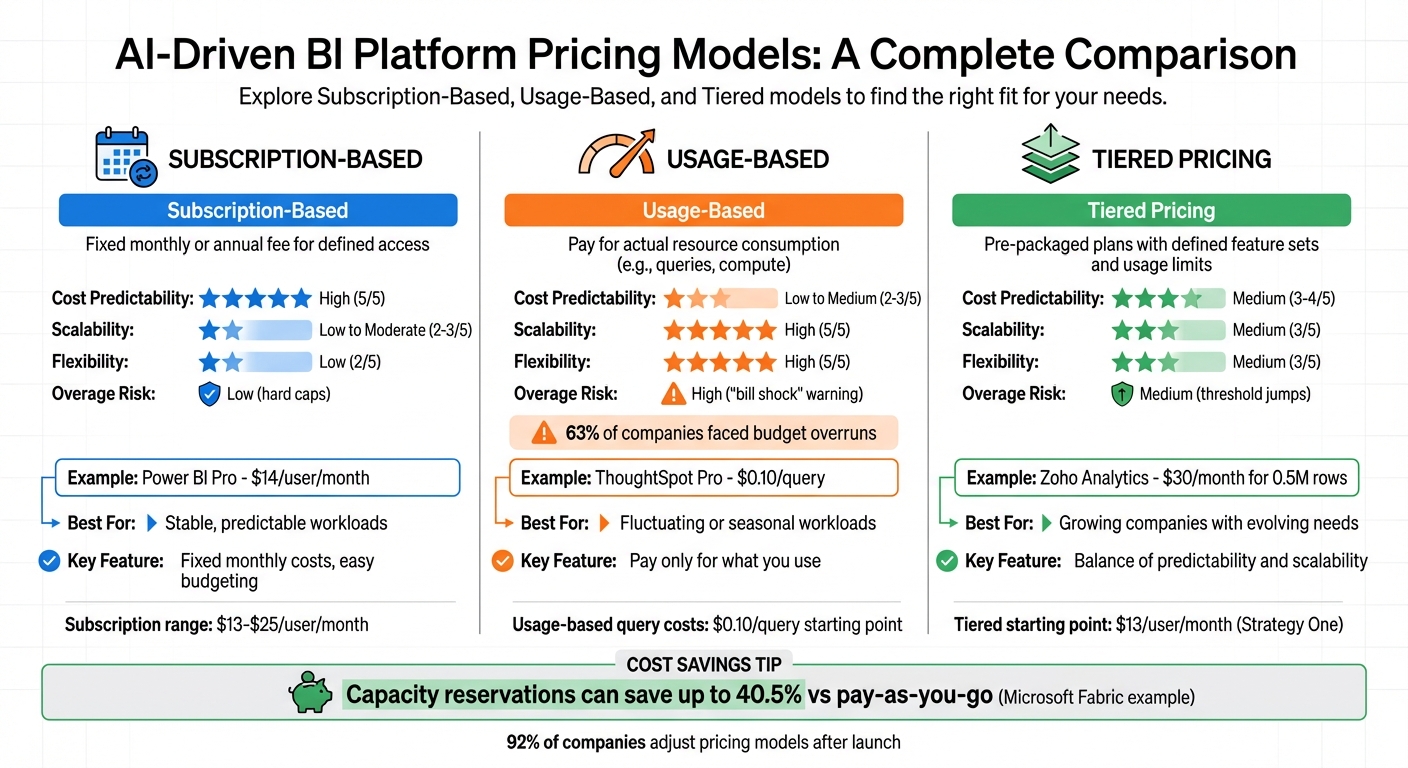
Choosing the right pricing model for real-time product metrics means weighing factors like cost predictability, scalability, flexibility, and the risk of unexpected charges. Here's a closer look at how the three models stack up.
Subscription models are all about predictability. They work best for stable workloads where you can reliably estimate user counts and data volumes. However, the trade-off is limited flexibility - you’re stuck with a fixed capacity until you manually upgrade. For instance, Power BI Pro charges $14.00 per user per month, offering consistent costs but requiring tier upgrades as your team grows[2].
Usage-based pricing takes the opposite approach. Costs scale automatically with your consumption, making it highly flexible. However, this can lead to unexpected expenses, especially during periods of heavy use. ThoughtSpot Pro, for example, starts at $0.10 per query, but costs can climb to $5.00–$6.00 per dashboard load per user, potentially causing "bill shock" during spikes in activity[15].
Tiered pricing strikes a balance between the two. It offers moderate predictability with predefined usage limits, but exceeding those limits can result in a sudden jump in costs. Zoho Analytics charges $30.00 per month for 0.5 million rows and 2 users, but exceeding the tier threshold means moving to the next pricing level. Azure AI Metrics Advisor demonstrates this model well, with costs dropping from $0.75 per time series (for 25 to 1,000 series) to $0.051 per time series as volumes increase[7].
| Pricing Model | Cost Predictability | Scalability | Flexibility | Overage Risk | Example Platform |
|---|---|---|---|---|---|
| Subscription | High | Low to Moderate | Low | Low (hard caps) | Power BI Pro ($14/user/month)[2] |
| Usage-Based | Low to Medium | High | High | High ("bill shock") | ThoughtSpot Pro ($0.10/query)[15] |
| Tiered | Medium | Medium | Medium | Medium (threshold jumps) | Zoho Analytics ($30 for 0.5M rows)[14] |
To manage overage risks, consider using capacity reservation options like Microsoft Fabric, which can cut costs by up to 40.5% compared to pay-as-you-go pricing[2]. If you’re leaning toward a usage-based model, keep an eye on background queries and automated refreshes that could inflate your bill[15]. Usage caps and alerts are also helpful tools to monitor and control consumption.
This comparison offers a clear framework to help you align your pricing strategy with your specific data usage needs.
Conclusion
From our detailed comparison, the best pricing model for your needs will ultimately depend on your usage patterns and where you are in your growth journey.
If your team operates with consistent, predictable usage, a subscription-based model might be a solid choice. Just keep an eye on usage to prevent overspending [6].
On the other hand, businesses dealing with fluctuating workloads or seasonal demand may find a usage-based model more suitable. These plans often charge around $0.10 per query [1]. Interestingly, 92% of companies using AI-driven pricing have tweaked their models at least once after launch, highlighting the importance of usage caps and real-time tracking to avoid unexpected costs [17][18].
For growing companies, tiered pricing can strike a good balance. Many tiered plans start at about $25.00 per user per month for teams of 5 to 50 users, offering a flexible entry point as your data needs evolve [1]. This approach is especially helpful when transitioning from basic analytics to more advanced AI tools without immediately committing to higher enterprise-level expenses.
Finally, for larger organizations with a mix of user types - where some employees only occasionally access reports - capacity- or session-based pricing might be a better fit [10]. And if your analysts spend a significant part of their time handling repetitive queries, investing in AI-driven conversational interfaces could deliver a worthwhile return, even with higher upfront costs [16].
FAQs
What should I consider when choosing a pricing model for AI-driven BI platforms that track real-time product metrics?
When choosing a pricing model for AI-driven BI platforms, it’s important to align the options with your business’s specific needs and budget. Subscription-based pricing provides consistent monthly or yearly costs, making it a good choice for businesses that prioritize predictable expenses. If your data usage or query frequency tends to fluctuate, usage-based pricing might be a better fit since you only pay for what you use. Another common option is tiered pricing, which offers varying levels of features or capacity, allowing your plan to grow alongside your business.
Be sure to factor in the total cost of ownership, which may include extra charges if you exceed plan limits. Many platforms offer free trials or basic tiers, giving you a chance to test their suitability before committing. Also, think about how the pricing model integrates with your operational needs and whether it can adapt as your business evolves. Striking the right balance between cost consistency and flexibility will ensure the pricing model supports your long-term objectives.
How can I manage costs effectively with usage-based pricing models?
To keep your costs in check with usage-based pricing models, start by getting a clear picture of how the platform tracks usage and which billing metrics are involved. Take the time to thoroughly review the pricing details to understand what might lead to extra charges.
If the platform offers it, set up usage alerts or limits to get notified before you go over your budget. Keep a close eye on your usage trends and regularly assess whether your current plan meets your business requirements. Staying proactive like this can help you steer clear of surprise costs and maintain control over your spending.
How can tiered pricing benefit growing businesses using AI-driven BI platforms?
Tiered pricing is a smart solution for businesses looking to use AI-driven BI platforms to monitor real-time product metrics. It provides the flexibility to start small, selecting a plan that matches current needs, and scale up gradually as the business grows. This way, companies can sidestep hefty upfront costs and invest only in the features and capacity they truly need at each stage.
What makes this model appealing is its ability to grow alongside the business. As data needs expand, businesses can seamlessly upgrade to higher tiers, unlocking advanced features, increased data capacity, or additional support without disrupting their operations. By paying only for what’s necessary, companies can keep budgets in check while still accessing the tools required to drive long-term growth.
Related reading
- Zuora vs Stripe vs Orb (2026): Usage-Based Billing for SaaS
- Usage-Based Pricing for SaaS: When It Works and When It Backfires
- Should You Add Enterprise Pricing? A Revenue-Impact Calculator for SaaS
- How to Price Your SaaS Product When You Have No Competitor Data
- SaaS Growth Model Spreadsheet Template (Free): MRR, Churn, CAC & LTV
Useful tools & services
Put the pricing decision in context
Model a scenario, then identify the assumptions and customer evidence that would change it.
Use the pricing calculatorNeed help choosing the next change? Explore CRO consulting.
More from each customer
New articles on this, by email.