Should You Add Enterprise Pricing? A Revenue-Impact Calculator for SaaS
Enterprise tiers can break revenue plateaus—learn when to add one, what to include, and how to model the revenue impact.
If your SaaS business is stuck in a revenue plateau with average contracts hovering around $10,000–$15,000, it might be time to consider enterprise pricing. Here's the quick takeaway:
- Why enterprise pricing matters: Larger accounts bring higher contract values ($50,000–$150,000) and better retention rates (120–130% NRR).
- Signs you're ready: Prospects request features like SSO, SOC 2 compliance, or custom legal terms. Your largest deals naturally hit $25,000–$30,000.
- What to include: Advanced features (e.g., SSO, audit logging), dedicated support, and custom agreements. Avoid overloading with unnecessary options.
- Financial impact: Use a revenue calculator to project gains. Even small pricing changes can boost operating profits by 11%.
Enterprise pricing isn’t for everyone, but if your product and team can handle the complexities, it could be the key to breaking through your growth ceiling.
3 SaaS Pricing Strategies to Increase MRR
When Enterprise Pricing Makes Sense for Your SaaS
Enterprise pricing isn't a one-size-fits-all solution for SaaS businesses. Implementing it too early can stretch your resources, while delaying it might mean leaving money on the table. The trick is identifying the right moment - when your business hits certain milestones that indicate genuine enterprise-level demand.
Signs Your SaaS Is Ready for Enterprise Pricing
To attract enterprise clients, your product must meet their expectations. This includes offering features like SSO/SAML, audit logging, role-based permissions, and compliance certifications such as SOC 2 [1]. Without these, enterprise buyers may not consider your solution robust enough for their needs.
Your infrastructure also needs to scale significantly. It should handle roughly 10× the usage of your largest current customer [1]. For instance, if your biggest client processes 100,000 API calls per month, your system should seamlessly support 1,000,000 calls without breaking a sweat.
Pay attention to the types of inquiries you're receiving. Requests for security questionnaires with 200+ questions, custom legal agreements (like MSAs or DPAs), or formal RFPs are strong signals that your prospects are operating at an enterprise level [1].
Deal size is another important clue. If your largest contracts are naturally reaching the $25,000–$30,000 range without an enterprise pricing tier, it's a sign that demand already exists. You might be undervaluing your product for these higher-tier clients.
Finally, consider whether your team is equipped to handle the complexities of enterprise sales. These deals often involve 3–6 month sales cycles and require navigating procurement processes with an average of 11 stakeholders [1][3]. If your team isn't ready for this, enterprise pricing might be premature.
Once you've confirmed your internal readiness, it's time to look at external demand within your customer base.
Finding Enterprise Demand in Your Customer Base
Beyond internal readiness, examine your customer data for patterns that suggest enterprise demand. Start by identifying high-usage outliers and tracking lost deals where the absence of enterprise features was a deciding factor [1]. These power users are already functioning at an enterprise level, even if your pricing doesn't reflect it.
Look at inbound leads from companies with 500+ employees. If these companies make up more than 20% of your pipeline but only about 10% of their deals are closing, your pricing model might be a barrier [1].
Analyze your last 50 deals by factors like customization level, deal size, and sales cycle length [2]. If over 40% of these deals required custom quotes or special terms, it’s a sign that your standard pricing tiers aren’t meeting market needs.
Lastly, talk to your top-quartile customers to understand what drives their ROI [7]. These conversations can reveal whether your most valuable clients are measuring returns in ways that your current pricing fails to address. This insight can help you design an enterprise tier that better matches the value you deliver to these customers.
Using the Revenue-Impact Calculator
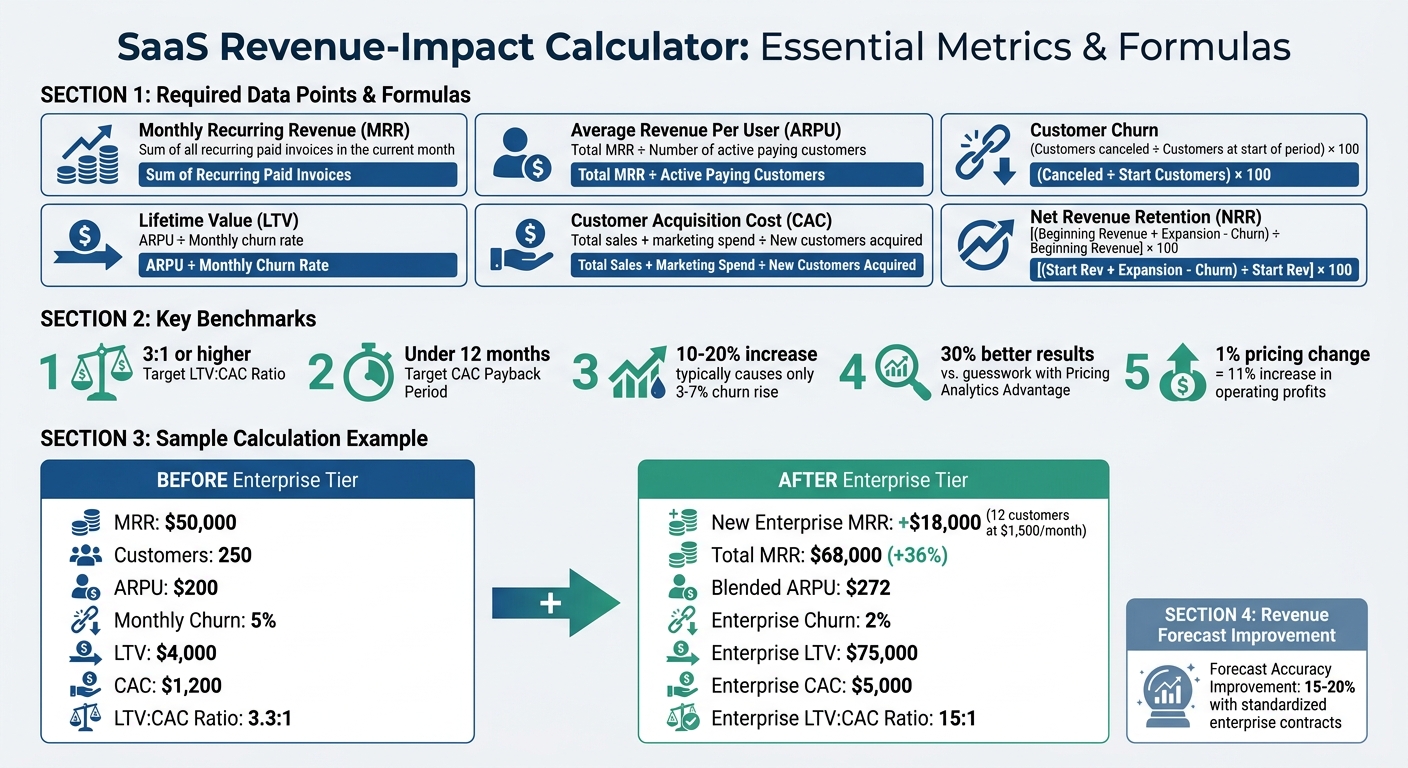
Once you've confirmed there's enterprise demand, the next step is figuring out the potential financial benefits. A revenue-impact calculator helps you model the effects of adding an enterprise tier, giving you clear, data-driven insights.
Data You'll Need
To measure how much an enterprise tier could increase your revenue, you need to start with a solid understanding of your key performance metrics. Collect these baseline numbers from your current business to ensure accurate projections.
- Monthly Recurring Revenue (MRR): Total of all recurring paid invoices for the current month [4].
- Average Revenue Per User (ARPU): Divide your total MRR by the number of active paying customers [4][8].
- Customer Churn Rate: Calculate by dividing the number of customers who canceled during a period by the number of customers at the start of that period, then multiply by 100 [4].
- Customer Lifetime Value (LTV): Use the formula ARPU ÷ monthly churn rate [4].
- Customer Acquisition Cost (CAC): Total sales and marketing spend divided by the number of new customers acquired [4]. Note that CAC for enterprise customers is typically higher due to longer sales cycles and more complex deals.
- Average Contract Value (ACV): Projected value of contracts for your planned enterprise tier.
- Net Revenue Retention (NRR): Use the formula [(Beginning Revenue + Expansion - Churn) ÷ Beginning Revenue] × 100 [8].
| Required Data Point | Formula |
|---|---|
| Current MRR | Sum of all recurring paid invoices in the current month |
| ARPU | Total MRR ÷ Number of active paying customers |
| Customer Churn | (Customers canceled ÷ Customers at start of period) × 100 |
| LTV | ARPU ÷ Monthly churn rate |
| CAC | Total sales + marketing spend ÷ New customers acquired |
| Net Revenue Retention | [(Beginning Revenue + Expansion - Churn) ÷ Beginning Revenue] × 100 |
With these metrics, you can effectively assess how introducing an enterprise tier impacts your revenue projections.
Reading Your Revenue Projections
The calculator compares your current revenue to scenarios that include an enterprise tier. One critical metric to monitor is your LTV:CAC ratio, which should ideally stay at 3:1 or higher for a healthy SaaS business [4]. This means if you spend $200 to acquire a customer, their lifetime value should be at least $600.
Pay attention to your CAC payback period - how long it takes to recover customer acquisition costs. Aim for a payback period of under 12 months [4][8]. For instance, if your enterprise tier is priced at $199/month with a CAC of $800, you'll need to maintain a monthly churn rate below 8.3% to keep that 3:1 ratio [4].
The calculator also highlights price elasticity - whether increasing ARPU offsets potential churn. Research shows that a 10%-20% price increase typically causes only a 3%-7% churn rise, leading to net revenue gains [4]. Companies that use pricing analytics often see 30% better results compared to those relying on guesswork [8].
Sample Calculation
Let’s break this down with an example. Imagine a SaaS company with $50,000 in MRR, 250 customers, and a 5% monthly churn rate. Their ARPU is $200 ($50,000 ÷ 250), giving them an LTV of $4,000 ($200 ÷ 0.05). With a CAC of $1,200, their LTV:CAC ratio is 3.3:1 - not bad, but there’s room for improvement.
Now, they introduce an enterprise tier priced at $1,500/month, targeting their top 20 customers. If 12 customers (a 60% conversion rate) upgrade, that adds $18,000 in new MRR. This pushes their blended ARPU to about $272. If enterprise churn drops to 2% monthly (common for larger contracts), these customers now deliver an LTV of $75,000 each.
With an enterprise CAC of $5,000, the LTV:CAC ratio for this segment skyrockets to 15:1. Overall, the company’s MRR increases by 36%, reaching $68,000. Additionally, the predictability of standardized enterprise contracts can improve revenue forecast accuracy by 15%-20% [2].
Designing Your Enterprise Pricing Tier
Once you've confirmed the revenue potential, the next step is crafting a pricing tier that meets enterprise-level demands while driving growth. The goal is to deliver clear value that justifies premium pricing.
What to Include in Enterprise Tiers
Enterprise customers have specific expectations when it comes to infrastructure, security, and service. They need features such as SSO/SAML, advanced role-based permissions, and audit logging to meet their compliance and operational standards [1]. For those with heightened security needs, options like dedicated infrastructure or single-tenant deployments are often non-negotiable.
On the service side, enterprise clients expect white-glove treatment. This includes dedicated Customer Success Managers (CSMs), fast-tracked support with tight response times, and quarterly business reviews [1]. Additionally, they often require custom legal agreements, extended payment terms (like net-60 or net-90), and sandbox environments to test the solution thoroughly [1][3].
Customization is another major priority. A whopping 78% of enterprise SaaS buyers view customization as a key factor when choosing a vendor [9]. Companies that offer tailored solutions can command 40-60% higher average contract values compared to those sticking to rigid tier-based models [9].
Pricing Models for Enterprise Customers
Your pricing model plays a big role in determining how revenue scales. Here are some common approaches:
- Pure per-seat pricing: Ideal for tools like CRMs or collaboration platforms, this model scales with headcount. However, it has a ceiling once all seats are filled [5].
- Usage-based pricing: Suited for data platforms or APIs, this model grows as customers use more features. But it can lead to unpredictable billing, which finance teams often dislike [5].
- Hybrid pricing: A mix of fixed fees and usage-based components. This model is gaining traction, with companies using it seeing a median revenue growth rate of 21%, outperforming pure subscription or usage-based models [5][10]. By 2025, 85% of SaaS leaders are expected to adopt either usage-based or hybrid pricing [5].
"Our Enterprise tier provides 80% standardization with modular add-ons for specific enterprise requirements... This approach has doubled our enterprise customer base." - Yamini Rangan, CEO of HubSpot [9]
Another option is value-based pricing, which ties fees to measurable business outcomes. This method can boost Annual Contract Value (ACV) by 15-25% on enterprise deals [10]. However, it requires clear, auditable metrics to track results. For reference, the median ACV for customers with 1,000+ seats is approximately $890,000 [10], underscoring the importance of choosing the right pricing model.
While these models can open up new revenue streams, they also come with operational complexities that need careful management.
Tradeoffs of Enterprise Pricing
Enterprise pricing offers clear benefits: higher revenue per customer, larger contracts, and better retention rates (enterprise accounts often achieve net revenue retention of 120-130% [1]). But it’s not without challenges. The sales cycles are lengthy, averaging 6-9 months, and involve 7-10+ stakeholders, including procurement, legal, IT security, and executives [6][3].
| Metric | Standardized Approach | Custom Approach |
|---|---|---|
| Average Sales Cycle | 45-60 days | 75-120 days |
| Win Rate (Qualified) | 25-35% | 30-40% |
| Average Deal Size | Lower but predictable | 20-40% higher |
| Implementation Success | 85-90% | 70-80% |
| Sales Rep Ramp Time | 3-4 months | 6-9 months |
Highly customized enterprise offerings require significant investment. SaaS companies with such offerings typically allocate 20-25% of ARR to customer success resources, compared to 12-15% for standardized offerings [9]. To manage these costs, set clear thresholds: for example, only offer custom quotes for deals exceeding $100,000 [2].
Tools like Configure, Price, Quote (CPQ) systems can help enforce discount limits and protect margins [2]. A good rule of thumb is to aim for 80% of deals to fit standard tiers, reserving custom quotes for high-value strategic accounts [2]. Striking the right balance is key to making enterprise pricing a driver of growth for your SaaS business.
Revenue Impact from Enterprise Pricing
Expected Revenue Increases
Getting enterprise pricing right can lead to impressive revenue growth. Take the example of a mid-market manufacturing SaaS company that, in December 2025, experimented with its pricing for 90 days. They shifted from a rigid three-tier model to a four-tier hybrid structure that included usage-based elements. The result? A $2 million boost in ARR - a 25% jump in just one quarter. On top of that, their new customer ACV increased by 35% [11].
Another case comes from a B2B marketing automation firm in September 2025. They moved away from a flat per-user pricing model and introduced a tiered "Good, Better, Best" hybrid structure. Over the next year, their ARR climbed from $8 million to $11.2 million - a 40% increase. But the benefits didn’t stop there: monthly churn dropped from 3.5% to 2.6%, average revenue per user went up from $125 to $155, and their sales cycle shrank from 68 days to 52 days [13].
What these examples show is that moving away from rigid pricing structures can unlock substantial growth. Even small pricing improvements can make a big difference - just a 1% change in pricing can lead to an 11% increase in operating profits for SaaS companies [12]. That said, achieving these results requires careful execution and avoiding common pitfalls.
Common Mistakes to Avoid
While the potential upside is clear, certain missteps can derail the effectiveness of enterprise pricing strategies. One frequent mistake is over-customizing deals under $50,000. The extra effort often doesn’t pay off, leading to delays in implementation and shrinking margins [2]. On the flip side, being too rigid with pricing can hurt win rates on larger deals. A better approach is to create standardized enterprise tiers that cover about 80% of deals, while reserving custom quotes for strategic accounts or deals over $100,000 [2].
Another issue is feature sprawl - turning the enterprise tier into a catch-all for every request from large prospects. This not only strains engineering resources but also risks confusing mid-tier customers [1].
Resistance from the sales team can also be a hurdle. Without proper training and tools, sales reps may view new pricing models as overly complicated and stick to what they know. A VP of Revenue from a manufacturing SaaS company shared this challenge:
"Our AEs were terrified... The most common objection was: 'This is too complicated. Customers want simple pricing'" [11].
To address this, companies need to equip their sales teams with the right resources, like ROI calculators, value-focused battle cards, and targeted training. These tools help shift the conversation from pricing to the value customers can achieve [11][14]. Lastly, without automated billing systems, businesses risk undercharging by as much as 8% annually due to errors in metering and missed overage charges [5].
Conclusion
Main Takeaways
Enterprise pricing isn't a universal solution - it works when your product is prepared for the demands of larger clients. This means having features like SSO/SAML authentication, SOC 2 Type II compliance, and the ability to manage usage at least 10 times greater than your largest customer. Key indicators that your SaaS might be ready for an enterprise tier include organic deals in the $25,000–$30,000 range or prospects asking for security questionnaires and custom MSAs.
Before diving in, crunch the numbers. A revenue-impact calculator can replace guesswork with solid data, helping you understand how an enterprise tier will affect your unit economics. Use metrics like ARPU, churn, LTV, and CAC to determine whether the higher costs of acquiring enterprise customers are sustainable. Remember to aim for at least a 3:1 LTV:CAC ratio while managing the complexities of serving larger accounts [4][8].
The potential upside is hard to ignore. Companies with strong enterprise pricing strategies often achieve 15–30% faster revenue growth compared to those using rigid models [3]. Even a small pricing improvement - just 1% - can lead to an 11% boost in operating profits [8]. But these results require careful planning. Analyze your customer base, create pricing tiers that cover the majority of deals, and set clear boundaries to avoid over-customization [2].
What to Do Next
Now that you have a clearer picture, it’s time to act. Start by auditing your last 50 deals. If fewer than 70% align with your current pricing tiers, it’s a sign that adjustments are needed [2]. Use your revenue-impact calculator to test how changes in ARPU or churn might justify an enterprise tier.
If the numbers look good and your product is ready, design an enterprise tier with distinct value propositions. Prioritize features like advanced permissions, dedicated infrastructure, and enhanced security, but avoid overloading the package. Equip your sales team with tools like ROI calculators and value-driven materials, and train them to shift conversations from price to outcomes. With these steps, you’ll be in a strong position to decide if enterprise pricing is the right growth strategy for your business.
FAQs
How do I know enterprise pricing won’t hurt my mid-market sales?
To ensure enterprise pricing doesn't interfere with mid-market sales, it's crucial to address the unique needs of each customer group. A smart approach is to use a hybrid pricing model: offer standardized, scalable tiers for mid-market clients while providing tailored options for enterprise customers.
Incorporating behavioral pricing tactics, such as anchoring, can also help. For example, presenting enterprise pricing alongside mid-market plans can make the latter appear more accessible and appealing.
By carefully segmenting your offerings and aligning pricing strategies with the specific requirements of each audience, you can successfully expand both markets without risking overlap or competition between them.
What’s the minimum enterprise readiness checklist for my product and team?
Getting ready to serve large, complex customers requires a solid foundation in organizational, technical, and process capabilities. Here's what you need to focus on:
- Know your market: Understand the unique challenges and requirements of enterprise clients.
- Flexible pricing: Offer pricing options that cater to enterprise needs, including the ability to handle custom quotes and contracts.
- Scalable product: Ensure your product can grow with your clients, supports integrations with other tools, and allows for customization.
- Strong processes: Build systems for managing long-term relationships, strategic pricing, and multi-year agreements.
- Prove ROI: Be ready to demonstrate the return on investment your enterprise clients can expect.
These elements are crucial for positioning your business to meet the demands of enterprise customers effectively.
Which enterprise pricing model fits my SaaS best (seat, usage, hybrid, or value-based)?
The best enterprise pricing model depends on how your customers interact with your product and the benefits they derive from it. A hybrid approach often strikes the right balance, blending per-seat, usage-based, or tiered pricing to cater to different requirements. If the value of your product grows with the number of users, a per-seat model offers predictability. On the other hand, for products with fluctuating usage, a usage-based model ties revenue directly to the value customers receive. Many SaaS companies combine fixed fees with consumption-based charges to provide flexibility while supporting growth.
Related reading
- Zuora vs Stripe vs Orb (2026): Usage-Based Billing for SaaS
- Usage-Based Pricing for SaaS: When It Works and When It Backfires
- what pricing models should i expect from ai-driven bi platforms that track real-time product metrics?
- How to Price Your SaaS Product When You Have No Competitor Data
- SaaS Growth Model Spreadsheet Template (Free): MRR, Churn, CAC & LTV
Useful tools & services
Locate the constraint in your funnel
Map the transitions so you can choose the next investigation or improvement.
Use the funnel templateNeed help choosing the next change? Explore CRO consulting.
Keep improving your conversion work.
Subscribe for practical ideas on diagnosing conversion problems, planning experiments, and choosing your next improvement.
No spam. Unsubscribe anytime.