Customer Retention Cost vs Acquisition Cost: Industry Benchmarks for 2026
2026 SaaS benchmarks: avg CAC $1,200 vs CRC $35, retention 5–10x cheaper, LTV:CAC targets, and when to shift focus from acquisition to retention.
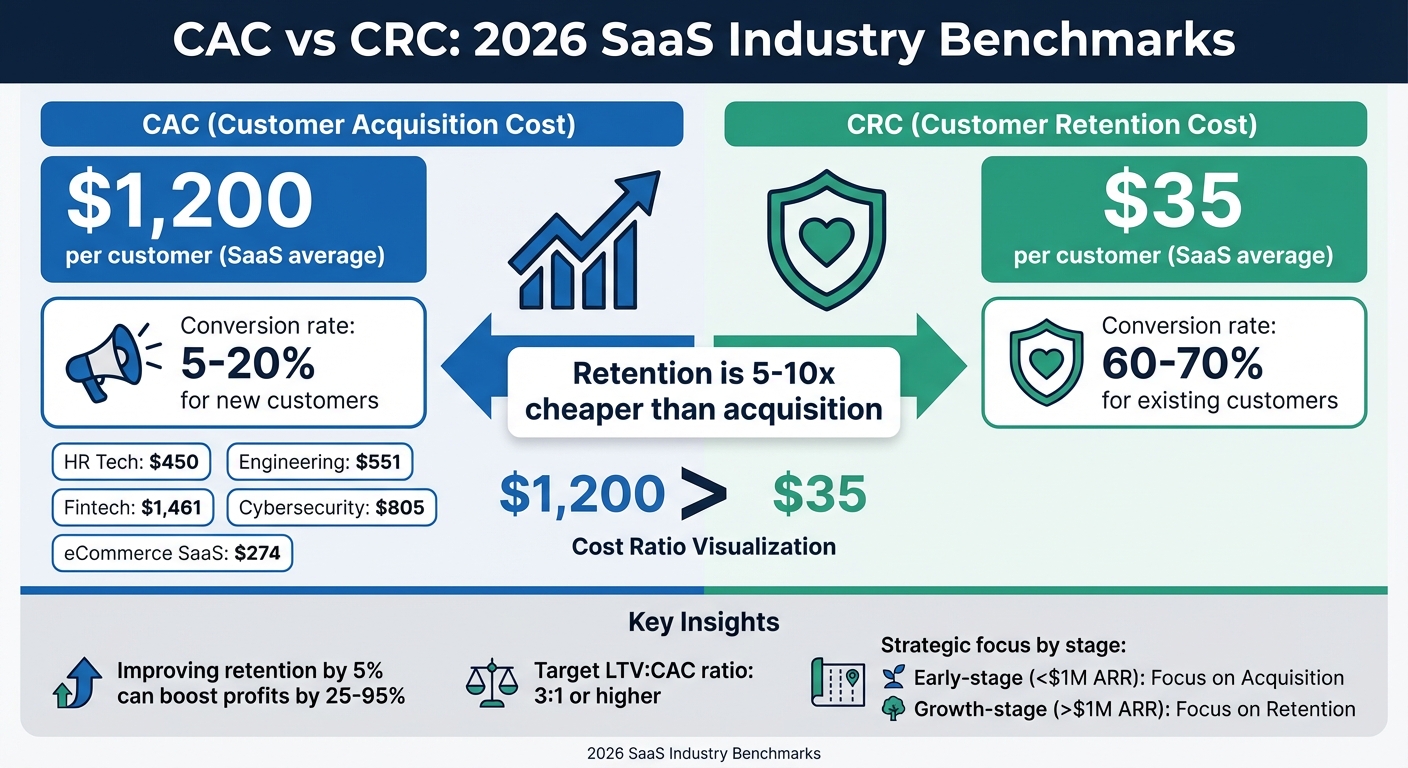
In 2026, SaaS companies face rising costs for both acquiring and retaining customers. Customer Acquisition Cost (CAC) has climbed significantly, averaging $1,200 per new customer, while Customer Retention Cost (CRC) is much lower, at $35 per customer for SaaS. Retaining customers is 5–10 times cheaper than acquiring new ones, and improving retention by just 5% can boost profits by 25–95%.
The key takeaway? Prioritize retention after achieving product-market fit, as existing customers are 60–70% more likely to convert compared to 5–20% for new prospects. However, early-stage companies (under $1M ARR) should focus on acquisition to grow their customer base. Balancing CAC and CRC is crucial for long-term profitability, with a target LTV:CAC ratio of 3:1 or higher.
| Metric | CAC | CRC |
|---|---|---|
| Average Cost (SaaS) | $1,200 per customer | $35 per customer |
| Conversion Rates | 5–20% for new customers | 60–70% for existing |
| Focus By Stage | Early-stage: Acquisition | Growth-stage: Retention |
Both metrics are essential, but the shift from acquisition to retention is what ensures sustainable growth.
Do You Have Balance Between CAC Payback and Retention? | SaaS Metrics School | CAC and GRR
1. Customer Retention Cost (CRC)
Customer Retention Cost (CRC) represents the total expense a business incurs to keep its customers engaged and loyal, while also working to reduce churn. This includes costs like salaries for customer success and support teams, CRM systems, engagement tools (like chatbots), dunning management software, and customer education initiatives [8]. The formula to calculate CRC is:
CRC = Total Retention Cost ÷ Number of Active Customers [8].
Calculating CRC accurately can be tricky. Many companies focus only on direct support costs, but a more comprehensive CRC should include all roles and tools contributing to customer support [5]. Some experts suggest using only the number of retained customers in the denominator for a more precise, time-specific efficiency metric [8].
Cost per Customer
As of 2026, SaaS companies spend about $35 per customer on retention compared to $500 per customer for acquisition - a staggering 17:1 ratio in telecommunications and around 6:1 in e-commerce [8]. Retention costs in professional services can range between $100 and $500 per customer, depending on the level of personalized support provided [1]. These cost differences highlight how retention strategies significantly affect profitability, as seen in the LTV:CAC (Lifetime Value to Customer Acquisition Cost) ratio.
Impact on LTV:CAC Ratios
Retention plays a major role in boosting the lifetime value (LTV) component of the LTV:CAC ratio, ultimately making acquisition efforts more profitable over time [8]. A strong SaaS business aims for an LTV:CAC ratio between 3:1 and 4:1 [10]. Improving retention not only strengthens LTV but also creates a compounding effect on profitability. Additionally, existing customers are 50% more likely to try new products and tend to spend 31% more than new customers, showing how reducing CRC can lead to higher revenue per customer [8].
2026 Industry Trends
In 2026, AI-driven personalization has become a game-changer for customer retention. 66% of customer service leaders now use Generative AI to tailor interactions and reduce churn, with 62% of business leaders reporting measurable improvements in retention rates [1]. Companies leveraging predictive analytics to anticipate churn are experiencing up to a 2.9x revenue increase [1]. Emotional loyalty - where customer attachment goes beyond discounts or rewards - has grown by 26% since 2021, now making up 34% of loyal customers [9]. Additionally, by 2026, half of organizations have adopted centralized SaaS management to better track usage and retention metrics [1].
2. Customer Acquisition Cost (CAC)
Customer Acquisition Cost (CAC) calculates the total expense associated with turning a prospect into a paying customer. This includes spending on marketing, sales team salaries, advertising, and sales resources. The formula is straightforward: CAC = Total Sales and Marketing Costs ÷ New Customers Acquired [12].
But getting an accurate CAC figure isn't as simple as plugging in numbers. Companies need to break it down by channel - organic search, for example, averages $205, while paid channels can jump to $341 [12]. Timing also matters. Your calculation period should align with your sales cycle, which has grown to 134 days in 2026, compared to 107 days in early 2022 [10]. A single, blended CAC figure often hides inefficiencies, making it harder to see which channels are performing well and which are wasting resources.
Cost per Customer
In 2026, the average B2B SaaS company spends about $1,200 to acquire a new customer [4][10]. That’s a 222% increase over the last eight years [10][13]. The gap between top-performing and struggling companies is stark: high performers spend $1.00 to generate $1.00 of Annual Recurring Revenue (ARR), while less efficient companies spend $2.82 for the same result [10][13].
"Customer acquisition cost has become the defining metric separating sustainable B2B SaaS companies from those burning through capital." - GTM 80/20 Marketing Team [10]
The acquisition channel you choose plays a huge role in your costs. Referral programs are the most affordable, with CAC averaging $150, while LinkedIn ads can skyrocket past $2,000 [4]. Companies using AI for acquisition have reported up to a 50% reduction in CAC, thanks to personalization and automation [10][13]. Regional differences also matter: acquiring a mobile user in North America costs around $5.28, compared to $0.50 to $2.00 in Latin America for similar goals [13].
| B2B SaaS Segment | Average CAC | Target Payback Period | LTV:CAC Benchmark |
|---|---|---|---|
| HR Tech | $450 | 8-12 months | 3.5:1 |
| Engineering | $551 | 9-14 months | 4.2:1 |
| Fintech | $1,461 | 18-24 months | 3.8:1 |
| Cybersecurity | $805 | 12-18 months | 5:1 |
| eCommerce SaaS | $274 | 6-10 months | 4.5:1 |
Source: Data compiled from SaaS Hero and GTM 80/20 benchmarks [10][4][14].
While understanding CAC is essential, the speed at which you recover these costs is equally important.
Payback Period
The CAC payback period shows how long it takes to earn back what you spent to acquire a customer. For 2026, the best small-to-medium businesses aim for a payback period under 12 months. Mid-market companies target 14–18 months, while enterprises aim for 18–24 months [12][4]. If your payback period exceeds 24 months, it can create cash flow issues that scare off investors.
A standout example is HR Tech platform TestGorilla, which achieved an impressive 80-day payback period while scaling to over 5,000 customers. They accomplished this by improving landing page conversions by 40% and leveraging competitor targeting strategies. This efficiency helped secure their $70M Series A funding [6][4].
Impact on LTV:CAC Ratios
The LTV:CAC ratio is a key benchmark for financial health, especially as the focus has shifted from "growth-at-all-costs" to sustainable growth [10][4]. A 3:1 ratio is the baseline for viability - meaning every customer generates three times the cost it took to acquire them. Companies that reach 4:1 or higher show they’re ready to scale [6][10][13].
"A 3:1 ratio represents the minimum threshold for sustainable growth, while 4:1 or higher indicates scale-ready unit economics." - Aaron Rovner, Strategy, SaaS Hero [6]
The median SaaS company now spends $2.00 on sales and marketing for every $1.00 of new ARR, a 14% increase compared to last year [12][10]. Rising digital ad costs (Google CPC is up 164%) make the LTV:CAC ratio even more critical to ensure acquisition efforts remain profitable [10][4].
This discussion ties directly to retention strategies, emphasizing that both efficient acquisition and long-term customer value are essential for profitability.
2026 Industry Trends
The buyer’s journey has evolved significantly. In 2026, the average B2B customer takes 211 days and requires 76 touches before making a purchase [3]. Most of this research happens online, with prospects spending less than 20% of their buying time interacting with vendors [15]. This shift has forced companies to rethink how they approach acquisition.
"In 2026, the question has evolved... How efficiently can we grow, and how defensible is that growth?" - Chad de Lisle, Division Lead, Disruptive Advertising [15]
AI has advanced from being a helpful tool to managing entire workflows autonomously. As a result, marketing technology usage dropped to 33% in 2024, with companies consolidating tools instead of adding more [10][13]. Rising digital ad costs (up 5.13% across the board) have pushed budgets toward content, SEO, and community-driven growth strategies [12][10]. Many companies are also turning to ecosystem-led growth - building pipelines through technology partnerships and integrations that bring in high-intent leads at lower acquisition costs [15].
Data quality has emerged as a hidden factor driving up CAC. A 20-40% email bounce rate wastes time and resources, inflating costs without anyone noticing [12]. Fixing outbound data to reduce bounce rates below 3% not only protects domain reputations but also boosts conversion efficiency.
Pros and Cons
Deciding how to balance Customer Retention Cost (CRC) and Customer Acquisition Cost (CAC) benchmarks depends heavily on where your business stands. For early-stage companies with less than $1M in Annual Recurring Revenue (ARR), the focus should lean heavily on CAC to grow a customer base and validate product-market fit [7]. As businesses scale, the dynamics shift significantly. Existing customers boast conversion rates of 60–70%, compared to just 5–20% for new prospects [7]. This stark contrast highlights when it’s time to rethink your spending priorities.
A common challenge for many SaaS companies is recognizing when retention becomes more profitable than acquisition. Nick Fogle, Founder & CEO of Churnkey, shares a cautionary tale:
"Take Wavve. We were crushing it: 30% month-over-month growth in year one. Then we looked at churn: 12% monthly. That's a growth ceiling so low you can hit your head on it." [7]
With the average SaaS company experiencing an annual churn rate of 38% [7] and a median CAC ratio of $2.00 spent for every $1.00 in new ARR [11], failing to prioritize retention can severely hinder growth.
For businesses generating between $1M and $5M ARR, shifting budgets toward retention infrastructure before churn spirals out of control is a smart move [7]. One of the most impactful retention strategies is implementing automated dunning and payment recovery tools, which can address the 8% involuntary churn caused by failed payments [7]. Companies like Snyk have seen firsthand how retention investments pay off - reducing their email bounce rate from 35–40% to under 5%, resulting in a 180% increase in Account Executive-sourced pipeline and a lower outbound CAC [11].
| Dimension | Customer Acquisition Cost (CAC) | Customer Retention Cost (CRC) |
|---|---|---|
| Conversion Rate | 5–20% [7] | 60–70% [7] |
| Scalability | High; essential for entering new markets [7] | Limited; capped by the size of the existing base [7] |
| Primary Focus | Market share and new user volume [2] | Lifetime value (LTV) and profitability [2] |
| Best For | Early-stage (under $1M ARR) [7] | Growth-stage ($1M–$5M+ ARR) [7] |
These benchmarks illustrate the strategic trade-offs between acquisition and retention. By carefully evaluating these dimensions, businesses can refine their strategies to maximize customer lifetime value. Measuring CAC and CRC accurately - and reallocating budgets when retention offers better returns - is key to scaling successfully. Considering that SaaS companies often spend $2.00 to acquire every $1.00 in new ARR, while existing customers convert at much higher rates, the argument for prioritizing retention becomes hard to ignore.
Conclusion
The numbers paint a clear picture: it's far cheaper to keep a customer than to find a new one - anywhere from five to ten times cheaper, in fact [7]. With the average B2B SaaS Customer Acquisition Cost (CAC) expected to hit $1,200 by 2026 [4], and conversion rates for existing customers sitting at a healthy 60–70% compared to just 5–20% for new prospects [1], focusing on retention becomes a no-brainer once you've nailed your product-market fit.
That said, priorities shift as your business grows. For companies under $1M in Annual Recurring Revenue (ARR), acquisition is king - it’s all about building a customer base and proving your market [7]. But once you cross that $1M ARR milestone, retention takes center stage. This is especially critical when you consider that 75% of software companies saw their Net Revenue Retention decline in 2024, even as they poured more money into post-sales efforts [13]. As Aaron Rovner from SaaSHero aptly puts it, "The 2026 B2B SaaS landscape rewards teams that treat CAC as a core constraint, not a side metric" [4].
Your LTV:CAC ratio is another key indicator. If it’s below 3:1, your business model could be in trouble [19,20]. And don’t underestimate the impact of small changes - boosting customer retention by just 5% can drive profit increases of 25% to 95% [1]. Considering that Google Ads CPC has surged by 164% and LinkedIn costs have jumped 89% between 2019 and 2026 [4], the days of cheap customer acquisition are long gone.
The real winners in 2026 aren’t choosing between acquisition and retention - they’re evolving their strategies. Early on, it’s all about aggressive customer acquisition. But as you grow, shifting focus to retention is what lays the groundwork for long-term SaaS success.
FAQs
What costs should I include in CRC?
To figure out Customer Retention Cost (CRC), you need to account for all the expenses related to keeping your customers engaged and reducing churn. These expenses might include loyalty programs, customer success efforts, communication campaigns, and any tools or software used to support retention.
Here's how you calculate it: add up all these costs - covering staff salaries, technology, and marketing efforts. Then, divide the total by the number of active customers. This gives you the average cost per customer, offering a clearer picture of what you're spending to maintain customer loyalty.
How do I calculate CAC by channel?
To figure out the Customer Acquisition Cost (CAC) for a specific channel, you simply divide the total expenses tied to that channel by the number of new customers it brought in. Here’s how to break it down:
- Add up all related expenses: This includes everything spent on marketing and sales for that channel, such as ad costs, salaries, and tools.
- Count the new customers: Determine how many customers were acquired through that channel during the period you're analyzing.
- Apply the formula:
CAC = Total Costs ÷ Number of New Customers
This calculation gives you a clear view of how much you’re spending to acquire each customer through a specific channel, helping you assess and improve its performance.
When should I shift budget from CAC to retention?
When your business has built a stable customer base and the cost of acquiring new customers (CAC) starts to outweigh the benefits, it’s time to rethink your budget. If your CAC climbs significantly, your LTV:CAC ratio dips below 3:1, or your churn rate begins to rise, shifting focus to retention could be a smarter move.
Retention strategies often provide a stronger return on investment (ROI) and drive long-term growth, especially when acquiring new customers becomes less efficient or cost-effective. By prioritizing retention, you can maximize the value of your existing customers while reducing the pressure on acquisition efforts.
Related reading
- How your acquisition strategy influences your conversion rate
- How to A/B test pricing as a boostrapped company
- Upsell vs. Cross-Sell Metrics: Key Differences
- Digital Marketing Services
- What Is Strategy Consulting? (And when to hire a consultant to do it for you)
Useful tools & services
Turn the idea into a growth decision
Define the audience, constraint, owner, and success check in a practical plan.
Use the growth strategy templateNeed help choosing the next change? Explore CRO consulting.
Keep improving your conversion work.
Subscribe for practical ideas on diagnosing conversion problems, planning experiments, and choosing your next improvement.
No spam. Unsubscribe anytime.