The $500K-$5M SaaS Pricing Mistake: Why Underpricing Kills Growth Faster Than Churn
How underpricing stunts SaaS growth—lowers ARPU, attracts high-support customers, lengthens CAC payback; adopt value-based pricing.
Underpricing is one of the biggest mistakes SaaS founders make. It can stifle growth, attract the wrong customers, and limit your ability to scale - even more than churn. Here's why it matters and how to fix it:
- Low prices hurt revenue and growth. Pricing too low leaves money on the table and can cost millions in lost value over time.
- Cheap pricing attracts low-value customers. These customers churn faster, demand more support, and bring in less revenue.
- Underpricing delays profitability. It extends the time it takes to recover customer acquisition costs (CAC), limiting funds for growth.
- Pricing impacts perception. Enterprise buyers often associate low prices with low quality, making it harder to move upmarket.
The solution? Value-based pricing. Charge based on the value your product delivers, not just costs or competition. Test pricing regularly, update it annually, and communicate changes clearly to customers.
Pricing isn’t just about revenue - it’s about positioning your business for long-term success.
The SaaS Pricing Strategy Mistake Costing You 6 Figures | Mike Moll
The Real Cost of Underpricing: Worse Than Churn
How Underpricing Brings in Low-Value Customers
Setting prices too low doesn’t just hurt your revenue - it attracts the wrong type of customers. When you focus on bargain pricing, you’re essentially inviting people who care more about saving money than solving their actual problems [3].
These cost-conscious customers often turn out to be the most challenging. They demand more attention, complain about minor issues, and churn faster than other customers. For example, a customer paying $10/month who churns after three months only brings in $30, while a $100/month customer who sticks around for two years generates $2,400 - a staggering 80x difference in lifetime value [3].
What’s more, low-price customers tend to need extra support. They’re often less experienced, less forgiving of product flaws, and less committed to making your solution work for them [3]. This means your team spends more time troubleshooting for customers who contribute very little revenue, leaving fewer resources to focus on growth.
Next, let’s look at how low pricing can hold back your ability to scale.
Why Low Pricing Limits Scalability
Beyond the immediate financial hit, underpricing slows down your growth by extending the time it takes to recover your Customer Acquisition Cost (CAC). The longer it takes to break even on a customer, the less capital you have to reinvest in areas like marketing or product development [2].
Without flexible pricing models - like usage-based or seat-based tiers - you miss out on expansion opportunities as your customers grow. This prevents you from achieving "negative revenue churn", where revenue from existing customers grows faster than losses from churn [6]. In fact, companies with usage-based pricing models grow 32% faster than those sticking to flat pricing [7].
Underpricing doesn’t just affect your bottom line - it can also hurt your brand perception. Enterprise buyers often associate low prices with low quality, making it harder to move upmarket when the time comes [6]. And the numbers don’t lie: a 20% underpricing gap can cost you between $12 million and $16 million in lost enterprise value over five years [2].
Underpricing vs. Churn: A Direct Comparison
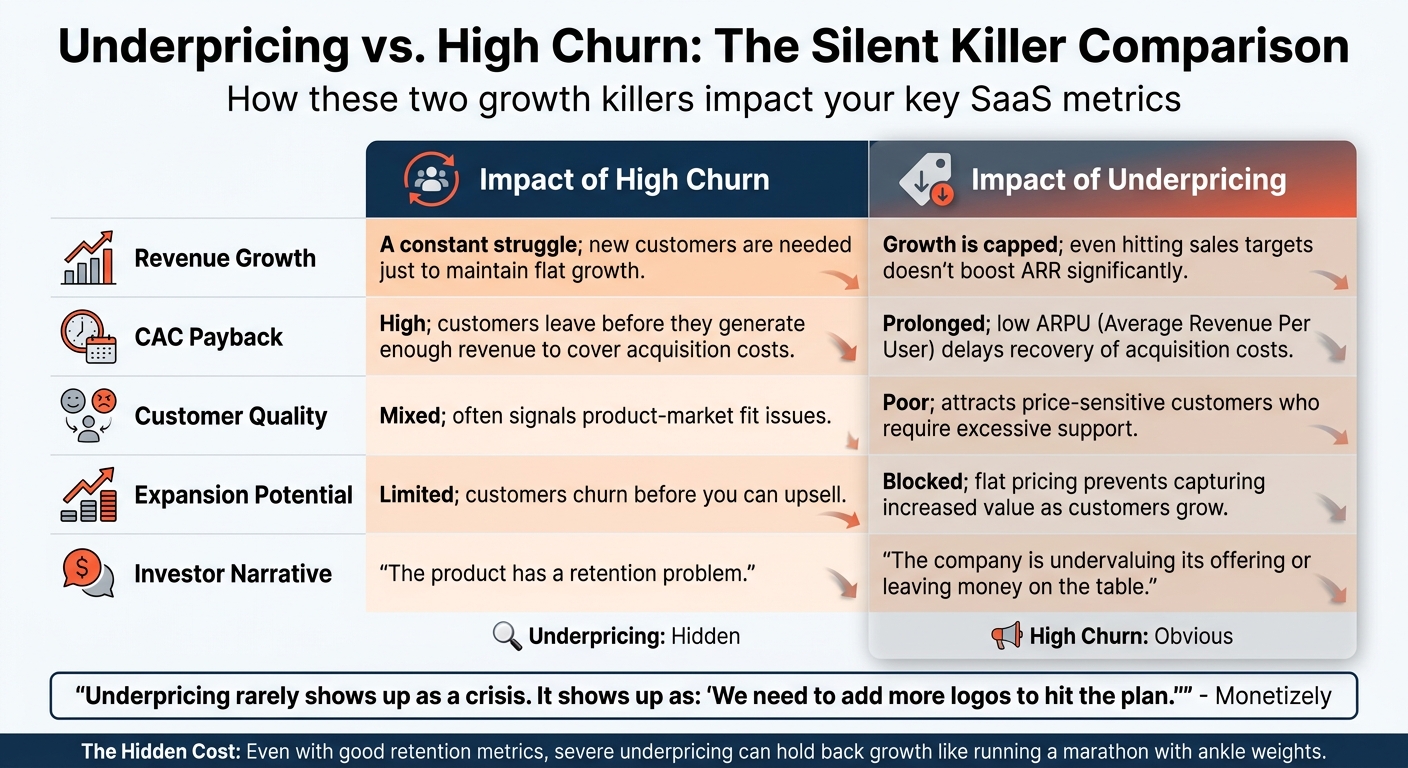
Churn tends to grab attention because it’s obvious - logos disappear, and dashboards light up in warning. Underpricing, however, is a silent killer. It quietly stunts your growth while everyone celebrates high conversion rates [2].
The differences between the two become clear when you compare their impacts on key business metrics:
| Metric | Impact of High Churn | Impact of Underpricing |
|---|---|---|
| Revenue Growth | A constant struggle; new customers are needed just to maintain flat growth. | Growth is capped; even hitting sales targets doesn’t boost ARR significantly. |
| CAC Payback | High; customers leave before they generate enough revenue to cover acquisition costs. | Prolonged; low ARPU (Average Revenue Per User) delays recovery of acquisition costs. |
| Customer Quality | Mixed; often signals product-market fit issues. | Poor; attracts price-sensitive customers who require excessive support. |
| Expansion Potential | Limited; customers churn before you can upsell. | Blocked; flat pricing prevents capturing increased value as customers grow. |
| Investor Narrative | "The product has a retention problem." | "The company is undervaluing its offering or leaving money on the table." |
As Monetizely puts it:
"Underpricing rarely shows up as a crisis. It shows up as: 'We need to add more logos to hit the plan.'"
Here’s the kicker: even if your retention metrics look good, you could still be severely underpriced. Your unit economics might seem fine at first glance, but in reality, you’re holding yourself back - like running a marathon with hidden ankle weights.
Why SaaS Founders Underprice Their Products
Underpricing isn't just a random misstep - it’s often tied to a mix of fear, flawed pricing strategies, and competitive pressures. Let’s break down why SaaS founders frequently set prices too low and how these choices can hold them back.
Fear and Imposter Syndrome
Many founders lower their prices to avoid hearing "too expensive" from potential customers. Instead of treating price objections as normal market feedback, they see them as personal failures. This mindset is often rooted in imposter syndrome - founders doubt their product has enough features or delivers enough value to justify higher prices. They might also believe that a lower price can compensate for a lack of brand recognition. But here’s the kicker: early customers are usually more concerned with solving their problems than with finding the cheapest option.
The numbers back this up: 82% of early-stage startups price their products below what customers are willing to pay, with an average gap of 3.1x between the price charged and the price customers would accept [8][5]. This approach often attracts price-sensitive customers who require extra support and churn quickly, reinforcing the founder’s belief that higher pricing isn’t justified. It’s a vicious cycle, and it’s no wonder that 64% of failed startups cite pricing issues as a key reason for their failure [5].
The Pitfalls of Cost-Plus Pricing
Cost-plus pricing - where you add a margin to your costs instead of basing your price on customer value - can lead to severe underpricing. Despite being outdated, about 10% of SaaS companies still rely on this method, which often misrepresents the product's actual worth [4].
"The mistake is pricing based on what it costs you to build, not what it's worth to the customer. Your development costs are irrelevant. Your server costs are irrelevant."
Here’s the problem: SaaS products usually have very low marginal costs. For instance, a service that costs $2 to deliver might be priced at $10 using cost-plus pricing, even though it could save a customer $40 worth of time. This approach undervalues the product and leaves money on the table. Unsurprisingly, 68% of companies using cost-plus pricing regret not switching to value-based pricing sooner [5].
Competitive and Market Pressures
Even when founders recognize the benefits of value-based pricing, many fall into the trap of copying competitors. They assume their rivals have similar cost structures and customer needs, which isn’t always true. This strategy often leads to dissatisfaction: 85% of SaaS companies that rely on competitor-based pricing regret their decision within 18 months [9]. On the flip side, companies that use value-based pricing grow 38% faster [9].
"When you price like everyone else, you're telling the market there's nothing special about what you've built. That perception is nearly impossible to change later."
How to Fix Your Pricing for Growth
Underpricing can hold your business back, cutting into revenue and limiting growth. Adjusting your pricing to better reflect the value you provide can pave the way for business expansion. Here’s a compelling stat to consider: 96% of SaaS companies that adjusted their pricing saw faster growth, while only 4% experienced slower growth [14].
Moving to Value-Based Pricing
Value-based pricing focuses on charging customers based on the value your product delivers, rather than the cost of creating it. To implement this, start by conducting 15-20 customer interviews to understand the key problems your product solves [10]. Ask questions like, "What would happen if you didn’t have this tool?" or "How much time or money does this save you each month?"
Once you’ve gathered this feedback, translate the benefits into monetary terms. For instance, if your software saves a customer 10 hours a week and their team’s hourly rate is $50, that’s $2,000 in monthly labor savings. A common approach is to price your product at 10-20% of the total economic value you generate [10][12]. In this example, that would mean pricing your product between $200 and $400 per month.
"Value-based pricing ensures that your pricing scales with the value customers get from your product, which creates a fairer exchange and higher customer satisfaction."
- Kyle Poyar, Partner, OpenView Venture Partners [11]
Next, segment your customers based on their perceived value. For example, a small startup and a large enterprise will likely use your product differently and gain different levels of value. SaaS companies with strong segmentation models see 25% higher revenue growth compared to those without [10]. Design three pricing tiers - such as Starter, Professional, and Enterprise - that align with how each customer segment uses your product. Companies offering three or more tiers often see 30% higher growth rates compared to simpler pricing structures [10].
Once you’ve established value-based pricing, the next focus is selecting a metric that reflects customer outcomes.
Picking the Right Value Metric
Your value metric is what you charge for - whether it’s per user, per project, per transaction, or per active contact. Choose a metric that grows alongside the value your customers receive [13][15]. For example, if your product helps agencies manage client projects, charging per project makes sense. If it automates email outreach, charging per contact may be a better fit.
Be cautious about metrics that discourage success. For instance, charging per email sent could backfire if your product helps customers send fewer, more effective emails. That would unintentionally discourage usage. Notably, 39% of SaaS companies now use some form of usage-based pricing, up from 23% in 2019 [11], because it aligns customer success with revenue growth.
Start by calculating your price floor with this formula:
Minimum Price = (CAC × 3) / 12 [13].
This ensures you’re not losing money on every customer. To find your price ceiling, use willingness-to-pay surveys like the Van Westendorp Price Sensitivity Meter [10][13]. These tools help you identify a range to work within.
Once you’ve chosen a metric, validate your pricing model through careful testing.
Testing and Adjusting Your Pricing
When testing new pricing, focus exclusively on new customers. Use a 50/50 split A/B test over a minimum of 30 days [13]. The key metric to track isn’t just your free trial to paid conversion rate - it’s Revenue per Trial (conversion rate × price). A lower conversion rate at a higher price can still produce more revenue.
If your trial-to-paid conversion exceeds 20% or if customers show no price objections, it’s a sign you can increase prices by 15-25% [13][2]. Patrick McKenzie offers this blunt advice:
"Go with the highest number you're thinking of and probably double that. If customers buy with zero hesitation, your price is too low."
- Patrick McKenzie [14]
When raising prices, grandfather existing customers for 6-12 months [14][13][2]. This means applying the new pricing only to new signups while monitoring results. Influize successfully made this shift, moving from a flat $49 plan to three tiers ($29, $79, and $199). The results? ARPU increased by 38%, and churn dropped by 50% [14].
Creating a Long-Term Pricing System
Pricing isn’t a one-and-done decision - it’s a dynamic process. To keep your SaaS business growing, your pricing needs to reflect the value you deliver. Ignoring this can lead to underpricing, with companies often leaving 30% to 85% of potential revenue on the table [16]. The key? Establish a structured system for regular pricing reviews and updates to ensure your pricing evolves alongside your product.
Why You Need Annual Price Reviews
Your SaaS product doesn’t stay the same. Every new feature or integration adds more value for your customers. Yet, 80% of SaaS startups underprice their offerings by 30% to 60% [18]. This happens when companies set prices once and fail to revisit them.
Regular pricing reviews are a proven growth driver. Companies that review pricing annually experience 30% higher growth rates, while those conducting bi-annual reviews achieve 23% higher profit margins than those who don’t [16]. Even a small adjustment - just 1% - can result in an 11% boost in profits [16]. That’s more impactful than improving customer acquisition or retention by the same percentage.
During your annual pricing review, focus on these five areas:
- Product maturity: Compare your current features to the last review [2].
- Competitive landscape: Look at how competitors have shifted their pricing or positioning [16][17].
- Customer feedback and usage: Pay attention to objections during sales calls, comments like "this is a steal", or cases where heavy usage doesn’t align with your Average Revenue Per User (ARPU) [2].
- Win/loss data: If your win rate is above 50% and price rarely causes losses, you’re likely underpricing [2].
"Winning because you're better is good. Winning because you're obviously cheaper is a pricing problem, not a product edge."
- Monetizely [2]
Adopt a tiered review cadence to stay on top of pricing. Conduct light quarterly reviews to track metrics like conversion rates and Customer Acquisition Cost (CAC). Then, once a year, do a deeper dive to rethink your overall pricing strategy, ideal customer profile, and market trends [16].
How to Communicate Price Changes to Customers
Changing prices is one thing - getting your customers on board is another. Poor communication can lead to churn when prices increase. For a typical 20% to 30% price hike, churn rates usually range from 8% to 12% [18], but you can minimize this with clear, thoughtful communication.
Start by emphasizing the value you’re delivering. Highlight ROI, recent feature updates, and performance improvements before mentioning the price change [19][20]. Frame the adjustment around customer outcomes and your product roadmap - not your internal costs [2][21]. Transparency is key; explain the reasons behind the change, whether it’s enhanced security, better infrastructure, or expanded support [19].
Timing also matters. Give customers at least 90 days’ notice [2][21], though 30 days is the bare minimum [18]. This gives them time to adjust budgets and prevents any surprises during renewal [20][21]. To ease the transition, consider maintaining current pricing for existing customers temporarily before moving them to the new rates [2][18]. Companies that grandfather customers during price increases retain 20% more of those customers over the following year [16].
Make sure your teams are prepared. Equip Sales and Customer Success teams with scripts, FAQs, and objection-handling tools that tie the price increase to ROI [2]. When customers clearly see the value they’re getting, they’re more likely to accept the change.
Finally, track how your communication strategy performs to ensure the price adjustment achieves the intended results.
Metrics to Track Pricing Performance
To ensure your pricing strategy is on point, monitor these key metrics regularly. They’ll help you identify and fix underpricing before it becomes a problem.
- Average Revenue Per User (ARPU): If ARPU isn’t increasing as you add features, your pricing model may not reflect the value you’re delivering [21].
- Net Revenue Retention (NRR): This measures revenue growth from existing customers through upgrades and expansions. A strong pricing strategy should push NRR above 110% [2][21].
- CAC Payback Period: This tracks how long it takes to recoup acquisition costs. A payback period over 18 months, despite good retention, could signal underpricing [2][17].
- LTV:CAC Ratio: This compares customer lifetime value to acquisition costs. A ratio below 3:1 suggests pricing is too low to scale marketing effectively [21].
- Win Rate vs. Loss Reasons: A win rate above 50% with no "price too high" objections is a red flag for underpricing [2][17].
- Upgrade Rate: Ideally, 20–40% of customers should upgrade to higher tiers within a year. Lower rates may indicate insufficient tier differentiation [21].
- Churn from Price Changes: For customers affected by price increases, churn above 15% points to communication gaps or a mismatch in perceived value [21].
| Metric | Healthy Benchmark | Signal of Underpricing |
|---|---|---|
| Win Rate | 20–30% | >45–50% with zero price pushback [2] |
| CAC Payback | <12–14 months | >18–20 months despite high usage [2] |
| Upgrade Rate | 20–40% annually | <10% (tiers not differentiated) [21] |
| NRR | >110% | ~100% despite strong adoption [2] |
Review these metrics quarterly to stay proactive. They’ll give you a clear picture of whether your pricing strategy is driving growth - or holding it back. Adjust as needed to keep your pricing aligned with your goals.
Conclusion: Using Pricing to Drive Growth
Pricing isn't just about revenue - it directly impacts growth. Underpricing can attract low-value customers, mess up unit economics, and hold back scalability. Here's a striking fact: improving pricing by just 1% can lead to an 11-12.7% increase in profits. That’s four times more impactful than improving customer acquisition and twice as effective as enhancing retention [14].
Switching to value-based pricing can completely change your growth trajectory. Instead of competing on price, this approach allows you to capture 10-20% of the value you deliver, offering customers a 5x-10x return on investment while maintaining strong margins [14][3]. This strategy not only drives sustainable growth but also attracts customers who care about results, not just discounts. These types of buyers are less likely to churn and require less support. Companies leveraging value-based pricing enjoy 31% higher profit margins compared to those using cost-plus or competitor-based models [22].
"Your pricing is the exchange rate on the value you create." - Patrick Campbell, Founder, ProfitWell [22]
The numbers back it up: 96% of SaaS companies that updated their pricing saw faster growth [14]. Whether you're reviewing your pricing structure for the first time or finally raising prices after years of hesitation, the data is clear - taking action works. Start by analyzing win/loss data and customer feedback for 30 days, then test adjustments with new customers [2].
Pricing is one of the most powerful tools for driving sustainable growth. Use it wisely, revisit it often, and turn your business into a scalable, revenue-generating machine that builds momentum over time.
FAQs
How do I know if my SaaS is underpriced?
If customers are snapping up your product without hesitation, rarely asking for discounts, or frequently labeling it as "cheap", these could be red flags that your pricing is too low. To address this, start with a pricing audit. Dive into key metrics like win/loss data, customer willingness-to-pay, and expansion revenue to get a clearer picture of your pricing strategy's effectiveness.
Want to test the waters? Try raising prices for specific customer segments. If you see revenue climb without a noticeable spike in churn, it’s a strong indicator that your prices might not reflect the value you’re offering. Combine these insights with customer feedback to fine-tune your pricing strategy and ensure it supports long-term growth.
What value metric should I charge for?
The best way to determine your SaaS value metric is by understanding how your product creates value for its customers. Focus on metrics that directly reflect the benefits they receive - like usage, number of users, or measurable outcomes. For instance, if your product helps save time or increase revenue, pricing based on usage (like API calls) or user-based tiers can be a good fit. The key is to pick a metric that grows alongside the value your customers gain, making it easier to justify higher pricing as their needs expand.
How can I raise prices without losing customers?
To raise prices without driving customers away, take a gradual and thoughtful approach. Begin with small, controlled experiments - adjusting just one factor at a time, ideally targeting new users. Keep a close eye on key metrics like Average Revenue Per User (ARPU) and churn rates to measure the impact.
Equally important is how you communicate the change. Be upfront and emphasize the added value your customers will receive. Frame the price increase as a way to reflect enhanced features or improved services. By making changes incrementally and clearly explaining the benefits, you can maintain customer trust while increasing revenue and profitability.
Related reading
- When to Offer SaaS Discounts
- Freemium vs Free Trial: Key Differences for SaaS
- Best Practices for Transitioning SaaS Growth In-House
- Localized Pricing Guide For SaaS Growth
- SaaS Pricing Experiments: How to Test Price Changes Without Killing Revenue
Useful tools & services
Put the pricing decision in context
Model a scenario, then identify the assumptions and customer evidence that would change it.
Use the pricing calculatorNeed help choosing the next change? Explore CRO consulting.
Keep improving your conversion work.
Subscribe for practical ideas on diagnosing conversion problems, planning experiments, and choosing your next improvement.
No spam. Unsubscribe anytime.