$1M ARR and Stuck: The Growth Playbook for Breaking Through to $3M
Move from founder-led hustle to systems: fix retention, test pricing, expand ICP, diversify channels, and automate onboarding to scale to $3M.
Reaching $1M ARR is a huge win, but many SaaS startups hit a wall here. Growth slows, churn rises, and the tactics that worked early on stop delivering. To scale to $3M ARR, you need to shift from founder-led hustle to scalable systems. Here's the playbook:
- Fix Retention: High churn (over 15%) kills growth. Focus on onboarding, lifecycle engagement, and reducing involuntary churn.
- Refine Pricing: Test new tiers, usage-based models, or price increases. A 1% price change can boost profits by 11–12.7%.
- Expand Your ICP: Use data to identify new customer segments or verticals. Target accounts most likely to grow and renew.
- Diversify Acquisition Channels: Avoid relying on one channel. Balance SEO, paid ads, partnerships, and outbound efforts.
- Automate Sales and Onboarding: Build repeatable processes to handle leads and activate users faster.
The key to scaling lies in retention, pricing, and systems - not just acquiring new customers. Start small, measure results, and iterate.
What Metrics to Track from 1 to 3M ARR | SaaS Metrics School | SaaS Scaling
Finding the Bottlenecks: Why Growth Stops at $1M ARR
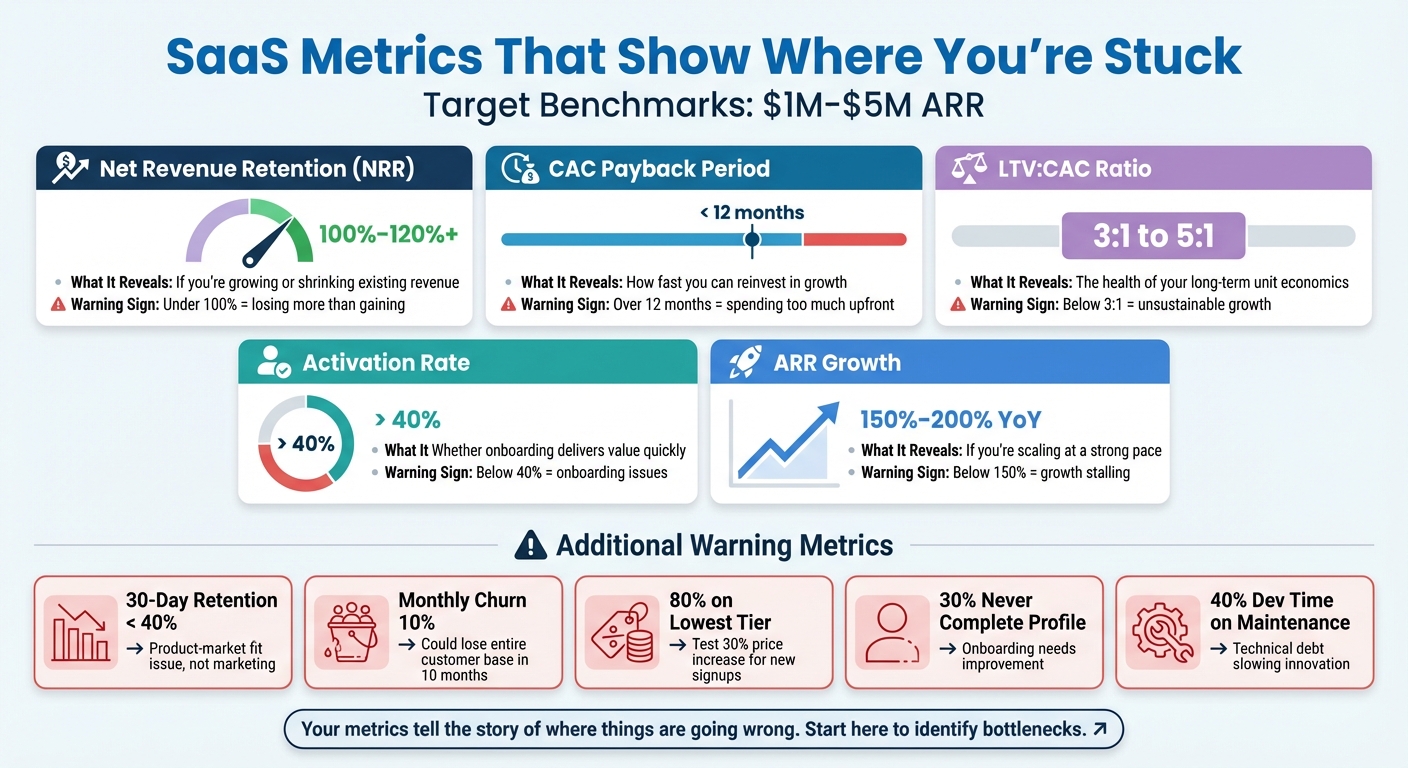
To break through the $1M ARR ceiling, you need to pinpoint the real obstacles holding you back. These might not always be about getting more leads - they could be about retention, pricing, or operational inefficiencies.
SaaS Metrics That Show Where You're Stuck
Your metrics tell the story of where things might be going wrong. Start with Net Revenue Retention (NRR) - this shows if your revenue from existing customers is growing or if churn and downgrades are eating into it. If your NRR is under 100%, you're losing more than you're gaining, which means trouble [1].
Another critical metric is your CAC Payback Period - how long it takes to earn back what you spent on acquiring a customer. If it takes over 12 months, you're spending too much upfront, leaving little room for reinvestment. The LTV:CAC ratio is another key indicator. Ideally, it should be between 3:1 and 5:1. If it's lower, your growth isn't sustainable [5].
Metrics like Lead Velocity Rate (LVR) and Activation Rate can help you predict future revenue trends and identify bottlenecks. For example, if your qualified leads haven't grown in 60 days or if activation rates dip below 40%, your monthly recurring revenue could start to decline soon [2].
| Metric | Target Benchmark ($1M–$5M ARR) | What It Reveals |
|---|---|---|
| NRR | 100%–120%+ | If you're growing or shrinking existing revenue |
| CAC Payback | < 12 months | How fast you can reinvest in growth |
| LTV:CAC | 3:1 to 5:1 | The health of your long-term unit economics |
| Activation Rate | > 40% | Whether onboarding delivers value quickly |
| ARR Growth | 150%–200% YoY | If you're scaling at a strong pace |
Common Mistakes That Kill Growth
Focusing too much on acquiring new customers while ignoring retention can derail growth completely. For instance, if your 30-day retention rate is below 40%, it’s likely a product–market fit issue, not a marketing problem [5]. Similarly, a monthly churn rate of 10% means you could lose your entire customer base in just ten months [5].
Pricing is another silent killer. If 80% of your customers stick to your lowest pricing tier, you're leaving money on the table. Try testing a 30% price hike for new signups to see if your pricing aligns with the value you're offering [5]. Onboarding is another area to watch - if over 30% of new users never complete their profiles, it's a sign your onboarding process needs work [5].
Technical debt can also slow you down. When 40% of your development time is spent on maintenance rather than innovation, your product updates slow, and your system becomes fragile [5]. Spreading yourself too thin across too many acquisition channels - like SEO, paid ads, cold outreach, and social media - can also hurt. Instead, focus on one channel for 90 days and fully commit before trying others [2].
Once you’ve tackled these bottlenecks, you can fine-tune your pricing strategy to unlock hidden revenue streams. In the next section, we’ll dive into how strategic pricing adjustments can boost your revenue without requiring new customer acquisitions.
Fixing Your Pricing to Increase Revenue
Breaking past the $1M ARR mark often requires a fresh look at pricing strategies. Pricing can be a powerful lever for growth - just a 1% price improvement can lead to an 11–12.7% profit increase, making it four times more impactful than customer acquisition efforts [10]. Despite this, about 75% of software companies don't have someone dedicated to pricing [10].
At this stage, many founders mistakenly believe their original pricing model is perfect because it got them to seven figures. They stop experimenting and shy away from price increases, fearing customer churn [7]. This hesitation can stall growth. Small teams often pay for features they don’t use, while enterprise customers pay flat rates despite consuming far more resources - sometimes ten times as much [8]. Adopting a value-based pricing model can help solve these issues and unlock new revenue opportunities.
Testing Value-Based Pricing Models
Value-based pricing focuses on charging for the outcomes your product delivers, rather than the cost of building it. In SaaS, this often translates to pricing at 10–20% of the total economic value your product provides to customers [10].
To make this work, you need to identify the value metric that resonates most with your customers. This might include workflows processed, active users, or revenue generated - rather than arbitrary metrics like feature bundles or seats [8][11]. Many successful startups simplify their offerings into three pricing tiers (Good, Better, Best), with 41% of them using exactly three tiers [10][6].
A hybrid approach - combining a base platform fee with usage-based pricing - can also encourage natural revenue growth as customers expand their usage [8][6]. For instance, instead of capping usage, allow for automated upgrades or overage fees, capturing additional revenue without disrupting the customer experience [6].
When testing new pricing models, try them with prospects over a 30–90 day period. This approach protects your existing revenue while providing meaningful data [8][6]. Switching your pricing page to emphasize annual plans and offering a 20% discount can also reduce churn by 30–40% and significantly boost annual signups - sometimes by as much as 342% [10][6].
Avoid common pitfalls, like overloading the cheapest tier with too many features. This can discourage customers from upgrading and limit expansion revenue [7]. To encourage upgrades, create clear price jumps between tiers - typically 2×–3× - to signal added value [10].
"Price signals quality. £39/mo feels like a 'real business tool.' £29/mo feels like a 'toy.'" - Max Beech, Head of Content, Athenic [6]
These pricing strategies can lay the groundwork for measurable revenue growth, as shown in the following case studies.
Case Studies: Revenue Impact Through Pricing Changes
Refining your pricing model can lead to dramatic improvements, as real-world examples demonstrate.
In December 2025, a B2B platform serving mid-market manufacturing operations boosted its ARR by 25% - adding $2M in just 90 days. They transitioned from a rigid three-tier per-seat pricing model to a four-tier hybrid structure, incorporating a base platform fee and usage-based pricing tied to workflows processed [8]. The results were striking: new customer ACV rose by 35% (from $18,000 to $24,300), quarterly expansion revenue grew by 40% (from $400K to $560K), and annual enterprise churn dropped from 8% to 4% [8].
"Customers loved the product but couldn't justify the cost to their CFO. Meanwhile, our power users were getting incredible ROI and would have paid significantly more." - VP of Revenue, Mid-market SaaS Company [8]
In another example, Collabify, a cloud collaboration platform, overcame a growth plateau in May 2025. Under the leadership of CRO Sarah Chen, they shifted from a static three-tier model ($10/$25/Custom) to a persona-based five-tier structure (Starter $8, Team $19, Business $39, Enterprise $69, Enterprise Plus Custom). By reserving advanced features like analytics and compliance for higher tiers, they achieved a 25% ARR growth over 12 months and a 14% increase in initial ARPU [9].
"The biggest mistake we made was waiting five years to reassess our pricing. Now we have quarterly pricing reviews and an annual deep-dive strategy session." - Sarah Chen, Chief Revenue Officer, Collabify [9]
When implementing price increases, consider grandfathering existing customers. This approach, where current customers temporarily retain their old rates, helps maintain goodwill and avoids sudden churn spikes [8][9][10]. It ensures your current revenue remains stable while new customers pay updated rates that better reflect the value your product delivers.
Reaching New Customer Segments
Once you've fine-tuned your pricing, the next step is expanding your reach. Many SaaS companies hitting $1M ARR often stick to their original customer profile. But here's the catch: that initial audience can only take you so far. To grow to $3M ARR, you need to identify and connect with new customer segments.
Using data to target the right audience can significantly improve your results. Companies that analyze customer data to uncover new ideal customer profile (ICP) segments report a 30–50% boost in marketing conversion rates and 20–35% shorter sales cycles [12]. The goal isn't to chase every lead but to focus on segments that are most likely to purchase, expand, and stick around.
Refining Your Ideal Customer Profile (ICP)
Your first ICP may have helped you reach $1M ARR, but it was likely built on assumptions rather than solid data. A better ICP should do more than describe potential buyers - it should predict who will buy, renew, and grow their accounts [12].
Start with a "Top 20" analysis: review the customers with the fastest sales cycles, highest expansion revenue, and lowest churn. Then, dig into accounts that churned to identify patterns like mismatched company size, incompatible technology, or budget issues [13]. Look for trends: What industries are they in? What tools do they use? This analysis reveals who your real best customers are - not just who you thought they were.
To make this actionable, build an ICP scorecard. Assign weights to key factors like industry (25%), company size (20%), and tech stack (15%), then score accounts on a scale of 1 to 5 [13]. This turns your ICP into a practical tool your team can rely on daily.
| ICP Tier | Score Range | Action/Strategy |
|---|---|---|
| Tier 1 | 4.0 - 5.0 | Personalized outreach, senior rep assignments |
| Tier 2 | 3.0 - 3.9 | Territory-based coverage, nurture with trigger-based follow-ups |
| Tier 3 | 2.0 - 2.9 | Automated outreach, content-driven engagement |
| Avoid | Below 2.0 | Do not pursue; high churn or poor fit |
"ICPs shouldn't just describe who might buy - they should predict who will buy, expand, and renew to maximize customer lifetime value (LTV)." – AlignICP Guide [12]
This clarity sets the stage for smarter market expansion.
Entering Adjacent Markets or Vertical Niches
With a refined ICP, you can focus your expansion strategy on segments that align with your most successful customers. To break through growth barriers, target areas where your value proposition already resonates. This allows you to expand without straying too far from your core market.
Vertical specialization is a proven way to grow quickly. Instead of pitching a one-size-fits-all solution, tailor your messaging for specific industries. For instance, an SEO tool could create separate campaigns for e-commerce businesses and marketing agencies - even if the product itself doesn't change [15][16]. This approach helps you capture underserved niches without overhauling your offering.
A real-world example: In April 2026, TripMaster added $504,758 in net new ARR by targeting a specific transit software vertical. Using Aaron Rovner's framework, they combined competitor-focused strategies with industry-specific messaging, achieving a 650% ROI and 20% conversion rates from paid search [16]. This shows how a focused vertical strategy can deliver fast, measurable results.
Geographic expansion is another avenue. If your focus has been on one region, consider expanding to similar markets like the UK or Australia. As you grow, adapt to local differences in currency, payment preferences, and regulations (e.g., data laws) [16]. To justify the switch, make sure customers in new regions see at least ten times the value of what they're paying [16].
You can also move between customer tiers, like transitioning from SMBs to mid-market or from mid-market to enterprise. This often means adjusting your sales approach - for example, shifting from a product-led growth (PLG) model for $5,000 deals to a sales-led model for $10,000+ ACV deals [15][16].
Before diving in, validate new segments with data. Use firmographics and customer feedback to confirm that the segment aligns with your refined ICP [16]. The ICE framework can help: prioritize opportunities based on Impact (potential size), Confidence (fit certainty), and Ease (cost and speed to test) [4]. A strong market entry should aim for an LTV:CAC ratio over 3:1 and a CAC payback period of 12–18 months [16].
To take this further, leverage intent data. Tools like 6sense or Demandbase can identify accounts that match your ICP and are actively researching solutions [12]. This shifts your focus from static profiles to dynamic, in-market leads - helping you reach prospects when they're ready to buy. Embed ICP scores directly into your CRM to make fit visible on every account and pipeline view [13].
"We're no longer fishing. We know who the right customers are, and we can qualify them quickly. Salesmotion has had a direct impact on pipeline quality." – Andrew Giordano, VP of Global Commercial Operations, Analytic Partners [13]
Top SaaS companies generate 30% to 50% of their growth from expansion revenue rather than new customer acquisition [15]. By refining your ICP and strategically entering new markets, you can unlock this growth potential and accelerate your path from $1M to $3M ARR.
Building a Scalable Go-to-Market System
Once you've nailed down your pricing strategy and customer segmentation, the next step is creating a go-to-market system that can handle growth. After hitting $1M ARR, the founder-driven approach that got you there - think hustle, creativity, and one-off deals - needs to evolve. To scale to $3M ARR and beyond, you'll need systems that streamline customer acquisition and minimize inefficiencies.
At this stage, the challenge isn't finding product-market fit; it's outdated processes holding you back. The methods that worked early on can become roadblocks if not replaced with scalable systems [3]. Companies that develop a formal operating rhythm before reaching $3M ARR grow 25-35% faster as they scale to $5M-$10M ARR [3]. The key? Build the infrastructure before growth demands it.
Diversifying Acquisition Channels
Relying too heavily on one acquisition channel is risky. A staggering 73% of stalled SaaS companies depend on a single source for new customers [18]. If that channel dries up or costs rise, growth can grind to a halt. To avoid this, aim for a balanced mix of channels that complement each other.
Here’s where the 40-30-20-10 framework comes in:
- Allocate 40% of your budget to your primary channel (e.g., SEO or paid search).
- Use 30% for a secondary channel (like partnerships).
- Dedicate 20% to an emerging channel (such as AI-driven search).
- Reserve 10% for experimenting with new ideas.
This approach spreads risk while keeping you focused on what’s working.
Bottom-of-funnel SEO is a standout strategy. Focus on high-intent keywords like "best [category] tools" or "[competitor] alternatives." For example, Tally.so grew to $338,000 MRR by dominating these types of searches with detailed comparison pages. Their conversion rates from AI search engines like ChatGPT and Perplexity were 17x higher than traditional Google traffic [17].
Another winning strategy? Multichannel campaigns. These outperform single-channel efforts, reducing cost per lead by 31% [21]. For example, you might send an email on Day 1, follow up with a LinkedIn connection on Day 3, and run retargeting ads throughout the buyer’s journey. Coordinating these touchpoints creates a seamless experience for prospects.
If you’re targeting enterprise clients, consider Account-Based Marketing (ABM). LiveRamp, for instance, focused on just 15 Fortune 500 companies, creating highly personalized campaigns backed by predictive insights. This strategy brought in over $50 million in annual revenue from those accounts [20]. Sometimes, going deep with a few key targets beats casting a wide net.
Don’t overlook founder-led content as a channel. A founder’s personal brand on platforms like LinkedIn or Twitter can build trust and attract inbound leads more effectively than traditional ads [18][19]. It’s a low-cost but high-effort strategy that can pay off big.
Once you’ve diversified your acquisition channels, the next step is automating your sales and onboarding processes to handle the influx of leads efficiently.
Automating Sales and Onboarding
With a strong acquisition strategy in place, it’s time to standardize and automate your sales process. At $1M ARR, founders often close deals themselves. To scale to $3M ARR, you’ll need a repeatable sales process that others can follow. Start by recording your best discovery calls and documenting common objections along with your responses [3]. This creates a playbook for training your first sales hires.
Leverage trigger-based outreach to automate prospecting while keeping messages personalized. For instance, set up sequences that activate when specific events occur - like a funding announcement, a new executive hire, or a visit to your pricing page. Tailor your messaging to each trigger. A "New VP of Sales" lead, for example, requires different messaging than a "Series B Funding" lead [21].
AI tools can also help automate lead scoring and outreach, which reduces the time it takes to close deals. Grammarly, for example, used this approach to improve conversion rates and speed up deal cycles [21].
For Product-Led Growth (PLG) models, automation should focus on usage signals. For example, when a trial account hits five active users, trigger an outreach sequence offering a demo or enterprise plan. This ensures you engage prospects at the moment they’re most likely to convert.
Onboarding automation should prioritize activation - getting users to their "aha moment" quickly. This is the moment when they first experience the core value of your product. High-quality onboarding processes typically achieve activation rates of 40-60% [19]. If you’re offering a self-serve product, aim for a time-to-value of under 60 minutes.
"The number one killer at this stage is operating model debt, not product-market fit." – Dhaval Shah, Fractional Leader [3]
Finally, establish a weekly, monthly, and quarterly operating cadence to review key metrics and pipeline velocity. As your team grows beyond 15 people, this rhythm ensures alignment and helps identify issues before they escalate [3].
Although it may feel counterintuitive to focus on systems instead of immediate growth, this groundwork sets the stage for faster scaling. Companies that invest in scalable go-to-market infrastructure before hitting $3M ARR position themselves for success in the long run.
Improving Retention and Monetization
You've built a scalable go-to-market system, and now it's time to focus on keeping the customers you've worked hard to acquire. At $1M ARR, retention becomes your growth engine. Even a small reduction in churn - say, from 4.0% to 3.8% - can shorten payback periods and increase net revenue retention [22]. Plus, expanding existing accounts is far more profitable than acquiring new customers, with returns ranging from 5 to 25 times higher [24][25].
But here's the tricky part: many founders don't know where they're losing customers. Churn can happen in several ways - voluntary cancellations, payment failures, or even passive disengagement [22]. In fact, involuntary churn alone can account for 10–40% of total churn, often slipping under the radar. For context, SMB SaaS companies typically experience 3–7% monthly logo churn, while mid-market businesses see around 2–3% [22].
"Users don't wake up one day and decide to leave for fun. They churn because your system failed to get them to value, keep them in a habit, or catch their risk signals in time." – Ronald Davenport, Lifecycle Marketing Consultant [22]
Targeted strategies can make a big difference. For example, between January and April 2023, the founder of a WordPress reporting plugin cut monthly churn from 8.2% to 3.1% by revamping onboarding, adding a cancellation flow, and automating dunning processes. Without spending more on acquisition, their MRR grew from $10,058 to $12,690 [23]. That’s the power of focusing on retention.
Rebuilding Onboarding for Higher Activation Rates
Onboarding can make or break your retention efforts. For some SaaS products, as much as 68% of all churn happens within the first 14 days [23]. If users don’t experience their “aha moment” quickly, they’re likely to leave. Data shows that users who reach this milestone within three days have a 91% retention rate, compared to just 34% for those who don’t [23].
Simplify your onboarding process. The WordPress plugin founder mentioned earlier reduced their onboarding flow from 11 steps to just 3: connect a data source, pick a template, and generate a report. They also added an intent screen (“What do you want to track?”) and a 5-step progress bar. These changes boosted activation rates from 22% to 47% and cut first-14-day churn from 68% to 41% [23].
Progress bars are especially effective because they give users a clear goal. Adding one to your dashboard can increase setup completion rates from 31% to 58% [23]. Instead of overwhelming users with every feature, guide them toward one meaningful outcome. For SMB customers, aim to deliver value within 10 minutes [22]. The faster users see results, the more likely they are to stick around.
Once onboarding is optimized, the next step is to keep users engaged with a systematic lifecycle approach.
Building Lifecycle Systems to Keep Customers Engaged
Activation is just the beginning. To prevent passive churn - when users disengage without canceling - you need systems to maintain engagement. Typically, there’s a 2–3 week window between when a user stops engaging and when they cancel [23]. Many companies miss this critical period.
A health score system can help you spot at-risk accounts early. Weight the score based on factors like recency of core actions (30%), weekly activity compared to the median (25%), and active collaborators (20%) [22]. When a score drops, trigger a rescue sequence. This could include targeted emails, outreach from your customer success team, or tailored success interventions. Using specific data to re-engage users can increase conversion rates from 2% to 12% [25].
"Generic emails tell customers you don't know what they do in your product." – Gatilab [23]
Don’t forget about involuntary churn due to payment failures. These issues are more of an operational challenge than a product flaw. Automated dunning systems can help. Send pre-expiry warnings 14 days before a card expires, and use magic links to make updating billing easy. A 7-day grace period for failed payments can boost recovery rates from 22% to 58% [23]. Standard dunning systems typically recover 30–50% of failed renewals [22].
Another key strategy is multi-threading your accounts. If only one person in an organization uses your product, you’re at risk of losing the account if they leave. Engage multiple users - at least 2–3 secondary users and one executive contact - within the first 30 days to reduce this risk [22].
Once you’ve stabilized retention and engagement, the next focus is on growing account value through upselling and cross-selling.
Upselling and Cross-Selling to Increase Revenue
Retention keeps customers, but expansion grows their value. SaaS upsells have a conversion rate of around 27.6%, much higher than the single-digit rates for acquiring new customers [24]. Top-performing companies achieve net revenue retention above 120%, meaning they grow revenue from existing customers faster than they lose it to churn [24][25].
Timing is everything. Use triggers - like hitting a usage threshold or accessing high-value features - to initiate upsell offers. For example, when a user adds a fourth team member or reaches 80% of their API limit, it’s the perfect moment to suggest an upgrade [25]. Notion uses a strict usage cap, limiting free accounts to 5 blocks. Once users hit that limit, they must either delete content or upgrade, converting 10–30% of users within 30 days [25].
Personalization also makes a big difference. Messages that reference specific usage data - like “You’ve created 47 docs - here’s how Pro customers create 100+” - can boost conversion rates to 12% [25]. A 3-touch expansion system works well: start with in-product education on Day 0, follow up with a personalized email sequence during Days 1–7, and then initiate high-intent sales outreach from Day 8 onward [25].
For seat expansions, reduce friction. Figma, for instance, allows users to invite collaborators easily. New users are automatically added to the team, and billing adjusts without requiring admin approval [25].
Annual plans are another effective tool. Customers on annual contracts churn at just 2.1% monthly compared to 6.8% for monthly plans [23]. Highlight annual pricing on your website and offer a discount - such as “pay for 8 months, get 12.” One company, Gatilab, increased annual plan adoption from 4% to 19% by raising their discount from 15% to 33%, adding $2,632 in MRR over four months. Annual customers also tend to have a 2.7× higher lifetime value compared to monthly customers at full price [23].
Lastly, don’t ignore customers trying to cancel. A simple 2-question exit survey can help you offer targeted retention options. For price-sensitive users, a 50% discount for three months can save 28% of them. For disengaged users, offering a free 30-minute setup call might retain 15%. Even a modest 12% save rate for other reasons can add up significantly over time [23].
"Your next $50K MRR isn't from new customers. It's already in your product, waiting for you to unlock it." – The Growth Terminal [25]
Conclusion: Your Playbook for Scaling to $3M ARR
Key Lessons for SaaS Growth
Reaching $1M ARR is a huge milestone, but moving past it requires a shift in approach. It's not about working harder - it's about working smarter. To scale to $3M ARR, you need to transition from founder-led hustle to system-driven execution. This means documenting your sales processes, establishing consistent operating rhythms, and relying on data to guide decisions rather than intuition [3][1].
Pricing can be your quickest growth lever. Take DocuSign as an example. Between 2022 and 2023, they transitioned from a usage-based pricing model to feature-tiered subscriptions. The result? Revenue soared from $469M in Q1 2022 to $675M in Q4 2023 - a 44% increase. At the same time, customer retention improved from 85% to 92% [14]. Similarly, LocalRank saw their revenue jump from $5,000 to $20,000 MRR just by introducing a $400/month "Scale" plan [17]. Offering a high-ticket tier can help you capture the full value of your product.
Retention and expansion now outweigh acquisition. At this stage, your next $50K in MRR likely isn't coming from new customers. Instead, it's already within your current user base, waiting to be unlocked. Focus on better onboarding, lifecycle management, and strategic upsells to drive growth. These areas are where deliberate, systematic improvements will make the biggest impact.
Next Steps: Implementing the Playbook
Turn these insights into actionable steps. Start by identifying your biggest bottleneck - whether it's underpriced plans, reliance on founder-led sales, or high customer churn - and zero in on fixing that issue. Remember, the key to scaling lies in refining pricing strategies, expanding current customer value, building scalable go-to-market processes, and improving retention.
"What got you to $1M ARR will not get you to $10M. And what worked at $10M breaks completely at $50M." - Tara Minh, Operation Enthusiast [1]
At this stage, aim for repeatability over perfection [1]. Begin small: document common sales objections, test a new pricing tier, or create a health score system to identify at-risk accounts. Commit to shipping one improvement within the next 30 days, measure its impact, and iterate. Companies that build strong systems at $3M ARR set themselves up to accelerate toward $5M and beyond. The playbook is laid out - now it's time to execute and scale to the next level.
FAQs
Which metric should I fix first to get unstuck at $1M ARR?
To hit that $1M ARR milestone, you need to tighten up your operating model. Inefficiencies like informal workflows, teams overly reliant on a single person, or decisions based purely on instinct can hold you back from scaling effectively. On top of that, don’t ignore technical debt - things like sluggish database queries or brittle system architectures can crumble under the pressure of growth.
By focusing on operational efficiency and ensuring your systems are built to scale, you’re not just aiming for $1M ARR - you’re setting the stage for $3M and beyond.
How can I test a price increase without losing customers?
To test a price increase without driving customers away, begin with a cautious approach. Start by experimenting with new customers only - this helps limit the impact on your existing base. Make sure to set clear goals, such as tracking metrics like Average Revenue Per User (ARPU) and churn rates to measure success. Also, establish clear stop conditions to manage potential risks effectively.
Run your experiment for 6–8 weeks to collect enough data for meaningful insights. To keep your loyal customers happy, consider strategies like grandfathering existing users (letting them keep their current pricing) or rolling out changes gradually. These methods can help maintain trust and reduce the chances of losing long-term customers during the process.
What’s the fastest way to find a new ICP segment that will renew?
The quickest way to pinpoint a new ideal customer profile (ICP) segment with a strong likelihood of renewal is by diving into data-driven signals. Metrics like feature adoption, usage limits, and customer lifetime value (CLV) can highlight segments that show promising potential for upselling or securing renewals.
Taking it a step further, crafting personalized offers and conducting targeted outreach based on specific customer behaviors can significantly improve renewal rates. This approach ensures your efforts are directed toward segments with the greatest growth opportunities.
Related reading
- How your acquisition strategy influences your conversion rate
- How to A/B test pricing as a boostrapped company
- Upsell vs. Cross-Sell Metrics: Key Differences
- Digital Marketing Services
- What Is Strategy Consulting? (And when to hire a consultant to do it for you)
Useful tools & services
Locate the constraint in your funnel
Map the transitions so you can choose the next investigation or improvement.
Use the funnel templateNeed help choosing the next change? Explore CRO consulting.
Keep improving your conversion work.
Subscribe for practical ideas on diagnosing conversion problems, planning experiments, and choosing your next improvement.
No spam. Unsubscribe anytime.