Usage-Based Pricing for SaaS: When It Works and When It Backfires
How usage-based pricing can boost SaaS growth, the risks (billing complexity, revenue volatility, bill shock), and when to choose hybrid models.
Usage-based pricing charges customers based on how much they use a product or service - like API calls, storage, or data processed - rather than a flat monthly fee. This approach aligns costs with value delivered, helping startups access tools affordably while scaling revenue naturally for providers. Companies using this model, such as Snowflake, Twilio, and Mailchimp, have seen faster growth and higher revenue retention. However, it comes with challenges like unpredictable revenue, billing complexity, and potential "bill shock" for customers.
Key Takeaways:
- Benefits: Scalable costs for customers, faster revenue growth for companies, and better alignment between usage and value.
- Challenges: Revenue unpredictability, customer concerns over unexpected charges, and the need for advanced billing systems.
- Examples:
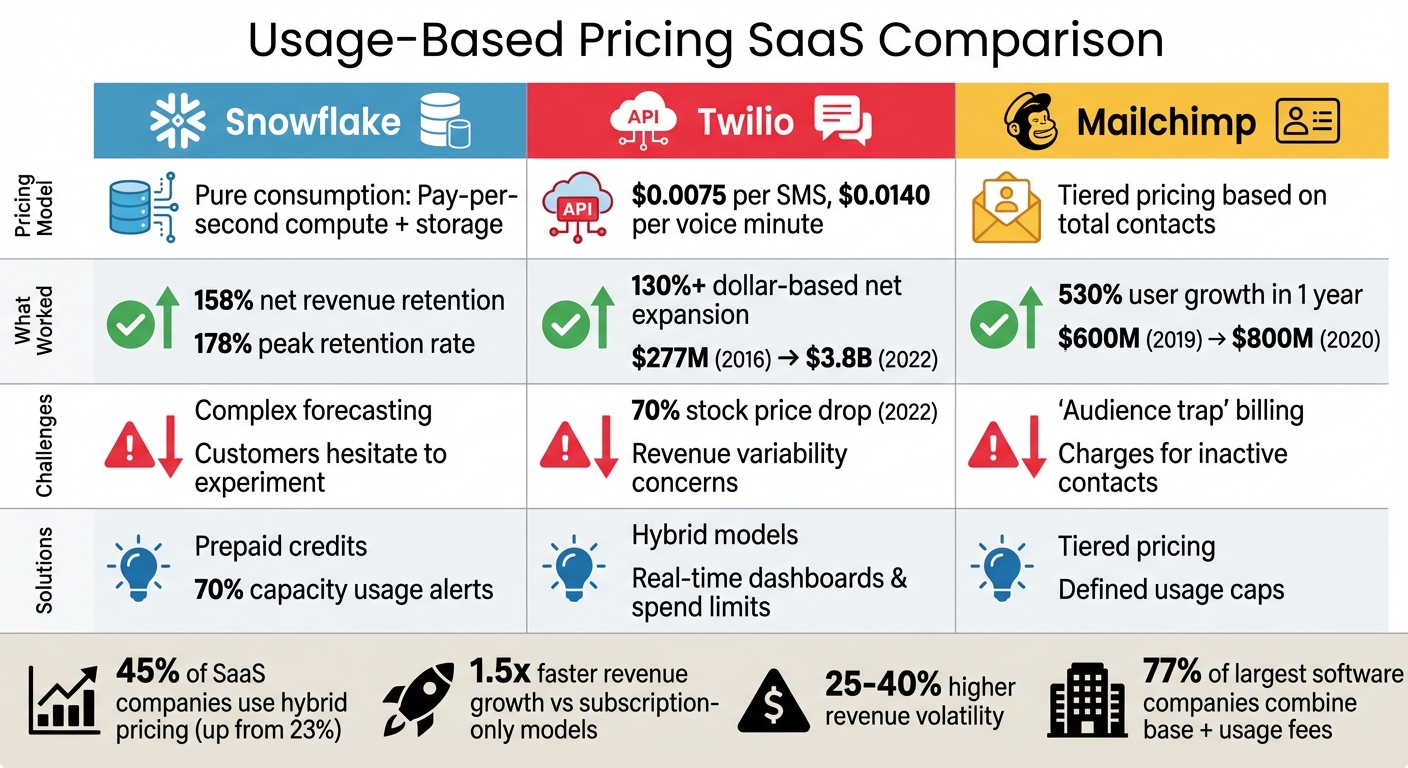
- Snowflake: Pure consumption model with 158% net revenue retention.
- Twilio: Flexible pricing but faced stock drops due to usage variability.
- Mailchimp: Tiered pricing tied to contact lists; criticized for lack of billing clarity.
Quick Comparison
| Company | What Worked | Challenges | Solutions |
|---|---|---|---|
| Snowflake | High retention (158%) with pay-as-you-go | Complex forecasting for customers | Prepaid credits, usage alerts |
| Twilio | Low entry barriers, strong developer appeal | Revenue variability, stock price drop | Hybrid models with minimum commitments |
| Mailchimp | Freemium model drove rapid user growth | Billing clarity issues ("audience trap") | Tiered pricing with usage caps |
Usage-based pricing works best for products where usage directly reflects value. However, companies must invest in tools like real-time tracking and alerts to avoid customer dissatisfaction. Hybrid pricing models (base fees + usage charges) are increasingly popular, balancing flexibility for customers with predictable revenue for businesses.
1. Snowflake
Pricing Model
Snowflake operates on a pure consumption pricing model, meaning you’re only charged for what you use, down to the second. Pricing is divided into three categories: storage, compute, and cloud services. Storage costs about $23 per terabyte per month, while compute is based on Snowflake credits, priced between $2.00 and $4.00 depending on the service tier [10].
Compute charges are billed per second, with a one-minute minimum. For instance, an X-Small virtual warehouse uses 1 credit per hour, while a 2X-Large warehouse consumes 32 credits per hour [10].
Customers can choose between two billing options:
- On Demand: Pay monthly in arrears.
- Pre-purchased capacity: Commit upfront for lower rates and long-term cost stability.
Snowflake also alerts customers when they’ve used 70% of their pre-purchased capacity, helping them manage costs effectively [10]. This detailed billing system not only clarifies expenses but also influences how customers use the platform.
Customer Impact
This pay-as-you-go model significantly simplifies capacity planning. Customers can start small, scaling their spending only as their needs grow. This eliminates the risk of over-provisioning or committing to large, upfront licenses [13, 17]. It’s a win for CFOs aiming to control budgets and for data teams prioritizing performance [6].
"The consumption model brings the vendor and its customers onto the same team, creating a relationship focused on the customer's success." – Snowflake Fundamentals [9]
That said, the model isn’t without challenges. Some customers hesitate to experiment freely since every query adds to their bill. Additionally, unpredictable costs can be tricky for teams accustomed to fixed monthly fees, making advanced monitoring tools essential to avoid surprise expenses [5, 10, 17].
A notable example came in December 2025 when SeemoreData highlighted the impact of Snowflake’s per-GB Snowpipe pricing model. By charging 0.0037 credits per GB, one customer’s daily data ingestion costs dropped from $1,300–$1,600 to approximately $250 - a reduction of 80% to 95% without any changes to their pipeline [12].
Revenue Growth
Snowflake’s customer-friendly approach has directly driven its revenue growth. By late 2025, the company reported a net revenue retention rate of 158%, with peaks as high as 178% in earlier years. This means existing customers increased their spending by 58% year-over-year through greater usage alone [10, 5].
The ability to scale usage and manage budgets effectively has encouraged higher spending and workload expansion among customers. This, in turn, has fueled investor confidence. Snowflake’s market cap climbed to $70 billion just a few years after its IPO, with P/E multiples reaching 16–17× [5, 20]. Its "land and expand" strategy became a textbook example of how to grow revenue organically [11].
"Usage-based pricing creates a natural expansion motion that investors can model with greater confidence." – Brent Thill, Analyst, Jefferies [11]
2. Twilio
Pricing Model
Twilio follows a flexible, usage-based pricing approach, which aligns costs with how much customers actually use the service. For instance, Twilio charges $0.0075 per SMS and $0.0140 per voice minute, with no monthly minimums. Developers can even start experimenting with Twilio using a modest $20 credit [8][3]. As usage increases, customers benefit from tiered discounts, reducing costs further [7].
While Twilio originally relied solely on usage-based pricing, it now offers hybrid plans like Twilio Flex, which combine a base fee with usage charges. They also provide committed-use contracts for businesses that want more predictable expenses. To handle the massive scale of its operations, Twilio has developed custom billing systems capable of processing billions of usage events every day [3].
Customer Impact
Twilio’s pricing structure makes it easy for startups to experiment without committing to hefty upfront costs. This flexibility is a big draw for developers - 87% of whom prefer pay-as-you-go models when trying out new tools [7].
"Twilio's pricing allowed us to start small and scale our communication costs alongside our customer base. We couldn't have afforded a traditional enterprise communication solution with high monthly minimums." – Sarah Chen, Founder, Healthcare Startup [8]
However, this model does come with its challenges. Some customers face "bill shock" when their usage unexpectedly spikes. To address this, Twilio provides tools like real-time usage dashboards, programmable spend limits, and automated alerts to help customers keep costs under control [3][13]. Another issue is the so-called "Success Gap", where customers' cost-optimization efforts may unintentionally limit Twilio's revenue potential [2]. Despite these hurdles, Twilio’s customer-centric pricing approach has contributed to its strong financial performance.
Revenue Growth
Twilio’s revenue has skyrocketed, growing from $277 million in 2016 to over $3.8 billion in 2022. This success is fueled by a consistently high Dollar-Based Net Expansion Rate, which remained above 130% for several years. By Q2 2022, the rate was still strong at 123%, with over 250,000 active customer accounts [8][3][7].
"Usage-based pricing means that as our customers succeed, Twilio succeeds alongside them. There's no misalignment between what we charge and the value customers receive." – Jeff Lawson, CEO, Twilio [3]
Even with usage fluctuations, Twilio’s CFO has stated that the company can forecast quarterly revenue with a margin of error as small as 2–3% [3]. However, concerns over usage variability have spooked investors, contributing to a 70% stock price drop between January and December 2022 [2]. Despite these challenges, Twilio maintains healthy gross margins of 50–55% by leveraging its massive scale to negotiate better rates with telecom carriers [8][3].
3. Mailchimp
Pricing Model
Mailchimp uses a mix of tiered subscriptions and usage-based pricing, with the main factor being the total number of contacts in your database. This includes all contacts - subscribed, unsubscribed, non-subscribed, or pending opt-in - which can make costs add up quickly [17][18]. As your contact list grows, your price increases within your chosen tier [14][15].
In 2019, Mailchimp shifted its pricing model from counting only "subscribed contacts" to considering "total contacts" [19]. Additionally, Mailchimp limits the number of emails you can send each month based on a multiplier system. For example, the Essentials plan (starting at $13/month for 500 contacts) allows up to 10 times the contact limit in email sends, while the Premium plan ($350/month for 10,000 contacts) increases that multiplier to 15 [17]. If you exceed these caps, overage fees kick in automatically [17]. While this approach ties pricing directly to growth and usage, it has sparked mixed feedback from users.
Customer Impact
One common complaint is the lack of billing transparency. Mailchimp charges for every contact in your audience, even if they’re inactive or appear multiple times in different lists. This can lead to unexpected cost increases, sometimes doubling your bill [17][18]. For instance, if the same person is listed in three separate audience groups, you’ll be charged for three contacts. Many users refer to this as the "audience trap" [17].
Mailchimp’s introduction of a freemium plan in 2009 was a game-changer for small businesses. Within a year, the platform’s user base skyrocketed from 85,000 to 450,000 - a staggering 530% jump. Paid conversions also increased by 150%, and overall revenue grew by 95% [16].
"Going freemium accelerated our growth beyond anything we could have anticipated. It wasn't just about user acquisition - it fundamentally changed how we thought about product development and customer success."
– Ben Chestnut, Co-founder, Mailchimp [16]
Revenue Growth
Despite the challenges with its pricing structure, Mailchimp has seen strong financial results. Between 2019 and 2020, the company’s revenue grew from $600 million to $800 million, marking a 20% year-over-year increase [19]. By 2020, nearly half of its revenue came from services outside of email, reflecting its transformation into a broader marketing platform [19]. After being acquired by Intuit for $12 billion in 2021, Mailchimp has focused more on the enterprise market by enhancing its premium tiers and integrating with Intuit’s other products [16]. The company now tracks over 200 customer usage patterns to fine-tune its pricing strategies for different segments [16].
Subscription vs. Usage-Based Pricing: Which Scales Better?
What Works and What Doesn't
Building on the case studies, let’s break down the strengths and weaknesses of usage-based pricing. This model shines when costs directly match the value customers receive. For example, Snowflake boasts a 178% net dollar retention rate [4], while Twilio consistently achieves over 130% dollar-based net expansion rates [3]. These numbers highlight how, as customers grow and scale, revenue naturally increases in line with their usage. This approach works particularly well for infrastructure products - like developers sending more messages through Twilio or data teams processing larger datasets with Snowflake - because increased usage directly correlates with customer success. But while the wins are clear, the challenges are just as noticeable.
One major issue is revenue unpredictability. Take Twilio, for instance: its stock plunged 70% in 2022 due to investor concerns about inconsistent revenue [2]. That same year, its revenue grew by only 10%, even as its customer base expanded by 16%. This highlights a problem often called the "Success Gap", where customers become so efficient in their usage that their growth no longer translates into proportional revenue gains [2]. Additionally, pure usage-based models experience 25–40% higher month-to-month revenue volatility compared to traditional subscription models [1].
Here’s a quick look at how this pricing model has played out for three companies:
| Company | What Worked | What Backfired | How They Fixed It |
|---|---|---|---|
| Snowflake | Separated storage and compute, leading to 178% peak net revenue retention [4] | Complex forecasting for both customers and investors [6] | Introduced minimum capacity reservations and prepaid credit commitments [2] |
| Twilio | Low entry barrier (e.g., $20 initial credit) and clear value alignment for developers [3] | Stock dropped 70% in 2022 as customers optimized usage, impacting revenue [2] | Adopted hybrid models with minimum commitments and volume discounts [2] |
| Mailchimp | Flexible pay-as-you-go model appealed to small senders [20] | Struggled with less predictable recurring revenue [20] | Shifted to tiered pricing with defined usage caps [20] |
To make usage-based pricing work, companies need robust operational systems. Real-time tracking, transparent dashboards, and automated alerts at key usage thresholds are essential to avoid "bill shock." Twilio, for example, found that 87% of its enterprise customers considered these tools critical [3]. Without such infrastructure, companies face significant hurdles. In fact, 36% of firms cite unpredictable revenue as their biggest issue, while 29% admit their billing systems can't handle usage-based models [21].
The market is increasingly adopting hybrid pricing strategies - a mix of base fees and usage charges. This setup balances customer desires for low entry costs and fair pricing with investor demands for predictable revenue. Today, 45% of public SaaS companies use hybrid pricing, up from just 23% five years ago [1]. As discussed earlier, hybrid pricing offers a middle ground, combining customer-friendly usage costs with revenue stability. Ultimately, usage-based pricing works best when the fees reflect the value delivered and companies invest in the operational tools needed to ensure transparency and predictability.
Conclusion
Snowflake, Twilio, and Mailchimp have shown how aligning pricing with usage brings both potential rewards and challenges. Usage-based pricing works best when a product's value can be tied directly to measurable activities - like API calls, data processed, or transactions. This model is particularly effective for infrastructure products with variable consumption patterns, especially when catering to developers or startups seeking low entry barriers. Interestingly, companies using this pricing strategy grow revenue 1.5 times faster than those relying solely on subscription models [1][13]. However, this approach demands robust real-time metering systems and clear dashboards to avoid billing disputes or unexpected charges.
On the flip side, usage-based pricing can cause problems when customers prioritize budget predictability or when usage tracking systems fail, leading to revenue loss and customer dissatisfaction. Hybrid models have emerged as a practical solution in such cases. In fact, 77% of the largest software companies now combine a base subscription fee with usage-based charges [6]. This hybrid approach strikes a balance, offering customers the flexibility they want while giving businesses the revenue stability investors value.
Before making the leap to usage-based pricing, consider running a 60–90 day cohort test or implementing shadow billing to assess its impact. Choose a "celebration metric" that reflects customer success positively [6], and provide spending alerts and limits to help users manage costs. These steps can help ensure your pricing model not only drives growth but also builds and maintains trust with your customers.
"Your pricing model isn't about what's trendy. It's about matching your product's unique characteristics to the right monetization structure." - Momentum Nexus [5]
This quote underscores the importance of tailoring your pricing strategy to your product's specific value. If you decide to adopt usage-based pricing, ensure your costs scale appropriately with customer usage and that your infrastructure can handle precise tracking. Ultimately, the most effective approach often blends usage-based and subscription elements, combining the strengths of both to meet customer needs and business goals.
FAQs
Is usage-based pricing right for my SaaS?
Usage-based pricing thrives when your service's value can be directly measured through metrics like API calls, data usage, or transactions. Customers often appreciate paying for what they actually use, making this model appealing. By tying revenue to the value delivered, it can help strengthen customer retention and lower churn rates.
That said, this approach demands reliable usage tracking, adaptable billing systems, and transparent communication with customers. Before jumping into this pricing model, assess how well your product's value aligns with usage and ensure your operations are prepared to handle the complexities it brings.
How can I prevent customer bill shock?
To help customers avoid unexpected charges in usage-based pricing models, prioritize open communication and real-time updates. Offer tools such as usage trackers and detailed dashboards that show current consumption alongside projected costs. Make sure charges are explained in a straightforward way to eliminate confusion. Utilize structured contract data effectively and set up usage alerts to notify customers as they near their limits. Keeping customers informed and updated helps build trust and ensures a better overall experience.
When should I use a hybrid pricing model?
A hybrid pricing model is a smart choice when you want to blend the predictable income of recurring revenue with the adaptability of usage-based billing. It works particularly well for SaaS products that deliver steady core value while also offering features that vary based on consumption. This setup not only helps you tap into additional revenue as customers grow but also ensures pricing aligns with how customers actually use your product - especially for API-driven or multi-tiered offerings. Just make sure your billing system is equipped to manage the extra complexity this model brings.
Related reading
- Zuora vs Stripe vs Orb (2026): Usage-Based Billing for SaaS
- what pricing models should i expect from ai-driven bi platforms that track real-time product metrics?
- Should You Add Enterprise Pricing? A Revenue-Impact Calculator for SaaS
- How to Price Your SaaS Product When You Have No Competitor Data
- SaaS Growth Model Spreadsheet Template (Free): MRR, Churn, CAC & LTV
Useful tools & services
Put the pricing decision in context
Model a scenario, then identify the assumptions and customer evidence that would change it.
Use the pricing calculatorNeed help choosing the next change? Explore CRO consulting.
Keep improving your conversion work.
Subscribe for practical ideas on diagnosing conversion problems, planning experiments, and choosing your next improvement.
No spam. Unsubscribe anytime.