The True Cost of Bad Onboarding: Quantifying Revenue Lost in the First 7 Days
How poor onboarding in the first 7 days wastes CAC, defers revenue, and spikes churn — and fixes that recover value.
When onboarding fails, businesses lose more than just customers - they lose money and growth opportunities. Poor onboarding leads to wasted acquisition costs, delayed revenue, and increased churn. Here’s what you need to know:
- 75% of SaaS users drop off in the first week if onboarding doesn’t meet their needs, and 90% churn if they don’t see value within seven days.
- Every idle day costs revenue. For consumption-based models, revenue only starts when users actively engage with the product.
- Churn is expensive. A mid-sized startup with 15% churn could lose $432,000 annually in wasted acquisition costs and lost lifetime value.
- Fixing onboarding pays off. A 5% improvement in onboarding completion can increase enterprise value by 25%.
The first seven days are critical. Speeding up Time-to-First-Value (TTFV), simplifying processes, and using tools like AI can reduce churn and recover lost revenue. Companies that prioritize onboarding see better retention, higher customer satisfaction, and stronger growth.
The One Onboarding Question That Slashed Churn by 27% Overnight
Calculating Revenue Loss in the First 7 Days
This section breaks down how onboarding issues in the first week can lead to significant revenue losses.
What Early Churn Costs You
When a customer churns early, you lose more than just their initial payment - you lose the entire Customer Acquisition Cost (CAC) and all potential future revenue. For example, if you spend $1,200 to acquire a customer paying $100/month, and they churn in the first week, you're left with a net loss of $1,100 [2]. For SaaS customers with a 24-month expected lifespan at $150/month, the loss skyrockets to $3,450 in future revenue [2].
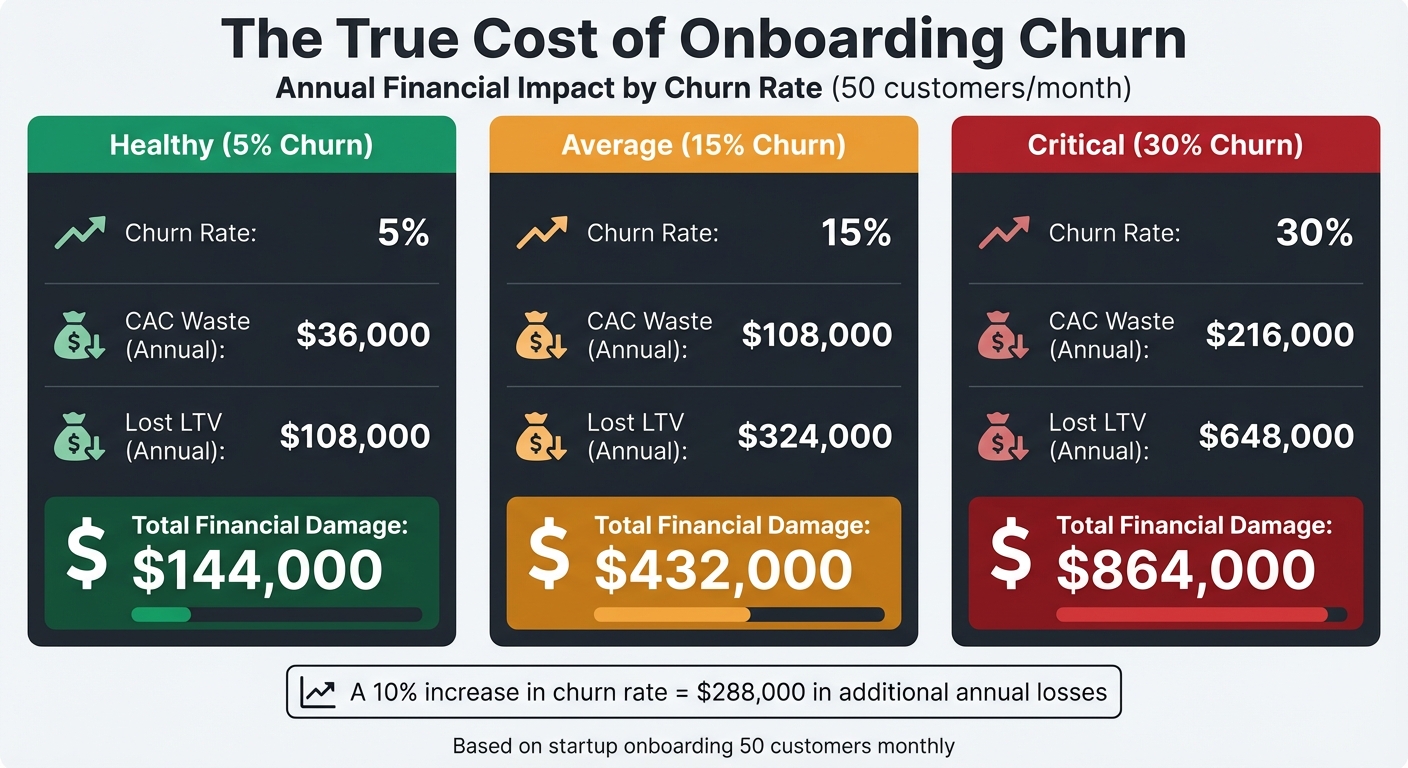
For a mid-sized startup onboarding 50 customers a month, the financial impact of different churn rates looks like this:
| Churn Scenario | CAC Waste (Annual) | Lost LTV (Annual) | Total Financial Damage |
|---|---|---|---|
| 5% Churn (Healthy) | $36,000 | $108,000 | $144,000 |
| 15% Churn (Average) | $108,000 | $324,000 | $432,000 |
| 30% Churn (Critical) | $216,000 | $648,000 | $864,000 |
Based on a startup onboarding 50 customers monthly [2].
"If your onboarding churn happens in month 1, you haven't just lost a customer; you've effectively handed $1,100 to your competitors." - Calcix Research Team [2]
Beyond the obvious loss of CAC and customer lifetime value (LTV), onboarding failures also come with hidden costs that can erode your bottom line.
Lost Revenue from Failed Activation
When activation fails, the losses extend far beyond the first month's revenue. 67% of customer churn occurs during onboarding [6], meaning a significant portion of your acquisition spend is wasted before customers even start generating revenue. On average, SaaS companies lose $18,000 for every 10 customers who fail to complete onboarding [2]. And with only 12% of users rating their onboarding as "effective" [7], most companies face serious challenges in this area.
The stakes are even higher when 89% of customers say they would switch to a competitor if the onboarding process is too complicated [6]. Poor onboarding doesn't just cost you revenue - it can also damage your growth trajectory.
For consumption-based models, the impact is immediate. Revenue begins only when customers actively use your product, so every day they remain idle during onboarding translates to deferred revenue. For service-based businesses, delays in collecting onboarding requirements like credentials or documents can cost around $2,500 in deferred revenue per client for firms billing $5,000/month [5].
These revenue losses are compounded by inefficiencies that ripple across your operations.
Support Costs and Productivity Drain
Onboarding inefficiencies don’t just hurt revenue - they also drain time and resources. Service businesses lose 5–10 hours per client on tasks like chasing down missing information, clarifying deliverables, and sifting through emails [5]. At $75/hour, this adds up to $22,500 to $45,000 annually for companies onboarding 10 clients per month [5].
Inefficient onboarding also burdens Customer Success teams, forcing them to spend 60% more time on manual tasks [6]. In contrast, SaaS companies using interactive onboarding tools report 40% fewer support tickets [7]. Poor onboarding also leads to project delays, with teams spending 27% more time than estimated due to unclear expectations, resulting in revenue leakage of 10–20% per project [5].
On the flip side, effective onboarding makes a noticeable difference. Users who receive "just-in-time" onboarding tips make 33% fewer errors [7], reducing the cycle of support requests and helping teams operate more efficiently.
Case Studies: Revenue Lost to Bad Onboarding
The following case studies highlight the financial toll that poor onboarding processes can take on businesses. These real-world examples show how friction in the user experience directly translates to lost revenue.
Case Study 1: Long Signup Flows Kill Activation
In November 2025, the project management software TaskFlow uncovered a troubling issue: 43% of new users failed email verification during signup. This single technical hiccup led to $127,000 in monthly revenue losses and a 68% increase in support costs [8].
The impact was far-reaching. Users who couldn't verify their emails never activated their accounts, meaning TaskFlow was effectively throwing away its customer acquisition budget on users who never contributed to revenue. To address this, the company introduced real-time email validation and smart typo correction during signup. The results were dramatic: failed signups dropped by 89%, and user activation rates jumped from 22% to 56%, a 156% improvement. This change not only recovered the $127,000 in monthly revenue but also boosted user lifetime value by 73% [8].
While TaskFlow focused on fixing signup issues, another company struggled with keeping users engaged early in their journey.
Case Study 2: No Early Engagement Means Higher Churn
In 2025, the recruiting platform The Room identified a different issue. Although new users were signing up, they weren’t engaging with the platform’s core feature - downloading resumes. This lack of early engagement accelerated churn, wiping out potential lifetime value [4].
To combat this, The Room replaced static onboarding instructions with interactive walkthroughs that guided users through their first resume download. Within just 10 days, they saw a 75% increase in their key activation metric [4]. By helping users experience the platform's value right away, they effectively stopped the silent churn that had been draining revenue. Similar interactive adjustments across the platform led to a 1.5x boost in activation rates and 1.7x more trial registrations [4].
How to Fix Onboarding and Stop Revenue Loss
The examples above highlight the consequences of poor onboarding. The upside? You don’t need to rebuild your entire platform to fix the problem. By focusing on three core areas, you can cut early churn and recover lost revenue.
Simplify Signup and Activation
One of the quickest ways to address revenue loss is to reduce friction between signup and delivering value. Allow users to experience key benefits before asking for billing information or lengthy forms. Save those steps for after they’ve hit their first "aha moment" [9][3]. If it takes more than three minutes for users to see results, you're likely losing them [2].
Prioritize speeding up time-to-first-value. Remove any step that doesn’t directly help users achieve their main goal. The faster they experience success, the more likely they are to stick around and convert into paying customers.
This streamlined signup process lays the groundwork for using AI to enhance onboarding.
Use AI to Guide Users Through Onboarding
AI tools can provide personalized onboarding at scale, cutting down on the need for additional support staff. Here’s a real-world example: In February 2026, a B2B SaaS company introduced an AI system using Claude for document creation and Make.com for workflow triggers. Within three months, they reduced their average onboarding time by 62% - from 21.3 days to just 8.1 days. Their two-person Customer Success team was able to handle 45 new customers a month, up from 15. Onboarding-related support tickets dropped by 56%, and 30-day customer satisfaction scores jumped 41%, from 6.2 to 8.7 out of 10 [10].
AI also tracks user behavior in real time. If progress stalls - like no activity for 10 minutes - it automatically provides relevant help [11]. This proactive approach not only shortens onboarding time but also prevents churn by addressing issues before they escalate. AI chatbots can instantly answer questions by pulling from documentation and past tickets, avoiding the delays that often lead to early abandonment [11]. Plus, AI-assisted onboarding costs roughly $0.50–$1.50 per user, compared to $15–$25 for human-led support [11].
Keep Users Engaged with Lifecycle Messages
The first week is critical: 90% of users churn if they don’t see clear value during this time [7]. Lifecycle messaging helps combat this by maintaining consistent, supportive communication during those early days. Automated email sequences and in-app notifications can keep users engaged without overwhelming them.
Behavioral triggers are key for sending timely, relevant messages. For instance, if a user gets stuck on a task or shows signs of frustration (like repeated failed clicks), you can send an offer of specific help. Celebrate milestones with badges, animations, or progress emails - these small wins build confidence and encourage users to keep going. Milestone-based onboarding has been shown to cut Day 7 churn by 28%, while milestone celebrations can boost user progression by 40% [7]. These strategies directly address the $432,000 in annual losses that mid-sized startups face from poor onboarding.
Tailor your messaging to fit different user roles or goals. For example, a marketing manager will need different guidance than a developer. Include social proof in your messages - something like "Join 47 other users who hit this milestone this week" - to drive a 33% increase in conversions [7].
Conclusion: What Better Onboarding Returns
What to Remember
The numbers don’t lie: a 5% improvement in onboarding completion can drive a 25% boost in total enterprise value [2]. For a mid-sized startup, reducing onboarding churn from 15% to 5% can save close to $300,000 annually. That’s money that would otherwise be lost to acquisition costs and diminished lifetime value [2]. Plus, customers who go through a well-structured onboarding process enjoy a 21% higher lifetime value compared to those who don’t [12].
The first seven days are critical. Companies that excel in onboarding report 2.5x higher customer expansion rates and 50% better retention [6]. By delivering value within the first 48 hours, tailoring the experience to user intent, and leveraging AI for real-time guidance, you’re not just onboarding customers - you’re laying the groundwork for sustained growth. In fact, 86% of customers remain loyal to businesses that prioritize onboarding content that educates and welcomes them [5][6][12]. These early efforts create a ripple effect, driving loyalty and revenue for the long haul.
This data highlights why intentional friction during onboarding isn’t just about reducing churn - it’s about creating meaningful engagement that lasts.
When Friction Helps Instead of Hurts
Not all friction is bad. Strategic friction, such as interactive walkthroughs, checklists, or required setup steps, can actually improve retention. The trick is to get users to actively participate - doing instead of just watching. This approach helps users build muscle memory and ensures they engage with your product’s core features [1][5].
Thoughtful friction also prevents users from feeling overwhelmed, keeps them focused, and ensures they experience that all-important "aha moment." It’s the difference between a user who clicks through a tutorial and forgets it by the next day, and one who completes a task and feels confident moving forward. When designed well, this type of friction doesn’t frustrate - it empowers. It helps users succeed, which, in turn, strengthens the foundation for long-term growth that effective onboarding is meant to create.
FAQs
How do I calculate revenue lost from Day 1–7 onboarding churn?
To figure out how much revenue is lost during the first week of onboarding churn, start by multiplying the number of customers who churn during this timeframe by their Customer Acquisition Cost (CAC). Then, consider the lifetime value (LTV) these customers could have contributed if they had stayed.
For instance, say 20 customers churn, and your CAC is $1,000 per customer. The immediate hit to your revenue is $20,000. This doesn’t even account for the additional revenue you’d miss out on from their potential lifetime value.
What’s the fastest way to reduce time-to-first-value in my product?
Want to help customers see results faster? Automating your onboarding processes is the way to go. By guiding customers to their first real success, automation can slash time-to-value by as much as 70%. That means customers experience benefits much sooner.
The key is to focus on delivering quick, tangible outcomes - ideally within the first 24 hours. Tools like step-by-step workflows, automated reminders, and self-serve portals make the process smooth and efficient. Not only does this create a better experience, but it also boosts retention by keeping customers engaged from the start.
Which onboarding metrics should I track in the first week?
In the first week, pay close attention to metrics that shed light on customer engagement and possible churn risks. Start with Time-to-First-Value (TTFV) - this measures how quickly users gain value from your product. Another important metric is onboarding completion rates, which reveal the percentage of users successfully finishing the onboarding process. Also, keep an eye on user engagement by tracking feature adoption and activity levels. These data points can pinpoint early signs of churn and help refine the onboarding process for a better user experience.
Related reading
- How to Use Discounts Without Hurting Revenue
- Top Upselling Techniques for SaaS Success
- 5 SaaS Discounting Rules for Retention
- How Proactive Support Reduces SaaS Churn
- How to Measure and Improve Time-to-Value
Useful tools & services
Find the obstacle before adding more onboarding
Review the path to first value and agree which changes your team should implement.
Explore onboarding optimizationNeed help choosing the next change? Explore CRO consulting.
Keep improving your conversion work.
Subscribe for practical ideas on diagnosing conversion problems, planning experiments, and choosing your next improvement.
No spam. Unsubscribe anytime.