Revenue Optimization for SaaS: The 3 Levers Beyond Acquisition
Boost SaaS profits by improving retention, expanding current accounts, and aligning pricing to customer value to reduce churn and increase ARR.
In SaaS, growth isn’t just about acquiring new customers - it’s about keeping them, growing their value, and pricing your product effectively. Here’s what you need to know:
- Retention: It’s cheaper to keep customers than to find new ones. Focus on onboarding, engagement, and proactive support to reduce churn. Even a 5% boost in retention can increase profits by 25–95%.
- Expansion: Upselling and cross-selling to existing customers can grow revenue faster than acquisition. Use data-driven triggers, like usage limits or ROI milestones, to time your offers.
- Pricing: Most SaaS companies underutilize pricing strategies. Value-based pricing, annual plans, and regular pricing reviews can significantly improve profitability. A 1% pricing improvement can increase profits by 11%.
If your Net Revenue Retention (NRR) is below 100% or you haven’t adjusted pricing in over a year, you’re likely leaving revenue on the table. Start optimizing these three levers to build a more profitable, scalable business.
::: @figure 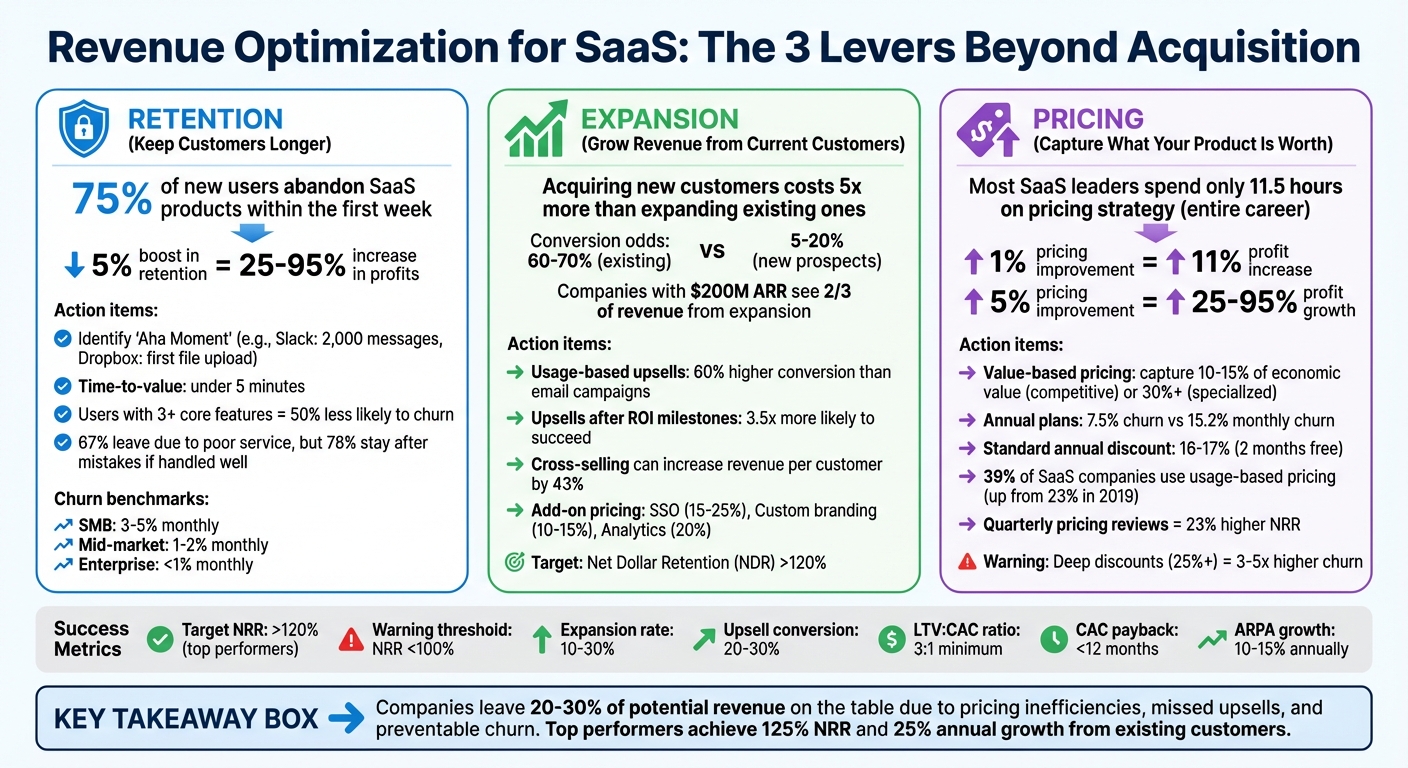 :::
:::
The ONLY 3 Ways to Expand Revenue (With SaaS Accounts)
::: @iframe https://www.youtube.com/embed/OAw_TF02z8Y :::
Lever 1: Retention - Keep Customers Longer
Retention starts the moment a user signs up. Here’s a striking fact: 75% of new users abandon a SaaS product within the first week if they don’t experience value quickly [6][7]. That’s why creating an impactful first experience is so critical - it sets the stage for long-term success.
To retain users, identify your product’s "Aha Moment" - the key action that predicts whether someone will stick around. For Slack, it’s a team exchanging 2,000 messages [6][7]. For Dropbox, it’s uploading the first file [6][7]. Use cohort analysis to uncover this moment for your product, then streamline your onboarding process to help users hit that milestone fast. The top-performing SaaS companies aim for time-to-value in under five minutes [7]. Once users achieve this, keep the momentum going with regular engagement.
Engagement shouldn’t be reactive; it should be continuous. Instead of "panic emails" sent only after churn, focus on maintaining steady communication throughout the customer’s journey [8]. Weekly activity summaries, monthly ROI reports, and milestone celebrations (without pushing sales) can reinforce the value you provide [8][9]. Fun fact: customers who use three or more core features are 50% less likely to churn compared to those who stick with just one [9].
Customer support and success teams are vital for retention too. 67% of users leave due to poor customer service, but here’s the silver lining: 78% will stay even after a mistake if the issue is handled exceptionally well [12]. This means shifting from reactive troubleshooting to proactive outreach - educating users and addressing potential problems before they escalate. As Equanax aptly puts it:
"Retention is not support, it is growth" [10].
To stay ahead of churn, track a combined customer health score. This should include metrics like login frequency, feature adoption, and support interactions. Use these insights to trigger personalized, proactive interventions [4][11]. With retention under control, you’re ready to explore ways to grow through expansion.
Lever 2: Expansion - Grow Revenue from Current Customers
Once you've nailed retention, the next step is driving revenue by expanding your existing customer base. Here's why this makes sense: acquiring a new customer costs five times more than growing revenue from one you already have [13]. Plus, the odds of selling to a current customer are much better - 60–70% compared to just 5–20% for new prospects [15]. As businesses grow, expansion becomes even more important. For instance, companies with $200M in ARR typically see two-thirds of their revenue coming from expansion rather than new customers [17]. By building on the trust established during retention, you can unlock meaningful growth.
Usage-Based and Feature-Driven Upsells
Timing is everything when it comes to upselling. Keep an eye on customers nearing 80% of their plan limits - whether that's seats, data storage, or API calls - and use in-app tools like usage meters to nudge them toward an upgrade. These triggers can boost upsell conversion rates by 60% compared to traditional email campaigns [13][14]. Jason Lemkin, Founder of SaaStr, explains it well:
"The best SaaS companies build expansion directly into their product experience. Customers should feel the pull toward expanded usage through the product itself." [15]
Beyond usage data, external factors like funding rounds or growing headcount can signal when to initiate an upsell [13]. Timing these conversations just after a customer hits a major ROI milestone makes them 3.5× more likely to succeed than if they’re tied to contract renewal dates alone [15]. Tools like "shadow billing", which show customers what their costs might look like on a higher tier, can ease concerns about unexpected charges and make the upgrade feel seamless [14].
Quarterly Business Reviews (QBRs)
For mid-market and enterprise clients, Quarterly Business Reviews (QBRs) are your chance to discuss expansion. But here's the catch: 86% of companies struggle to effectively communicate added value during these meetings, often zeroing in on pricing and contracts instead of outcomes [22]. The key is to focus on business goals and measurable ROI. Once that's clear, introducing more seats or premium features feels like a natural next step [13].
Customer success teams that emphasize business value over technical features see a 38% higher success rate with expansion [1]. Before each QBR, dig into product usage data to identify opportunities - like customers who are hitting usage limits or exploring advanced features [16]. Use the meeting to highlight how new capabilities align with their evolving needs. Show them how moving to a higher tier can address emerging challenges and support their growth [5].
Cross-Selling Add-Ons
Cross-selling is another powerful way to grow revenue, with the potential to increase revenue per customer by up to 43% [20]. The trick is to modularize key features into add-ons - like single sign-on (SSO), which typically adds 15–25% to the price, custom branding (10–15%), or advanced analytics (20%) [14]. This keeps the core product affordable while allowing you to capture more value from larger clients.
To make cross-selling effective, trigger recommendations at the right moment. For example, if a customer is exploring reporting tools, suggest an advanced analytics add-on [19]. Offering trial credits for more complex features can lower barriers to adoption, and including customer testimonials on cross-sell pages can help build trust [18]. Align your Sales and Customer Success teams to identify opportunities based on customer health scores, all while maintaining the trusted advisor role of your Customer Success Manager (CSM) [21].
Patrick Campbell, CEO of ProfitWell, sums it up perfectly:
"Monetization is the most efficient growth lever in a company's arsenal, yet most companies don't put enough focus on their pricing strategy." [15]
The best SaaS companies aim for a Net Dollar Retention (NDR) of over 120% [16], meaning their existing customers generate more revenue over time. By using these strategies, you can turn your retained customers into a reliable engine for growth. Next, fine-tune your pricing strategy to ensure you're capturing the full value of your product and completing the revenue optimization cycle.
Lever 3: Pricing - Capture What Your Product Is Worth
Once you've boosted revenue through expansion, fine-tuning your pricing strategy ensures your product reflects its true value.
Pricing is a key driver of revenue, yet most SaaS leaders dedicate only about 11.5 hours over their entire career to pricing strategy [26]. That’s a missed opportunity. A 1% improvement in pricing can increase profits by 11%, and a 5% improvement can lead to profit growth of 25% to 95% [24][3]. The secret lies in moving away from cost-based or competitor-based pricing to a model that reflects the actual value your product delivers.
Value-Based Pricing Models
Value-based pricing sets your price according to what customers are willing to pay for the outcomes your product delivers. It’s not about your costs or what competitors charge. The first step is identifying your value metric - the unit that connects your pricing to the value customers receive. For example, a CRM might charge per contact, while a payment processor might charge per transaction. Companies using value metrics grow at twice the rate of those that don’t [26].
To implement this approach, calculate the economic benefits your software provides in three areas: hard dollar savings (cost reductions), revenue generation (helping customers earn more), and risk reduction (e.g., avoiding compliance issues) [24]. Then, segment your market by factors like company size, industry, or use case complexity, and design tiered pricing that reflects these differences [23][24]. Use the "value ratio" as a guide: aim to capture 10–15% of the total economic value for products with many competitors, and 30% or more for solutions that are highly specialized or critical to business operations [24].
Kyle Poyar, Partner at OpenView Venture Partners, explains:
"Value-based pricing ensures that your pricing scales with the value customers get from your product, which creates a fairer exchange and higher customer satisfaction." [23]
Sales teams can support this approach by using ROI calculators and case studies to shift discussions from features to outcomes [24][3]. The fastest-growing SaaS companies - those with a 21% median growth rate - often use a hybrid pricing model that combines subscription fees with usage-based pricing [26]. This trend is growing: 39% of SaaS companies now use some form of usage-based pricing, up from 23% in 2019 [23].
Once you’ve set a strong value-based pricing foundation, you can refine it further by experimenting with discounts and plan structures.
Testing Discounts and Annual Plans
Annual plans are a great way to improve cash flow and reduce churn. Customers on annual subscriptions have an average churn rate of 7.5%, compared to 15.2% for monthly plans [3]. Offering a discount equivalent to "2 months free" (about 16–17%) is the industry standard for annual plans [28][30]. For consumer products, framing discounts as "2 months free" often performs better than percentage-based discounts because it feels more tangible [28].
To price annual plans effectively, use your retention data. For example, if customers typically stay for 4 months, set your annual price at the cost of 5–6 months to increase lifetime value by 25–50% [28]. Dan Layfield, who led growth at Codecademy, used this strategy to help scale the company from $10M to $50M in ARR by converting many users to long-term plans [28].
When testing discounts, use cohort analysis by splitting prospects into groups of 100–200 users. Compare the performance of different promotions against a control group with standard pricing [27]. Time-limited discounts of 14 days or less often drive 25% higher conversion rates than open-ended promotions [27]. But be cautious with deep discounts - while 80% of SaaS companies offer discounts of 25% or more, these customers tend to churn at 3–5x higher rates [26].
If you’re raising prices, consider grandfathering existing customers by allowing them to keep their current rates for a set period. This reduces churn and maintains trust [3]. Salesforce, for example, uses a "discount laddering" approach in 3-year agreements: offering a 25% discount in year one, 15% in year two, and 10% in year three. This strategy balances initial incentives with long-term revenue protection [29].
Beyond discounts, tracking churn data and analyzing competitors can help you refine your pricing strategy even further.
Using Churn Data and Competitive Analysis
Churn data is a goldmine for understanding whether your pricing aligns with the value customers see in your product. Break down churn by customer type - such as industry, company size, or plan type - to uncover pricing sensitivities [32]. For instance, small businesses might leave due to tight budgets, while enterprise clients may churn if features don’t justify the cost. It’s also important to track why customers leave: did they go out of business, or did they switch to a cheaper competitor? [33]
Jeremy Holland, Managing Partner at The Riverside Company, highlights this point:
"It would be hugely valuable if companies tracked why customers churned. It is different if the customer went out of business than if they chose to go to a cheaper competitor." [33]
Competitive analysis should evaluate both explicit costs (like subscription fees) and implicit costs (such as setup time or labor). Emphasizing a lower total cost of ownership (TCO) can justify a higher upfront price compared to competitors with more complex implementations [31]. Keep an eye on direct competitors as well as alternative "custom stacks" - collections of smaller, lower-cost tools that customers might use to replace your solution [31].
Companies that conduct quarterly competitive pricing reviews achieve 23% higher net revenue retention than those that only review pricing annually [35]. Use product analytics to set alerts for "usage plateaus" or "feature drop-offs", which are often early signs of price-related churn [34]. SaaS companies that adjust their pricing quarterly see 10–15% higher annual growth rates compared to those that update pricing less frequently [25].
Patrick Campbell, CEO of ProfitWell, sums it up perfectly:
"The most efficient path to revenue growth isn't building a better sales team or spending more on acquisition - it's building a better pricing strategy." [25]
Together with retention and expansion, a strong pricing strategy completes the trio of revenue levers that drive sustainable SaaS growth beyond customer acquisition.
How to Measure Success
To gauge whether your retention, expansion, and pricing strategies are hitting the mark, focus on a handful of impactful metrics. These provide a clear picture of how well your business strategies are performing and align directly with the key levers outlined earlier.
Retention Metrics
When it comes to retention, Net Revenue Retention (NRR) is often regarded as the gold standard for assessing product-market fit and overall business health. Top-performing SaaS companies aim for NRR above 120%, while anything below 100% signals challenges ahead [36][2]. As KISSmetrics puts it:
"If you could only look at one metric to assess the health and trajectory of a SaaS business, it should be net revenue retention" [36].
To complement NRR, track Gross Revenue Retention (GRR), which focuses solely on revenue lost through contraction and churn, excluding expansion revenue. This helps establish your baseline for retention [36]. Additionally, monitor customer churn and revenue churn separately. A mismatch - like low customer churn but high revenue churn - indicates you're losing high-value accounts [37].
Churn benchmarks vary depending on your target market:
- SMB-focused SaaS: 3–5% monthly churn
- Mid-market SaaS: 1–2% monthly churn
- Enterprise SaaS: Below 1% monthly churn [37]
Early warning systems based on product engagement data can help you act before churn happens. For instance, flagging accounts where weekly active users drop by 40% gives your customer success team a chance to step in before cancellations occur [36].
Expansion Metrics
Expansion metrics highlight how effectively you're growing revenue from your existing customers. Start by tracking your expansion rate, which measures revenue growth within your current customer base. High-performing companies typically achieve expansion rates between 10–30% [38][5].
Other key metrics include:
- Upsell conversion rates: Aim for 20–30% [5][39].
- Time to first upsell: Use this to optimize when you introduce upgrades.
Usage-based pricing models often outperform traditional subscription models. For example, companies with usage-based pricing report 28% higher NRR on average [2]. Snowflake is a standout example, achieving an industry-leading 169% NRR in 2021 thanks to its consumption-based pricing for compute and storage [2].
Cohort analysis can also be a game-changer. By grouping customers based on their sign-up date, you can identify which segments offer the most expansion potential and how revenue evolves over time [5][40]. Jason Lemkin, Founder of SaaStr, explains:
"Customers that expand their usage and spend with you by 20%+ per year will stay with you forever - or at least until you screw it up" [39].
Pricing Metrics
Pricing metrics ensure your revenue strategy aligns with the value your product delivers. Start by tracking Average Revenue Per User (ARPU) and Average Revenue Per Account (ARPA) to gauge pricing health. A good target is 10–15% annual ARPA growth [5].
Your LTV:CAC ratio is another critical metric. A ratio of at least 3:1 is ideal, while anything below 1:1 indicates you're losing money on customer acquisition [37][41].
Regular willingness-to-pay research is essential. Conduct this quarterly, breaking down data by customer persona, company size, and use case. Neglecting this research can lead to underpricing by as much as 30–85% [25]. Kyle Poyar, Partner at OpenView Partners, emphasizes:
"The most successful SaaS companies conduct willingness-to-pay research at least quarterly, and they segment this data by customer persona, size, and use case" [25].
Finally, monitor your CAC payback period. The goal is to recover acquisition costs within 12 months or less by fine-tuning pricing tiers [25][41]. Salesforce, for example, reported an NRR of 119% in Fiscal Year 2023, driven by its add-on strategy, which included products like Einstein AI and advanced analytics modules [2].
Improving NRR by just 10 points can compound into more than 2.5x growth impact over five years [2]. By consistently measuring these metrics, you'll uncover the levers that drive sustainable and scalable growth.
Conclusion
Acquiring new customers can be expensive - 5 to 7 times more costly than retaining existing ones. Even a modest 5% increase in retention can boost profits by 25% to 95%[1]. On top of that, refining your pricing strategy has nearly four times the profit impact compared to focusing solely on acquisition[25].
To unlock growth, start by auditing your onboarding process and addressing early churn. Align your pricing with the value you deliver, and create a systematic plan for expansion. These actions lay the groundwork for stronger revenue growth driven by a thoughtful pricing strategy.
Experts in the field emphasize the importance of these approaches. Patrick Campbell, CEO of ProfitWell, states:
"The most efficient path to revenue growth isn't building a better sales team or spending more on acquisition - it's building a better pricing strategy."[25]
Jason Lemkin, Founder of SaaStr, adds:
"SaaS companies with negative churn - where expansion revenue exceeds revenue lost to churn - have an inherent advantage that becomes nearly unstoppable as they scale."[1]
The reality is that many SaaS companies leave 20–30% of potential revenue on the table due to pricing inefficiencies, missed upsell opportunities, and preventable churn[42]. Top-performing companies, on the other hand, achieve 125% NRR and grow 25% annually from their existing customer base[42].
Take a close look at your retention, expansion, and pricing metrics. If your Net Revenue Retention (NRR) is below 100%, your monthly churn rate is over 2%, or you haven’t adjusted your pricing in more than a year, you’re likely missing out on significant revenue opportunities. For example, reducing monthly churn by just 1% can lead to a 12% increase in annual revenue[42].
The real challenge isn't deciding whether to focus on these levers - it’s about how quickly you can take action to build a sustainable growth engine.
FAQs
::: faq
How do I find my product’s “Aha Moment” fast?
To pinpoint your product's "Aha Moment", start by identifying the point where users first grasp its core value. Look at user behavior to uncover key moments of feature engagement. Surveys and interviews can also provide direct insights into what resonates most with users. Additionally, analyze your onboarding process to find common patterns or paths that lead users to this realization. These efforts can help refine your onboarding and overall product experience, making it easier for users to reach their "Aha Moment" faster. :::
::: faq
What should go into a customer health score?
A customer health score in SaaS blends various data points to evaluate how engaged, satisfied, and likely to renew a customer is. It typically includes usage metrics (like app activity and feature adoption), engagement signals, customer satisfaction metrics such as NPS, and qualitative feedback that captures behavioral shifts or emotional cues. By merging both numbers and insights from customer behavior, businesses can better anticipate churn, spot growth opportunities, and refine their customer success strategies. :::
::: faq
How often should I review and update pricing?
Pricing should be revisited regularly - every 6 to 12 months is a good rule of thumb. However, if market trends shift or customer feedback signals a need for change, it’s worth adjusting sooner. Consistent reviews help keep your pricing competitive and in tune with what customers are looking for. :::
Related reading
- How to Use Discounts Without Hurting Revenue
- Top Upselling Techniques for SaaS Success
- 5 SaaS Discounting Rules for Retention
- How Proactive Support Reduces SaaS Churn
- How to Measure and Improve Time-to-Value
Useful tools & services
Go deeper than any blog post.
The full system behind these articles—frameworks, diagnostics, and playbooks delivered to your inbox.
No spam. Unsubscribe anytime.