Hire a Growth Team vs Growth Consultant: Decision Framework for SaaS
Compare in-house growth teams vs growth consultants for SaaS: costs, speed, and the best fit by company stage.
When your SaaS business needs to break through a growth plateau, you face a key decision: hire an in-house growth team or bring in a growth consultant. Each option has distinct pros, cons, and costs. Here’s the quick breakdown:
- Growth Teams: Full-time employees who focus on execution and long-term strategies. Best for scaling companies ($5M+ ARR). Costs can reach $250,000–$450,000 annually (or more with benefits and equity).
- Growth Consultants: External experts for short-term projects or diagnosing issues. Ideal for early-stage SaaS (<$5M ARR). Costs range from $30,000–$100,000 for 2–6 months.
Key factors to consider:
- Business Stage: Early-stage companies benefit from consultants; scaling businesses need in-house teams.
- Budget: Consultants are more flexible and cost-effective initially. Teams require higher upfront investment.
- Speed: Consultants deliver results faster (1–2 weeks), while teams take months to ramp up.
Quick Comparison:
| Factor | Growth Team | Growth Consultant |
|---|---|---|
| Cost | $250K–$450K/year | $30K–$100K/project |
| Speed to Impact | 4–6 months | 1–2 weeks |
| Best For | Scaling SaaS ($5M+ ARR) | Early-stage SaaS (<$5M ARR) |
Ultimately, early-stage SaaS companies should start with consultants, while scaling businesses should invest in in-house teams for long-term growth.
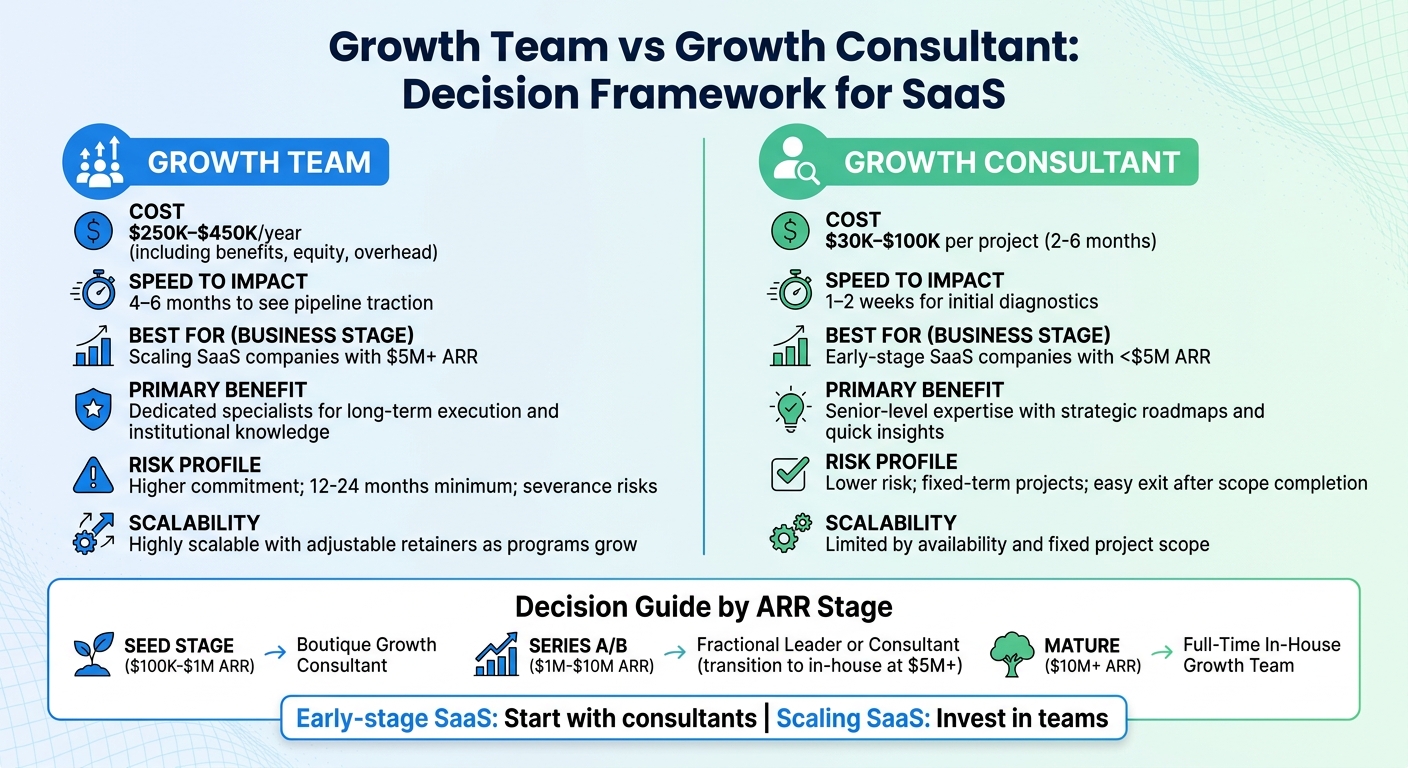
Growth Teams vs Growth Consultants: Core Differences
In-House Team vs External Expertise
The key distinction here lies in the type of knowledge each brings to the table. Consultants bring specialized skills and quick insights from working with multiple SaaS companies [1]. On the other hand, in-house teams develop a deep understanding of the company’s unique challenges and long-term goals [1]. As Nata Shved, COO at Brights, explains:
"Speed and direction matter to SaaS equally. You have to move fast while staying connected to what your users actually need, and be ready to change direction when the feedback demands it" [1].
Typically, SaaS companies rely on consultants for major early-stage decisions. Once the need for continuous execution grows, they often transition to hiring full-time team members [1].
Speed and Flexibility
One major advantage of consultants is their ability to hit the ground running. They can start delivering results within 1–2 weeks [7]. In contrast, hiring a full-time team member can take 2–4 months, with an additional 6–9 months for them to fully ramp up [1][7]. During this time, companies must cover salaries and benefits, which can be a significant expense for startups without immediate results.
Consultants also offer unmatched flexibility. Their involvement can scale up or down depending on the company’s needs - whether it’s preparing for a major fundraising round or solving a specific technical issue. In contrast, in-house teams, with fixed roles and schedules, may struggle to pivot quickly when new expertise is required.
Cost Comparison
The financial differences between consultants and in-house teams are striking. A full-time VP of Growth typically costs $250,000 to $450,000 annually, with total expenses (including benefits, taxes, equipment, and equity) often doubling or tripling the base salary [1][7]. Similarly, an in-house marketing manager costs $90,000 to $130,000 per year when all expenses are factored in [6].
Consultants, on the other hand, work on project-based fees or hourly rates. Early-stage projects lasting 2–3 months typically cost around $30,000, while larger 3–6 month engagements range from $50,000 to $100,000 [1]. Hourly rates vary between $150 and $500+, and strategy sprints or audits cost $15,000–$30,000 [2]. For companies with $1–5 million in ARR, hiring a consultant for 6–12 months can cost about the same as a full-time VP - but without the long-term commitment, severance risks, or recruiting costs.
Side-by-Side Comparison: Growth Teams vs Growth Consultants
Comparison Table
Here’s a breakdown of key differences to help you decide between hiring a growth team or a growth consultant. Each option serves distinct needs and priorities.
| Factor | Growth Team / Agency | Growth Consultant |
|---|---|---|
| Primary Benefit | Provides dedicated specialists for high-level execution; can start executing within 30 days [2]. | Offers senior-level expertise with strategic roadmaps and audits [2]. |
| Speed to Impact | Expect pipeline traction in 4–6 months with the full team in action [2]. | Initial diagnostics ready in 1–2 weeks; major systems built by months 2–3 [7]. |
| Scalability | Highly scalable, with retainers adjusting as programs grow [2]. | Limited by the consultant's availability and fixed project scope [2]. |
| Strategic Ownership | Account managers oversee relationships rather than specific outcomes [2]. | Provides clear strategic direction, often in 90-day sprints [8][2]. |
| Implementation | Handles full implementation, including technical fixes [2]. | Delivers a roadmap; execution is up to the client team [2]. |
| Cost Structure | Retainers range from $4,000–$6,000 for startups and $10,000–$20,000+ for enterprises [2]. | Project fees range from $5,000–$30,000 for audits/sprints, with ongoing advisory at $3,000–$8,000/month [2]. |
| Risk Profile | Requires a higher upfront commitment; a poor fit could result in 6–12 months of lost retainer fees [8][2]. | Lower risk for short-term projects; easy to exit after completing the defined scope [2]. |
| Best For | Ideal for Series A startups (pre-$5M ARR) with limited internal resources needing quick channel validation [2]. | Best for tackling specific issues (e.g., site migration, penalty recovery) or diagnosing stalled growth [2]. |
| SaaS Metrics Focus | Often emphasizes traffic and lead volume unless aligned with pipeline metrics [2]. | Prioritizes strategic KPIs like CAC, LTV, Net Revenue Retention, and Churn [5][8]. |
SaaS companies that use performance-based consultant agreements report 22% higher satisfaction with ROI compared to those using traditional retainer models [8]. This highlights the importance of aligning compensation with measurable outcomes. However, as April Dunford points out:
"Performance-based compensation works when you can clearly define and measure success. But it fails spectacularly when those definitions are ambiguous" [8].
The table above underscores the core distinction: growth teams focus on execution, while consultants concentrate on diagnosing and advising. Your choice depends on whether you need hands-on implementation or strategic direction. Use this comparison to align your decision with your business's current priorities.
How to Decide: 3 Key Factors
When it comes to choosing the right growth strategy, focus on three main factors: your business stage, budget, and speed. These elements act as a guide to help you make decisions based on where your company is right now, what resources you have, and how quickly you need results.
Your Current Business Stage
Early-stage SaaS companies (under $1M ARR) should consider working with consultants or agencies. At this stage, you're still figuring out product-market fit and need to conserve cash. Agencies can help you launch products 3–6 months faster while saving 30–50% upfront by avoiding the costs of salaries, benefits, and equipment [9].
Growth-stage companies ($1M–$5M ARR) are better suited for fractional leadership. As Preston Zeller, a Fractional Chief Growth Officer, explains:
"A fractional engagement can diagnose problems before you commit to a full-time hire" [7].
This approach gives you access to senior-level expertise without the hefty $200,000+ salary. It’s a great way to identify and fix broken systems while building a foundation for scaling.
Scaling companies ($5M–$10M+ ARR) should move toward building in-house teams. At this point, the complexity of your operations justifies hiring a full-time leader who can develop institutional knowledge and foster a long-term culture [7]. For companies at $50M+ ARR with strong organic channels (generating 35%+ of the pipeline), dedicated in-house directors are essential, while consultants can assist with specialized audits [2].
Budget and Available Resources
After identifying your business stage, assess your budget and resources to decide on the right investment. Hiring a full-time growth leader can cost 2–3 times their base salary when you factor in benefits, equity, and recruiting fees. For example, a $200,000 base salary can balloon to $400,000–$600,000+ in the first year, considering equity (0.5–2%), overhead (25–40%), recruiter fees ($40,000–$80,000), and onboarding time (3–6 months) [7].
Fractional engagements offer more flexibility, typically costing $120,000–$300,000 for 3–6 months. These arrangements allow you to pause or pivot without incurring severance or other exit costs [7]. However, consultants rely on your internal team for execution. If your engineering or content teams are too stretched to prioritize growth initiatives, a consultant’s strategy may sit idle, delivering little ROI. In such cases, an agency that manages full implementation might be a better fit [2].
Don’t forget tool costs. Agencies often include software (like Ahrefs or Clearscope) in their retainer, whereas hiring a consultant or in-house lead means you’ll need to purchase licenses separately - an expense that can run $10,000–$20,000 annually [2]. Finally, consider the time investment required from leadership. Fractional leads or consultants typically need 3–5 hours per week of strategic collaboration to succeed [2].
Testing Speed and Risk Tolerance
Speed matters in SaaS growth. Consultants can deliver results within weeks, while full-time hires often take months to ramp up. For early-stage companies (Seed to Series A), consultants can produce outcomes 3–4 times faster than relying on internal trial-and-error [1].
Your risk tolerance should also guide your decision. Consultants are a lower-risk option since their engagements are fixed-term. If the fit isn’t right, you can simply choose not to renew. In contrast, hiring in-house is a long-term commitment, often requiring 12–24 months. If an in-house hire doesn’t work out, you face significant exit costs, including severance, wasted time, and restarting a lengthy hiring process - setbacks that can hurt your growth trajectory [7].
As Preston Zeller puts it:
"Fractional is often the smarter first move - lower risk, faster start, and the option to upgrade later" [7].
A hybrid approach, like starting with a fractional consultant, can be effective. They can build systems and even assist in hiring and onboarding their full-time replacement, ensuring a smooth transition [7]. Matching your strategy to your company’s stage, resources, and appetite for risk can make all the difference in driving growth.
Examples: Which Option Fits Your SaaS Company
Building on our decision framework, here are examples to help you determine the best growth strategy for your SaaS company based on its stage of development.
Seed-Stage SaaS ($100K-$1M ARR)
At this early stage, resist the urge to hire a full growth team. Your primary focus should be refining your Ideal Customer Profile (ICP) and validating your value proposition through founder-led outbound efforts. For companies earning less than $5,000 MRR, founders should lead sales conversations before bringing in outside help [4].
Once you pass $5,000 MRR but remain under $15,000 MRR, hiring a boutique growth consultant is often a smarter investment than working with agencies or building a full team. Ankur Tiwari, Founder of Thoughtlytics, notes:
"Early-stage B2B SaaS companies under $15k MRR typically get better ROI from a boutique growth consultant than from a channel-focused agency" [4].
Boutique consultants take a comprehensive approach, addressing ICP alignment, messaging, and funnel bottlenecks instead of focusing on specific marketing channels. You can test your messaging affordably through cold outreach or LinkedIn DMs before committing significant funds - like $5,000 - on ads. A consultant can also help you address key issues, such as ensuring users reach their "Aha Moment" within 10 minutes or resolving pricing misalignment, before you scale [4]. This method prioritizes speed and efficiency, which are critical at this stage.
Series A/B SaaS ($1M-$10M ARR)
For companies in the $1M–$5M ARR range, this is a pivotal stage of growth. Hiring a fractional leader or consultant can help identify and address challenges before committing to a costly $200,000+ full-time hire. This approach reduces the risk of hiring mistakes while ensuring your growth systems are validated.
Take the example of a UK-based AI project management company at Series A. Organic traffic accounted for only 8% of their demo pipeline. Instead of building a full-time team, they hired an agency to audit their inbound strategy and revamp messaging around business outcomes. The result? Within one quarter, demo signups increased by 178%, and trial-to-paid conversions jumped by 62% [2].
Another B2B SaaS company dealing with fragmented data brought in a consultant to automate their reporting systems. Their marketing team had been manually exporting data for 10–12 hours each week. By using PostgreSQL and n8n, the consultant cut reporting time by 90%, from over 10 hours to just 60 minutes. This also uncovered cross-channel insights that allowed for smarter budget allocation [1].
As your company approaches $5M–$10M ARR, it’s time to start building an in-house team. Fractional leaders can help by crafting job descriptions for their full-time replacements and even assisting in the interview process. This phased approach ensures a smoother transition while balancing budget considerations and the need for dedicated strategic leadership [7].
Mature SaaS ($10M+ ARR)
Once your company surpasses $10M ARR, growth strategies need to evolve. At this point, the complexity of your operations demands hiring a full-time growth leader for consistent, long-term oversight.
A full-time leader brings advantages that consultants can’t match, such as institutional knowledge, cultural alignment, and the ability to build a strong team over time [7]. However, even mature companies can hit growth plateaus when their systems struggle to handle increased complexity. In these cases, hiring a growth consultant for a short-term engagement (3–6 months) can help realign your marketing, sales, and RevOps teams. After stabilizing your growth system, the consultant can hand it back to your in-house team [3]. This approach minimizes costly hiring errors and ensures the permanent team inherits a well-functioning system [7].
At this stage, growth efforts should go beyond acquiring new leads. Focus on improving Net Revenue Retention (NRR) by expanding within your existing customer base. To achieve this, your team must work from a unified CRM platform, like HubSpot or Salesforce, to maintain accurate forecasts and prevent silos between marketing, sales, and operations [3]. This strategy aligns with the need to balance your current business stage, budget, and long-term goals.
Conclusion
Deciding between a growth team and a growth consultant boils down to aligning your strategy with your company’s current stage and available resources. It’s about finding the right fit for your budget, capabilities, and growth priorities.
At its core, this decision hinges on three factors: where your business stands in its growth journey, what resources you can commit, and how quickly you need to experiment and adapt. For early-stage companies, consultants often provide specialized expertise at about one-quarter of the annual cost of a full-time VP [1]. As your company matures, building an in-house growth team becomes critical for long-term ownership and aligning with your company’s vision.
A common pitfall for SaaS companies is mismatching their growth strategy with their actual stage. Hiring too soon can deplete resources, while waiting too long can delay key insights. Often, combining both approaches works best - leveraging consultants to tackle immediate challenges and transitioning to an in-house team for sustained growth.
"Sustainable growth begins with alignment, not acceleration" [3].
Whether you opt for a growth consultant, a fractional leader, or an in-house team, your choice should reflect your company’s current reality - not just your aspirations. The right approach will address today’s hurdles, optimize your budget, and lay the groundwork for scalable success.
FAQs
What should I hire first: a growth lead, marketing, or RevOps?
The right first hire for your SaaS company depends heavily on where you are in your journey and what challenges you’re facing. Let’s break it down:
-
If you’re at $2M–$10M ARR and growth has plateaued: Bringing in a fractional growth lead could be the game-changer you need. They’ll focus on aligning your team’s efforts and driving strategic leadership to get things moving again.
-
If your focus is on improving onboarding, retention, or scaling ARR: A growth consultant might be the right choice. They can zero in on these specific areas and help you refine processes to boost performance.
-
If you’ve achieved product-market fit and are ready to scale marketing: This is the time to prioritize marketing expertise. Building a strong marketing foundation will help you expand your reach and attract more customers.
-
When aligning sales, marketing, and customer success becomes critical: RevOps (Revenue Operations) takes center stage. A RevOps specialist will ensure these teams work seamlessly together to drive sustained growth.
Each hire should address your most pressing challenge, ensuring your company continues to grow efficiently and effectively.
How do I know if a consultant’s plan will actually get executed?
To make sure a consultant’s plan is executed effectively, assess how well they can align their strategies with your team’s abilities and dedication. Focus on whether they outline clear milestones, establish accountability measures, and showcase evidence of follow-through in their previous work. Consultants who deliver practical, actionable plans, oversee execution, and provide consistent oversight are far more likely to drive successful implementation.
When is a hybrid approach better than choosing only one?
When a SaaS business is navigating growth or undergoing strategic changes, a hybrid approach can be the perfect solution. It combines the strengths of an in-house team with the specialized skills of external experts, making it especially useful for tackling challenges like stalled growth or refining go-to-market strategies - all while keeping internal operations running smoothly.
This approach shines during critical growth phases, as it enables quicker decision-making and bridges gaps in areas like strategic planning or technical knowledge. The result? A more agile and responsive team ready to handle complex challenges.
Related reading
- How your acquisition strategy influences your conversion rate
- How to A/B test pricing as a boostrapped company
- Upsell vs. Cross-Sell Metrics: Key Differences
- Digital Marketing Services
- What Is Strategy Consulting? (And when to hire a consultant to do it for you)
Useful tools & services
Locate the constraint in your funnel
Map the transitions so you can choose the next investigation or improvement.
Use the funnel templateNeed help choosing the next change? Explore CRO consulting.
Keep improving your conversion work.
Subscribe for practical ideas on diagnosing conversion problems, planning experiments, and choosing your next improvement.
No spam. Unsubscribe anytime.