SaaS Trial-to-Paid Conversion: Benchmarks and Tactics for Each Funnel Stage
Fix the weakest part of your trial funnel—signup, activation, engagement, or upgrades—to multiply SaaS trial-to-paid revenue.
SaaS trial-to-paid conversion is a critical metric for driving revenue. Improving this rate by just 1% can boost new revenue by 15%. Yet, most SaaS companies prioritize user acquisition over optimizing this funnel stage, despite the top 20% achieving conversion rates 10x higher than the bottom 20%.
Key insights:
- Median B2B SaaS conversion rate: 8% (2026 data).
- Top performers: 42%-55% conversion rates.
- Trial models matter: Opt-out trials (credit card upfront) convert 5x higher than opt-in trials but lower signups by 50%-70%.
- Conversion rates vary by industry, with CRM software (29%) and fintech (28%-32%) leading, while enterprise tools see the lowest rates (5%).
Strategies include:
- Simplify signups by reducing form fields and using social logins.
- Accelerate activation by guiding users to their "aha moment" within 3 days.
- Segment users by behavior to personalize engagement.
- Streamline upgrades with pre-filled forms and a SaaS pricing strategy built on value-driven prompts.
How To Increase Your Trial Conversions For Your SaaS
::: @iframe https://www.youtube.com/embed/Kv3olmGKVmw :::
SaaS Trial-to-Paid Conversion Benchmarks
::: @figure 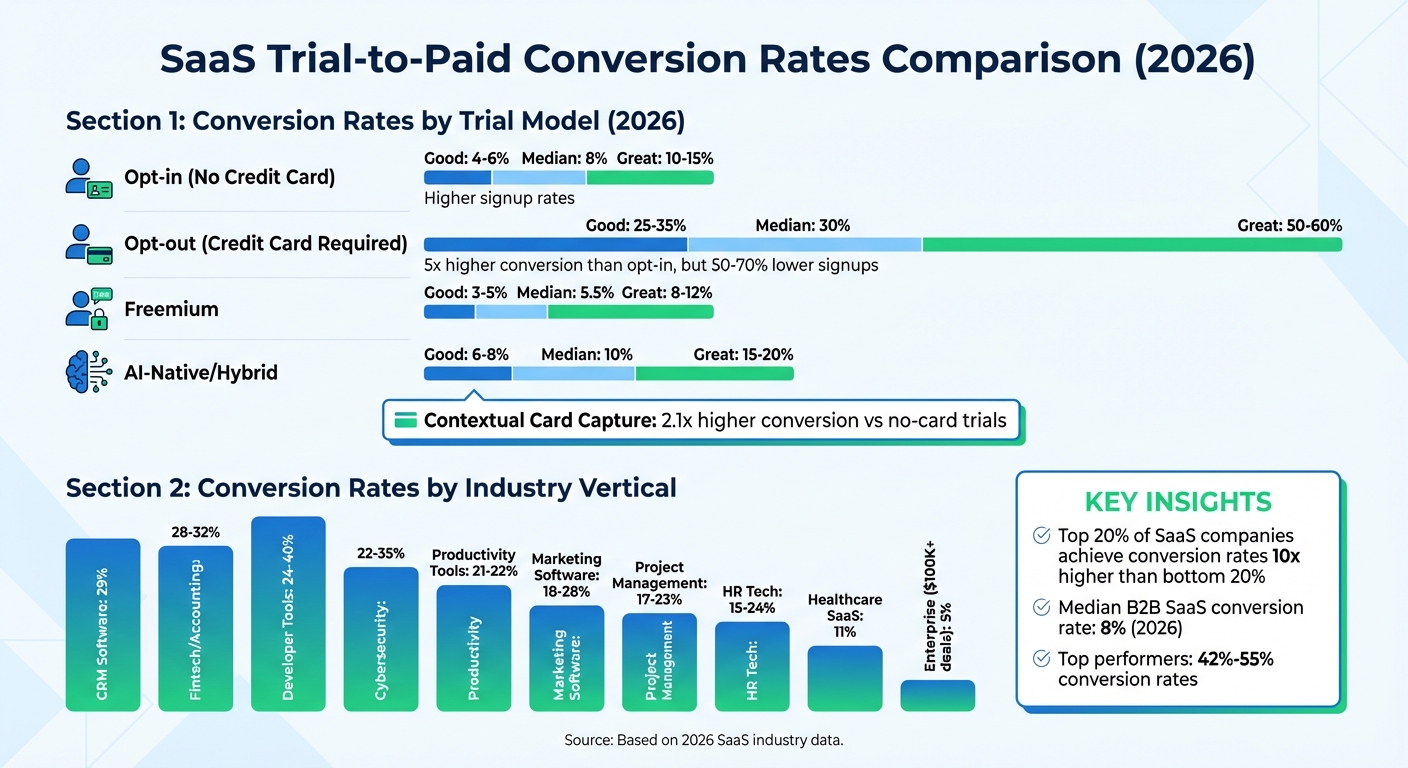 :::
:::
Let’s dive into how trial models and industry verticals can shape conversion rates. Knowing where your business stands compared to these benchmarks can help you determine if your challenges stem from performance gaps or mismatched expectations. Below, you'll find data on what qualifies as "good" and "great" conversion rates across various trial models and industries.
Conversion Rates by Trial Model
The type of trial you offer plays a major role in your conversion rates. For example, opt-out trials (where a credit card is required upfront) convert five times higher than opt-in trials (no credit card required) [5][2]. However, this approach can also slash signup rates by 50-70% [1][2][8].
Here’s a breakdown of the 2026 data:
| Trial Model | Good | Great | Median |
|---|---|---|---|
| Opt-in (No Credit Card) | 4-6% | 10-15% | 8% |
| Opt-out (Credit Card Required) | 25-35% | 50-60% | 30% |
| Freemium | 3-5% | 8-12% | 5.5% |
| AI-Native/Hybrid | 6-8% | 15-20% | 10% |
A newer strategy called contextual card capture has gained traction. Instead of asking for payment details during signup, this method requests them at key usage milestones. The result? It delivers 2.1 times higher conversion rates compared to no-card trials [10], while still maintaining better signup numbers than traditional opt-out models.
"There is no single correct model. Instead of debating whether you should have a free trial vs. freemium model, focus on your user's desired outcome and their challenges, then arm them with everything they need to succeed." – Wes Bush, CEO & Founder, ProductLed [2]
Conversion Rates by Industry Vertical
Conversion rates also vary widely depending on the industry. Factors like buyer expertise, decision-making complexity, and urgency all play a role. For instance, technical buyers (such as developers) often convert at double the rate of business buyers because they can more quickly assess the product's value [10][3]. On the other hand, enterprise tools requiring multiple approvals - IT, finance, legal - tend to see lower conversion rates [7][10].
| Vertical | Median Conversion Rate |
|---|---|
| CRM Software | 29% |
| Fintech/Accounting | 28-32% |
| Developer Tools | 24-40% |
| Cybersecurity | 22-35% |
| Productivity Tools | 21-22% |
| Marketing Software | 18-28% |
| HR Tech | 15-24% |
| Project Management | 17-23% |
| Healthcare SaaS | 11% |
| Enterprise ($100K+ deals) | 5% |
Products tied to revenue generation or risk reduction - like marketing automation or cybersecurity solutions - tend to have stronger conversion rates because they address urgent business needs [7]. However, as the Annual Contract Value (ACV) increases, conversion rates drop. For example, products priced under $500 convert at 22%, while those over $100,000 see rates as low as 5% [10].
Signup Stage: Getting More Trial Starts
With 55% of trial cancellations happening on Day 0 [5], your signup process needs to do more than gather information - it must guide users toward meaningful actions right away.
The data highlights a clear trade-off between signup volume and the quality of conversions. Opt-in trials (no credit card required) convert 8.5% of visitors into signups, but only 18.2% of those become paying customers. On the other hand, opt-out trials (credit card required) see just 2.5% of visitors signing up, but a significant 48.8% of those convert to paid users. When comparing the overall impact, credit-card-required trials result in 10.5 paying customers per 1,000 visitors, compared to just 3.6 for no-card trials [3]. Requiring a credit card upfront acts as a filter, attracting more serious potential buyers.
To maximize these critical early interactions, focus on reducing friction and ensuring the signup flow aligns with user intent.
How to Reduce Signup Friction
The length of your signup form can directly affect revenue. For example, shortening a form from 15 fields to just 3 can reduce drop-offs by over 50% [11].
"Reducing your signup form from 15 fields to 3 is a revenue decision more than a design one" [3].
Social logins and Single Sign-On (SSO) simplify the process further. Allowing users to log in with one click using accounts like Google, LinkedIn, or Microsoft removes a major hurdle [6]. For B2B products, SSO also accelerates team adoption by letting users authenticate with their existing work credentials.
Another effective strategy is contextual card capture - asking for payment details at a decisive moment in the signup process. This approach can improve conversion rates by 2.1× compared to trials that don’t require a card [10].
Finally, customizing your signup flow to match user intent can drive even better results.
Matching Signup Flows to User Intent
Not all signups come from the same level of intent. High-intent channels like direct traffic and referrals convert at rates of 42% and 38%, respectively, while social media signups lag behind at just 12% [10]. Your signup process should reflect these differences.
For high-intent users - those arriving via direct searches or referrals - removing all unnecessary steps is key since they already know what they want. On the other hand, users from lower-intent channels like social media or display ads benefit from a more guided approach. Adding two or three qualifying questions can help direct them to a tailored onboarding experience. Teams that implement this kind of segmentation see conversion rates 2.4× higher than those using generic signup flows [10].
VoiceDrop is a great example of this in action. By switching from generic messaging to outcomes-focused headlines, reducing form fields, and incorporating targeted social proof, they boosted trial signups and increased their trial-to-paid conversion rate from 12% to 57% [4].
The first few minutes of a user’s experience are critical - research shows that the "aha moment" often occurs within just 7 minutes of their first session [3]. Any friction during signup that delays this moment increases the risk of abandonment. Your signup process should aim to lead users directly to a meaningful action, not a generic product tour or an empty dashboard.
Activation Stage: Helping Users Find Value Fast
After simplifying signups, the next critical step is ensuring users quickly discover your product's value. This "aha moment" happens when users grasp how your product solves their problem [12]. Here's why it matters: a 10% boost in trial activation rates can lead to a 7.3% rise in paid conversions [9].
Timing is everything. When users engage with key features within the first three days, their likelihood of converting increases fourfold. But even small delays make a difference - just 10 minutes of hesitation can reduce conversions by 8%. Missing that crucial three-day window? It slashes activation chances by a staggering 68% [3][9][10].
While the median SaaS activation rate hovers around 52%, top performers hit 85% or more [10]. The difference lies in how effectively users are guided toward their first meaningful success.
With speed in mind, the next step is defining the right activation metrics.
How to Define and Measure Activation
Activation isn't about surface-level actions like logging in. It's about identifying key behaviors that predict whether users will stick around long-term [12][9].
Take Slack, for example. They found that teams sending 2,000 messages unlocked the value of searchable history, making them almost guaranteed to convert into paying customers [12]. Similarly, Facebook realized that users who added seven friends in their first 10 days were far more likely to stay engaged. This insight led to features like friend suggestions and contact imports [12]. For Dropbox, activation meant uploading at least one file to one device, so they redesigned onboarding to prioritize this action [12].
Your product's activation event will depend on its core value. For instance:
- Analytics tools: Viewing the first report.
- Collaboration software: Inviting a teammate.
- Automation platforms: Completing the first workflow.
The goal is to pinpoint the action that correlates most strongly with retention and paid conversions.
Of course, product complexity plays a big role in how quickly users activate. Simple products often see 42% activation on Day 0, while technical tools requiring integrations may only hit 2% [9]. This doesn’t spell doom for complex solutions - it just means expectations and onboarding need to adapt.
| Product Complexity | Day 0 | Day 3 | Never Activate |
|---|---|---|---|
| Simple (1-step) | 42% | 12% | 10% |
| Medium (2-5 steps) | 18% | 22% | 8% |
| Complex (6+ steps) | 5% | 28% | 12% |
| Technical (needs integration) | 2% | 21% | 14% |
Once you've defined the key activation events, the next focus is streamlining onboarding to help users hit those milestones quickly.
Onboarding Tactics That Speed Up Activation
Top-performing companies aim to deliver value within the first 10 minutes [9][10]. A great example: In August 2025, Athenic revamped their onboarding process by reducing steps from 12 to 7, adding Google SSO, and introducing a "Quick Win" path with pre-built templates. The results? Median time-to-activation dropped from 8.2 days to just 1.6 days, while activation rates soared from 42% to 81% [13].
Here are a few proven strategies to accelerate activation:
- Pre-fill workspaces with demo data and templates so users immediately see what success looks like - no extra effort required.
- Use progressive disclosure to avoid overwhelming users. Focus only on the features needed for the current step, and save things like profile customization or notification settings for later [12].
- Trigger contextual help based on user actions. For instance, if someone connects data but hasn’t run a report yet, send targeted guidance to nudge them forward [12][4].
Timing matters, too. Users who reach their "aha moment" within 48 hours are 3.4 times more likely to convert to paid plans than those who take a week or more [13].
Finally, leverage psychology to keep users engaged. Progress indicators - like a visual bar showing "3 of 5 steps complete" - tap into the Zeigarnik effect, which drives people to finish incomplete tasks. And when users hit milestones, celebrate with subtle in-app messages like "You've created your first project!" to reinforce their progress [6][4].
Engagement Stage: Keeping Trial Users Active
Getting users to sign up is one thing - keeping them engaged is where the real effort begins. Here's the reality: nearly 60% of free-trial users drop off before Day 3, and only about 20% reach activation [6]. To combat this steep drop-off, you need targeted engagement strategies.
Frequent engagement is a game-changer. Users who interact with the product 3 or more times in the first week are 3–5x more likely to convert than those who only engage once [14]. The secret lies in behavioral segmentation. Instead of grouping users by demographics, divide them into cohorts based on their activity levels - like "not activated", "low usage", and "power users." This approach allows you to craft engagement flows that feel personalized and relevant [14].
"Users aren't failing to pay. They're failing to experience enough value to justify paying." - Ronald Davenport, Lifecycle Architect [14]
Timing is everything. Focus your efforts on moments when users are experiencing value - such as completing a project or hitting a milestone. Behavioral triggers, like these, outperform traditional calendar-based email tactics by 67% [10].
How to Deliver Ongoing Value During Trials
Once you've activated a user, the next challenge is keeping them engaged. The key is to consistently reinforce the value of your product. For example, send mid-trial emails around Day 8–10 that highlight their actual usage data. Instead of generic updates, show them how your product is making a difference. A message like, "You've automated 12 workflows this week", is far more impactful than a list of features they haven’t used [15].
Streamline your communications during the trial. If a user hasn’t been active for 24 hours, send a "need help?" email. For power users, you can accelerate upgrade messaging. These small adjustments can boost engagement by 60% [15].
In-app notifications also play a big role. Contextual messages, like "Upgrade to Unlock" banners, should appear when a user hits 70% of a feature or usage limit. These notifications work because they target users at the exact moment they’re showing high intent to upgrade [6].
Building Retention Loops
As the trial period winds down, retention loops can help keep users engaged and moving toward conversion. For example, daily nudges or milestone celebrations can encourage habitual usage.
Strategic trial extensions are another effective tactic. Instead of offering extensions to everyone, focus on engaged users who haven’t converted yet. This keeps high-intent users in the funnel without creating an expectation of free extensions for inactive users [3].
Toward the end of the trial, leverage loss aversion. Instead of cutting off access completely, offer limited functionality to highlight what they’ll miss if they don’t upgrade. Remind users of the specific data or workflows they’ll lose access to [15].
Zendrop’s experience is a great case study. In February 2026, they revamped their trial-to-paid process by focusing on faster activation and habit-building triggers, like encouraging 3+ uses in the first week. The result? Their trial conversion rate jumped from 20% to 28%, leading to a 366% year-over-year revenue increase across 4 million users [14].
Conversion Stage: Getting Trial Users to Pay
After successfully activating and engaging users, the next step is learning how to convert free trial users into paying customers. This phase is all about removing any remaining obstacles and turning their engagement into revenue. On average, the trial-to-paid conversion rate for B2B SaaS companies is 18.5%, but top-performing companies often hit rates above 25%. How? By focusing on two things: reducing friction and reinforcing value when users are ready to commit.
How to Simplify the Upgrade Process
Every extra step in the checkout process can cost you conversions. Did you know that cutting just three fields from a payment page can increase conversions by 8%? [3] That's why it's crucial to make the upgrade process as smooth as possible. Pre-fill known details like a user’s name, email, and company to save them time, and keep the required fields to a minimum.
Timing also matters. Instead of asking users to upgrade on a fixed calendar date, trigger payment requests at moments when they’re experiencing the most value. For example, prompting an upgrade right after a user completes their first project or hits a major milestone can boost conversions by 258% compared to time-based prompts [4].
"The moment a user decides to upgrade, nothing should slow them down. Auto-fill what you can. Minimize steps. Make the decision feel easy to execute." – PulseAhead [3]
Using Value Recaps to Drive Conversions
As a trial period nears its end, send users a recap of their successes within the product. A 24–48 hour summary that highlights their achievements - like "12 automated workflows" or "8 hours saved" - can reinforce the value they’ve gained [16][14].
Loss aversion can be a powerful motivator. Instead of simply promoting features, focus on what users stand to lose if they don’t upgrade. This could include losing access to their data, completed projects, or the results they’ve achieved so far. Position the upgrade as a way to protect their progress rather than just another purchase [14].
For users who don’t convert right away, follow up within 7–14 days after their trial expires. Tailor these messages based on their behavior. For instance, a highly engaged user might receive a message emphasizing what they’re missing out on, while a less active user could get updates about new features or improvements they’d find valuable [14].
Conclusion
Turning trial users into paying customers means fine-tuning every part of your funnel - signup, activation, engagement, and conversion. The numbers speak for themselves: even a small 1% improvement in trial-to-paid conversion can lead to a 15% boost in new revenue [3]. Whether you're running opt-in trials with an average conversion rate of 18.2% or opt-out trials at 48.8%, understanding your position helps you zero in on areas that need attention [3].
The strategies we've outlined - like reducing signup friction, delivering value within the first 10 minutes, creating retention loops, and streamlining upgrades - work together to drive success. Take VoiceDrop as an example: by optimizing their signup and activation processes, they skyrocketed their conversion rate from 12% to 57%, increased monthly revenue by 376%, and slashed customer acquisition costs by 79% [4].
"Active testing and iteration are what separate the products that convert from the ones that don't." – Randy Wattilete, Founder, Kirro [5]
The secret lies in constant iteration. Users who engage with key features within their first three days are four times more likely to convert than those who don't [3]. And every 10% improvement in trial activation leads to a 7.3% increase in paid conversions [9]. These small, consistent tweaks add up - initial changes might deliver a 200-375% boost, but sustained monthly improvements can compound into a 500-800% increase over 12-18 months [4].
The formula is simple: identify your biggest weak spot - whether it's users abandoning on Day 0, slow activation, or upgrade roadblocks - and fix it. Track the results, then tackle the next issue. You don’t need a complete product overhaul to see results. Instead, focus on delivering faster time to value during those critical first seven days [3].
FAQs
::: faq
Which trial model should I choose for my SaaS?
The best trial model for your SaaS hinges on your target audience, the complexity of your product, and your overall objectives.
- Opt-in trials (no payment upfront) are great for drawing in a larger number of users, though they typically show lower conversion rates - around 8.5%.
- Opt-out trials (credit card required) tend to deliver higher conversion rates, sometimes reaching 25%, but they also discourage some users from signing up.
- Freemium models are ideal for products that thrive on viral growth, although their conversion rates usually fall between 2-5%.
Choose a trial model that aligns with your product's characteristics and your growth strategy. :::
::: faq
What’s the best activation metric for my product?
The best activation metric is the one that truly captures meaningful engagement and shows that users are progressing toward finding value in your product. A popular option is tracking the percentage of users who hit the "aha moment" - that point when they clearly see the core value your product offers. Other helpful metrics might include the number of sign-ups that complete onboarding, trial users actively using key features, or users maintaining consistent session activity. The key is to pick a metric that aligns directly with your product’s unique value and purpose. :::
::: faq
How do I raise conversion without cutting trial signups?
If you're looking to turn more trial users into paying customers without cutting back on signups, the key lies in refining the trial experience itself. Here’s how you can make it happen:
- Streamline onboarding: Make sure new users see the value of your product fast. A smoother onboarding process helps users understand how your product solves their problems right away.
- Reduce time to first value: Aim to deliver noticeable value within the first 10 minutes. The quicker users experience benefits, the more likely they are to stick around.
- Use behavioral triggers: Instead of relying on generic, calendar-based reminders, leverage user behavior to send tailored prompts. For example, if someone hasn’t explored a key feature, nudge them toward it.
Another critical step? Boosting activation rates. This means getting users to engage meaningfully with your product early on. You can do this through:
- Personalized onboarding: Tailor the experience to each user’s needs and goals.
- In-app messaging: Provide helpful tips or suggestions while users navigate your platform.
- Fast access to key features: Don’t make users dig around - highlight the most impactful features upfront.
By focusing on these strategies, you can create a trial experience that not only engages users but also encourages them to convert into paying customers. :::
Related reading
- How your acquisition strategy influences your conversion rate
- How to A/B test pricing as a boostrapped company
- Upsell vs. Cross-Sell Metrics: Key Differences
- Digital Marketing Services
- What Is Strategy Consulting? (And when to hire a consultant to do it for you)
Useful tools & services
Go deeper than any blog post.
The full system behind these articles—frameworks, diagnostics, and playbooks delivered to your inbox.
No spam. Unsubscribe anytime.