Affiliate disclosure: Apollo may pay Artisan Strategies a commission if you purchase through the affiliate links in this article.
The SaaS Monetization Audit: Are You Leaving Revenue on the Table
A 5-step monetization audit to find pricing leaks, optimize tiers, and boost SaaS revenue and retention.
Are you leaving money on the table with your SaaS pricing strategy? Most SaaS companies are. A quick 1% improvement in pricing can boost profits by 11%, yet many businesses rarely revisit their pricing models. This guide offers a 5-step framework to help you identify revenue leaks, optimize pricing, and grow your bottom line.
Key Takeaways:
- Track Revenue Metrics: Focus on ARR, NRR, GRR, churn rate, and CAC payback period. Compare them to industry benchmarks to find gaps.
- Audit Pricing Models: Align pricing with customer value. Hybrid and usage-based models are on the rise, offering flexibility and growth potential.
- Optimize Tiers: Ensure tier structures encourage upgrades without creating churn risks. Use soft limits and add-ons to smooth transitions.
- Expand Revenue: Upsell and cross-sell to existing customers. Expansion revenue is cheaper to generate and should contribute 30–40% of ARR growth.
- Reduce Churn: Address pricing-related churn by improving onboarding, offering annual plans, and communicating ROI effectively.
Regular monetization audits can uncover missed opportunities and ensure your pricing evolves with customer needs. Let’s dive into the details.
How To Run A SaaS Pricing Project (4 Step Strategy)
Step 1: Measure Your Core Revenue Metrics
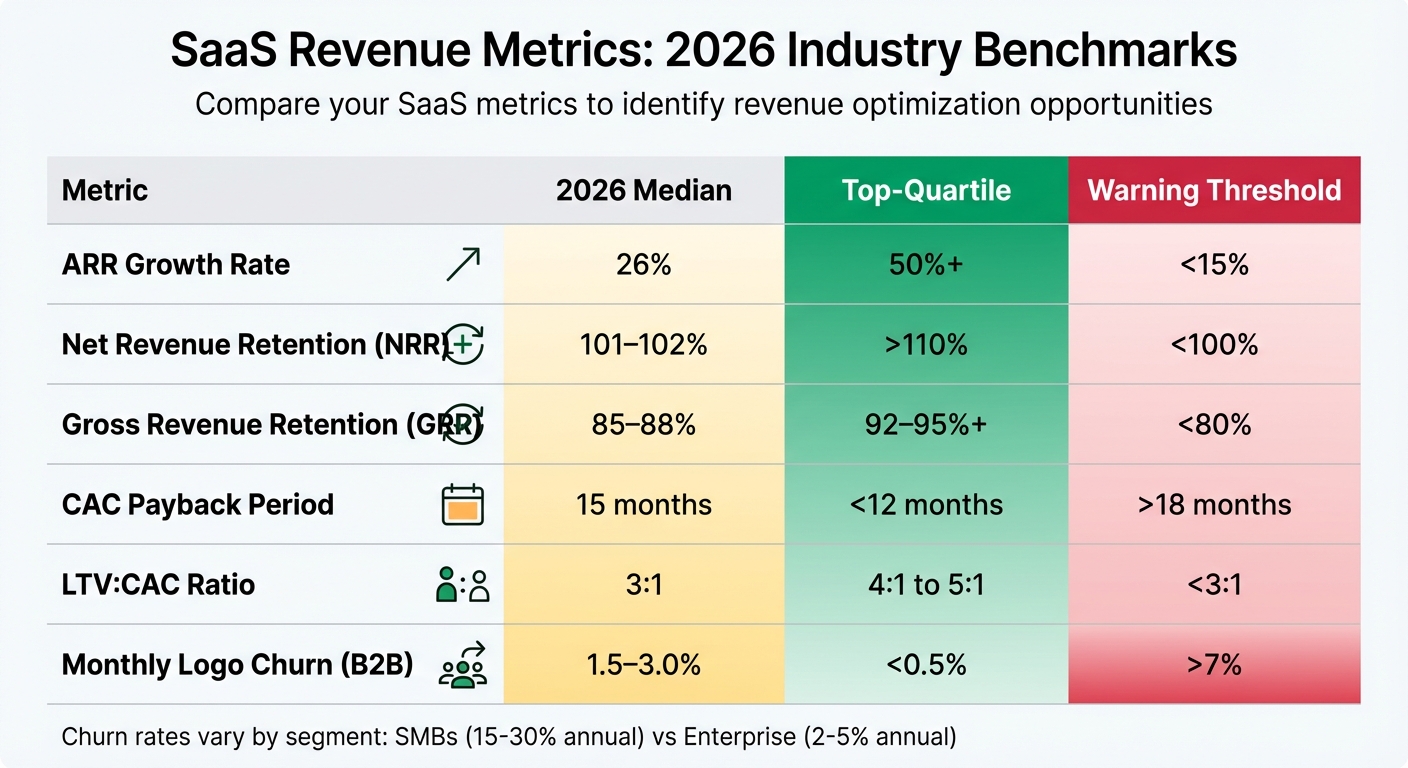
Before you can address revenue leaks, you need to assess your current monetization health. This involves tracking key financial metrics that reflect your company's performance. It's not about counting users - it's about understanding how well your business generates and retains revenue.
Which Metrics to Track
Here are the metrics you should focus on:
-
Annual Recurring Revenue (ARR): This measures predictable income, giving you a snapshot of your revenue base. However, it doesn't address how efficiently you're growing or managing costs.
-
Net Revenue Retention (NRR): Often considered the most critical metric for predicting valuation, NRR shows how much revenue you're retaining and expanding from existing customers. If your NRR is above 100%, you're growing even without new customers. Companies with NRR over 130% often achieve valuation multiples of 15–20× forward revenue, while those under 100% may only see 3–5× [1].
"NRR is the single metric that most predicts valuation multiples. If you are a founder preparing for a raise, improving NRR by 10 points may add more to your valuation than doubling new logo acquisition."
– Bruno Ueda, Co-Founder, PipelineRoad [1] -
Gross Revenue Retention (GRR): This shows how much revenue you retain without factoring in expansion. GRR under 80% suggests a serious retention issue that expansion revenue might be masking [2].
-
CAC Payback Period: This metric tells you how long it takes to recoup the cost of acquiring a customer. The 2026 median is 15 months, with top-performing companies achieving under 12 months. Anything over 18 months signals inefficiency [2].
-
Churn Rate: This is the silent threat to recurring revenue. Track both logo churn (customers leaving) and revenue churn (revenue lost). Most churn - 60–70% - happens within the first 90 days, making onboarding crucial [1]. Also, distinguish between voluntary churn (customers canceling) and involuntary churn (e.g., failed payments). Involuntary churn often accounts for 20–40% of total churn and can be reduced with automated dunning processes [1].
Once you've gathered these metrics, compare them to industry benchmarks to identify where you might be falling behind.
How Your Numbers Compare to Industry Standards
Benchmarking your metrics against industry standards helps you pinpoint areas for improvement.
| Metric | 2026 Median | Top-Quartile | Warning Threshold |
|---|---|---|---|
| ARR Growth Rate | 26% [2][3] Apollo* | 50%+ [2] | <15% |
| Net Revenue Retention (NRR) | 101–102% [4] | >110% [4] | <100% |
| Gross Revenue Retention (GRR) | 85–88% [2][3] Apollo* | 92–95%+ [2][3] Apollo* | <80% |
| CAC Payback Period | 15 months [2] | <12 months [2] | >18 months |
| LTV:CAC Ratio | 3:1 [2] | 4:1 to 5:1 [2] | <3:1 |
| Monthly Logo Churn (B2B) | 1.5–3.0% [1] | <0.5% [1] | >7% |
*We may earn a commission from purchases through these links.
Keep in mind that churn rates vary by customer segment. SMBs (under $15,000 ACV) often experience annual churn rates of 15–30%, while Enterprise customers (over $100,000 ACV) typically see just 2–5% churn [1][4]. Blending these segments can distort your analysis - a 10% churn rate might be acceptable for SMBs but disastrous for Enterprise accounts.
For example, in 2024, TestGorilla, an HR tech company, achieved an impressive CAC payback period of just 80 days. This level of efficiency played a key role in their $70 million Series A funding round [4].
Step 2: Review Your Pricing Model
Your pricing model directly impacts how much revenue you can generate from customers. If your model doesn’t align with customer value, you could be missing out on as much as 20–40% of potential revenue [5]. The goal is to match what you charge with how customers perceive your product’s value - and ensure your pricing scales alongside their growth.
Most SaaS companies adopt one of four pricing models: flat-rate (a single price for everything), per-seat (charging per user), usage-based (charging based on consumption), or hybrid (a combination of a base fee and variable charges). Each approach comes with its own set of trade-offs.
"Pricing is the single most impactful lever for SaaS revenue growth. A 1% improvement in pricing increases profits by 11% on average."
– Emily Watson, Technical Writer and Developer Advocate [5]
The trend is shifting toward hybrid and usage-based models. By 2026, 61% of SaaS companies are expected to incorporate a usage-based component, compared to just 34% in 2021 [5]. This shift reflects a move away from rigid pricing structures toward models that better align costs with customer value.
Pros and Cons of Each Pricing Model
Choosing the right pricing model requires understanding its strengths and weaknesses. Here’s a quick breakdown:
| Pricing Model | Pros | Cons | Best For |
|---|---|---|---|
| Flat-Rate | Simple to communicate and predictable revenue | Limits upselling opportunities and may leave money on the table with heavy users | Early-stage products with straightforward value |
| Per-Seat | Easy for customers to budget; scales with team size | Can discourage adoption and lead to seat-sharing | Collaboration tools or CRM platforms |
| Usage-Based | Aligns cost with usage; lowers entry barriers | Revenue can fluctuate and may cause "bill shock" | APIs, infrastructure, and data-heavy platforms |
| Hybrid | Balances predictable revenue with growth potential | Requires advanced billing systems and usage tracking | Mature SaaS with diverse customer needs (typically $10M+ ARR) |
These trade-offs are evident in real-world examples, like DocuSign and New Relic.
Take DocuSign, for instance. In 2022, they transitioned from a purely usage-based pricing model (charging per envelope sent) to a feature-tiered subscription model. This shift helped grow revenue from $469 million in Q1 2022 to $675 million by Q4 2023, while boosting customer retention from 85% to 92% [6]. It’s a clear example of how the right pricing strategy can fuel both growth and loyalty.
On the other hand, New Relic’s pivot in July 2020 from host-based subscriptions to a consumption model (charging $0.25 per GB of data ingested, plus per-seat fees) initially caused a 30% drop in stock value. However, this change enabled them to grow account numbers and increase data usage, as customers benefited from more cost-effective monitoring [6].
The key takeaway? Your pricing model should reflect how customers gain value from your product. For example, if collaboration is the primary value driver, a per-seat model might make the most sense.
When to Consider Hybrid Pricing
Hybrid pricing, which combines a fixed fee with variable charges, is increasingly popular among SaaS companies generating over $10M ARR [5]. It provides a stable revenue base while allowing growth as customers use more of the product.
For enterprise customers, hybrid pricing often breaks down as 70% fixed and 30% variable; for mid-market, it’s typically 50/50; and for high-volume customers, it shifts to 30% fixed and 70% variable [10].
Take HubSpot, for example. They charge a $45 monthly base fee, plus per-contact pricing for marketing contacts. Similarly, GitHub offers a $4 per user monthly fee, with additional charges of $0.008 per compute-minute for Actions [5]. These models ensure predictable recurring revenue while capturing extra value as usage grows.
Zoom’s experience with hybrid pricing also highlights its potential. In 2021, they introduced the "Zoom One" bundle, consolidating over 11 add-ons into streamlined plans. This move helped them achieve a 115% net dollar retention rate in their enterprise segment and a 27% year-over-year increase in customers spending over $100,000 by FY2024 [6]. To avoid "bill shock", Zoom implemented automated usage alerts at 50%, 75%, and 90% of included thresholds - a smart way to maintain customer trust [10].
If you notice wide variations in customer usage, or if your product’s value scales with consumption (like API calls or data processed), hybrid pricing could be the way forward. However, transitioning to this model requires robust real-time usage tracking and sophisticated billing systems [10].
Interestingly, 86% of SaaS companies valued above $100 million now use at least three dimensions in their pricing structures. Companies with multi-dimensional models report 34% higher LTV/CAC ratios [8]. If your pricing still relies on a single variable, you might be leaving significant revenue untapped.
This step lays the groundwork for identifying even more revenue opportunities as part of your SaaS monetization strategy.
Step 3: Check Your Value Metrics and Tier Structure
Your value metric plays a crucial role in driving revenue growth. It aligns pricing with customer outcomes, scales with usage, and should remain straightforward to measure [11]. When this alignment is off, it creates "price walls", which can lead to churn [13].
One common misstep? Choosing a metric that discourages the very behavior your product is meant to promote. For instance, charging per message in a collaboration tool could discourage communication - the key action that makes the tool worthwhile [11][9]. Instead, your value metric should encourage usage that leads to customer success.
To evaluate your current approach, map out the "Customer Value Path." This means identifying the primary business outcomes your product delivers, such as revenue growth, cost savings, or time saved [11]. Then, assess your metric on a 1–5 scale across five key dimensions: value alignment, simplicity, measurability, predictability, and capacity for expansion [11]. A low score might indicate untapped revenue opportunities.
"The right SaaS pricing metric is the one that tightly correlates with customer‑perceived value, is easy to understand and measure, and can scale with usage."
– Monetizely [11]
Healthy SaaS companies typically see Expansion MRR contribute 30–40% of total revenue growth [13]. If your numbers fall short, your tier structure might be the issue. A well-designed tier system uses "Strategic Headroom", meaning most customers reach 60–70% of their tier capacity within 12 months. This encourages natural expansion conversations without creating forced urgency [13].
From here, review your tier limits and add-on structure to ensure smooth transitions as customers grow.
Review Your Tier Limits and Add-Ons
Start by auditing each tier's limits and gates. If customers frequently hit a limit but choose not to upgrade, this signals a churn risk rather than an opportunity for expansion [13].
Take Airtable as an example. In February 2026, a pricing audit revealed that its Business tier, priced at $54/month, scored 4.7/10 on price perception despite its features being rated 10/10. The issue? A steep 2.25x price jump from the Team tier ($24/month) without sufficient justification, especially compared to competitors like NocoDB ($24/month) and SeaTable ($14/month) [12].
Price increases over 2x between tiers require strong feature justification to avoid negative reactions [12]. If you're seeing resistance at a particular tier, ask yourself if the value increase aligns with the price - or if features need to be redistributed.
For limits that customers occasionally exceed without impacting your infrastructure, consider using soft limits (e.g., warnings or throttling) instead of hard stops. Soft limits allow for organic growth and open the door to upgrade conversations without disrupting service [13]. Save hard limits for features tied to direct infrastructure costs or those that define tier differences.
Add-ons can help ease the upgrade path while capturing extra revenue. Use dashboards to show customers their usage against limits, and send proactive notifications when they hit 75% of their capacity. This way, upgrades won't come as a surprise [13].
Once your tier limits are optimized, the next step is ensuring your pricing reflects the value customers derive.
Match Pricing to Customer Value
Your pricing should align with how customers measure their own success. For example, sales teams might value pricing based on seats, merchants on transactions, and infrastructure platforms on usage [13][11]. Misaligned value metrics often leave customers feeling overcharged.
A great example comes from a B2B analytics SaaS, which raised its price from £29/month to £149/month in 2025 after discovering that the product saved customers 15 hours per week - worth approximately £1,500. While the conversion rate dropped slightly from 18% to 14%, the 5.1x increase in revenue per customer made up for the loss in volume, resulting in a 314% MRR boost within six months [14].
Similarly, a B2B marketing automation SaaS saw MRR grow from £40K to £127K (a 218% increase) over six months by shifting from a flat £99/month "Pro" plan to a contact-based model (£49/£149/£399). This change increased revenue per customer from £62 to £108 [14].
The key is making sure your Customer Lifetime Value (LTV) is 3–5x the annual price. If your product doesn’t deliver proportional value - whether in time saved, revenue generated, or costs reduced - customers won’t find the price sustainable [14]. Conduct willingness-to-pay interviews with 15–20 prospects to confirm your pricing reflects the value customers perceive.
For businesses with diverse customer segments, hybrid models combining a base platform fee with usage-based components can strike a balance between predictability and growth potential [13][11].
Step 4: Find Upsell, Cross-Sell, and Expansion Opportunities
Optimizing your pricing model is important, but tapping into additional revenue streams from current customers can be just as impactful. Did you know that expansion revenue is significantly more cost-efficient than acquiring new customers? On average, it costs $1.18 to generate $1 from expansion revenue, compared to $1.68 for new customer acquisition [16]. Despite this, 90% of SaaS companies make critical pricing mistakes that cost them 20–40% of potential revenue [17]. Often, these losses stem from missed opportunities for growth within their existing customer base.
The best-performing SaaS businesses consistently generate 30–40% of their new Annual Recurring Revenue (ARR) from current customers, maintaining a Net Revenue Retention (NRR) rate of over 120% [15][16]. If your metrics don’t measure up, it’s likely you’re missing key insights in your customer data or haven’t implemented a clear expansion strategy.
Use Customer Data to Spot Revenue Opportunities
Customer data holds the key to identifying untapped revenue. For instance, set triggers to monitor when customers hit 80% of their tier capacity or frequently request features available in higher tiers [15]. Dive into win/loss data and feature requests to spot patterns. If customers repeatedly ask for higher-tier functionalities or hesitate to upgrade despite hitting usage limits, it could point to pricing issues or a need to better communicate the value of upgrading.
Before suggesting an upgrade, focus on documenting the return on investment (ROI) and benchmarking how customers are currently using your product [15]. Show them the tangible benefits of moving to a higher tier. For example, if your tool is saving them time, calculate that in dollar terms to illustrate the value. However, avoid upselling too early - customers need to experience the full value of their current tier first [15].
These insights can help you design more effective expansion strategies.
Build Data-Driven Expansion Plans
Using these customer signals, create expansion plans that align naturally with their growth. Design tiers that scale based on value - such as Starter, Professional, and Enterprise - so upgrades feel like a logical next step, not a forced move [15]. Frame the upgrade as an opportunity rather than a cost, and highlight what they might be losing by not upgrading. For instance, if a customer is manually exporting data because of limited API access, show how much time and effort they could save with a higher tier.
Customer success teams play a big role here. Companies with dedicated expansion teams in Customer Success see a 28% boost in net retention, with CS-led models achieving 15–30% higher NRR [15][16]. Train your CS teams to adopt a consultative approach and work closely with sales to ensure the expansion process feels seamless.
Incorporate Product-Led Growth (PLG) strategies by using in-app tools like usage meters and highlighting premium features within the basic experience. This reduces friction and makes upgrading feel like a natural decision [16]. Take Artisan Strategies as an example - they increased checkout conversions by 47% after improving their pricing and onboarding processes to clarify the upgrade path.
When structuring your tiers, reserve advanced features - like enhanced security or robust analytics - for higher plans, but ensure that base tiers still offer essential functionality [15]. Avoid "feature withholding", where basic features are arbitrarily restricted to push upgrades, as this can frustrate customers and hurt trust [15].
Track key metrics like your Expansion Rate (Expansion MRR / Starting MRR) and aim for 10–30%, alongside an Upsell Rate (Customers Upgraded / Total Customers) of 20–30% [16]. Falling short of these benchmarks? It might be time to rethink your tier structure, value metrics, or expansion triggers.
Now, let’s move on to refining strategies for reducing churn and boosting retention, rounding out your monetization audit framework.
Step 5: Reduce Churn and Improve Retention
After reviewing revenue metrics and pricing models, the next step is to focus on reducing churn and improving retention. Retention is crucial because it not only protects revenue but also drives growth. Pricing-related issues account for about 30% of customer churn, with 40% of customers citing "too expensive for the value provided" as their primary reason for leaving [18]. When customers see a clear return on investment (ROI), they are more likely to stay. Considering that acquiring new customers costs 5–25 times more than retaining existing ones [19], prioritizing retention is a far more profitable strategy.
Even a small improvement in pricing - just 1% - can lead to an 11% increase in profit [19], making pricing adjustments a powerful tool for boosting retention and improving Net Revenue Retention (NRR).
"Customers don't leave because of price. They leave because they don't see the ROI." – Jason Lemkin, Founder of SaaStr [18]
Review Your Lifecycle Systems
Start by auditing your onboarding and engagement processes to identify potential retention risks. For instance, churn often spikes around 60 days, a critical period when customers reassess the value of your product [18]. Monitoring customer behavior is essential during this time. Pay close attention to feature usage patterns - customers who churn due to pricing often use fewer advanced features, show declining engagement, and rarely upgrade beyond their initial subscription plan [18].
To counter this, your customer success team should conduct "Value Realization Reviews", which explicitly measure and communicate ROI to customers [18]. Companies with well-developed customer success programs report 40% less pricing-related churn [18]. Behavioral signals like reduced logins or declining feature usage can help you identify at-risk customers early. Once identified, take proactive steps, such as personalized outreach or tailored pricing adjustments, to re-engage them [19].
From here, you can explore pricing strategies designed to further enhance retention.
Implement Strategic Pricing Changes
Once lifecycle engagement is optimized, consider adjusting your pricing structures to reduce churn even further. Annual contracts tend to have churn rates 30% lower than monthly billing options [19]. Offering a 15–20% discount for yearly commitments can encourage customers to stick around longer. Additionally, companies that charge implementation or setup fees see 12.5% lower churn rates [19], as these fees create a shared commitment and ensure customers have the tools they need to succeed from the start.
If you need to raise prices, use grandfathering to retain trust with your existing customers. This approach allows current customers to keep their original pricing - either permanently or temporarily - while new customers pay the updated rates [19]. SaaS companies that effectively communicate their value can charge prices up to 31% higher than competitors without increasing churn [18]. The key is to align your pricing with the metrics that matter most to your customers and to consistently demonstrate that value throughout their journey.
Your SaaS Monetization Audit Framework
You've already explored the five key steps: tracking core metrics, examining your pricing model, auditing your tier structure, identifying growth opportunities, and addressing churn. Now, it's time to turn those insights into a repeatable process. One of the biggest reasons SaaS companies lose revenue is because pricing often gets "set and forgotten." Regular audits - every quarter or six months - are now the norm due to fast-changing market conditions [12]. For example, after a major market shift in 2025, leading SaaS platforms raised their prices by 20–40% across the board [12]. This framework builds on the earlier steps to help you zero in on any revenue leaks.
A structured audit helps turn gut feelings into clear, actionable strategies. Dan Layfield, who leads Growth at Codecademy, puts it perfectly:
"Setting up the subscription is easy. Making it profitable is the hard part." [7]
Below, you'll find a checklist to guide your monetization audit and uncover areas where revenue might be slipping through the cracks.
Your Audit Checklist
This checklist is designed for biannual audits, breaking down the five-step framework into actionable tasks.
-
Core Metrics Review: Monitor key metrics like Net Revenue Retention (NRR), Monthly Recurring Revenue (MRR), Customer Acquisition Cost (CAC), Lifetime Value (LTV), and churn rate. Compare your conversion rates to industry standards: free trial conversions for B2B SaaS typically range from 15–25%, while freemium options see lower rates of 5–10% [7].
-
Pricing Model Alignment: Check if your pricing structure (Tiered, Per-Seat, Usage-Based, or Hybrid) matches how customers perceive and receive value. Use data-driven tools like the Van Westendorp model instead of relying on competitor pricing guesses [7].
-
Tier Structure Optimization: Review your tiers to ensure they cater to different user personas with clear upgrade paths. Analyze step-up ratios - price jumps between tiers shouldn’t exceed 2x unless there's a strong, well-communicated feature justification [12]. Adding a "Most Popular" badge to your pricing page can nudge 10–20% more users toward the middle tier [7].
-
Expansion Strategy: Look for ways to increase spending from current customers through add-ons, seat increases, or usage-based pricing. Use customer data to identify opportunities and create targeted plans to push NRR above 100% [7].
-
Retention Infrastructure: Examine both involuntary churn (e.g., failed payments) and voluntary churn (e.g., cancellations). Implement dunning strategies and "Smart Retries" [7]. Offer annual billing discounts based on retention data - the ideal discount range to balance conversion and retention is 17–20% [12].
Work with Artisan Strategies
If your audit reveals revenue gaps, consider partnering with Artisan Strategies to take your results to the next level. Artisan Strategies uses an experiment-focused approach to SaaS growth, working closely with your team to test, measure, and refine strategies. They focus on activation, monetization, and retention to turn onboarding into profit, fine-tune pricing, and boost customer lifetime value.
Their track record speaks for itself. Artisan Strategies has helped clients achieve a 5× retention boost by simplifying a 9-step signup process to just 3 screens, a 47% increase in checkout conversions, and $748,000 in annualized revenue growth through pricing adjustments. With a money-back guarantee tied to measurable revenue improvements, they’re confident in their process. If you're ready to stop leaving money on the table, their SaaS CRO Audit offers a 3-month roadmap, funnel analysis, and prioritized tests designed to double trial conversions in just 90 days.
Conclusion
Monetization isn’t just a one-time decision - it’s an ongoing, strategic effort. As one industry expert aptly put it, "A great product with poor monetization will struggle, while a good product with excellent monetization can thrive" [20]. The key to maximizing revenue lies in consistently refining your pricing strategy and treating it as a dynamic process.
SaaS companies that stick to traditional pricing methods often leave about 30% of potential revenue untapped. On the other hand, those leveraging advanced pricing intelligence tools see 15–23% higher net revenue retention. Even small steps, like regular pricing experiments, can deliver significant results - boosting annual revenue by 7–11% [21].
Your audit checklist is a practical guide to stop relying on guesswork and start optimizing your approach. By tracking critical metrics, aligning pricing with customer value, revisiting tier structures, identifying expansion opportunities, and addressing churn, you can uncover hidden revenue opportunities. For example, behavioral value segmentation alone has been shown to improve customer retention by 14% and increase average revenue per user by 9% [21].
Every small adjustment matters. Whether you focus on fine-tuning your pricing tiers, testing annual billing discounts, or analyzing retention metrics, these incremental, data-driven changes add up over time. As GetMonetizely highlighted, "Pricing is no longer a periodic exercise but a continuous strategic discipline that directly impacts acquisition costs, customer lifetime value, and overall business viability" [21].
If your audit uncovers significant gaps or you’re looking for expert guidance, the tools and strategies outlined here can help you turn insights into meaningful revenue gains. Take a closer look at your pricing strategy today and ensure you’re capturing the full value of your product.
FAQs
How do I choose the right value metric for my pricing?
To choose a value metric, focus on something that represents how customers see value in your product, can be measured, and grows as usage increases. Start by understanding the specific ways your product benefits customers. Then, narrow it down to 1–3 potential metrics. These could include things like number of seats, usage units, or feature tiers.
Once you have a shortlist, evaluate each metric based on three key factors:
- Value alignment: Does the metric reflect the actual value customers get from your product?
- Predictability: Is the metric stable and easy to forecast for both you and your customers?
- Growth potential: Can the metric scale naturally as customers use your product more?
Finally, test your chosen metric with customers. Make sure it not only works for your revenue model but also aligns with how customers perceive the value of your product.
When should I switch to usage-based or hybrid pricing?
When your SaaS product has clear and measurable units of consumption - like API calls or storage - switching to usage-based pricing can be a smart move. This approach ties your revenue directly to the value customers get, making it easier to retain users and attract those who are mindful of costs.
If maintaining steady revenue is a priority, consider a hybrid model. This combines fixed fees with usage-based charges, giving you more predictable income while still offering customers the flexibility they need. It’s a way to strike a balance between stability and adaptability.
How often should I run a monetization audit?
Running a SaaS monetization audit on a regular basis can make a big difference. Experts recommend doing these audits quarterly - or even more often - to fine-tune pricing strategies, improve customer retention, and identify upsell opportunities. Consistent reviews help ensure you're optimizing revenue and staying ahead in a competitive market.
Related reading
- Feature Flagging Software With Experimentation Analytics (2026)
- Time to Value (TTV): How the Best SaaS Companies Measure and Reduce It
- Customer Activation Metrics: The 7 KPIs Every Product Team Should Track
- User Activation Rate: How to Find and Fix Your SaaS Aha Moment
- SaaS Time to Value Benchmarks 2026: Average TTV by Category
Useful tools & services
Put the pricing decision in context
Model a scenario, then identify the assumptions and customer evidence that would change it.
Use the pricing calculatorNeed help choosing the next change? Explore CRO consulting.
Keep improving your conversion work.
Subscribe for practical ideas on diagnosing conversion problems, planning experiments, and choosing your next improvement.
No spam. Unsubscribe anytime.