SaaS Expansion Revenue: How to Grow ARR 40% Without New Customers
Unlock 40% ARR growth from existing customers through upsells, cross-sells, pricing tweaks and strategic account reviews.
Want to grow your SaaS revenue by 40% without chasing new customers? The secret lies in leveraging your existing customer base through upselling, cross-selling, and optimizing pricing models. Here's a quick breakdown:
- Upselling: Identify high-usage accounts and guide them to premium plans. Example: Customers nearing 80% of plan limits are 73% more likely to upgrade if approached proactively.
- Cross-Selling: Offer complementary products based on customer behavior. Example: Add-ons like reporting tools or API access can increase revenue by 60–70%.
- Pricing Optimization: Use tiered or usage-based models that scale naturally with customer needs. Companies with usage-based pricing see 38% higher growth.
- Customer Segmentation & Reviews: Segment accounts by potential and conduct Executive Business Reviews to align offerings with customer goals.
Top SaaS companies like Snowflake and Slack prove this works - with Net Revenue Retention (NRR) rates of 120%+ driven by expansion revenue. For benchmarks on expansion revenue rates and NRR decomposition, see our SaaS expansion revenue benchmarks. By focusing on your current customers, you can achieve cost-effective growth while strengthening relationships.
The ONLY 3 Ways to Expand Revenue (With SaaS Accounts)
Upselling: Moving Customers to Higher Tiers and Premium Features
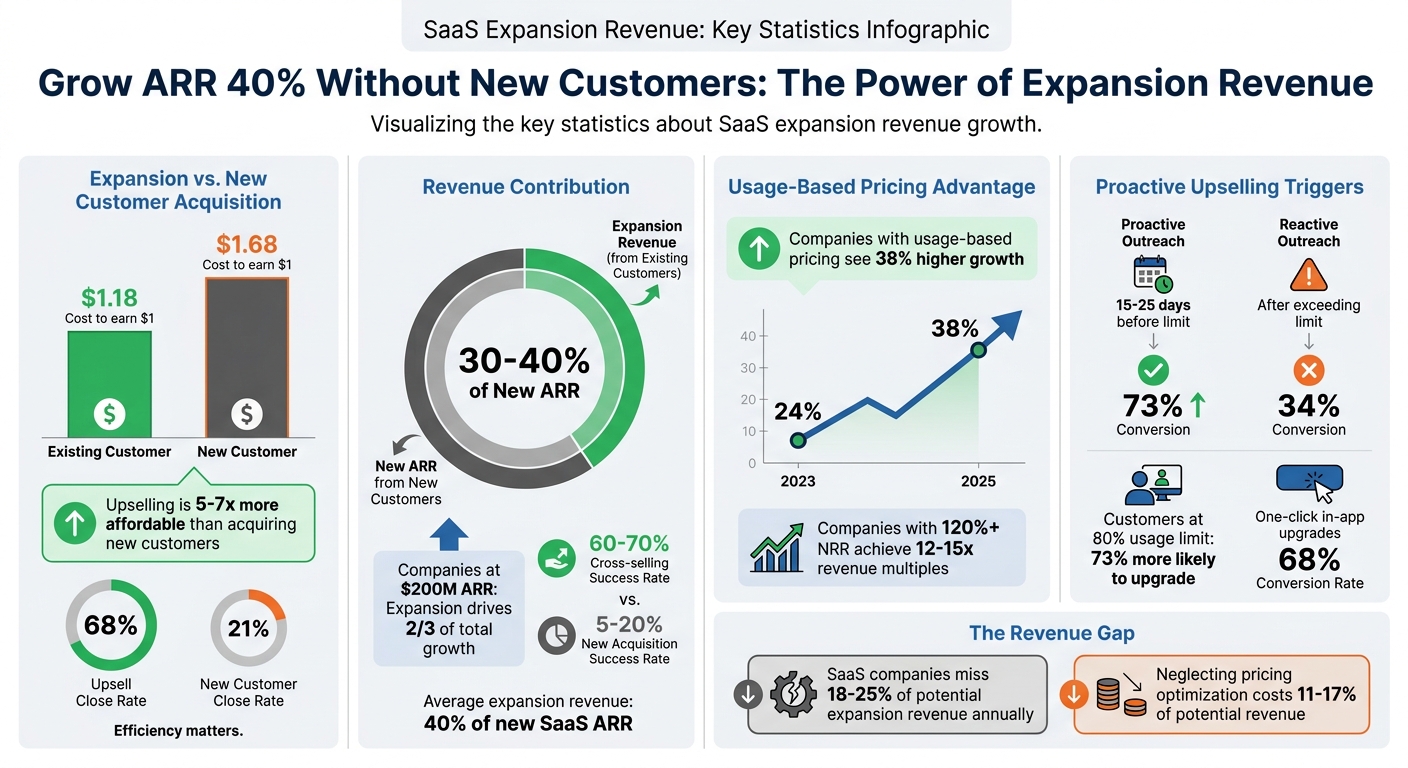
Increasing ARR by focusing on current customers is a smart, cost-effective strategy. Upselling is not only 5–7 times more affordable than acquiring new customers, but it also boasts a much higher close rate - 68% compared to 21% for new customer acquisitions [5]. The key is identifying the right moments to guide customers toward higher tiers naturally.
Finding High-Potential Accounts for Upselling
One of the best indicators that a customer is ready to upgrade is their usage patterns. When customers approach 80–85% of their plan limits - whether it's API calls, storage, or seats - they’re primed for an upsell. For instance, WorkflowHQ saw their conversion rate jump to 74% after implementing trigger-based alerts to flag customers nearing these thresholds. As Tom Chen, their VP of Sales, described:
"We were reactive on upsells... Conversion: 41%. Implemented trigger-based proactive upselling - we detect when they're at 80% of limit and offer upgrade before they hit the wall. Conversion: 74%." [5]
Besides usage thresholds, other signs of upgrade potential include customers frequently interacting with locked features or inquiring about advanced capabilities [5][6]. High engagement metrics, like a daily-to-monthly active user ratio over 0.6 or logins from executive-level stakeholders, also signal strong product reliance and decision-making authority [6]. External factors, such as rapid seat invites within two weeks or company hiring surges, can further indicate readiness for premium features [5][8].
To act on these signals, automate alerts through SQL queries or CRM systems. Timing is critical - proactive outreach 15–25 days before a customer hits their limit has a 73% conversion rate, while waiting until they exceed limits drops the rate to 34% [5]. These insights help frame your upselling efforts around customer needs.
Presenting Premium Features for Clear ROI
When discussing premium features, focus on the outcomes they deliver rather than just listing what’s included. Instead of saying, "Our Enterprise plan includes advanced analytics", frame it as, "You'll identify bottlenecks three times faster, saving your team 12 hours weekly." Using specific data, like "You've used 8,247 of 10,000 API calls", makes the upgrade need crystal clear [5].
The ideal time for these conversations is right after a customer achieves a significant milestone with your product [7]. Position the premium tier as the solution to future challenges, turning the discussion into a consultative session rather than a sales pitch [10]. During Quarterly Business Reviews, highlight the customer’s achievements and show how premium features could amplify their success [10].
If a full tier upgrade feels like too much, introduce intermediate options. For example, WorkflowHQ added a "Business" tier between their "Pro" ($199) and "Enterprise" ($799) plans. This incremental step led to a 51% conversion rate from Pro to Business, as customers found the smaller price jump more appealing [5].
By aligning premium features with clear benefits, you make the upgrade decision easier for customers.
Making the Upgrade Process Frictionless
Simplify the upgrade process with one-click in-app options. This approach not only boosts conversion rates to 68% but also reduces the average close time from 12 days to just 2.3 days. WorkflowHQ’s implementation of this method in September 2025 resulted in an additional $631,000 in ARR over the next 12 months [5].
Transparency during the upgrade process is equally important. Clearly display prorated billing differences to eliminate financial uncertainty, and add "Upgrade to unlock" buttons directly within the product dashboard for immediate action. If a customer asks about premium-only features, offer a 14-day trial without requiring a credit card. This lets them experience the value firsthand before committing [5].
Run daily checks to identify customers with 70–85% usage, as this group converts at rates between 58–73% [5]. By making upgrades seamless and removing barriers, you can drive ARR growth while ensuring a positive customer experience.
Cross-Selling: Increasing Revenue with Complementary Products
Cross-selling complementary products can be incredibly effective, boasting a success rate of 60–70% compared to just 5–20% for new customer acquisition efforts [11]. Plus, customers who use multiple products tend to stick around longer - showing 65% lower churn - and report three times the satisfaction [9]. On average, expansion revenue, which includes cross-selling, accounts for about 40% of new SaaS ARR. For companies generating over $50 million in ARR, this figure often climbs above 50% [15].
The secret lies in understanding which customers need specific products at the right time. Cross-selling differs from upselling because it focuses on new use cases or solving related problems. For instance, a CRM user might benefit from adding an analytics module, while a team using basic workflow automation might eventually need API access as their operations grow. By using data-driven insights, you can uncover these opportunities and make well-timed offers.
Using Behavioral Data to Find Cross-Selling Opportunities
Behavioral data is a goldmine for identifying cross-selling potential. Tools like product affinity modeling and whitespace mapping can reveal patterns. For example, customers who use Product A alongside Product B might show 40% higher retention rates [12][13]. Behavioral triggers, such as frequent clicks on locked features, searches for unavailable modules in your knowledge base, or connecting multiple third-party integrations, can signal unmet needs [5].
External factors also offer valuable clues. For example, LinkedIn job postings for roles like "Head of Analytics" might suggest a customer is ready for a reporting module. Similarly, announcements about funding, geographic expansion, or leadership changes can indicate evolving needs [12]. Even support tickets and chat logs can highlight recurring issues that a complementary add-on could address [9].
Creating Personalized Cross-Sell Campaigns
Once you’ve identified cross-sell opportunities, the next step is crafting personalized campaigns that solve specific customer problems. Instead of simply pitching an add-on, frame the offer around the customer’s needs. For instance, you could say: “I noticed your team has connected several analytics tools to your dashboard. Our Advanced Reporting module can consolidate these into one streamlined view.”
Timing is crucial. Present cross-sell offers either within the first 30 days of onboarding or right after key product milestones to maximize conversion rates [11][9].
Pricing also plays a big role in success. Offers priced within 10–25% of the original purchase value tend to convert better, while higher-priced add-ons can create hesitation [14]. If the add-on is more expensive, consider breaking it into smaller modules or rolling it out in phases. Using a “complete the look” approach - positioning the add-on as the final piece of a customer’s setup - can increase conversions by up to 78% compared to generic product suggestions [14].
Examples of Effective Cross-Selling
WorkflowHQ provides a great example of cross-selling done right. They implemented modular pricing for add-ons like Advanced Reporting ($50/month), API Access ($100/month), and White-labeling ($200/month) [5]. This approach lowered the barrier to entry and allowed customers to expand their capabilities incrementally.
Led by VP of Sales Tom Chen, WorkflowHQ developed a proactive strategy that tracked eight behavioral signals, including usage limits, team growth, and feature requests. Over the 12 months ending in September 2025, this method grew expansion revenue from 18% to 67% of total new revenue, adding $847,000 in expansion ARR [5]. The key was identifying customer needs early, before they turned into pain points, and addressing them with tailored solutions.
Optimizing Tiered and Usage-Based Pricing Models
Fine-tuning your SaaS pricing strategy can unlock more Annual Recurring Revenue (ARR) from your current customers. A well-structured pricing model creates a seamless path for customers to increase their spending. Research shows that many SaaS businesses miss out on 11–17% of potential revenue each year by neglecting this critical area [19]. The right approach makes expansion feel natural, reducing the need for heavy sales efforts.
The secret? Align your pricing with how customers measure success. Companies that use value-based pricing grow 2–3 times faster than those relying on flat or seat-based models [17]. For instance, seat-based pricing fits well for sales tools tied to team growth. But for an API platform, usage-based pricing tied to API calls better reflects customer value.
Flat-Rate vs. Tiered vs. Usage-Based: A Comparison
Each pricing model offers distinct advantages and challenges. Flat-rate pricing is predictable but limits growth since there's no built-in upsell mechanism. Tiered pricing, on the other hand, works well for diverse customer needs, providing clear upgrade paths as customers grow. Usage-based pricing scales naturally with customer consumption, though it can lead to revenue fluctuations.
Public SaaS companies with usage-based pricing components see 38% higher revenue growth compared to their peers [17]. By 2025, 38% of SaaS companies are expected to adopt usage-based pricing, up from 24% in 2023 [32,33]. This shift is gaining momentum, particularly in AI-driven products where value isn't tied to headcount.
| Pricing Model | Expansion Potential | Customer Fit | Revenue Predictability |
|---|---|---|---|
| Flat-Rate | Low (No natural upsell) | Simple products; single use case | High (Fixed recurring fees) |
| Tiered | High (Clear upgrade paths) | Diverse segments; varying needs | Medium (Depends on migration) |
| Usage-Based | Very High (Scales with value) | Variable consumption; APIs | Low (Volatile based on usage) |
Hybrid models combine a fixed subscription fee with usage-based overages, offering a balance of revenue stability and growth potential [29,30]. These comparisons highlight scalable pricing strategies that drive natural expansion.
Implementing Scalable Pricing Structures
The best tiered pricing structures create "strategic headroom." Design your tiers so customers reach 60–70% of their capacity within 12 months [16]. This encourages natural conversations about upgrades without making customers feel constrained. When usage hits 75–80% of their current tier, automated in-product notifications can nudge customers toward upgrades - framing it as helpful guidance rather than a sales push [26,28].
Each tier should have one standout "hero feature" that clearly defines its value for a specific customer segment [16]. Avoid large price jumps between tiers unless the additional value is obvious; disproportionate increases can lead to churn instead of upgrades. The transition between tiers should feel logical and seamless.
"Expansion should be engineered into your pricing architecture, not left to chance." - Preston Zeller [18]
For usage-based pricing, choose a value metric that aligns with how customers measure ROI, such as API calls or transactions [20]. For example, Stripe charges 2.9% + $0.30 per successful transaction [29,33], while Intercom shifted to outcome-based pricing at $0.99 per AI resolution [19]. The metric must reflect customer value to avoid the "pain of paying", where customers limit usage to save money [21].
Monitoring and Adjusting Pricing Models
Pricing isn't a one-time decision - it needs regular adjustments to stay relevant. Companies that experiment with pricing quarterly grow 2.1 times faster than those that don't [20]. Annual price increases typically don't lead to higher churn; in fact, a 10–20% price hike only results in 3–7% additional churn in the first quarter [19].
Identify barriers to expansion by mapping limits, gates, and upgrade triggers. If customers consistently hit limits but resist upgrading, this could signal a churn risk rather than an opportunity [16]. Use analytics to monitor when customers reach 80% of their current tier's capacity - these moments are prime for expansion [17].
Before rolling out changes, test new pricing structures on new customers for 60–90 days [26,29,33]. Evaluate key metrics like your LTV:CAC ratio (aim for 3:1 or better) and CAC payback period (under 12 months for SMBs, under 18 months for mid-market) [29,33]. HubSpot’s CMO Kipp Bodnar highlights their approach:
"Our tiered pricing structure is designed to grow with our customers. As they extract more value, they're naturally guided to the next tier that supports their expansion." [22]
Keep pricing simple - limit options to 3–4 tiers to avoid overwhelming customers. The middle tier often generates 60–70% of revenue [29,33]. When customers approach tier limits, show them the opportunity cost of not upgrading by quantifying the revenue or efficiency they could gain [17].
Using Account Segmentation and EBRs for Expansion Revenue
To build on upselling and cross-selling strategies, combining smart segmentation with well-executed Executive Business Reviews (EBRs) can refine your approach to driving expansion revenue. By segmenting accounts effectively, you can pinpoint customers with the highest potential for growth, focusing resources where they’ll deliver the best results. Since expanding existing accounts is far more cost-efficient than acquiring new ones, the challenge lies in identifying hidden opportunities that might go unnoticed when treating all customers the same.
When segmentation is paired with structured EBRs, it becomes easier to uncover accounts that are primed for growth. This method allows teams to create targeted conversations that unlock revenue opportunities already within reach.
Segmenting Accounts Based on Behavior and Needs
A strong segmentation strategy relies on four key factors: firmographics (industry, revenue), technographics (technology compatibility), behavioral patterns (product usage), and intent signals (such as hiring activity or research on platforms like G2) [23]. Using these factors, you can create a three-tier account model to focus your efforts:
- Tier 1 accounts: These make up the top 5–10% of customers, showing high compatibility and active buying signals. Dedicate 50–60% of your sales efforts to these accounts, with weekly monitoring for updates [23].
- Tier 2 accounts: Customers in this group fit your profile well but currently show dormant signals. Check for intent spikes every two weeks [23].
- Tier 3 accounts: These accounts have limited potential for expansion. Place them in automated nurture campaigns until their signals shift [23].
Tracking specific triggers is crucial for driving conversions. Some of the most effective triggers include team growth (64% conversion rate), requests for features behind paywalls (58%), and increased user activity over 30 days (52%) [3].
For example, WorkflowHQ, a SaaS company specializing in workflow automation, implemented a trigger-based segmentation system under VP of Sales Tom Chen. By monitoring eight key behavioral signals - such as hitting 80% of usage limits or team expansion - they increased expansion revenue from 18% to 67% of total growth within six months. Their system identified 387 triggered customers monthly, achieving a 68% response rate and a 46% upgrade rate, which generated $631,000 in additional revenue over 12 months with an ROI of 7,414% [5].
"We detect when they're at 80% of limit and offer upgrade before they hit the wall. Conversion: 74%. Same offer, better timing. Expansion revenue went from 23% of growth to 67%."
- Tom Chen, VP Sales, WorkflowHQ [5]
To make segmentation actionable, build a composite scoring model that weighs firmographic fit (30%), technographic compatibility (20%), behavioral engagement (25%), and intent signals (25%) [23]. Automate tier assignments in your CRM so your team works with live data instead of outdated lists [23].
Once accounts are segmented and prioritized, the next step is leveraging EBRs to turn insights into strategic growth opportunities.
Running Effective Executive Business Reviews
Unlike Quarterly Business Reviews (QBRs), which focus on usage metrics and support issues, EBRs are centered on business outcomes, strategic value, and future growth [24]. This shift elevates the conversation, transforming it into a partnership that naturally highlights expansion opportunities.
Preparation is key. Start 3–4 weeks in advance by gathering insights from the customer’s earnings calls, company news, and strategic initiatives to ensure the discussion aligns with their priorities [24]. Use pre-meeting surveys or brief interviews to confirm focus areas [24].
Keep the agenda concise, focusing on 3–5 key themes to avoid overwhelming the customer with data [24]. Highlight the value you’ve already delivered - such as cost savings or operational efficiencies - and then present forward-looking recommendations. These could include unlocking value from underused features or aligning your roadmap with their goals [24].
The "Renewal-Plus" approach can be particularly effective. Before presenting a renewal, identify one upgrade or add-on that supports the customer’s current objectives. This frames expansion as a logical next step, not just another sales pitch [10]. Anchor the conversation in behavioral changes - like reaching 80% of usage limits or adding new team members - to naturally guide the discussion [4, 38].
"In most EBRs, CSMs and execs are speaking different languages. And because of that, execs will often choose to pass on EBRs. They believe (rightly or wrongly) they're wasting their time."
To ensure executive attendance, provide 4–6 weeks’ notice with clear calendar invites outlining the meeting's objectives [24]. After the meeting, follow up within 48 hours with a summary of action items, assigned owners, and deadlines [24]. This follow-through keeps momentum alive and demonstrates a professional approach.
Analytic Partners offers a great example of signal-driven prioritization. Under Andrew Giordano, VP of Global Commercial Operations, the company automated the process of identifying high-potential accounts. This reduced account research time by 85% - from 3 hours to just 15 minutes per account - and increased their qualified pipeline by 40% year-over-year [23]. These efforts directly supported their goal of achieving 40% ARR growth by ensuring the team focused on the most promising expansion opportunities.
Measuring and Scaling Expansion Revenue Strategies
To separate sustainable growth from fleeting gains, it’s crucial to measure and scale expansion strategies using the right metrics.
Key Metrics for Expansion Revenue Success
Net Revenue Retention (NRR) is the gold standard for assessing expansion success. It calculates the percentage of recurring revenue retained from existing customers, factoring in upsells, cross-sells, add-ons, and deductions for churn and contraction [2][25]. The formula is straightforward:
(Starting MRR + Expansion Revenue – Churn and Contraction) ÷ Starting MRR.
Healthy NRR benchmarks differ by customer segment:
- SMBs: Aim for 115% or higher.
- Mid-market: Target 125% or more.
- Enterprise: Strive for 130%+.
Companies exceeding 120% NRR often enjoy revenue multiples of 12–15×, while those below 100% see valuations closer to 5–7× [25].
Other useful metrics include:
- Expansion Rate: Expansion MRR ÷ Starting MRR for the period.
- Upsell Rate: The percentage of customers upgrading to higher-value plans.
Identifying early signs of expansion is equally important. For instance, if seat utilization tops 80%, customers may soon need more capacity [25]. Similarly, users engaging with five or more features are far more likely to expand [25]. Tracking Product Qualified Leads (PQLs) - users who hit specific usage milestones tied to expansion - can refine your strategy further [25][26]. Additionally, monitoring how quickly customers adopt new features or integrations offers insights into future growth potential [25].
On the cost front, expansion revenue is far more efficient than acquiring new customers. While adding $1 of ARR from existing customers costs $0.08–$0.15, acquiring new logos costs $0.40–$0.70 [26]. Top-performing SaaS companies generate 30–40% of new ARR from existing customers [2][25], and as businesses scale to $200 million in ARR, expansion often accounts for two-thirds of total ARR growth [1].
"Expansion revenue is structurally higher-margin than new logo revenue, and it compounds on a growing base."
- Udit.co [26]
These metrics provide the foundation for designing strategies that scale effectively across different customer segments.
Scaling Expansion Strategies Across Customer Segments
Once you’ve nailed the metrics, the next step is tailoring strategies to different customer types. Here’s how to approach it:
- SMBs: Focus on seat growth and self-serve upgrades.
- Mid-market: Prioritize feature upsells like SSO or admin tools.
- Enterprise: Leverage cross-selling and usage-based models [25][26].
Take Snowflake as an example. They achieved an impressive 169% NRR by using a consumption-based model that scales with customer workloads [4]. Similarly, Notion reached 130%+ NRR by driving viral seat growth and introducing premium AI features after customers had used the core product for 3–6 months [25]. Meanwhile, Wistia transitioned to usage-based pricing by capping video counts, which boosted revenue by 46% and doubled sales within months [4].
Automation can also supercharge your efforts. HubSpot uses CRM data to detect when users visit pricing pages or max out free-plan limits, enabling faster annual upgrades through timely outreach [4]. Slack employs a 10,000-message history limit as a trigger, helping them achieve a 143% NRR by addressing customers’ data-retention needs [4]. These automated prompts ensure expansion conversations happen at just the right time.
Ownership matters too. For smaller expansions (under $20,000–$25,000), Customer Success Managers can take the lead, while Sales or Account Executives should handle enterprise-level cross-sells [26]. Companies with dedicated expansion teams within Customer Success report net retention rates 28% higher than their peers [2].
To embed expansion into your product strategy, allocate around 40% of development resources to features that naturally drive upgrades [25]. For instance, "expansion loops" can be designed where new features - like collaborative tools - encourage users to invite teammates, increasing usage organically [25]. Another effective tactic is "shadow billing", which transparently shows customers what they’d pay on a higher tier based on current usage, reducing the chance of bill shock [4].
Timing is everything. The best moments for expansion conversations are at success milestones or 60–90 days before renewal. Avoid bringing them up during renewal negotiations when customers may feel defensive [26]. A coordinated three-step approach often works best:
- In-product education during high-engagement moments (converts 60% better than email).
- Personalized, data-driven emails (e.g., "You’ve created 47 docs").
- High-intent sales outreach [4][27].
Personalized emails citing specific usage data can boost conversions from 1–2% to 8–12%, while hard usage limits convert 10–30% of users within 30 days [27].
"The expansion conversation starts from trust rather than skepticism. You are not convincing someone to take a risk; you are helping someone who already likes your product get more out of it."
- Udit.co [26]
Conclusion
Boosting ARR by 40% doesn’t have to mean pouring resources into acquiring new customers. Instead, you can focus on upselling to higher tiers, cross-selling complementary products, refining pricing strategies, and using account segmentation combined with Executive Business Reviews to unlock hidden revenue within your existing customer base.
The numbers back this up. On average, it costs $1.18 to earn $1 from an existing customer, compared to $1.68 from a new one [2]. Leading SaaS companies already generate 30–40% of new ARR from their current customers [2]. As businesses scale toward $200 million in ARR, expansion revenue often drives two-thirds of total growth [1].
"Expansion is not a sales tactic – it's a strategic growth engine. Those who master it will outpace peers in both resilience and market leadership."
- OPEXEngine [3]
Yet, many SaaS companies miss out on 18–25% of potential expansion revenue every year because valuable signals are buried in unmonitored data [28]. This is where strategic action can make a difference. By setting up usage-based triggers, offering high-value add-ons like SSO or advanced analytics, and aligning Customer Success and Sales teams around expansion opportunities, you can systematically capture this untapped revenue.
The key is to choose strategies that align with your customer base and pricing model. Monitor your Net Revenue Retention closely, automate expansion triggers, and remember that expansion revenue builds over time [3]. By combining upselling, cross-selling, pricing adjustments, and strategic account management, you can drive ARR growth in a cost-effective way. Your customers already trust your product - help them unlock even greater value while strengthening your bottom line.
FAQs
How do I find the best upsell targets in my customer base?
To spot upsell opportunities, zero in on accounts that show signs of increased engagement. Look for behaviors like higher usage, expanded workflows, or adoption of new features - these are often strong indicators of upsell potential.
Data is your ally here. Use triggers such as:
- Usage thresholds: Accounts hitting specific usage limits may need a higher-tier plan.
- Product adoption rates: Customers exploring new features signal interest in broader capabilities.
- Growth milestones: Companies experiencing rapid growth might require more robust solutions.
Leverage AI and automation tools to track these signals. These tools can help you stay ahead by proactively identifying when to suggest upgrades, ensuring you capture revenue opportunities while keeping customers engaged.
What add-ons should I cross-sell first to increase ARR fast?
When it comes to cross-selling, zero in on add-ons that directly solve customer challenges and have a strong chance of being adopted. Think about offering premium features or complementary products that align with clear usage triggers or key growth milestones in your customers' journey.
Why? Add-ons tied to these pivotal moments are more likely to resonate with users, making them easier to adopt. Plus, they can lead to a noticeable boost in ARR (Annual Recurring Revenue) in a shorter amount of time.
Which pricing model should I switch to for expansion growth?
Switching to value-based or tiered pricing models can be a powerful way to spark growth by giving customers clear paths to upgrade. These models work by tying pricing to factors like usage, features, or specific roles, which naturally encourages customers to invest more as their needs evolve and their success scales. This method creates a direct connection between customer value and revenue, making it a smart strategy for driving ARR growth over time.
Related reading
- SaaS Marketing Budget Benchmarks 2026
- SaaS Growth Rate Benchmarks 2026
- How to Use Discounts Without Hurting Revenue
- Top Upselling Techniques for SaaS Success
- 5 SaaS Discounting Rules for Retention
- How Proactive Support Reduces SaaS Churn
- How to Measure and Improve Time-to-Value
Useful tools & services
Locate the constraint in your funnel
Map the transitions so you can choose the next investigation or improvement.
Use the funnel templateNeed help choosing the next change? Explore CRO consulting.
More from each customer
New articles on this, by email.