Net Revenue Retention Benchmarks 2026: NRR by ARR Stage & Vertical
NRR benchmarks for SaaS in 2026 by ARR stage, vertical, and pricing model—plus practical levers to lift net revenue retention and valuation multiples.
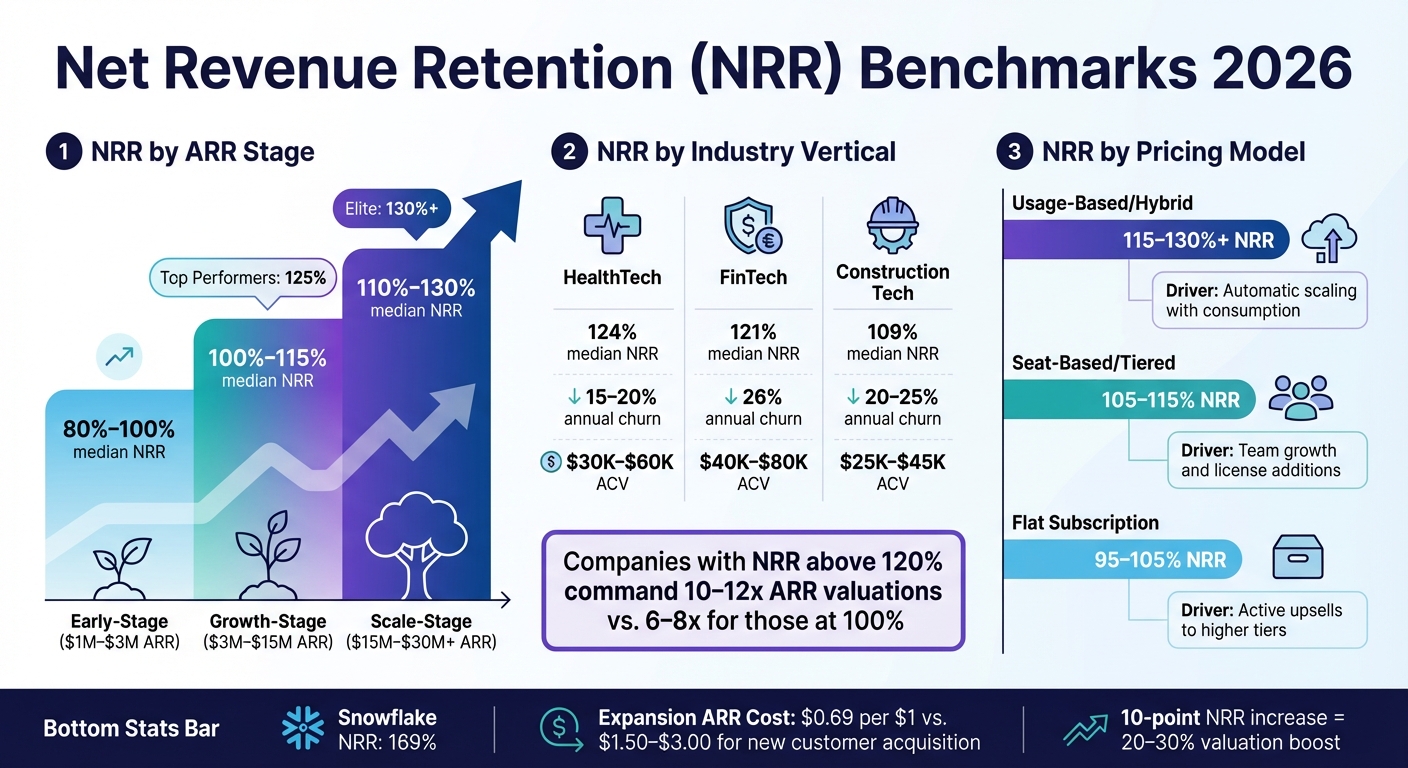
Net Revenue Retention (NRR) is the metric every SaaS company should prioritize in 2026. Why? It measures how much revenue you retain and grow from existing customers, and it’s now more critical than ARR growth for assessing business health. Companies with NRR above 120% are commanding 10–12x ARR valuations, while those at 100% hover around 6–8x.
Here’s what you need to know:
-
NRR by ARR Stage:
- Early-stage ($1M–$3M ARR): 80%–100% median NRR.
- Growth-stage ($3M–$15M ARR): 100%–115%, with top performers hitting 125%.
- Scale-stage ($15M–$30M+ ARR): 110%–130%, elite companies exceed 130%.
-
NRR by Vertical:
- HealthTech leads with 124% median NRR.
- FinTech holds strong at 121%.
- Construction Tech averages 109%.
-
NRR by Business Model:
- Usage-based pricing drives 115–130%+ NRR.
- Flat subscription models struggle with 95–105%.
Key strategies to boost NRR:
- Strengthen onboarding to reduce early churn.
- Use health scores and proactive retention tactics.
- Focus on expansion revenue - it's 2–3x more cost-efficient than acquiring new customers.
- Align pricing with customer value (e.g., usage-based or hybrid models).
High NRR isn’t just a metric - it’s a growth multiplier. Companies like Snowflake (169% NRR) prove that aligning revenue with customer success drives sustainable growth and premium valuations.
SaaS monetization in 2026: Tiering, Usage, AI Add-Ons & Pricing Experiments with Krzysztof
NRR Benchmarks by ARR Stage
Your Net Revenue Retention (NRR) goals should shift as your SaaS company grows. Here's a breakdown of 2026 NRR benchmarks based on ARR stage:
$1M–$3M ARR: Early-Stage SaaS
For companies earning $1M–$3M in ARR, median NRR usually falls between 80% and 100% [5]. At this stage, businesses are still fine-tuning their product–market fit and customer success strategies. Early churn is common, often due to factors like an undefined Ideal Customer Profile (ICP), inconsistent onboarding, or reactive support. A significant portion of churn often happens within the first 90 days.
"If your NRR is below 100%, your SaaS business is quietly leaking revenue. If it's above 110%, you're building compounding growth."
– Eric Mousaw [5]
To combat this, focus on building a strong onboarding process. Customers who hit their "aha moment" early on are 3–4x more likely to stay. Aim for a first-week activation rate of 40% or higher. Address involuntary churn by using automated dunning sequences, which can recover 30–50% of failed payments. Additionally, switching customers from monthly to annual subscriptions can reduce churn significantly, as annual subscribers tend to churn at about one-third the rate of monthly ones [7].
$3M–$15M ARR: Series A Growth
For companies in the $3M–$15M ARR range, NRR typically increases to 100%–115%, with top performers exceeding 125% [5]. With product–market fit more established, the focus shifts to scaling retention and growing customer revenue. Companies under $10M ARR often hit a median NRR of 100–110%, while the best performers surpass 115%.
At this stage, structured processes become critical. Companies start exploring early expansion strategies like tiered pricing, usage-based add-ons, or seat-based growth to drive upsell revenue. Customer Success teams adopt a proactive approach, using metrics like health scores based on logins and feature usage to identify at-risk accounts. A smart tactic here is aligning sales incentives with retention by introducing commission clawbacks if a customer churns within 6–12 months. For enterprise clients (those with an ACV above $100,000), expansion revenue can contribute 30–50% of new ARR [7].
$15M–$30M+ ARR: Growth Stage
For businesses in the $15M–$30M+ ARR range, median NRR rises to 110%–130%, with elite performers often exceeding 130% [5]. At this level, expansion revenue becomes a core part of the business model rather than an add-on.
Top-performing companies often use hybrid or usage-based pricing models, which can push NRR above 115%, compared to flat-pricing models that typically max out at 95%–105%. These companies also invest in deep product integrations and create "data gravity", making it financially unwise for customers to switch providers. This approach helps reduce monthly logo churn to 1.5%–3% and net MRR churn to 0%–2% [9][10]. This switching-cost dynamic is exactly why premium AI tools retain far better than budget ones — see our SaaS churn rate benchmarks for 2026.
"NRR is the single metric that most predicts valuation multiples. Improving NRR by 10 points may add more to your valuation than doubling new logo acquisition."
– Bruno Ueda, Co-Founder, PipelineRoad [7]
For perspective, an NRR of 120% leads to roughly 149% revenue growth over five years. Even a modest 10-point increase in NRR can boost a company’s valuation by 20%–30%, potentially adding tens or hundreds of millions of dollars [3][7].
These benchmarks provide a roadmap to refine retention strategies as your company grows. Next, we'll explore benchmarks by industry and business model to further sharpen these insights.
NRR Benchmarks by Industry Vertical
NRR (Net Revenue Retention) varies widely across SaaS verticals, influenced by factors like regulatory requirements, customer dependency, and switching costs. Let’s take a closer look at how Health Tech, FinTech, and Construction Tech perform in this area.
Health Tech: Leading the Pack
Health Tech boasts the highest median NRR at 124% by 2026 [11]. This impressive figure stems from the sector's strict regulatory environment and the critical nature of its solutions. Once healthcare providers adopt a compliant system, switching becomes costly and operationally complex.
Annual churn in Health Tech is the lowest among major verticals, ranging from 15–20% [11]. Companies like Veeva, a standout in life sciences solutions, maintain an NRR of 120% by embedding themselves into essential regulatory and operational workflows [1][13]. Additionally, compliance demands, which can increase development costs by 20–50%, give these companies pricing leverage, resulting in median ACVs (Annual Contract Values) between $30,000 and $60,000 [11].
FinTech: Resilient in Volatile Markets
FinTech achieves a median NRR of 121% by 2026, even with a higher annual churn rate of 26% [11]. This sector offsets churn with elevated ACVs, typically ranging from $40,000 to $80,000, and usage-based pricing models that naturally capture revenue growth as customer transaction volumes increase [11][12]. Moreover, trust-based relationships and the long-term nature of financial products contribute to customer retention.
Construction Tech: Navigating Cyclical Demand
Construction Tech, with a median NRR of 109% by 2026, faces challenges due to its project-based and cyclical nature [11]. Annual churn rates hover between 20–25%, as software is often viewed as a tool for specific projects rather than a core operational necessity [11].
Despite this, companies in this sector can achieve steady retention by focusing on clients handling multiple projects and creating integrations that extend across entire workflows. This approach shifts the software’s role from being project-specific to becoming a broader, company-wide solution.
| Vertical | 2026 Median NRR | Annual Churn Rate | Median ACV |
|---|---|---|---|
| Health Tech | 124% | 15–20% | $30K–$60K |
| FinTech | 121% | 26% | $40K–$80K |
| Construction Tech | 109% | 20–25% | $25K–$45K |
"Vertical SaaS commands 2–3x higher ACVs than horizontal precisely because specialization creates value."
– knowledgelib.io [11]
These benchmarks highlight the importance of aligning NRR goals with the dynamics of your specific vertical. For instance, expecting Health Tech-level NRR in Construction Tech might be unrealistic due to fundamental differences in customer behavior and market structure. Next, we’ll explore how various SaaS business models impact NRR outcomes.
NRR Benchmarks by Business Model
Your business model plays a key role in shaping Net Revenue Retention (NRR) outcomes, building on industry-specific benchmarks. Vertical SaaS companies often achieve NRR between 115–120% due to their deep integration within specific industries and tailored expansion strategies. For instance, Toast reaches 115% NRR by offering an all-in-one system that combines point-of-sale, inventory, payroll, and online ordering solutions [1][14].
On the other hand, Horizontal SaaS companies face tougher retention challenges. Serving a wide range of customers with varied needs often leads to higher competition and easier switching for users. For example, sales and marketing platforms typically see NRR around 103%, while HR and collaboration tools range between 98% and 119% NRR [1].
Vertical SaaS and AI-Driven Models
Vertical SaaS companies excel by focusing on niche markets and employing a "land and expand" strategy. This involves starting with a core product and then upselling specialized features, such as embedded payments, compliance tools, or AI-driven solutions. This strategy can improve sales efficiency by 40–50% compared to horizontal models [14]. Vertical SaaS is also growing faster, with projections showing a 16.3% compound annual growth rate (CAGR) through 2033, compared to 11.2% for horizontal platforms [15].
"Vertical SaaS is outperforming horizontal SaaS, and this gap is expected to widen... vertical SaaS is projected to grow at around a 16.3% CAGR through 2033, compared to about 11.2% for horizontal platforms."
– Sarabjeet Arora, Amazon Web Services (AWS) [15]
Additionally, embedding financial services into vertical SaaS can multiply revenue per customer by 2–5 times by managing both operational and transactional needs [14].
Horizontal SaaS: Broad Market Challenges
Unlike vertical models, horizontal SaaS platforms face challenges tied to their broad market approach. While top-performing horizontal companies may achieve NRR around 110%, many struggle to exceed 105% [1]. This is largely due to diluted product relevance and stiff competition, as customers often have multiple alternatives and lower switching costs when the software isn't tailored to specific workflows.
To address these hurdles, successful horizontal SaaS companies often build multi-product ecosystems. Offering multiple modules and integrations strengthens customer stickiness. For example, customers using three or more integrations churn at about one-third the rate of those relying on standalone products [8].
Product-Led Growth vs. Sales-Led Growth
Product-led growth (PLG) models rely on self-serve expansion and automatic scaling, often resulting in NRR between 115–130% or more [1][3]. A great example is Notion, which achieved an NRR exceeding 130% in February 2026 by leveraging four key PLG strategies: viral seat growth through collaboration, freemium-to-pro upsells for AI features, cross-selling its calendar product, and offering unlimited blocks for free users to increase retention [19]. Similarly, companies like Snowflake and Databricks have reported NRR benchmarks of 140–170% by using hybrid pricing models that combine base costs with consumption-based expansion [19][3].
"Usage-based pricing models consistently drive higher NRR because revenue scales automatically with customer value - no sales intervention required."
– Griffin Parry, CEO and Co-Founder, m3ter [3]
In contrast, sales-led growth (SLG) models focus on account management for expansion, which is less efficient at scale. The typical customer acquisition cost (CAC) payback period for PLG is about 6 months, compared to 22 months for enterprise SLG models [4]. PLG also avoids the longer sales cycles - often 20–30% longer - common in 2026 [18].
| Pricing Model | Typical NRR Range | Primary Expansion Driver |
|---|---|---|
| Usage-Based / Hybrid | 115–130%+ | Automatic scaling with consumption |
| Seat-Based / Tiered | 105–115% | Team growth and license additions |
| Flat Subscription | 95–105% | Active upsells to higher tiers |
Usage-based and hybrid pricing models not only deliver about 10% higher NRR but also reduce churn by 22% compared to per-seat pricing [17]. With the rise of AI agents replacing human roles, the industry is shifting toward consumption and outcome-based pricing models that align more closely with the value delivered [16][17].
These insights provide a comprehensive framework for improving retention across different business models and stages of annual recurring revenue (ARR). By aligning pricing and growth strategies with these benchmarks, companies can optimize NRR performance effectively.
How to Improve NRR in 2026
This section dives into specific strategies tailored to different growth stages and business models for improving Net Revenue Retention (NRR) in 2026. The quickest wins often come from tackling existing problems first, then setting up systems that drive consistent growth.
Build Retention Systems
Your approach to retention should match your Annual Recurring Revenue (ARR) stage:
-
Early-stage companies (under $3M ARR): Focus on milestone-based onboarding to guide users to their "aha moment" quickly. Why? Because 40-60% of users drop off after just one session [9]. Aim for a 40%+ activation rate within the first week [8].
-
Growth-stage companies ($3M-$15M ARR): Use automated health scoring and real-time alerts to flag potential churn risks. This allows Customer Success teams to step in before it’s too late. A great example is MapsPeople, which revamped its pricing into value-based packages in 2026, pushing its NRR up to 111% (from about 100%) and increasing revenue from target segments by 75% [20].
-
Scale-stage companies ($15M+ ARR): Double down on "product-led retention" by integrating deeply with customers’ workflows. Data shows that customers using three or more integrations have a churn rate roughly one-third that of standalone users [8].
"The fastest way to reduce churn for most SaaS companies isn't a new feature or a better onboarding flow - it's fixing the dunning sequence. You're literally throwing away revenue that customers want to give you."
– Lincoln Murphy, Customer Success Consultant, Sixteen Ventures [8]
Once you’ve built a strong retention system, the next step is to focus on generating more revenue from your existing customers.
Increase Expansion Revenue
Adding $1 in expansion ARR is far more cost-efficient than acquiring new customers. On average, it costs $0.69 in sales and marketing to generate $1 of expansion ARR, compared to $1.50-$3.00 for acquiring a new logo [6].
To identify expansion opportunities, track key metrics like:
- Seat utilization: If usage exceeds 80%, it’s a strong indicator of expansion potential.
- Feature adoption: Customers using five or more features expand at three times the rate of others [19].
Successful SaaS companies are now dedicating about 40% of their product roadmap to expansion features, compared to 30% for retention and 30% for acquisition [19].
Your expansion strategy should be tailored to your customer segments:
- SMBs: Focus on seat growth and volume discounts as their teams grow.
- Mid-market accounts: Push feature upsells and encourage adoption across multiple departments a few months after purchase.
- Enterprise customers: Use Executive Business Reviews (EBRs) to highlight the value of cross-selling and secure multi-year commitments [19].
For example, GrowSurf reduced its monthly churn from 12% to 3-4% in 2026 by segmenting customers and prioritizing high-impact accounts with significant ARR [20].
Adjust Strategies by Stage and Model
Fine-tuning your go-to-market strategy based on your growth stage and business model is key to optimizing NRR.
-
Product-led growth (PLG) models: Implement usage-based or hybrid pricing to automatically capture revenue as customers scale. Add product-led features like multi-product bundles and automated tier-limit notifications. Snowflake’s 169% NRR in 2026 is a testament to the power of consumption-based pricing [20].
-
Sales-led growth (SLG) models: Provide Customer Success teams with real-time usage data to guide proactive renewals. Use a land-and-expand approach, starting with smaller departmental deals that grow into company-wide deployments [3][12]. Offer annual billing with a 15-20% discount to reduce churn - annual subscribers churn at just one-third the rate of monthly ones [7].
To ensure sales teams target the right customers, tie their incentives to retention. For example, use commission clawbacks if a customer churns within 6-12 months [7]. Keep in mind that 60-70% of annual churn happens in the first 90 days, so nailing the onboarding experience is critical for long-term NRR [7].
Conclusion
Based on the benchmarks and strategies discussed, Net Revenue Retention (NRR) stands out as the clearest measure of your SaaS company's health. By 2026, companies with NRR above 120% are projected to achieve ARR valuations of 10–12x, compared to 6–8x for those at 100% NRR [1].
"Net revenue retention (NRR) is one of the most powerful drivers of SaaS valuation. High-NRR companies achieve faster, more capital-efficient growth and command premium multiples." - Griffin Parry, CEO and Co-Founder, m3ter [3]
Use the benchmarks shared in this article to assess your position based on your ARR stage, vertical, and business model. Set realistic goals for retention and expansion by aligning your targets with your specific segment - whether enterprise, mid-market, or SMB. This builds on earlier insights into creating tailored retention systems and strategies for driving expansion revenue.
However, NRR alone doesn’t tell the full story. Pair it with Gross Revenue Retention (GRR) to get a complete picture of customer stability. If your GRR falls below 85%, it’s a red flag that you need to address retention issues before focusing on expansion [2]. High NRR driven by a few growing accounts can sometimes mask dangerous levels of customer churn, which will eventually hurt your business.
Beyond benchmarking, improving retention directly impacts your valuation. The steps are clear: develop retention systems suited to your growth stage, prioritize expansion revenue - where every $1 of expansion ARR costs just $0.69 compared to $1.50–$3.00 for acquiring new customers [6] - and ensure your pricing model reflects the value customers derive from your product. Companies like Datadog and Snowflake, with NRRs of 130% and 127% respectively, showcase the power of aligning revenue with customer usage to achieve scalable, long-term growth [1]. Adopting these strategies can help boost retention and drive efficient, sustainable growth.
FAQs
How do I calculate NRR correctly?
To figure out Net Revenue Retention (NRR), you need to calculate the percentage of recurring revenue your business retains from existing customers over a set period. This includes any additional revenue from upselling or cross-selling (expansion revenue) while subtracting losses from downgrades (contraction) and customer churn.
Here’s the formula:
NRR = [(Starting MRR + Expansion MRR - Contraction MRR - Churned MRR) / Starting MRR] × 100
Make sure to account for all relevant expansion, contraction, and churn figures to get an accurate result.
What NRR target should I set for my ARR stage?
When assessing your Net Revenue Retention (NRR) at different stages of Annual Recurring Revenue (ARR), there are key benchmarks to keep in mind:
- An NRR above 100% is typically a positive sign, indicating that you're retaining existing customers while driving additional revenue from them.
- Achieving an NRR of 110% or higher places you in a strong position, reflecting solid customer satisfaction and expansion.
- The best-performing companies often push beyond 120%, showcasing exceptional growth and customer retention strategies.
These benchmarks serve as a helpful guide to measure your success and set achievable growth targets.
How can I raise NRR without raising prices?
If you want to boost Net Revenue Retention (NRR) without touching your pricing, the key lies in focusing on your existing customers. Specifically, aim to increase their engagement and satisfaction while reducing churn. Here's how:
- Spot upsell opportunities: Identify ways to offer additional value through premium features or expanded services that align with customer needs.
- Strengthen customer success efforts: Provide proactive support, education, and resources to help customers achieve their goals with your product.
- Minimize downgrades: Monitor customer usage patterns and address potential issues before they lead to reduced subscriptions or cancellations.
- Encourage usage growth: Highlight product features that drive engagement and deliver measurable benefits, making your solution indispensable.
By prioritizing these strategies, you can grow retention and revenue within your current customer base - no price increases required.
Related reading
- SaaS Marketing Budget Benchmarks 2026
- SaaS Growth Rate Benchmarks 2026
- How to Use Discounts Without Hurting Revenue
- Top Upselling Techniques for SaaS Success
- 5 SaaS Discounting Rules for Retention
- How Proactive Support Reduces SaaS Churn
- How to Measure and Improve Time-to-Value
Useful tools & services
Locate the constraint in your funnel
Map the transitions so you can choose the next investigation or improvement.
Use the funnel templateNeed help choosing the next change? Explore CRO consulting.
Keep improving your conversion work.
Subscribe for practical ideas on diagnosing conversion problems, planning experiments, and choosing your next improvement.
No spam. Unsubscribe anytime.