How 8 SaaS Companies Reduced Churn by Fixing Their First-Run Experience
Eight SaaS case studies show how faster first-run onboarding, alerts, and milestone nudges cut early churn and boost activation.
Most SaaS churn starts early - within the first 48 hours. Users are motivated when they sign up, but that fades fast if they don’t see value quickly. Research shows every hour of delay in reaching value can lead to an 8% drop in activation rates. By day two, engagement often plummets to just 15%.
The solution? Fix the first-run experience. This means guiding users to their "aha moment" - the point where they see the product’s value - as fast as possible.
Here’s how 8 SaaS companies solved their early churn problems:
- Groove: Reduced churn by 71% with "Red Flag" alerts for disengaged users.
- Slack: Cut trial churn by 30% by encouraging teams to hit activity milestones.
- Dropbox: Boosted feature adoption by 30% with role-specific onboarding.
- Zapier: Lowered 90-day churn from 25% to 6–10% using milestone-based outreach.
- Amplitude: Increased feature adoption by 20% with simplified onboarding and nudges.
- Heyday: Reduced setup time from 48 hours to 4, slashing early churn by 300%.
- StatusPage.io: Saved $1.2M in revenue by addressing drop-offs with nightly alerts.
- SmartReach.io: Lowered annual churn from 27% to 17.5% with health scores.
Key takeaway: Small, targeted fixes - like faster onboarding, proactive alerts, and milestone tracking - can drastically improve retention. Focus on removing friction in the first 48 hours, and you’ll see big results.
::: @figure 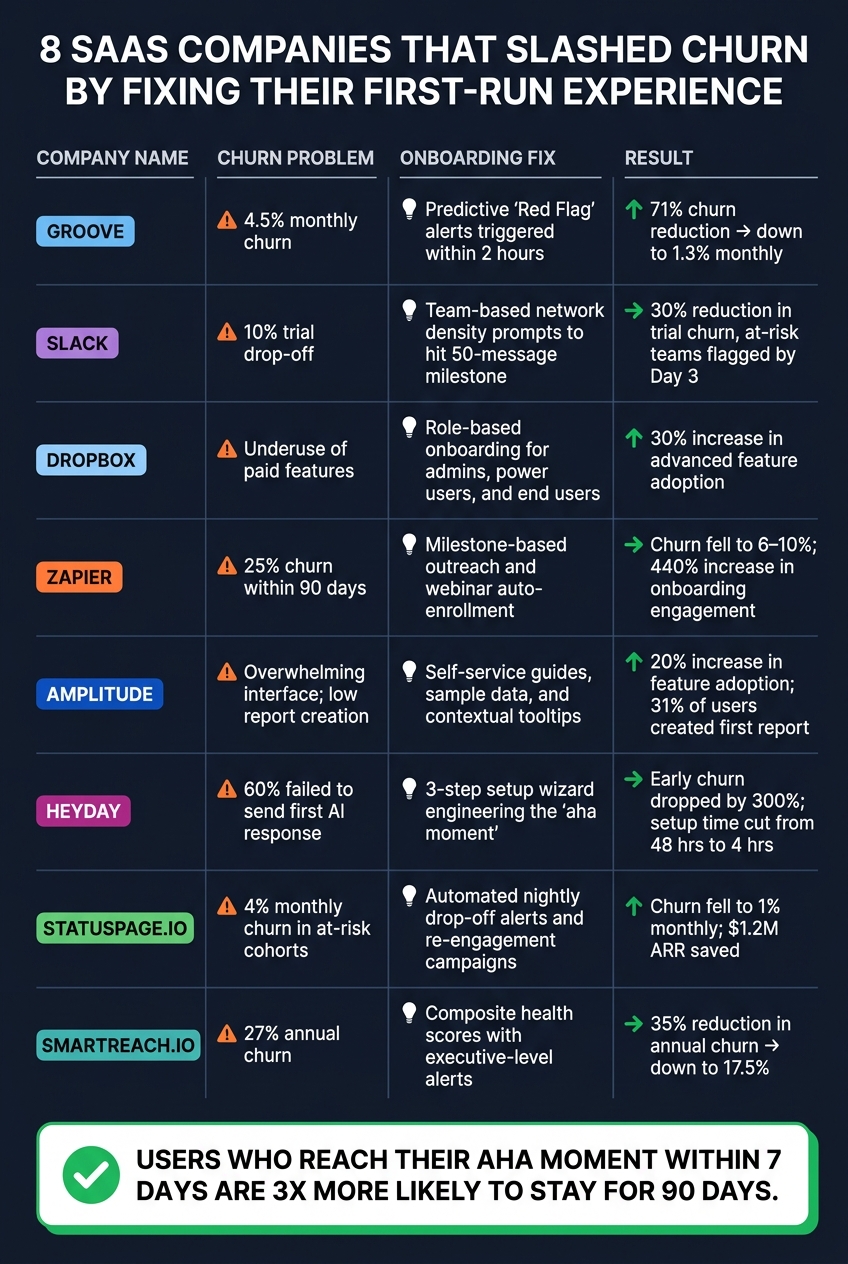 :::
:::
I Fixed My SaaS Onboarding and Hit $100k/m - Here's the Exact System
::: @iframe https://www.youtube.com/embed/Qy7n3cFglmU :::
sbb-itb-0499eb9
Case Studies: 8 SaaS Companies That Fixed Their First-Run Experience
Each of these companies faced unique onboarding challenges and used early behavioral data to address them effectively.
Groove: Spotting and Solving Early Disengagement
Groove's churn issue wasn’t obvious at first. It became clear only after analyzing session data. They discovered that users who left had first sessions lasting just 35 seconds, compared to over 3 minutes for those who stayed [5]. This revealed that many users were leaving before they even engaged with the platform.
To tackle this, Groove developed a "Red Flag Metrics" system. It tracked session durations and sent automated support emails within two hours when activity fell below a certain threshold [3]. This allowed them to step in quickly, without waiting for a support ticket or a monthly review.
The outcome? Monthly churn dropped from 4.5% to 1.3%, a 71% decrease, and users who received these interventions were 40% more likely to renew within three months [3].
Slack: Helping Teams Reach Critical Mass
Slack’s churn issue wasn’t about individual users; it was about teams failing to take off. Workspaces with fewer than 50 messages exchanged in the first two weeks were far more likely to churn [3]. A single user in an empty workspace simply wasn’t enough to showcase Slack’s value.
Slack introduced Network Density Analysis, which flagged low-activity workspaces early on. They used in-app prompts to encourage users to invite teammates and set up integrations. The goal? Get teams to hit the 50-message milestone as quickly as possible [3]. Once they did, retention rates improved significantly. Trial churn dropped from 10% to 7% - a 30% reduction - with at-risk teams identified by day 3 of the trial [3].
Dropbox: Tailored Onboarding for Different Roles
Dropbox faced a more nuanced problem. Business users were paying for premium features but using the product like the free version. Advanced tools like team folders were often ignored [3].
The solution was role-based onboarding, which provided customized training for administrators, power users, and end users [3]. Each group received guidance tailored to their specific workflows. For example, administrators learned about permission settings, while end users were taught collaboration techniques. This targeted approach boosted engagement with advanced features, ensuring users got more value from their subscriptions.
Zapier: Helping Users Achieve Early Wins
Zapier found that 25% of users churned within 90 days because they never went beyond simple, one-step automations [3]. These users missed out on the product's true potential: multi-step workflows.
Zapier implemented milestone-based outreach. They tracked user activity and automatically invited users to a targeted webinar after they connected a high-value app [3]. This timely intervention helped users progress to more advanced automations. As a result, 90-day churn dropped from 25% to between 6% and 10%, largely due to helping users achieve their first meaningful success faster.
Amplitude: Simplifying the Path to Value
Amplitude struggled with a complex interface that overwhelmed new users. Many left before creating their first meaningful report [3].
To address this, Amplitude embraced a product-led growth model. They introduced self-service onboarding, interactive guides, and sample data sets to help users explore without needing to set up their own data first [3]. Contextual tooltips appeared when users hovered over unfamiliar features, offering help exactly when needed. Behavioral nudges encouraged users to create reports at the right moments. These changes led to a 20% increase in feature adoption, and 31% of users created their first report after the nudges were added [6].
Patterns Across All 8 Case Studies
Common Strategies
Across all eight companies, one thing stood out: they acted early to counter user disengagement. Instead of waiting for cancellations, they used specific behavioral signals to predict churn days or even weeks ahead. For example, Groove focused on session length, Slack kept an eye on message volume, and StatusPage.io flagged a 30% or greater drop in usage. While the exact metrics varied - session duration, feature usage, message counts - the shared goal was the same: intervene early to prevent churn.
Another shared insight was the importance of helping users reach their "aha moment" quickly. Users who hit that moment early were 3.4 times more likely to convert to paying customers than those who took a week [2]. Zapier leaned into this by creating milestone-based outreach. Amplitude simplified its interface so users could generate their first report faster. Heyday slashed its 48-hour setup process to under 4 hours with a streamlined three-step wizard.
These companies also embraced progressive disclosure, showing users only the features they needed at the moment. This approach led to activation rates of 61% for products with fewer initial features, compared to just 24% for those that overloaded users with eight or more features upfront [4]. Amplitude’s contextual tooltips and Dropbox’s role-specific onboarding paths are great examples of this principle in action.
"The biggest mindset shift was realizing onboarding isn't about teaching features - it's about manufacturing success as quickly as possible." - Priya Sharma, Head of Product at DataSync [4]
Side-by-Side Comparison of Fixes and Results
Here's a closer look at how each company tackled their specific challenges and the measurable results they achieved:
| Company | Churn Problem | Onboarding Intervention | Retention Outcome |
|---|---|---|---|
| Groove | 4.5% monthly churn | Predictive "Red Flag" alerts triggered within 2 hours | 71% churn reduction (down to 1.3%) [3] |
| Slack | 10% trial drop-off | Team-based network density prompts | 30% reduction in trial churn [3] |
| Dropbox | Underuse of paid features | Role-based training for admins, power users, and end users | 30% increase in advanced feature adoption [3] |
| Zapier | 25% churn within 90 days | Milestone-based outreach and webinar auto-enrollment | Churn fell to 6–10%; 440% increase in onboarding engagement [3] |
| Amplitude | Overwhelming interface; low report creation | Self-service guides, sample data, and contextual tooltips | 20% increase in feature adoption; 31% of users created first report [6] |
| Heyday | 60% failed to send first AI response | 3-step setup wizard engineering the "aha moment" | Early churn dropped by 300% [3] |
| StatusPage.io | 4% monthly churn in at-risk cohorts | Automated nightly drop-off alerts and re-engagement campaigns | 75% improvement; churn fell to 1% monthly, saving $1.2M in ARR [3] |
| SmartReach.io | 27% annual churn | Composite health scores with executive-level alerts | 35% reduction in annual churn (down to 17.5%) [3] |
The key takeaway? These companies didn’t try to overhaul their entire products. Instead, they pinpointed just one or two friction points during onboarding and fixed them. This laser-focused strategy worked across a wide range of products and user bases, delivering consistent and impressive results. It’s a powerful reminder for SaaS founders: small, targeted improvements can make a big difference in user retention.
What SaaS Founders Can Do With These Lessons
Tactics That Reduce Churn in the First-Run Window
These case studies highlight effective strategies to cut early churn, and the key takeaway is shortening time-to-value. For self-serve products, aim to deliver a meaningful outcome within 10 minutes. If your onboarding process takes longer, trim or postpone unnecessary steps. For instance, Athenic reduced its onboarding flow from 12 to 7 steps in August 2025. This change increased activation rates from 42% to 81%, improved trial-to-paid conversions from 8% to 22%, and slashed the median time-to-value from 8.2 days to just 1.6 days [2].
Another impactful strategy is replacing blank dashboards with demo data or ready-made templates. An empty dashboard can overwhelm users, leading to what UX experts call "blank canvas" paralysis. By showing users the product’s output right away, you eliminate this friction and help them see value faster.
Lastly, swap one-time product tours for persistent in-app checklists with 4–7 actionable items. Unlike tours that users often skip or forget, checklists remain visible and motivate users to complete tasks. Research shows that users presented with a checklist complete 2.3 times more activation steps than those left to explore on their own. ProductFruits saw a 3.5x increase in conversion rates among users who completed a 5-step checklist tied to their “aha moment,” alongside a 20% boost in Day 1 retention [10, 17].
The next step? Identify where your users are dropping off and apply these tactics to remove barriers.
How to Find and Fix Your Own First-Run Bottlenecks
To fix early churn, start by mapping your user journey to identify sticking points. Break down your activation funnel step by step - from signup to the moment users achieve real value. Then, segment users into two groups: those who remain active in Month 2 and those who churn. The differences in behavior between these groups will reveal your leading indicators.
Once you’ve identified a drop-off point, compare your metrics to these benchmarks:
| Metric | Healthy Benchmark | Churn Signal |
|---|---|---|
| Time-to-first-value | <10 minutes (self-serve) | >30 minutes |
| Day-1 activation rate | 25–35% | <15% |
| 7-day activation rate | 40–55% | <25% |
| Checklist completion | 30–45% | <15% |
| Feature adoption (14-day) | 3+ core features | <2 features |
If your Day-1 activation rate is below 15%, that’s a strong indicator of churn. Focus on fixing one bottleneck at a time. For example, in March 2026, CloudMetrics noticed a 42% drop-off at the "connect cloud account" step. Instead of overhauling their entire onboarding flow, they introduced a proactive AI assistant to guide users through this specific step. The result? Onboarding completion jumped from 34% to 61%, and 60-day churn dropped by 25% [1].
"The single most important thing we did was make the bot proactive. Our help center has the same information, but nobody goes there during onboarding." - Sarah, Product Lead, CloudMetrics [1]
Another simple yet effective approach is using behavioral email triggers. A four-email sequence - starting with a welcome email at signup, followed by a quick-win nudge at 4 hours, next steps at 24 hours, and a personalized check-in at 48 hours - can improve early retention significantly without requiring major engineering work [8]. For mid-market customers spending $200 or more per month, adding a personal touch within the first 48 hours can boost 30-day retention by an average of 22% [7].
Conclusion: First-Run Experience Is a Retention Decision
The companies highlighted - Groove, Slack, Dropbox, Zapier, Amplitude, and others - all came to the same conclusion: churn is often decided long before any renewal prompt appears. That decision is made during the first session, the first 48 hours, or the first week. This makes every moment of the first-run experience essential for long-term retention.
The first-run experience isn’t just about tweaking user interfaces; it’s a deliberate strategy to drive retention. As RetentionCheck aptly states: "Onboarding is not a nice-to-have; it is the primary driver of early-stage retention." [7] Data backs this up - users who hit a product's "aha moment" within 7 days are 3 times more likely to stay for 90 days, and companies excelling in onboarding completion report 32% lower churn within that same timeframe compared to those that lag behind [7].
The game-changer for companies battling churn was shifting their view of onboarding. They stopped seeing it as a one-off task and started treating it as an ongoing strategy. This involved tracking every step of the activation funnel, responding to user behavior in real time, and continuously testing to uncover what causes drop-offs. Groove and Athenic are proof that even small, focused adjustments can deliver major retention wins.
The numbers speak for themselves. Groove reduced its monthly churn rate from 4.5% to 1.3% - a 71% drop - by introducing a "Red Flag" system to monitor key user behaviors [3]. Athenic increased activation rates from 42% to 81% by eliminating friction during the critical first 48 hours [2].
"Churn isn't inevitable. With the right approach, you can turn your leaky bucket into a retention machine." - Mafruh Faruqi, Co-Founder, Saasfactor [3]
The takeaway? You don’t need a massive overhaul to see results. Small, precise changes made during the right timeframe can deliver outsized improvements in retention. Focus on the early stages, measure what matters, and turn your onboarding process into a retention powerhouse.
FAQs
::: faq
What’s the best way to define our product’s “aha moment”?
To pinpoint your product's "aha moment", focus on the instant when users first recognize its value. This could be when they complete an essential action, like creating a project or uploading a file. Study user behavior to uncover milestones that correlate with long-term engagement. Then, experiment with different triggers to perfect this moment. Helping users experience value early on can significantly improve retention and cut down on churn. :::
::: faq
Which early behaviors best predict churn in the first 48 hours?
Early signs of churn often emerge within the first 48 hours. These include users not hitting the "aha moment", struggling with onboarding, or showing little engagement. When people don’t quickly recognize the value of your product, they’re more likely to leave. To combat this, prioritize a smooth onboarding experience and make sure users experience value right away. :::
::: faq
What’s the fastest first-run fix we can ship without engineering?
One of the fastest ways to enhance your first-run experience is by fine-tuning your onboarding process. The goal is to make the experience as simple and engaging as possible. Here’s how you can do it:
- Progressive feature introductions: Introduce features gradually rather than overwhelming users all at once.
- Meaningful empty states: Use templates or helpful examples to make empty screens more useful and less intimidating.
- Interactive tutorials: Provide hands-on guidance that helps users understand your product in real time.
- Step-by-step checklists: Create clear, actionable steps to guide users toward their "aha moment" within the first 48 hours. This can dramatically improve activation rates and cut down on early churn.
The best part? These improvements focus solely on content and design, meaning no engineering resources are required. :::
Related reading
- Why We Avoid Feature Bloat
- Product-Led Onboarding: How to Design Flows That Activate Users Fast
- SaaS Onboarding Teardowns: 9 Sign-Up Flows That Convert Above 15%
- From 2% to 8% Trial Conversion: What Changed at 5 SaaS Companies
- How to Use Discounts Without Hurting Revenue
Useful tools & services
Go deeper than any blog post.
The full system behind these articles—frameworks, diagnostics, and playbooks delivered to your inbox.
No spam. Unsubscribe anytime.