Companies With Freemium Models: 10 SaaS Examples & Conversion Rates
10 companies with freemium models—Slack, Dropbox, Zoom, Notion and more—with free-to-paid conversion rates and what actually makes each model convert.
Freemium isn't just a pricing model — it's a customer acquisition engine. Companies like Dropbox, Slack, Canva, and even ChatGPT use it to pull millions of users into the product, then convert a fraction of them into paying customers. The math is simple: get enough people using the free version, and even a 3-5% conversion rate generates serious revenue.
But most companies get it wrong. They give away too much (killing the upgrade incentive) or too little (killing adoption). The companies below have found the balance — from SaaS staples like HubSpot and Zoom to platforms like LinkedIn and Spotify. Here's how 10 SaaS companies run freemium, plus a look at freemium models beyond traditional software.
What Is the Freemium Model in SaaS?
The freemium model gives users permanent, free access to a stripped-down version of a product. Advanced features, higher usage limits, or better support sit behind a paywall. Unlike a free trial (which expires after 7-30 days), freemium users can stay on the free plan forever.
That distinction matters. Freemium is a user acquisition strategy, not a monetization strategy. The free plan exists to get people in the door. Revenue comes from the subset who outgrow it.
The companies that do this best share three traits: low marginal cost per free user, a product that gets stickier over time, and natural upgrade triggers built into the workflow.
Quick Comparison: Free vs. Paid Features
For the economics behind these free-vs-paid decisions—how 25 SaaS companies choose what to gate—see our deep dive on feature gating in SaaS.
| Company | Free Plan Includes | What Drives Upgrades |
|---|---|---|
| Dropbox | 2GB cloud storage | Storage limits hit quickly for power users |
| Slack | Messaging, 90-day history | Teams lose access to older messages |
| Mailchimp | Email marketing for up to 500 contacts | List growth forces paid plans |
| Spotify | Ad-supported streaming | Ads + no offline listening create friction |
| Canva | Design editor + basic templates | Brand kits, premium assets gated |
| Trello | Task boards + basic automation | Advanced integrations, views, and security |
| Zoom | Unlimited 1:1 calls, 40-min group limit | Group call time cap is the conversion trigger |
| HubSpot | CRM, email templates, forms | Automation and advanced marketing tools |
| Pipedrive | Sales pipeline + contact management | Deal and contact limits force upgrades |
| Intercom | Basic customer messaging | Automation and enterprise features |
1. Dropbox
Dropbox's freemium model is one of the most studied in SaaS history. The free plan offers 2GB of storage — enough to get started, but tight enough that most users hit the ceiling within weeks.
The genius is in the referral loop. Free users earn extra storage by inviting friends, which means every new user becomes a distribution channel. Dropbox grew its user base to over 200 million largely through this mechanic, even though only an estimated 2-4% converted to paid plans. At scale, that's still massive revenue.
The key insight: Dropbox didn't need high conversion rates. They needed volume. The free plan was never about generating revenue directly — it was about making the product so embedded in people's workflows that upgrading felt inevitable, not optional.
2. Slack

Slack's free plan is deliberately designed around a single friction point: message history. Free teams can only access the last 90 days of messages. For a small team trying Slack out, that's fine. For a growing company with institutional knowledge living in Slack channels, losing access to older conversations becomes painful fast.
The bottom-up adoption model is what makes this work. Individual teams adopt Slack for free, prove its value internally, and then the organization upgrades when enough teams are using it. Slack doesn't need to sell to the CTO — they need the CTO's teams to refuse to use anything else.
This approach drove Slack to some of the highest freemium conversion rates in SaaS. Estimates put their free-to-paid rate around 30% — far above the industry average of 2-5%.
3. Spotify
Spotify takes a different approach than most B2B SaaS companies on this list: they monetize free users directly through ads while simultaneously converting them to premium subscriptions.
The free tier gives users access to the full music catalog, but with interruptions — ads every few songs, no offline downloads, limited skips, and lower audio quality. These aren't arbitrary restrictions. Each one targets a specific pain point that premium solves.
Spotify has achieved a roughly 45% conversion rate from free to paid — extraordinary by any standard. The secret is that the free experience is good enough to create a habit but annoying enough to make upgrading irresistible. Every ad break is essentially a pitch for premium.
4. Canva
Canva is arguably the biggest freemium success story of the last decade. The company reached a $40 billion valuation largely by making professional design accessible to non-designers through an extremely generous free plan.
Free users get access to the drag-and-drop editor, thousands of templates, and basic design elements. Premium unlocks brand kits (critical for teams), premium stock photos, background removal, and more storage. The free plan is genuinely useful — you can create a decent social media graphic or presentation without paying a cent.
What drives upgrades is workflow dependency. Once a marketing team standardizes on Canva and needs consistent branding across dozens of assets, the premium features go from "nice to have" to essential. Canva's model proves that giving away a lot for free isn't a liability if the premium features align with growing professional needs.
5. Mailchimp
Mailchimp waited eight years before introducing a free plan. Co-founder Ben Chestnut has said they didn't consider freemium until their paid business was profitable enough to subsidize free users — a lesson most SaaS companies ignore.
The free plan supports up to 500 contacts with basic email marketing tools. As businesses grow their lists and need automation, A/B testing, and advanced analytics, upgrading becomes the only path forward.
After introducing freemium, Mailchimp reported a 150% increase in paying subscribers and 650% growth in profits within one year. The timing mattered: they built a sustainable paid business first, then used freemium to pour fuel on it.
6. Zoom
Zoom's freemium model has one of the most elegant conversion triggers in SaaS: the 40-minute time limit on group calls. One-on-one calls are unlimited, which gets individuals hooked. But the moment you need a team meeting, you hit the wall.
Virality is baked into the product. Every Zoom meeting is an invitation for non-users to experience the product. Free users recruit other free users, who eventually recruit paying users when their organizations need longer meetings, larger participant caps, and admin controls.
The pandemic accelerated this flywheel dramatically, but the model was working well before 2020. Zoom's CEO Eric Yuan has said the freemium approach was essential in a crowded market — letting people try the product removed the biggest barrier to adoption.
7. Trello
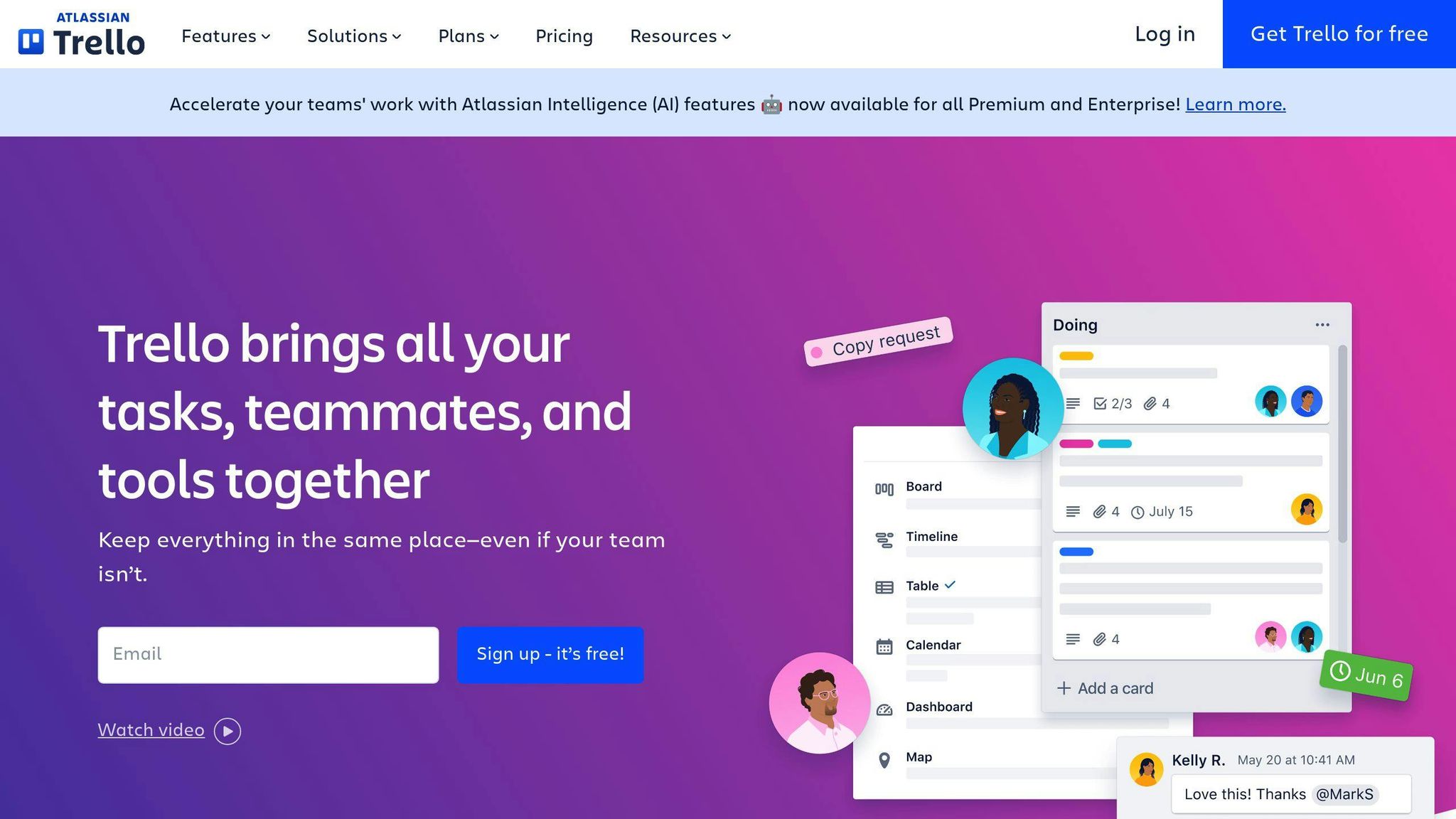
Trello's free tier is one of the most generous in project management. You get unlimited boards, cards, and members with basic automation. The restrictions are on power-ups (integrations), views, and administrative controls.
The conversion path follows a familiar pattern: individuals and small teams start free, the tool becomes embedded in daily workflows, and growing teams need features that only premium provides — timeline views, dashboard reporting, and advanced automation rules.
Trello doesn't push hard for upgrades. Instead, they rely on organic friction — the moment a team tries to connect Trello to their other tools or needs a Gantt-style view, the upgrade prompt appears naturally. This low-pressure approach keeps free users engaged rather than annoyed.
8. HubSpot

HubSpot stands out because its free plan spans multiple product lines — CRM, marketing, sales, and customer service tools. Most freemium products gate by features within a single product. HubSpot gates by sophistication: the free CRM is functional, but automation, advanced reporting, and deeper marketing tools require paid plans.
This breadth strategy has attracted over 100,000 businesses to the free CRM. The cross-sell opportunity is enormous — a company that starts with free CRM often expands into marketing automation, then sales tools, then service. Each expansion is a new paid tier.
HubSpot also invests heavily in educational content (courses, certifications, blog posts) that trains free users on marketing practices that naturally require HubSpot's premium tools to execute. The education is the upsell.
9. Pipedrive

Pipedrive targets a specific niche — small sales teams that need pipeline visibility without enterprise complexity. The free plan caps at 50 open deals and 2,500 contacts, which is enough for a solo founder or tiny team but tight for anyone doing real outbound.
The restrictions are smart. They don't limit the core experience (visual pipeline management) — they limit scale. Users get to experience why Pipedrive works, and the upgrade only becomes necessary when the business is doing well enough to justify the cost. That alignment between growth and upgrade timing keeps churn low.
Pipedrive has grown to over 100,000 users globally, largely through organic growth and referrals from users who started on free and upgraded as their teams expanded.
10. Intercom
Intercom's free plan includes basic customer messaging and customer profiles — enough to test whether live chat improves customer activation rates. The premium features (automation, bots, targeted messaging, enterprise support) are where the real power sits.
Intercom's upgrade path is designed around growing complexity. A startup with 50 users can manage customer conversations manually. A company with 5,000 users cannot. The need for automation and segmentation grows in direct proportion to the user base, creating a natural conversion timeline.
Industry-wide, customer messaging platforms see freemium conversion rates between 5-10%, and Intercom's focus on demonstrating clear ROI (reduced support ticket volume, improved onboarding completion) gives users a concrete reason to pay.
Freemium Beyond SaaS: ChatGPT, Amazon, and LinkedIn
Freemium isn't limited to traditional SaaS. Some of the most interesting freemium examples right now come from companies that aren't typically categorized as SaaS at all.
Is ChatGPT a Freemium Model?
Yes. OpenAI's ChatGPT is one of the most prominent freemium products in the world right now, with over 700 million weekly active users. The free tier gives users access to GPT-5.2 Instant with limited messages, while paid plans — ChatGPT Go ($8/month), Plus ($20/month), and Pro ($200/month) — unlock higher usage caps, advanced reasoning models, and features like video generation and deep research tools.
ChatGPT's freemium approach follows the classic playbook: the free version is useful enough to build a daily habit, but power users — researchers, developers, marketers, writers — hit the message ceiling and upgrade. The product also benefits from massive virality, since every person who shares a ChatGPT output is effectively demonstrating the product to potential users.
Is Amazon a Freemium Model?
Amazon itself isn't a freemium product — it's an e-commerce marketplace where anyone can browse and buy without a subscription. However, Amazon Prime operates on a model that shares DNA with freemium. Amazon gives you the baseline shopping experience for free, then upsells Prime membership ($139/year) for faster shipping, streaming video, music, and other perks.
Several Amazon services do use true freemium: AWS offers a generous free tier for cloud services, Amazon Music has a free ad-supported plan, and Kindle offers free reading options alongside paid subscriptions. So while Amazon as a whole isn't freemium, it deploys freemium tactics across its ecosystem strategically.
LinkedIn is one of the largest freemium businesses in the world. The free version lets users build professional profiles, grow their network, and browse jobs. LinkedIn Premium, Sales Navigator, and Recruiter sit behind the paywall — targeting professionals, salespeople, and HR teams who need advanced search, InMail credits, and analytics.
LinkedIn's freemium math works because the free users are the product's value. Every free profile makes the network more useful for premium subscribers searching for candidates, leads, or connections. This network-effect dynamic means LinkedIn actively wants as many free users as possible — they make the paid tiers more valuable just by existing.
Freemium vs. Free Trial: Which Model Works Better?
This is one of the most common questions SaaS founders ask, and the answer depends on your product and market.
Free trials give users full access for a limited time (usually 7-30 days), then require payment. They attract fewer sign-ups but convert at much higher rates — data from First Page Sage shows opt-in free trials convert at roughly 18%, and opt-out trials (where you enter a credit card upfront) convert at nearly 49%.
Freemium gives users permanent access to limited features. Sign-up rates are higher (13-16% of website visitors), but conversion to paid is much lower — typically 2-5% for most SaaS companies.
The hybrid approach is gaining traction: offer a freemium plan but give new users a time-limited trial of premium features. When the trial expires, they drop to the free tier — but now they know exactly what they're missing. This "reverse trial" model can significantly improve conversion rates because users have already experienced the premium value firsthand.
The bottom line: if your product's value is immediately obvious and you're selling to buyers ready to commit, a free trial likely converts better. If your product benefits from network effects, viral adoption, or takes time to become sticky, freemium is the stronger play.
What Is a Good Freemium Conversion Rate?
The benchmarks vary depending on who you ask, but here's what the data shows:
| Model Type | Average Conversion Rate | Top Performers |
|---|---|---|
| Freemium (self-serve) | 2-5% | 6-8% |
| Freemium (sales-assisted) | 5-7% | 10-15% |
| Free trial (opt-in) | ~18% | 25%+ |
| Free trial (opt-out) | ~49% | 75%+ |
For the full funnel picture — visitor-to-signup, trial-to-paid, and freemium rates by motion and ACV — see our SaaS conversion rate benchmarks from 1,200+ companies. For a deeper cut focused just on the free-to-paid step, see our freemium conversion rate benchmarks.
A few important caveats. Conversion rate alone doesn't tell the story. A 3% conversion rate on a product with 10 million free users generates far more revenue than a 25% conversion rate on a product with 10,000 trial users. Freemium companies win on volume, not conversion efficiency.
The outliers are instructive: Spotify converts roughly 45% of free users to paid. Slack reportedly hits around 30%. These companies share two traits — their products are genuinely habit-forming, and the free-to-paid friction points are sharp enough to push users over the line without pushing them away.
If you're running a freemium model and seeing below 2% conversion, the problem is almost always one of three things: you're giving away too much in the free tier, your premium features don't solve a real pain point, or your onboarding doesn't get free users to the "aha moment" fast enough. Diagnosing and fixing low trial-to-paid conversion rates is one of the highest-leverage growth activities any SaaS company can pursue.
How to Convert Freemium Users to Paid Customers
The companies above share several common conversion tactics worth studying:
Build usage-based ceilings into the product. Dropbox caps storage. Slack limits history. Zoom caps group call time. The best conversion triggers aren't arbitrary paywalls — they're limitations that users naturally bump into as they use the product more. The ceiling should feel like a consequence of success ("I've outgrown the free plan"), not a punishment.
Get users to the value moment before asking for money. HubSpot's free CRM lets users manage contacts and track deals before they ever see a premium prompt. Canva lets you create and publish designs. The upgrade pitch lands differently when users already depend on the product.
Make the free plan a distribution channel. Every Zoom call, Dropbox shared folder, and Slack workspace invite is a free user recruiting another free user. Products with built-in virality can afford lower conversion rates because the top of funnel keeps growing organically.
Use in-product prompts at moments of need. The best upgrade prompts appear when the user hits a limit, not on a schedule. Trello shows the upgrade option when someone tries to add a blocked power-up. Mailchimp surfaces it when you approach your contact limit. Timing beats frequency every time.
Track activation metrics relentlessly. Not all free users are equal. The ones who complete onboarding, invite teammates, or use the product three or more days in their first week are far more likely to convert. Focusing conversion optimization efforts on this segment — through targeted onboarding emails, personalized in-app guidance, and well-timed upgrade offers — will outperform blanket approaches every time.
Pros and Cons of the Freemium Model
Before adopting freemium, you need to know what you're signing up for.
Advantages
Massive top-of-funnel. Removing the price barrier means more people try the product. Wix has attracted over 200 million registered users. HubSpot's free CRM brought in 100,000+ businesses. At this scale, even modest conversion rates produce significant revenue.
Lower customer acquisition cost. When free users recruit other free users through sharing, referrals, and word-of-mouth, the marginal cost of acquiring new users drops close to zero. Dropbox's referral-driven growth is the textbook example.
Product-led growth flywheel. Freemium products sell themselves. Users experience the value, become dependent on the workflow, and upgrade when they need more. This reduces reliance on sales teams for lower-tier customers.
Rich usage data. A large free user base generates enormous amounts of behavioral data — which features get used, where users drop off, what triggers upgrades. That data drives product development and conversion rate optimization in ways that pure sales-led models can't match.
Disadvantages
Infrastructure costs without revenue. Every free user consumes server resources, storage, and support bandwidth. If your marginal cost per user isn't close to zero, a freemium model can drain cash fast. Docebo famously got zero conversions from 7,000 freemium sign-ups before pivoting away from the model.
Low conversion rates are the norm. Most freemium SaaS products convert 2-5% of free users to paid. If you don't have the volume to make that math work, a free trial model (which converts at 15-25%) may generate more revenue with fewer headaches.
Free users can overwhelm your support team. Users who aren't paying still expect help. Without careful scoping of free-tier support (self-serve docs, community forums, limited email support), your team spends time on users who may never convert.
Anchoring effect on pricing. When users get the product for free, asking them to jump to $50 or $100/month feels steep. SaaS companies need to clearly demonstrate why the paid version is worth the premium — and that messaging has to start early in the free user experience.
Is Freemium Right for Your SaaS?
Freemium works best when your product has low marginal costs per user, benefits from network effects or viral sharing, and has a clear value curve where free users naturally outgrow the free tier. Think collaboration tools, communication platforms, and products where more usage equals more value.
Freemium is a poor fit for niche products with small addressable markets, high-touch enterprise software, or products where the core value requires access to premium features. In these cases, a free trial or demo-based sales model will almost always outperform.
The strongest signal? Look at your product's natural usage pattern. If users hit meaningful limitations as they become more successful (more contacts, more storage, more team members, longer calls), freemium is a strong candidate. If the product delivers its full value immediately and there's no natural upgrade trigger, a time-limited trial creates urgency that freemium lacks.
Key Takeaways From the Best Freemium Strategies
After studying how these ten companies run their freemium models, a few principles emerge consistently:
Treat freemium as acquisition, not monetization. The free plan exists to fill the top of your funnel. Revenue comes from the users who outgrow it. If you're evaluating freemium by how much revenue the free tier generates, you're measuring the wrong thing.
Design upgrade triggers around user success. The best freemium products create "happy problems" — your team grew, your list expanded, your storage filled up. Upgrading should feel like a natural next step in the user's growth, not a penalty.
Give away enough to create real dependency. If the free plan is too limited to be useful, users leave. If it's too generous, they never upgrade. The art is finding the line where free users are genuinely productive but can clearly see what they're missing.
Measure what matters. Track activation rate (what percentage of sign-ups reach the "aha moment"), time to upgrade, and customer lifetime value by acquisition channel. Conversion rate alone can be misleading — a 2% rate on massive volume may beat a 15% rate on a trickle of trial sign-ups.
For SaaS businesses refining their freemium approach, the companies on this list prove that the model works — but only when the free-to-paid journey is designed with as much care as the product itself.
FAQs
What companies use the freemium model?
The most well-known freemium companies include Dropbox, Slack, Spotify, Canva, Zoom, HubSpot, Mailchimp, Trello, LinkedIn, and Intercom. Beyond traditional SaaS, ChatGPT (OpenAI), Amazon Music, Evernote, and Grammarly also use freemium. Each company structures its free tier differently — some limit storage (Dropbox), some limit features (Canva), some cap usage (Zoom's 40-minute group calls), and some inject ads (Spotify). The common thread is a free plan that creates product dependency and natural triggers to upgrade.
What is an example of a freemium model?
Dropbox is the textbook example. New users get 2GB of free cloud storage — enough to store a few hundred documents and photos. As users save more files, share folders with colleagues, and rely on Dropbox across devices, they hit the storage ceiling and upgrade to a paid plan (starting at 2TB). Dropbox also offers bonus storage for referring friends, which turns free users into a distribution channel. This combination of useful-but-limited free tier plus a built-in referral loop helped Dropbox grow to over 200 million users.
Is ChatGPT a freemium model?
Yes. ChatGPT offers a free tier with access to GPT-5.2 Instant with limited messages per day. Paid plans include ChatGPT Go ($8/month), Plus ($20/month), and Pro ($200/month), each unlocking progressively higher usage caps, advanced reasoning models, and premium features like video generation and deep research. It follows the standard freemium playbook — the free version builds a daily habit, and power users who hit message limits upgrade to paid plans. With 700+ million weekly active users, ChatGPT is one of the largest freemium products ever launched.
Is Amazon a freemium model?
Amazon's core marketplace is not freemium — anyone can browse and buy without a subscription. However, Amazon deploys freemium across several services. Amazon Prime acts as a premium upsell on the free shopping experience (faster shipping, streaming, music). AWS offers a free tier for cloud computing. Amazon Music has a free ad-supported plan. So while "Amazon" as a whole isn't a freemium product, it uses freemium strategies extensively within its ecosystem.
What is the average freemium to paid conversion rate?
Most SaaS companies see 2-5% of freemium users upgrade to paid plans. Self-serve products tend toward the lower end, while products with sales-assisted conversion can reach 5-7%. Top performers like Slack (~30%) and Spotify (~45%) significantly beat these averages, but they're the exception. The key factors are product stickiness, the clarity of premium value, and how effectively the onboarding process gets users to experience that value quickly.
What's the difference between freemium and a free trial?
Freemium gives users permanent access to a limited version of the product. Free trials give full access for a limited time (typically 7-30 days). Freemium excels at user acquisition (higher sign-up rates, viral growth potential), while free trials excel at conversion (18-49% conversion rates vs. 2-5% for freemium). Many companies now use a hybrid "reverse trial" approach — starting users on premium, then downgrading to free when the trial expires.
When should a SaaS company NOT use freemium?
Freemium is a poor fit when your addressable market is small (you need volume to make the math work), your product has high per-user infrastructure costs, or your value proposition requires access to premium features to demonstrate. Enterprise-focused products, highly specialized tools, and products that deliver full value immediately tend to perform better with free trials or demo-based sales models. About 86% of B2B SaaS companies prefer free trials over freemium for these reasons.
Related reading
- How to Use Discounts Without Hurting Revenue
- Top Upselling Techniques for SaaS Success
- 5 SaaS Discounting Rules for Retention
- How Proactive Support Reduces SaaS Churn
- How to Measure and Improve Time-to-Value
Useful tools & services
Go deeper than any blog post.
The full system behind these articles—frameworks, diagnostics, and playbooks delivered to your inbox.
No spam. Unsubscribe anytime.