Vertical SaaS Pricing: How Niche Markets Change Every Pricing Rule
Pricing must mirror industry value - tie fees to patient visits, projects, or AUM to boost retention and revenue in niche SaaS.
Vertical SaaS pricing is all about tailoring your SaaS pricing strategy to fit the specific needs of an industry. Unlike horizontal SaaS, which uses generic pricing models like per-user fees, vertical SaaS ties pricing to metrics that matter most to niche markets - like patient visits in healthcare or project value in construction. This approach not only aligns with how customers measure value but also improves retention and reduces acquisition costs.
Key Takeaways:
- Industry-Specific Pricing Works Better: Vertical SaaS companies using custom pricing models see 28% higher retention and 19% lower acquisition costs.
- Switch from Per-User to Value-Based Pricing: Metrics like patient encounters, project volume, or assets under management resonate more with customers.
- Smaller Markets, Higher Revenue Potential: Vertical SaaS often justifies premium pricing due to its specialized features and compliance capabilities.
Put simply: To succeed in niche markets, your pricing must reflect the workflows, challenges, and value drivers of your target industry. This means moving away from one-size-fits-all models and focusing on what truly matters to your customers.
GTM 110: Vertical SaaS Secrets and Unlocking Growth with Price's Law with Dennis Lyandres
::: @iframe https://www.youtube.com/embed/CifzujeX2eE :::
Pricing Challenges in Niche Markets
Vertical SaaS pricing comes with its own playbook. The hurdles you face in niche markets aren't the same as those in horizontal SaaS, and understanding these differences is key to building a successful strategy. Let’s dive into the main challenges and how they influence pricing decisions.
Understanding Niche Customer Expectations
In niche markets, customers evaluate value through industry-specific lenses. Whether it’s patient visits in healthcare, project volume in construction, or table covers in restaurants, aligning pricing with these metrics can reduce friction and increase what customers are willing to pay.
Take this for example: industry-specific pricing can increase willingness-to-pay by 8–12% compared to generic, user-based pricing [2]. Veeva Systems nailed this with their life sciences software. Instead of charging per user, they tied pricing to the number of clinical trials managed. This approach helped them hit net retention rates above 120% and surpass $1.5 billion in annual revenue by 2025 [6].
Timing also matters. Structuring contracts around industry budget cycles can cut sales cycles by an average of 32% [2].
And let’s not forget compliance. In regulated sectors like healthcare or finance, features like HIPAA compliance or audit trails aren’t extras - they’re expected as part of the base package [1]. Treating them as add-ons can alienate potential customers.
Balancing Simplicity with Customization
Striking the right balance between simple and tailored pricing is no small feat. Customers want clarity, but they also expect flexibility to meet their unique needs.
One way to achieve this is by bundling options around workflows. For instance, restaurant software might offer “front-of-house” and “back-of-house” packages instead of a confusing tier system. Keep the base tiers straightforward, using metrics customers already understand, and reserve advanced features like integrations or compliance tools for premium packages.
The rewards are worth it. Vertical SaaS companies using industry-specific models can see 15–20% higher average contract values compared to those with one-size-fits-all pricing [3]. By aligning pricing with workflows, customers can quickly identify the best fit without drawn-out negotiations.
Working with Limited Market Size
A smaller market doesn’t mean smaller revenue. It just means you need to extract more value from each customer. Premium pricing is often justified because vertical SaaS solves highly specific, often critical, problems.
For example, healthcare SaaS often charges 30–50% more than horizontal solutions due to the high-stakes environments and compliance demands they cater to [6]. Similarly, Procore, a construction management platform, grew to a valuation of over $9 billion by pricing based on total project volume instead of user seats [5].
Shifting from user-based pricing to value-based models tied to business metrics can unlock growth, even in smaller markets. Toast, a restaurant management platform, is a great case in point. Over 40% of its revenue comes from embedded financial services like payment processing and payroll, rather than just software subscriptions [4]. This approach ties revenue directly to the customer’s business performance, creating a scalable model.
These strategies show that vertical SaaS can thrive by maximizing the value of each customer relationship. Companies in this space report annual logo churn as low as 4–8% - far lower than horizontal SMB SaaS - and achieve net revenue retention rates of 110–130% by focusing on expansion within their existing customer base [4].
"Outcome-based pricing creates perfect alignment between vendor and customer success, but requires sophisticated measurement capabilities and customer trust." - Tomasz Tunguz, Redpoint Ventures [2]
Navigating these challenges requires flexible and thoughtful pricing models, which we’ll explore in the next section.
Pricing Models for Vertical SaaS
::: @figure 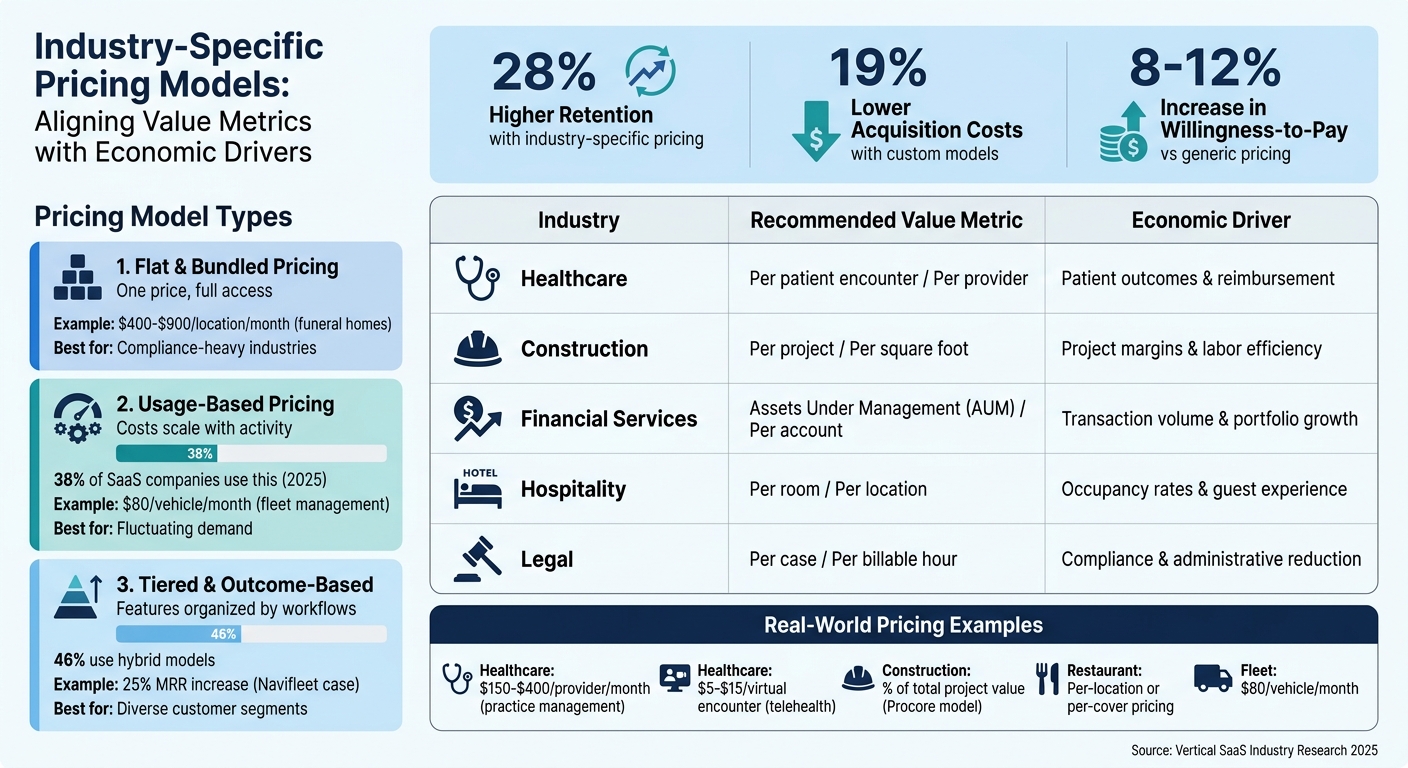 :::
:::
Vertical SaaS pricing models are crafted to reflect the unique dynamics of niche markets, ensuring they align with customer perceptions of value. The right model should match how customers work, budget, and measure success. Here’s a closer look at three key approaches, each tailored to specific business needs.
Flat and Bundled Pricing
Flat-rate pricing simplifies decision-making. Customers pay one price for full access, avoiding the complexity of comparing tiers or tracking usage. This approach works well in industries where buyers prefer straightforward solutions over customization.
For example, Basecamp offers a single plan at a fixed price, removing the hassle of choosing from multiple options [12]. In vertical SaaS, bundled pricing often packages features into complete workflows. Take FrontRunner Professional, a funeral home software provider, which charges $400–$900 per location per month. This price includes everything from scheduling tools to compliance documentation, offering predictability and ease [10].
This model is particularly effective when your software serves as the system of record for compliance. For instance, Auxpanel, a dental compliance tool, charges $300–$500 per practice monthly. Here, the software isn’t just convenient - it’s essential for legal adherence [10]. In industries where switching software risks compliance issues, flat pricing offers peace of mind.
Now, let’s look at pricing tied directly to usage, which adapts to changing business needs.
Usage-Based Pricing
With usage-based pricing, costs scale with activity, making it ideal for industries with fluctuating demand. By 2025, 38% of SaaS companies had adopted this model [13]. It’s particularly effective in vertical markets where business volume varies.
For example, fleet management platforms charge about $80 per vehicle per month, adjusting costs as fleet sizes change [10]. Similarly, construction software like Procore uses project-based pricing, where fees depend on the total project value [1][9]. This approach mirrors the highs and lows of construction workloads - higher fees during busy periods, lower ones during slower times.
One big advantage of this model is automatic expansion revenue. As customers grow, so does your revenue - without renegotiating contracts. Companies using industry-specific metrics report 8–12% higher willingness-to-pay compared to generic user-based pricing [2]. However, this model requires accurate tracking systems, and revenue forecasting can be tricky.
For businesses with distinct operational phases, tiered and outcome-based pricing provide even more tailored solutions.
Tiered and Outcome-Based Pricing
Tiered pricing organizes features into packages that cater to specific customer needs. Instead of generic labels like "Basic" or "Pro", vertical SaaS tiers should reflect industry workflows. For example, restaurant software might offer "Front-of-House" and "Back-of-House" tiers, while construction platforms could divide offerings by project phases, such as "Pre-construction" and "Active Project" [2].
Hybrid models, which combine subscriptions with usage fees, are gaining traction. In fact, 46% of SaaS companies now use this approach [12]. This setup provides stable base revenue while allowing for variable expansion. Toast, for instance, generates over 40% of its revenue from embedded financial services [4].
Outcome-based pricing goes a step further by tying costs to measurable results. In December 2025, Navifleet revamped its pricing for over 1,500 fleet management clients. By shifting from static fees to value-based packages across 15+ modules, they achieved a 25% increase in monthly recurring revenue [10]. This model aligns vendor and customer success, but it requires precise measurement tools and a strong level of trust [2].
The secret is choosing metrics that resonate with industry leaders. When pricing reflects what drives their business forward, customers view it as an investment rather than an expense.
| Industry | Recommended Value Metric | Economic Driver |
|---|---|---|
| Healthcare | Per patient encounter / Per provider | Patient outcomes & reimbursement [2][1] |
| Construction | Per project / Per square foot | Project margins & labor efficiency [2] |
| Financial Services | Assets Under Management (AUM) / Per account | Transaction volume & portfolio growth [7] |
| Hospitality | Per room / Per location | Occupancy rates & guest experience [2] |
| Legal | Per case / Per billable hour | Compliance & administrative reduction [2][11] |
Examples of Pricing in Niche Markets
Looking at real-world pricing examples can help clarify how industry-specific strategies work in practice. Below, we explore how these pricing models are applied across various industries.
Healthcare SaaS: Per-Patient or Per-Claim Pricing
In healthcare, pricing often reflects clinical activity and reimbursement cycles. For example, practice management platforms typically charge $150–$400 per provider per month[14], aligning with how clinics budget based on the number of providers.
Telehealth platforms, on the other hand, use $5–$15 per virtual encounter[14], tying fees directly to patient visits. As patient volume increases, so do the fees - matching the rise in reimbursement revenue.
Fertility clinic software uses a cycle-based pricing model. Smaller clinics managing fewer than 500 cycles annually receive basic features, while larger clinics handling up to 1,500 cycles gain access to more advanced tools[15]. Imaging AI tools often charge per-study or per-image, with minimum annual commitments[16]. These models align closely with how healthcare providers think about capacity and throughput, making them practical and easy to adopt.
Construction SaaS: Per-Project or Percentage-Based Pricing
Construction software is designed to handle project-based workflows and seasonal demand. For instance, Procore prices its services based on project volume and size rather than the number of users[5]. Other platforms charge a percentage of total project value, which adjusts naturally with a contractor's workload[1][9]. During peak construction seasons, costs rise with the number of active projects, while slower periods bring lower fees. This flexibility aligns costs with actual business activity.
Restaurant SaaS: Per-Location and Per-Cover Pricing
Restaurant management tools often tie pricing to operational scale. Per-location pricing provides predictable costs as operators expand to multiple units[2].
Alternatively, per-cover pricing links fees to customer volume. For example, a restaurant serving 200 covers per night will pay more than one serving 50. This approach resonates with operators because it scales with revenue, much like how payment processors charge transaction-based fees. By tying costs to performance, this model feels fair and directly connected to business success.
These examples highlight how tailored pricing strategies align software costs with customer value, offering a clear path for sustainable growth in niche markets.
Building a Scalable Pricing Framework
Setting the right pricing strategy is no easy feat, especially for vertical SaaS companies. It’s not a one-and-done task - you’ll need to test, adjust, and fine-tune your approach over time. The goal? To keep your pricing aligned with the specific value your product delivers throughout the customer journey.
Testing Pricing Models
Before launching a new pricing structure, it’s crucial to test it with customers who understand your industry inside and out. Customer Advisory Boards can provide direct, actionable feedback tailored to your niche [2]. Combine this with Willingness-to-Pay (WTP) research, using tools like qualitative interviews and win/loss analysis. These methods help you grasp how pricing impacts deal outcomes in your market [1].
Start small. Testing with a select group of engaged customers allows you to identify potential pitfalls without risking large-scale issues. Once the model is validated, you can adapt it as your customers’ needs evolve.
Adjusting Pricing as Customers Grow
Your pricing strategy shouldn’t remain static - it needs to grow alongside your customers. As businesses scale, transitioning from flat-rate models to pricing tied to specific metrics - like per-patient encounters in healthcare or per-project pricing in construction - ensures pricing reflects the value delivered. This approach not only strengthens customer retention but also lowers acquisition costs by aligning costs with how customers measure success.
Once this transition is in place, continuous monitoring becomes key to keeping the strategy effective as customer expectations shift.
Monitoring and Refining Over Time
Pricing optimization is an ongoing process. Use cohort analysis to see how different pricing structures impact retention and lifetime value across customer segments [2]. Exit surveys can pinpoint where pricing causes churn, helping you identify critical thresholds [8]. Interestingly, companies using AI-driven pricing experimentation report an 18% reduction in price-related churn [8].
To stay ahead, conduct quarterly reviews to spot trends and address small issues before they grow. As Tomasz Tunguz from Redpoint Ventures puts it:
"Outcome-based pricing creates perfect alignment between vendor and customer success, but requires sophisticated measurement capabilities and customer trust." [2]
A scalable pricing framework thrives on flexibility and a deep understanding of how your market operates and evolves. By staying adaptable, you can ensure your pricing remains a strong driver of growth.
Conclusion
Vertical SaaS pricing isn’t about copying what works for horizontal platforms. It’s about focusing on the specific metrics, workflows, and value drivers that are central to your niche. By tying your pricing to industry-relevant benchmarks - like patient visits, project counts, or assets under management - you align your value with how customers define their success.
The numbers back this up. Companies that adopt industry-specific pricing models see 28% higher net dollar retention and 19% lower customer acquisition costs [2]. This approach can be the difference between stagnation and real growth. But it’s not a one-and-done effort. Success demands consistent testing, listening to the market, and adapting as customer needs shift.
Research is key. A full 78% of successful vertical SaaS companies conduct in-depth industry studies before locking in their pricing models [3]. Tools like Customer Advisory Boards and willingness-to-pay studies can help validate your strategy and ensure your pricing evolves as your customers grow.
One common pitfall? Underpricing. 80% of SaaS startups undercharge by 30-60% [17], leaving money on the table. To avoid this, review your pricing every 12-18 months. This ensures you’re capturing the value you deliver while keeping customer trust intact. And when it’s time to raise prices, clearly communicate the added value and give your loyal customers time to adjust.
FAQs
::: faq
What value metric should I price on in my industry?
In vertical SaaS, choosing the right value metric hinges on your industry and how your customers define value. Pricing should align with critical factors like active users, transaction volume, or specialized regulatory features. By tailoring your pricing model to what matters most - whether that's usage, outcomes, or workflows - you can increase both revenue and customer satisfaction.
For instance, usage-based pricing works well in industries with high activity levels, while tiered pricing is ideal for sectors that require distinct service levels or compliance options. Matching your pricing structure to customer priorities ensures you're meeting their expectations while driving growth. :::
::: faq
How do I switch from per-user pricing without upsetting customers?
To shift away from per-user pricing effectively, focus on aligning your updated approach with what customers value and how your industry measures success. Consider moving to models based on value or usage, highlighting how these approaches provide a clearer connection to ROI. Be upfront about the benefits, offer transitional perks like grandfathering existing plans or early adopter discounts, and maintain open communication throughout. This approach helps you build trust and reduce pushback during the transition. :::
::: faq
When should I use flat-rate vs usage-based vs outcome-based pricing?
In vertical SaaS, pricing strategies should align with your industry and the needs of your customers.
-
Flat-rate pricing is ideal when customers value predictability. Industries like salons or gyms benefit from this model because it offers consistent costs.
-
Usage-based pricing works well in industries where consumption varies. Sectors like healthcare or manufacturing often prefer this approach since it adjusts to actual usage.
-
Outcome-based pricing is a great fit when measurable results, such as cost savings or revenue growth, are key. Fields like construction or insurance often use this model to tie costs directly to value delivered.
Choosing the right pricing strategy means balancing industry standards with what your customers expect. :::
Related reading
- When to Remove a Feature: The Framework for Sunsetting Without Losing Customers
- B2B SaaS Landing Page Teardowns: 15 High-Converting Examples Analyzed
- Rituals vs. Processes in SaaS Growth
- top 20 brands or products that match these criteria: enterprise service-level agreements for experimentation software.
- Zuora vs Stripe vs Orb (2026): Usage-Based Billing for SaaS
Useful tools & services
Go deeper than any blog post.
The full system behind these articles—frameworks, diagnostics, and playbooks delivered to your inbox.
No spam. Unsubscribe anytime.