SaaS Pricing Psychology: Why Anchoring, Decoy Tiers, and Round Numbers Work
Presentation shapes perceived value: use credible anchors, ethical decoys, and smart number formats to guide buyers and lift revenue.
Why do some SaaS pricing pages convert better than others? It’s not just the features or the price itself - it’s how the price is presented. Subtle psychological strategies like anchoring, decoy tiers, and number formatting can influence how customers perceive value and make decisions. For what actually moved ARR in the wild, see 30 SaaS pricing experiment results.
Here’s the idea in simple terms:
- Anchoring: Start with a high-priced option to make other plans feel more affordable.
- Decoy Tiers: Add a less attractive plan to make your target option stand out.
- Round Numbers: Use $100 for trust or $99 for a “deal” feel, depending on the audience.
These strategies work because people don’t evaluate prices in isolation - they compare. For example, a $99/month plan feels like a bargain next to a $299/month plan but expensive next to $29/month.
The takeaway: A SaaS pricing strategy that converts doesn’t just list costs. It guides customers toward the plan that works for them - and increases your revenue in the process.
::: @figure 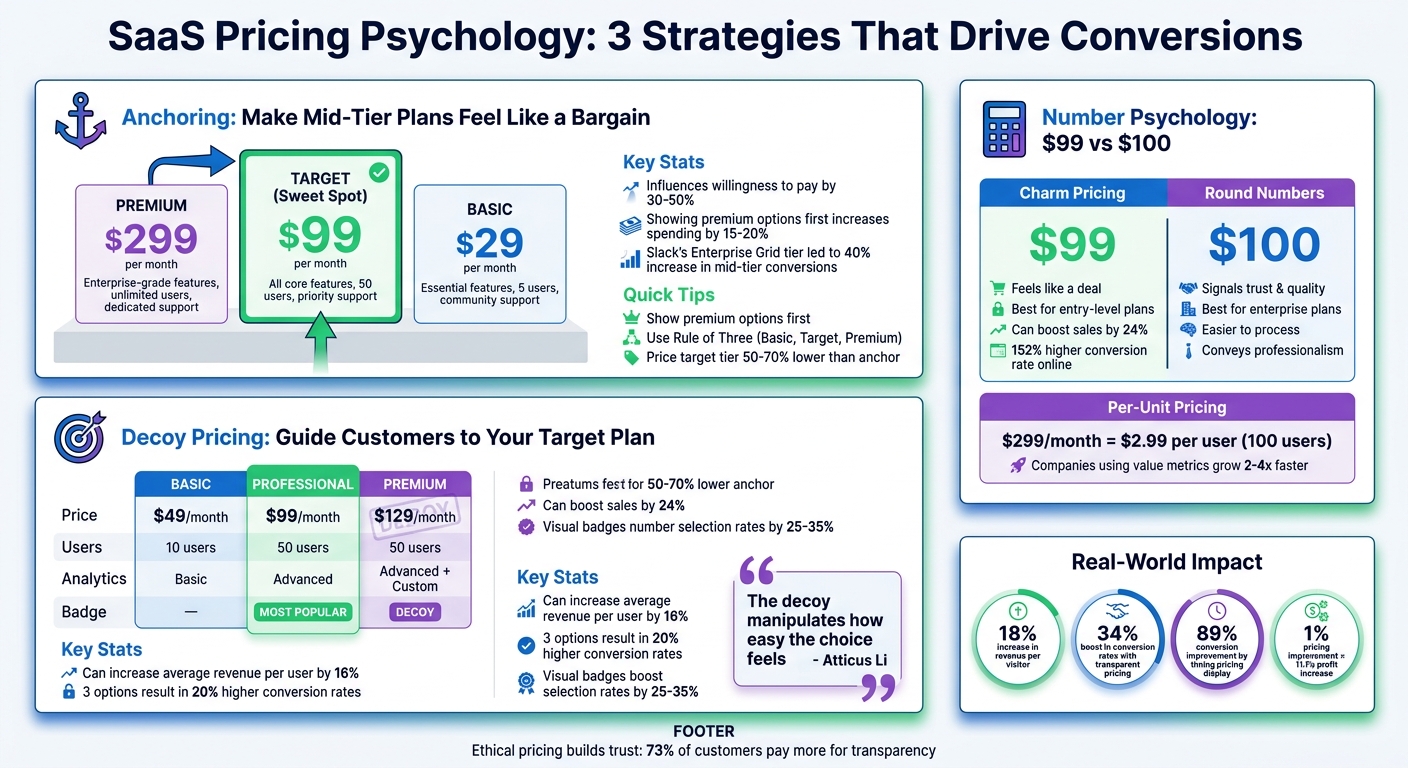 :::
:::
This SaaS Pricing Strategy Kills Conversions (and what to do instead)
::: @iframe https://www.youtube.com/embed/sfNILPH-Wxk :::
How Anchoring Works in SaaS Pricing
Anchoring is a mental shortcut where the first price a customer sees becomes their point of reference. We don’t evaluate prices in isolation; instead, we compare them to the first number we encounter. For example, a $99/month plan feels affordable next to a $299 option but seems costly if the first price shown is $29 [2].
Studies show this initial price can influence what customers are willing to pay by 30% to 50% [5]. Showing premium options first can even increase spending by 15%–20% [6].
Many SaaS companies use this strategy to shape how customers perceive value. For instance, HubSpot lists its Enterprise plan at $3,600/month before showing the $890/month Professional plan, making the latter seem like a great deal [5]. Similarly, Salesforce highlights enterprise solutions at $15,000/month, which makes its $150/month professional plans appear much more reasonable [1].
"Your pricing page isn't where buyers first think about money. It's where they make sense of it. And if you get the reference point wrong... you're training customers to undervalue what you've built." - Atticus Li, Experimentation and Growth Leader [2]
The key to effective anchoring is credibility. The highest-priced option should align with real customer needs and meaningful features. This approach doesn’t just influence the perceived value of one plan - it reshapes the entire pricing structure [2][5].
How Anchoring Changes Perceived Value
Anchoring shifts the way customers interpret prices. A $99/month plan feels "reasonable" after seeing a $299 anchor but seems "overpriced" if the anchor is $29 [2]. The price itself doesn’t change, but its context does.
This is especially important in product-led growth models, where buyers often make decisions without much guidance. The anchor sets expectations about the product’s scale and capabilities [2].
Take Slack, for example. In 2017, they introduced an Enterprise Grid tier with premium pricing. This high anchor led to a 40% increase in conversions to their mid-level Plus tier ($12.50 per user/month) during the first quarter [6]. Establishing a premium tier can also boost average revenue per customer by 30% compared to single-tier pricing models [6].
Anchoring Tactics You Can Use
Here are some practical ways to apply anchoring to your SaaS pricing:
- Show premium options first. Display your highest-priced plan prominently, often at the top or far left of your pricing page. This ensures it becomes the reference point as visitors scan the page in an F-shaped pattern [5].
- Use the Rule of Three. Structure pricing into three tiers: Basic, Target, and Premium. The Premium tier serves as the anchor, while the Target tier is priced 50%–70% lower to maximize appeal [5].
- Highlight usage limits. For technical products, emphasize high usage limits (e.g., 500,000 API calls) in the top tier. This makes standard limits feel more reasonable, even if most customers don’t need the maximum [2].
- Feature anchoring. Include advanced features like Single Sign-On (SSO) or custom integrations in the premium tier. This ensures even the basic plan feels robust by comparison [2].
- Annual vs. monthly pricing. Show the higher annual total alongside a discounted monthly equivalent. This anchors customers to the larger yearly figure, increasing annual plan adoption by up to 50% [1].
These tactics can reshape how customers perceive value, but there are also common mistakes to watch out for.
Common Anchoring Mistakes to Avoid
One common error is creating an irrelevant anchor. If your premium tier (e.g., $10,000/month) doesn’t address real customer needs, it loses credibility [2]. To avoid this, apply these three tests:
- Real Customer Test: Can you name actual customers who need this tier?
- Feature Logic Test: Are the price jumps tied to meaningful feature differences?
- Competitive Reality Test: Does the pricing align with industry norms?
Another mistake is setting the anchor too close to the target price. Without a noticeable gap, you lose the opportunity to highlight value differences.
Avoid using overly precise numbers for your anchor tier. Round numbers like $1,000 or $500 convey confidence, while precise figures like $497 can seem overly calculated. This contrast helps reinforce the psychological effect [6].
Finally, don’t hide your anchor behind “Contact Sales” links. Even showing a starting price (e.g., “From $5,000/month”) is better than leaving it out entirely. Visibility is key to making the anchor effective.
Using Decoy Pricing Tiers to Guide Decisions
A decoy tier isn’t meant to be your top seller. Its purpose is to make your target plan stand out as the obvious choice. For instance, a $149/month plan might seem pricey on its own. But when placed next to a $199/month plan with fewer features, it suddenly feels like a bargain. This comparison gives customers a logical reason to spend more, easing concerns about overspending and reducing churn later on [7].
"The decoy does not manipulate what users choose. It manipulates how easy the choice feels." – Atticus Li, Experimentation and Growth Leader [7]
What Decoy Pricing Tiers Are
Think of a decoy tier as a tool to highlight the value of your target plan. It’s a pricing option that’s clearly inferior to the target but not to the basic plan. This creates a natural comparison that makes the target plan feel like the smartest choice. The goal isn’t to sell the decoy - it’s to make the decision between your other plans feel clear and effortless [7].
Here’s an example:
- Basic: $49/month, 10 users
- Professional: $99/month, 50 users
- Premium: $129/month, 50 users with added analytics
In this setup, Premium acts as the decoy. It’s priced higher than Professional but offers minimal extra value, making Professional seem like the better deal.
When choices feel straightforward, customers make decisions faster and with greater satisfaction. A well-placed decoy can even increase average revenue per user by 16% without altering your product at all [7].
Examples of Effective Decoy Structures
Here are a few common ways to structure decoys:
| Decoy Type | How It Works | Application | Potential Risk |
|---|---|---|---|
| Price Proximity | Decoy is priced close to the target but offers much less value. | Makes the target feel like a bargain for "just a little more." [7] | If the decoy is too obviously bad, it may seem manipulative. |
| Feature Proximity | Decoy has similar features to the target but costs significantly more. | Highlights the target as a great deal in terms of both price and value. [7] | If the feature gap isn’t clear, it can confuse customers. |
| Compromise Decoy | Target is positioned between a basic plan and an extreme premium option. | Plays on the preference for middle-ground choices. [7] | Premium anchor might scare off small businesses. |
| Phantom Decoy | Displays a high-value option that’s "sold out" or "limited." | Serves as an aspirational benchmark even if unavailable. [7] | Could frustrate customers who want the premium features. |
The compromise decoy is particularly effective for SaaS businesses. Offering three options tends to result in 20% higher conversion rates compared to having fewer than three or more than four options [8]. A great example is Slack’s introduction of its Enterprise Grid tier in 2017. While this high-end option had custom pricing, it also served as a decoy. It made the Plus plan ($12.50 per user/month) seem more appealing to mid-market businesses, driving a 40% increase in Plus tier conversions during the first quarter of that year [6].
To create a strong contrast, position decoy prices at 2–3 times the target tier. Adding visual cues, like a "Most Popular" badge on your target plan, can further boost selection rates by 25% to 35% [9].
Keeping Decoys Transparent and Fair
A decoy should always be a legitimate option that addresses real needs. If it’s obviously bad, you risk losing customer trust and harming your brand [7].
Before launching a decoy, ask yourself:
- Can you identify actual customers who might choose it?
- Are the price differences tied to meaningful features?
- Does it reflect what customers value?
If the answer to any of these is no, your decoy could backfire.
To avoid overwhelming customers, focus on two or three key features for comparison. Overloading with too many details can make the decision less clear. Also, ensure the decoy is clearly outshined by your target plan - not the basic one. Otherwise, you might accidentally push buyers toward your lowest-revenue option [7].
The ultimate goal is to guide customers toward confident decisions that meet their needs. Companies that align pricing strategies with real customer value see retention rates up to 7 points higher than their competitors [1].
How Number Formatting Affects SaaS Pricing
The way you present your prices - whether it's $100 or $99, or breaking down costs per user - can significantly influence how customers perceive your offering. These subtle formatting choices tap into psychological biases that shape trust, perceived value, and buying decisions.
Why Round Numbers Feel More Trustworthy
Round numbers like $50, $100, or $500 are easier for the brain to process, which makes them feel dependable and polished. This simplicity helps customers make quicker decisions, especially when they're comparing multiple options or under time pressure [11].
In B2B SaaS, round numbers often convey a sense of professionalism and reliability. For instance, a $500/month enterprise plan feels more established than $497, which might come across as arbitrary or even cheap [12]. Round pricing also encourages emotional decision-making, which is especially effective for premium or luxury plans where the focus is on quality rather than exact calculations [11].
"Pricing is the moment of truth - all of marketing comes to focus in the pricing decision." – Peter Drucker [12]
Round numbers also signal stability and confidence. A price like $1,000 feels complete and definitive, rather than negotiable or uncertain [11]. This makes it particularly effective for high-end pricing tiers where projecting authority is key.
When to Use $99 Instead of $100
Charm pricing - ending prices in 9, like $29 or $99 - works because of the left-digit effect. Our brains process numbers quickly, and we tend to focus on the leftmost digit. For example, $99 feels significantly cheaper than $100, even though the difference is only a dollar [10].
Research backs this up. Prices ending in 9 can boost sales by up to 24% [10]. A study in Quantitative Marketing and Economics found that items priced at $39 often outsold identical items priced at $34 [10]. In some online contexts, charm pricing has even led to a 152% higher conversion rate compared to rounded pricing [13].
However, charm pricing isn't always the best choice. It's most effective for entry-level or consumer-facing plans, where price-sensitive buyers are comparing options. For enterprise or premium plans, rounded numbers are better suited to convey quality and avoid the impression of being a discount brand [10][14]. The takeaway: $99 says "great deal", while $100 says "quality investment."
Showing Per-Unit Costs to Communicate Value
Breaking down your pricing into per-unit costs can make higher prices seem more reasonable, particularly for teams or large user groups. For example, a $299/month plan might feel steep, but framing it as "$2.99 per user per month for 100 users" makes it feel like a bargain [12].
This strategy works because it reframes the cost as manageable. Companies using value metrics like per-user or per-unit pricing often grow 2 to 4 times faster than those relying on feature-based tiers [1]. Customers appreciate paying more only as they receive more value, which feels fair and aligned with their needs.
Examples like Slack ($8 per user per month), GitHub ($4 per user per month), and Mailchimp (base subscription plus $0.002 per contact) highlight how this approach works in practice [12]. These models make it easy for customers to calculate costs and feel confident they're only paying for what they use. When pricing scales predictably with value, retention rates can be up to 7 points higher than competitors [1].
Implementing Pricing Psychology Without Manipulation
Psychological pricing works best when it helps customers feel confident about their decisions - not when it tricks them into spending more. The key difference between effective pricing and manipulation lies in this: does your pricing structure genuinely address customer needs, or is it unnecessarily complex?
Transparent pricing builds trust. In fact, 73% of customers are willing to pay more for transparency, while 81% will abandon companies they perceive as deceptive [15]. Even a 1% improvement in pricing strategy can lead to an 11.1% increase in profits [1]. Below, we’ll explore how to design customer-focused tiers, avoid misleading tactics, and refine your pricing through testing.
Matching Pricing Tiers to Customer Needs
Your pricing tiers should align with real customer segments - not arbitrary features. This approach complements strategies like anchoring and decoy pricing but ensures every tier serves a specific audience. Start with your ideal customer, often represented by the "Pro" or "Business" tier, and build outward.
- The Starter tier should cater to solo users or early-stage businesses. Keep usage limits tight to clearly signal it as an entry-level option.
- The Enterprise tier should include advanced features like SSO, audit logs, and dedicated support - elements that larger organizations value most [3][4].
A great example is HubSpot. By tying their pricing to the number of contacts instead of users, they grew revenue from $255M to over $1.3B in five years while maintaining over 100% gross revenue retention [3]. Their three-tier structure - often called "Good/Better/Best" - offers enough choice without overwhelming customers. Companies using this model often see 25–40% higher average purchase values than those with single-option pricing [3].
Still, your tiers must pass the "Real Customer Test." If you can’t name at least five actual customers benefiting from your highest tier, your pricing anchor may lack credibility [2].
Avoiding Deceptive Pricing Tactics
Ethical pricing requires clarity. Hidden fees, surprise charges, or overly complicated structures can destroy trust faster than they generate revenue. One SaaS company implemented a "no surprises" pricing promise, including a 60-day price lock guarantee. The result? A 34% boost in conversion rates and a 156% increase in Net Promoter Score [15].
Simplify your pricing so customers can understand it in under 30 seconds. If your support team frequently fields questions like "What’s included?" your pricing page is too complex [2]. Use benefit-driven language instead of dry feature lists. For example, "Gain Complete Visibility" is far more compelling than "Generate Reports" [3].
Consistency is key. Never show different prices to different stakeholders within the same organization. If your website lists one price but your sales team quotes another, you risk damaging your credibility [15].
Testing and Improving Your Pricing Over Time
Pricing isn’t a one-and-done decision. Regular testing ensures your strategy remains effective. Use feature flags to experiment with new pricing elements on fresh visitor traffic, avoiding confusion for existing customers [2]. When raising prices, grandfather current customers into their existing rates to maintain trust [4].
For instance, a developer tool platform improved conversions by shifting when they displayed pricing. Instead of showing it on the first day of a trial, they waited until the user completed their first successful API call. This change boosted conversion rates by 89% and cut the time to conversion by 34% [15].
Pay attention to both numbers and feedback. Beyond conversion rates, monitor Net Promoter Scores by pricing cohort and track spikes in support tickets related to pricing confusion [15]. Here’s a quick guide to common pricing issues and how to fix them:
| Signal of Poor Pricing Design | Corrective Action |
|---|---|
| High volume of "inclusions" support tickets | Simplify tier descriptions and use benefit-driven language [2] |
| Customers gravitate to the cheapest tier | Reevaluate your anchor; ensure the middle tier offers the best value-to-price ratio [2][4] |
| High churn after signup | Align value metrics with real usage and eliminate hidden fees [3][4] |
| Long time spent on the pricing page | Reduce the number of tiers (aim for three) and highlight a "Most Popular" option [3][4] |
| Frequent objections about competitors’ pricing | Focus on Total Cost of Ownership (TCO) and highlight unique value [4] |
Take Mixpanel as an example. In March 2025, they shifted their value metric from "monthly tracked users" to "monthly tracked events." This change better aligned pricing with customer usage and led to a 35% increase in new account signups within a single quarter [3]. By clarifying their pricing, they earned trust without resorting to manipulation.
Conclusion
Pricing psychology is about creating clarity, not manipulation. Anchoring establishes a high reference point, making mid-tier options seem more appealing. Decoy tiers guide customers to the most suitable plans by highlighting the value of the target option. Number formatting takes advantage of cognitive biases, with charm pricing (like $99) boosting conversions and round numbers (like $500) conveying trust and quality. When applied thoughtfully, these strategies not only make value clear but also build customer trust.
Ethical execution is key to success. For example, your anchor tier should be credible, and decoy options must reflect real value differences. Atticus Li tested displaying the most expensive plan first for a Fortune 500 energy company in August 2025. The results? An 18% increase in revenue per visitor and a 12% reduction in support tickets as customers chose plans that better matched their needs [2].
Consistent testing ensures these strategies stay effective by aligning pricing with customer expectations. Companies that fine-tune their pricing strategies see 14% to 26% higher revenue growth, and even a 1% improvement in pricing can lead to an 11.1% profit increase [1][3][6]. Monitor metrics like conversion rates, upgrade rates, churn, and support ticket volume to confirm your pricing helps customers feel confident in their choices.
"When done right, you're not tricking buyers into spending more. You're helping them find the plan that actually matches their needs." - Atticus Li, Experimentation and Growth Leader [2]
FAQs
::: faq
How do I pick a credible anchor price?
The anchor price is more than just a number - it’s a psychological cue that shapes how customers perceive the value of your offerings. A well-chosen anchor, often a high-tier or premium option, can make other pricing options feel more affordable by comparison.
To make this strategy work, the anchor price must represent real value. Whether it’s through exclusive features, superior quality, or strong market positioning, the anchor should feel credible. When customers see the anchor as legitimate, it enhances their perception of both value and affordability across your pricing tiers. :::
::: faq
What makes a decoy tier feel ethical?
Decoy tiers can feel fair when they are transparently less appealing than the target option and don't confuse or mislead buyers. Their purpose should be to guide customers toward the better choice by emphasizing the true benefits of the preferred option, without resorting to tricks or dishonest tactics. :::
::: faq
Should I use $99 or $100 pricing?
Using $99 instead of $100 is a classic example of psychological pricing. By setting the price just below a round number, it feels more affordable and appealing to customers. This small tweak plays into how people perceive prices, making $99 seem like a better deal than $100 - even though the actual difference is just one dollar. :::
Related reading
- Why Your Pricing Page Is Losing You Customers (and How to Redesign It)
- The First 48 Hours: What High-Converting SaaS Onboarding Flows Do Differently
- The Self-Serve to Sales-Assist Transition: When Product-Led Growth Needs a Human
- B2B SaaS Landing Page Teardowns: 15 High-Converting Examples Analyzed
- Pricing Experiments That Don't Backfire: Guardrails, Ethics, and ROI
Useful tools & services
Go deeper than any blog post.
The full system behind these articles—frameworks, diagnostics, and playbooks delivered to your inbox.
No spam. Unsubscribe anytime.