Net Dollar Retention Above 120%: How 10 SaaS Companies Expanded Without New Logos
How 10 SaaS firms reached 120%+ NDR using usage-based pricing, seat expansion, cross-selling, and proactive customer success.
Net Dollar Retention (NDR) measures how much revenue you keep - and grow - from your existing customers over a year. If your NDR is above 120%, your current customers generate more revenue than you lose, without needing new customers. This is the gold standard for SaaS companies.
Why does it matter?
- Companies with 120%+ NDR grow twice as fast as competitors.
- They often trade at higher revenue multiples (10–12x vs. 4–6x).
- At 120% NDR, you can double revenue in 5 years without adding new logos.
Here’s how 10 SaaS companies, like Snowflake, Datadog, and Figma, hit 120%+ NDR:
- Snowflake: Revenue grows as customers use more data (125% NDR).
- Figma: Collaboration features drive team adoption (140%+ NDR).
- HubSpot: Cross-selling multiple hubs boosted NDR from 88.6% to 115%.
Key strategies include:
- Upselling and cross-selling with seat expansions, tier upgrades, and usage-based pricing.
- Using customer success teams to identify churn risks and revenue opportunities early.
- Testing pricing models like consumption-based or modular pricing to align with customer value.
The takeaway: Focus on growing revenue from your existing customers by embedding expansion into your pricing, product, and customer success strategies.
NRR Explained: The Key to SaaS Success
::: @iframe https://www.youtube.com/embed/0lHV-oQH6yU :::
10 SaaS Companies That Reached 120%+ NDR
These companies found ways to grow revenue from their existing customers by embedding smart pricing models, thoughtful product design, and effective customer success strategies into their offerings.
Snowflake hit a 125% NDR for FY2026 [1] and has historically kept it between 165–170% [2]. Its consumption-based pricing ensures that as customers' data usage grows, so does Snowflake's revenue - automatically.
Monday.com achieved an impressive 140–145% NDR by building expansion directly into its platform. As more teams within a company adopt the tool, seats and tiers are upgraded naturally, leading to growth as a result of increased customer value [2].
Figma maintained NDR levels above 140% before its acquisition and reached 136% in Q4 2025 [2][7]. Its "multiplayer" feature created network effects, driving adoption beyond its core audience of designers. By February 2026, CEO Dylan Field shared that nearly 60% of files created using Figma's "Figma Make" AI tool came from non-designers, highlighting its reach beyond its original user base [10].
ServiceNow expanded from IT into HR, Legal, and Finance by using a "workflow data flywheel" to spot inefficiencies in processes. By FY2025, this strategy helped achieve a 125% NDR while scaling accounts from $100,000 to over $10 million across more than 2,100 customers in 7–10 years [9].
Datadog maintained an NDR of around 120% as of Q4 2025, thanks to its usage-based pricing that grows alongside customer infrastructure needs [1].
Cloudflare reported a 120% NDR in Q4 2025 by pairing usage-based scalability with the adoption of multiple product modules [1].
CrowdStrike took a similar approach, focusing on cross-selling additional modules within its endpoint security platform. This strategy resulted in an NDR of 115–120%, as customers adopted more features to meet evolving security requirements [2].
HubSpot transformed its NDR from 88.6% at its 2014 IPO to a peak of 115% in 2021. This shift was driven by a multi-hub strategy and a move to seat-based pricing. By Q1 2025, 24% of Pro+ customers had added extra core seats, and by 2021, 37% were using four or more hubs. Jason Lemkin, Founder of SaaStr, noted:
"Pricing model is everything. HubSpot's transformation from 70% to 100% NRR came primarily from pricing innovation, not product changes." [6]
Zoom boosted adoption and retention by creating solutions tailored to industries like education and healthcare. Between 2016 and 2017, its freemium model with a 40-minute meeting cap led to 215% year-over-year usage growth. For enterprise clients, Zoom used the Zuora platform to offer flexible, custom pricing. Sunil Madan, Head of Business Operations at Zoom, explained:
"The biggest advantage Zuora gives Zoom? The speed to deliver." [8]
Each of these companies found their own way to surpass 120% NDR. What they all have in common is their ability to weave expansion into their product experience and pricing strategy. The next section will explore how you can apply these strategies to your own business.
How to Achieve 120%+ NDR
The companies that hit 120%+ Net Dollar Retention (NDR) didn’t get there by luck. They built their pricing strategies, product features, and customer success efforts with expansion in mind right from the start. Their playbook can be summed up in three areas: upselling and cross-selling, driving revenue through customer success, and experimenting with pricing models.
How to Upsell and Cross-Sell Effectively
Expansion revenue relies on four key drivers: seat expansion, tier upsells, cross-selling, and usage-based growth [4].
Seat expansion happens naturally as customers grow their teams. Tier upsells work when premium features - like advanced analytics, compliance tools, or single sign-on - are exclusive to higher-priced plans [5, 18]. Cross-selling thrives when complementary products solve related problems. For instance, HubSpot offers its Marketing Hub to Sales Hub customers, creating a seamless ecosystem of tools [9, 5].
Timing is everything. Offers triggered by customer behavior convert three to five times better than scheduled ones [11]. Take WorkflowHQ, for example. By tracking eight specific behaviors - like reaching 80% of API limits or adding teammates - they boosted expansion revenue from 18% to 67%. Their close rates jumped from 34% to 68%, and upgrade closing time dropped from 12 days to just 2.3 [13].
Upselling is also far more cost-effective than acquiring new customers. It costs just $0.27 per $1 of revenue, compared to $1.13 for landing new logos. Expansion revenue, in general, costs only 5% to 25% of the customer acquisition cost for new accounts [10, 18].
Next, let’s look at how a proactive customer success strategy can unlock even more opportunities.
Using Customer Success to Drive Revenue
Customer success teams need to move beyond reactive support and focus on delivering proactive outcomes. Their job is to spot at-risk accounts before they churn and identify expansion opportunities early [21, 22]. This means tracking customer behavior closely - like usage thresholds or feature exploration - to catch signals ahead of time.
A smooth handoff between customer success and sales is crucial. In this setup, customer success identifies and qualifies opportunities, while sales or account management handles negotiations. This keeps customer success managers as trusted advisors, not salespeople chasing quotas. As one expert at Udit.co explained:
"The moment a customer thinks their CSM is trying to hit a quota rather than help them succeed, the trust that makes the CS relationship valuable is damaged." (– Udit.co) [4]
Timing matters here too. Reaching out when a customer hits 80–85% of their usage limit leads to a 73% conversion rate. Waiting until they’re over the limit - and likely frustrated - drops that to just 34% [13]. The first 90 days are especially critical. Most churn happens when customers fail to meet their initial goals early on [14].
Even small gains in retention can have a massive impact. Improving retention by just 5% can increase profits by 25% to 95% [20, 8]. In fact, by 2025, 52% of new revenue came from expanding existing accounts rather than signing new ones [12].
Proactive strategies like these set the stage for optimizing pricing models to further boost retention.
Testing Pricing Models to Improve Retention
Fine-tuning your pricing strategy can unlock major growth. For example, HubSpot’s move to usage-based pricing in 2014 improved retention by 41%, pushing NDR from 88.6% to nearly 100% within a year. By 2021, 37% of HubSpot’s Pro+ customers were using four or more product hubs, driving NDR to 115% [6].
Usage-based pricing also helps reduce churn by giving customers flexibility to scale down instead of canceling entirely [24, 11]. New Relic followed this approach in 2020, consolidating 13 products into a single platform and charging $0.25 per GB of data ingestion, alongside seat fees. The result? Increased platform adoption and lower churn, as customers weren’t penalized for expanding their usage [16].
Another example is SAP’s “RISE with SAP,” launched in 2021. This bundled ERP software, cloud hosting, and technical support into one annual fee. By the end of 2023, SAP’s cloud revenue hit €13.64 billion, accounting for 45% of total revenue, while over 3,000 legacy customers migrated to the cloud [16].
When adjusting pricing, it’s critical to maintain trust. Grandfathering existing customers for 12 months can help keep the relationship positive. As Jim Steele, former President of Salesforce, explained:
"We maintained trust by ensuring customers never felt like we were changing the rules mid-game. Price increases were almost always tied to genuine new value." (– Jim Steele, Former President, Salesforce) [15]
NDR Strategy Comparison: 10 Companies Side by Side
::: @figure 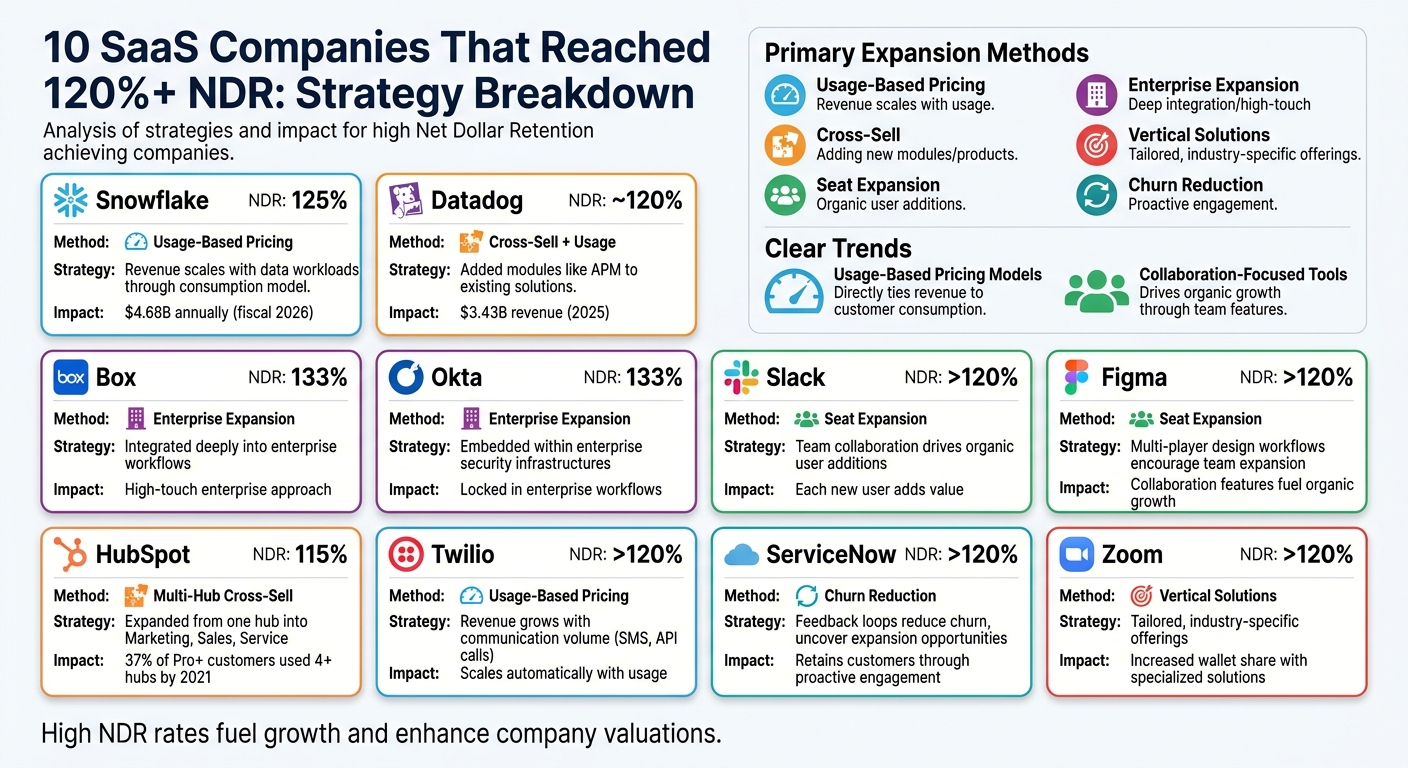 :::
:::
Company Strategy Comparison Table
The table below outlines how ten companies achieved Net Dollar Retention (NDR) rates of 120% or higher. Each company used distinct strategies to grow revenue from existing customers, including usage-based pricing, cross-selling, and collaboration-driven tools.
| Company | NDR Rate | Primary Expansion Method | Key Strategy | Expansion Revenue Impact |
|---|---|---|---|---|
| Snowflake | 125% [3] | Usage-Based Pricing | Revenue scales with data workloads through a consumption model | Reached $4.68B annually by fiscal 2026 [3] |
| Datadog | ~120% [3] | Cross-Sell + Usage | Added modules like APM to existing customer solutions | Generated $3.43B in revenue in 2025 [3] |
| Box | 133% [17] | Enterprise Expansion | Integrated deeply into enterprise workflows before its IPO | Achieved growth through a high-touch approach [17] |
| Okta | 133% [17] | Enterprise Expansion | Embedded within enterprise security infrastructures pre-IPO | Locked in enterprise workflows [17] |
| HubSpot | 115% [6] | Multi-Hub Cross-Sell | Expanded from one hub into Marketing, Sales, and Service modules | 37% of Pro+ customers used 4+ hubs by 2021 [6] |
| Slack | >120% [4] | Seat Expansion | Growth driven by team collaboration and organic user additions | Each new user adds value [4] |
| Figma | >120% [4] | Seat Expansion | Encouraged team expansion with multi-player design workflows | Collaboration features fuel organic growth [4] |
| Twilio | >120% [4] | Usage-Based Pricing | Revenue grows with customer communication volume (e.g., SMS, API calls) | Scales automatically with usage [4] |
| ServiceNow | >120% | Churn Reduction | Feedback loops reduce churn and uncover expansion opportunities | Retains customers through proactive engagement |
| Zoom | >120% | Vertical Solutions | Focused on tailored, industry-specific offerings | Increased wallet share with specialized solutions |
This comparison shows two clear trends: usage-based pricing models (e.g., Snowflake and Twilio) drive scalable revenue growth, while collaboration-focused tools (e.g., Slack and Figma) thrive on network effects. Both approaches ensure strong customer retention and expansion, which are crucial for maintaining high NDR.
High NDR rates not only fuel growth but also enhance company valuations, making these strategies integral to long-term success.
What SaaS Companies Can Learn
Here are some key takeaways and actionable steps to help SaaS companies sustain 120%+ Net Dollar Retention (NDR).
Main Lessons for Reaching 120%+ NDR
To achieve and maintain 120%+ NDR, focus on these three principles:
-
Stabilize before scaling.
If your Gross Dollar Retention (GDR) is below 90%, churn will undermine your growth efforts. Expansion revenue alone won’t make up for high customer attrition. Start by addressing involuntary churn with tools like automated dunning sequences. Simultaneously, refine your product-market fit to ensure customers stick around before you invest in scaling upsells [1][4]. -
Align pricing with customer value.
Your pricing model should reflect how customers experience success with your product. For example, Snowflake and Twilio thrived with usage-based pricing, where revenue naturally grew as customers achieved more. HubSpot’s multi-hub approach worked because each module targeted a specific customer pain point. The common thread? Their pricing strategies grew alongside customer outcomes, not arbitrary metrics like seat counts or rigid tiers [4][6]. -
Automate expansion signal detection.
Expansion opportunities shouldn’t rely on manual tracking. Companies like FormStack360 saw major gains by automating this process. By using scoring models based on factors like usage volume, feature exploration, and team growth, they reduced their signal-to-offer time from 52 days to just 8. This shift boosted their monthly expansion opportunities from 30 to 124 and increased annual expansion revenue by 82% [19]. The takeaway: expansion is about timing, enabled by systematic detection.
These principles provide a roadmap for sustainable revenue growth. Next, let’s explore how to put them into action.
Action Steps for Your Team
To operationalize these lessons, follow these steps:
-
Analyze your retention metrics.
Calculate both GDR and NDR to pinpoint where your challenges lie. If GDR is under 90%, focus first on reducing churn through measures like fixing involuntary churn and improving product stickiness. Only after stabilizing churn should you create expansion strategies [4][18]. -
Engage your top customers.
Identify the top 20% of your customers who contribute 80% of your revenue. Interview them to understand their views on pricing fairness and unmet feature needs. Use these insights to determine the best expansion strategy - whether that’s seat expansion, tier upsells, cross-sells, or usage-based growth [5][4]. -
Build an expansion trigger system.
Track key signals like customers nearing 80–85% of their usage limits, adding team members, or requesting premium features. Proactively reach out when they hit these thresholds - this approach can secure a 73% conversion rate, far better than waiting too long [13]. Assign Customer Success teams to monitor these signals and hand off leads to a dedicated Expansion or Sales team for negotiations. Keeping these roles separate ensures trust while driving revenue [4].
FAQs
::: faq
How do I calculate NDR vs. GDR?
Here are the formulas you need to calculate Net Dollar Retention (NDR) and Gross Dollar Retention (GDR):
- NDR = (Starting ARR + Expansion Revenue – Contraction Revenue – Churned Revenue) / Starting ARR × 100
- GDR = (Starting Revenue – Revenue Lost from Churn and Contractions) / Starting Revenue × 100
The key difference? NDR accounts for expansion revenue, giving a full picture of growth, while GDR focuses only on the revenue retained after accounting for churn and contractions. Both metrics are expressed as percentages, making them easy to compare. :::
::: faq
What’s the fastest way to lift NDR above 120%?
If you want to push your NDR (Net Dollar Retention) above 120%, focus on specific strategies for expanding revenue. This includes techniques like upselling, cross-selling, and growing revenue tied to customer usage. Pair these efforts with strong customer success initiatives to spot the perfect moments for upsell opportunities. This way, you can get the most value out of your current customer base. :::
::: faq
Which pricing model best drives expansion revenue?
Usage-based pricing works well for boosting expansion revenue. By tying the cost of the product to how much customers use it, this model connects the product's value directly to the customer's success. As customers use more, they naturally pay more, which encourages growth. This setup also makes upselling, cross-selling, and increasing revenue feel seamless and less forced. :::
Related reading
- SaaS Discounting Is a Trap: 5 Alternatives That Protect Revenue and Close Deals
- SaaS Pricing Pages (2025): Best Practices That Actually Convert
- SaaS CAC Payback Period Benchmarks 2026 by Industry
- Why Most SaaS A/B Tests Fail Before They Start (Sample Size, Timing, and Segmentation)
- Vertical SaaS Pricing: How Niche Markets Change Every Pricing Rule
Useful tools & services
Go deeper than any blog post.
The full system behind these articles—frameworks, diagnostics, and playbooks delivered to your inbox.
No spam. Unsubscribe anytime.