SaaS Discounting Is a Trap: 5 Alternatives That Protect Revenue and Close Deals
Why discounts erode SaaS revenue and five non-price strategies—value-based pricing, trials, bundles, annual prepay, usage-based billing.
Discounting feels like the easy way to close deals, but it can cost SaaS businesses more than they realize. Lowering prices often attracts churn-prone customers, reduces lifetime value (LTV), and weakens your product’s perceived worth. For example, discounts over 20% can slash LTV by 30% and double churn rates. Over time, this can drain millions in revenue.
Instead of cutting prices, here are five better strategies to close deals without sacrificing margins:
- SaaS Pricing Strategy: Value-Based Pricing: Charge based on the outcomes your product delivers, like ROI or time saved.
- Extended Free Trials: Let customers experience your product’s value before committing, using trials instead of discounts.
- Bundled Offers: Combine complementary features or services into packages that feel worth more.
- Annual Prepayment Incentives: Offer small savings for upfront yearly payments to improve cash flow and retention.
- Usage-Based Pricing: Charge based on actual usage, aligning costs with customer success.
The takeaway? Discounts may close deals quickly, but these alternatives build stronger customer relationships and protect long-term revenue. Stop competing on price and focus on delivering value.
::: @figure 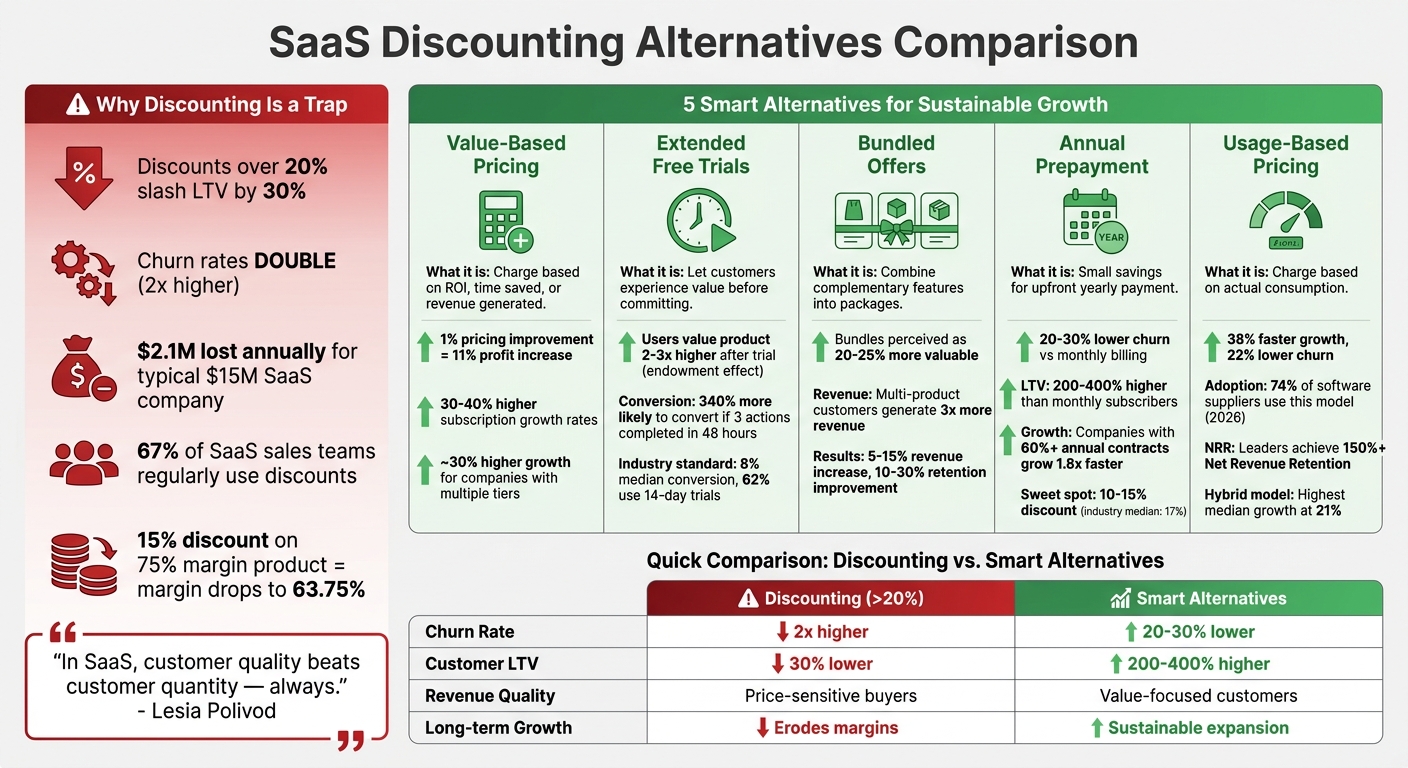 :::
:::
SaaS pricing debunked: AI impact, value metrics, & pricing strategies
::: @iframe https://www.youtube.com/embed/MQ2ecEEYU1s :::
Why Discounting Hurts SaaS Businesses
Discounting might help close deals in the short term, but it comes with long-term consequences that can harm your business. These challenges often build up over time, making it harder to sustain growth and profitability.
Attracts Price-Sensitive Customers
Discounts often draw in buyers who focus more on cost than value. These price-sensitive customers are less likely to stick around for the long haul and are quick to leave when a cheaper option appears.
For example, offering a 20% discount on a $500/month subscription with a $6,000 customer acquisition cost (CAC) means it takes three more months to recover that investment. If discounts climb to 30–50%, churn rates can increase by 5–10% [1] [6].
This creates a tough cycle: you spend the same on acquiring customers, but you earn less revenue per user, and they leave sooner. Over time, this also undermines the perceived value of your product, making it harder to attract loyal customers.
Lowers Perceived Value
Beyond attracting short-term buyers, frequent discounting can hurt how your product is viewed. Research shows that customers often associate discounted products with lower quality [3].
"Frequent discounting serves to lower the value of the brand because of an almost subconscious reaction by the consumer who believes that quality also has been lowered." – Killian Branding [3]
Discounting also weakens your price anchor. If your $200/month plan is regularly discounted to $140, customers start to see $140 as the "real" price. This trains them to wait for deals instead of paying full price, further eroding your ability to maintain consistent revenue.
Hinders Long-Term Growth
Even small discounts can have a big impact on margins. For instance, a 15% discount on a product with a 75% gross margin reduces it to 63.75%. At $15 million in revenue, this could mean losing $150,000 for every percentage point of margin lost [1] [2].
Relying on discounts to close deals also weakens your sales team's ability to sell on value. Over time, this "shortcut" approach makes it harder to command higher prices, as your team becomes less skilled at communicating your product's worth.
"Discounting is like drugs. It's addictive, and businesses usually get hooked on short-term gains." – Steve McKee, Author of When Growth Stalls [3]
The impact of unchecked discounting goes beyond individual deals. A typical $15 million SaaS company loses around $2.1 million annually due to pricing structure issues, including excessive discounting [2]. That lost revenue could be used to improve your product, support customers, or enter new markets - key areas for sustainable growth.
Alternative 1: Value-Based Pricing
Value-based pricing focuses on aligning your pricing with the outcomes your product delivers, such as ROI, time saved, or revenue generated. Instead of basing prices on competitor rates or internal costs, this approach ties what you charge to the measurable value customers gain.
How Value-Based Pricing Works
This strategy connects your pricing to customer outcomes by aligning the value metric, product packaging, and price points. The focus is on tangible benefits like ROI, time savings, or risk reduction [7][9].
A key component is calculating the Economic Value to Customer (EVC). Here's how it works:
- Start with the price of the next-best alternative.
- Add the value of your product's unique advantages.
- Subtract any switching costs.
For example, if a competitor charges $10,000 per year and your product saves 20 hours weekly at $50/hour (equaling $52,000 in annual labor savings), the EVC clearly surpasses the competitor's price. This outcome-driven approach highlights the financial benefits your product brings.
Benefits of Value-Based Pricing
Aligning your pricing with customer value allows you to achieve higher returns. For instance:
- A 1% improvement in pricing can increase profits by 11% [8][10].
- SaaS companies with advanced value-based pricing strategies often see 30–40% higher subscription growth rates [8].
- Businesses with multiple pricing tiers experience about 30% higher growth rates [8].
This method shifts the focus from discounts to ROI. Instead of customers asking for a lower price, they want to know, "What ROI will I get?" For example, if your $500/month tool saves a customer $5,000/month in labor costs, the pricing becomes easy to justify.
"Value-based pricing is not charging the most to every customer. It's not extracting maximum willingness to pay from each individual buyer based on their circumstances." – Chris Mele, Author [7]
How to Implement Value-Based Pricing
- Identify value drivers: Focus on direct cost savings, revenue generation, efficiency improvements, and risk reduction [9].
- Talk to your customers: Interview 15–20 customers to understand the business problems your product solves and quantify the impact [8].
- Create ROI calculators: Build tools that let prospects input data like labor costs, hours saved, and users impacted. For example, calculate the annual value as Hours saved per week × Hourly labor cost × Users affected × 52 weeks [9].
- Segment by value use cases: Instead of grouping customers by company size, group them by how they achieve outcomes with your product. For example, a marketing agency and an e-commerce company may both use your email platform, but one focuses on client campaigns while the other targets cart abandonment [7].
- Train your sales team: Teach your team to focus on outcomes, not features. Instead of relying on feature-heavy pitches, use outcome-based messaging like "Reduce proposal turnaround from 3 days to 4 hours." Support these statements with case studies and metrics [8][9].
Alternative 2: Extended Free Trials with Upselling
Free trials offer a way for potential customers to experience your product without risk, helping them see its value firsthand. Instead of relying on discounts to close deals, free trials let users incorporate the product into their daily routine, showcasing its benefits. This approach taps into loss aversion, the idea that people feel the pain of losing something more strongly than the joy of gaining it [11][13].
Why Free Trials Work Better Than Discounts
When people use a product during a trial, they begin to feel a sense of ownership. Studies show that users value a product 2-3x higher once they feel they "own" it, a phenomenon known as the endowment effect [11]. For example, trial users who complete three specific actions - like importing data, starting a project, or inviting teammates - within the first 48 hours are 340% more likely to convert than the average user [11].
Discounts, on the other hand, often attract bargain hunters who are more likely to churn quickly. Free trials, by contrast, attract users who care about the product's utility and results. By early 2026, 57% of B2B software companies were using free trials as their main acquisition strategy, with a median conversion rate of 8% [13]. Furthermore, users who explore three or more features during a trial are 2-3x more likely to convert compared to those who only use one feature [12].
"We don't sell software, we sell the fear of going backward." - Brian Halligan, Co-founder, HubSpot [11]
A well-designed trial builds on this sense of ownership, deepening customer commitment.
How to Build an Effective Free Trial
A successful trial should highlight your product’s value while maintaining the perception of its full price.
Align trial length with your Time-to-Value (TTV). If it takes 12 days for users to experience their first "aha moment", a 14-day trial might be too short. In 2026, 62% of SaaS companies use 14-day trials, but reducing TTV by 30% can boost conversion rates by up to 15% [12].
Show immediate value. Highlight key features right away. Use milestone-based emails to celebrate user achievements during the trial, reinforcing the benefits they’ve already experienced [12]. Encourage early integrations, such as connecting your product to a CRM, to make it a critical part of their workflow [11].
Create retrieval anxiety. Help users recognize what they’d lose if they don’t convert. This isn’t about withholding access to their data; it’s about showing the effort they’ve invested - like building workflows or developing muscle memory - and how much harder switching would be [11]. Notably, 80% of trial conversions happen in the first three days or the last two days of the trial period [12].
Trial vs. Discount: A Side-by-Side Look
| Metric | Trial-Based Model | Discounting Model (>20% off) |
|---|---|---|
| Acquisition Cost (CAC) | Higher initial effort in onboarding | Lower (price attracts quick signups) |
| Churn Rate | Baseline (standard for ICP) | 2x higher than full-price [1] |
| Customer Lifetime Value | Full value | 30% lower on average [1] |
| Value Perception | High (based on utility) | Low (anchored to the sale price) [11] |
| Conversion Driver | Value realization/Loss aversion | Financial incentive |
If users need more time to see the product’s value, it’s better to extend the trial than to offer a discount [1]. This approach protects your pricing while giving the product more time to prove itself.
Alternative 3: Bundled Offers and Feature Unlocks
Bundling offers a smart way to increase customer value without cutting into your core revenue. Instead of lowering prices, bundling combines multiple features or services into a single package. This approach adds value by solving related problems and creating a more comprehensive solution.
How Bundling Adds Value
When features or services work well together, they simplify decision-making for customers. Instead of weighing the pros and cons of several individual products, customers are more likely to choose an all-in-one package. Research shows that bundles are often seen as 20% to 25% more valuable than buying the same items separately [16].
Bundles also streamline the buying process. A single purchase feels less daunting than managing multiple transactions. For SaaS companies, multi-product customers generate about 3x more revenue than single-product users and are less likely to churn [14]. These benefits highlight why bundling can be a win-win for businesses and their customers.
How to Implement Bundling
Start by identifying features or services that naturally complement each other or address common customer challenges. HubSpot provides a great example of this strategy in action. Their Chief Product Officer, Christopher O'Donnell, shared:
"We built our platform based on where our customers were telling us they had friction in their business" [14].
Between 2017 and 2021, HubSpot expanded from a single marketing tool into a platform offering Marketing, Sales, Service, CMS, and Operations hubs. By 2021, over 55% of their customers used multiple hubs, and the company’s revenue surged from $375.6 million to more than $1.3 billion [14].
To make bundling work, consider structuring your packages into tiers - such as Starter, Professional, and Enterprise. This approach allows customers to begin with a lower-cost option and upgrade as their needs grow. Use platform data to spot when customers might benefit from a higher-tier bundle. For instance, if a marketing user starts exploring sales-related features, it could be the right time to offer an integrated solution [14].
If you include discounts in your bundles, aim for a range of 15% to 30%. This strikes a balance between adding value and maintaining the perceived worth of your core products [15].
Case Study: Bundling Success
Bundling can deliver impressive results when done right. Companies that implement bundling strategies often see revenue increases of 5% to 15% and customer retention improvements of 10% to 30% [14]. By making customers more successful and less likely to churn, bundling not only protects revenue but actively boosts it.
Here’s a snapshot of how bundling impacts key metrics:
| Metric | Impact of Bundling |
|---|---|
| Revenue Growth | 5% – 15% increase [14] |
| Customer Retention | 10% – 30% improvement [14] |
| Revenue per Customer | ~3x higher for multi-product users [14] |
| Average Revenue Per User (ARPU) | 15% – 40% increase [16] |
Alternative 4: Annual Prepayment Incentives
Annual prepayment incentives offer a smart way to secure upfront customer commitment by providing modest savings in exchange for a year-long payment. This approach not only boosts immediate cash flow but also locks in customers for 12 months, creating a win-win scenario.
How Annual Prepayment Protects Revenue
When customers commit to annual payments, businesses gain immediate capital to fund operations and extend their financial runway [18]. Data shows that SaaS companies with at least 60% of their contracts on annual billing grow 1.8 times faster than those relying on monthly plans [23].
Annual plans also reduce churn by eliminating 11 monthly renewal opportunities that could lead to cancellations [17][20]. On average, 26% of new ARR for SaaS companies comes from annual contracts [17], and these subscribers experience 20–30% lower churn rates compared to monthly customers [22]. Fewer payment transactions - just one per year instead of twelve - also cut payment failures by 92% [23]. This all adds up to a significant boost in customer lifetime value (LTV), with annual customers achieving 200–400% higher LTV than monthly subscribers [18].
Best Practices for Prepayment Incentives
To make annual prepayment incentives effective, consider these strategies:
-
Set Discounts Thoughtfully: Discounts should range between 10–15% to encourage commitment without cutting too deeply into margins. As the Glencoyne Editorial Team suggests, the discount floor should reflect the interest from a high-yield savings account, while the ceiling should align with the company’s cost of capital [18]. The industry median is 17%, often marketed as "two months free" [1]. Avoid discounts over 20%, as they can reduce LTV by 30% on average [1].
-
Optimize Pricing Presentation: Show annual pricing as a monthly equivalent (e.g., "$80/month billed annually") [21][20]. Set the default pricing page toggle to "Annual" to make monthly billing feel like an exception [20]. For hesitant buyers, consider offering a short trial or a money-back guarantee, which can increase conversion rates by up to 34% [22].
-
Control Discounts with a Matrix: Use a discount authority matrix to manage pricing decisions. For example, allow sales reps to approve up to 10%, managers up to 15%, and VPs to handle anything higher with proper documentation [1].
These practices not only protect revenue but also strengthen long-term customer relationships.
Prepayment vs. Traditional Discounts
| Feature | Annual Prepayment Incentive | Traditional Discount |
|---|---|---|
| Revenue Impact | Secures 12 months of ARR upfront [17] | Reduces per-unit revenue without commitment [1] |
| Customer Retention | 20–30% lower churn; removes 11 renewal points [22][20] | 2× higher churn rate vs. full-price customers [1] |
| LTV Impact | 200–400% higher LTV [18] | 30% lower LTV for discounts >20% [1] |
| Cash Flow | Immediate upfront capital [23] | Collected in installments; lower margins |
| Customer Type | Committed, value-focused buyers [20] | Price-sensitive shoppers [18][1] |
| Payment Risk | 92% fewer payment failures [23] | 12 opportunities for failure annually [23] |
This table highlights how annual prepayment incentives outperform traditional discounts in driving revenue, retention, and overall customer value.
Experts also suggest fine-tuning annual plans. Dan Layfield from Codecademy offers this advice:
"Price your annual plan to be slightly more than your average monthly subscriber's total LTV" [19].
This approach ensures businesses capture more value from committed customers while still offering meaningful savings.
Alternative 5: Usage-Based Pricing
Usage-based pricing charges customers based on what they actually use - like API calls or data processed - making the cost directly proportional to the value they receive. This approach helps customers avoid paying for unused capacity, making it a fairer and more flexible option.
What Is Usage-Based Pricing?
Instead of a flat fee, this model tracks activity and bills accordingly. For example:
- Stripe charges 2.9% + $0.30 per successful card transaction.
- Twilio bills around $0.0079 per SMS message sent.
- Intercom Fin charges $0.99 for each resolution handled by its AI agent.
- OpenAI prices GPT-5.2 usage at $1.75 per million input tokens.
This pricing model works particularly well for developer tools, APIs, and AI platforms where usage is easy to measure.
It also lowers the barrier to entry for smaller customers, allowing them to start with minimal spending. Meanwhile, larger users naturally pay more as they derive greater value from the service.
"Usage-based pricing means customers pay based on actual consumption rather than fixed subscription fees, aligning revenue directly with the value customers receive."
- Jordan Zamir, CEO & Co-Founder of Turnstile [29].
Benefits of Usage-Based Pricing
Usage-based pricing addresses several shortcomings of traditional subscription models:
- No more paying for unused capacity: Customers only pay for what they use, eliminating "shelfware" - unused licenses or capacity [24].
- Automatic revenue growth: As customers use more, their spending increases without the need for upsell calls or upgrade prompts. Dan Layfield from Codecademy highlights this: "Usage-based pricing is the reason some companies post NRR above 150%. Expansion happens automatically as customers grow" [25].
- Higher growth and lower churn: Companies using this model report 38% faster growth and 22% lower churn compared to traditional subscriptions [33,41].
- Scales with customer success: By 2026, 74% of software suppliers had adopted usage-based models, and 61% of SaaS companies used some form of usage-based or hybrid pricing [34,35]. Leaders like Snowflake and Twilio have achieved Net Revenue Retention rates of 158% and 155%, respectively [25].
However, implementing this model requires careful planning. To avoid surprising customers with high bills, companies should provide real-time usage dashboards to track consumption and costs [41,42]. Features like spending caps and automated alerts at key budget thresholds (e.g., 50%, 75%, 90%) can also help [35,42].
Many businesses combine usage-based pricing with a hybrid model, which includes a base subscription fee covering a set amount of usage, plus additional charges for overages. This approach balances flexibility for customers with predictable revenue for the business. Companies using hybrid models have reported the highest median growth rates at 21% [25].
Pricing Model Comparison
Here’s how usage-based pricing stacks up against other SaaS pricing models:
| Pricing Model | Pros | Cons | Revenue Impact |
|---|---|---|---|
| Usage-Based | Aligns cost with value; low entry barrier; automatic growth [24] | Revenue can be unpredictable; potential for high charges [41,42] | High expansion potential; scales with customer success; up to 38% higher NRR [28] |
| Flat-Rate | Simple to understand; predictable revenue [28] | Leaves money on the table with power users; lacks natural expansion [33,40] | Limited growth from increased usage [28] |
| Per-User | Easy for budgeting; scales with team size [30] | Can lead to seat-sharing; doesn’t always reflect true value [41,42] | Predictable but limited by team growth [26] |
| Hybrid | Balances predictability with growth; reduces friction [27] | Requires complex billing and tracking systems [28] | Highest median growth rates (21%) and up to 38% higher NRR [28] |
Conclusion
This article highlighted how discounting can hurt SaaS profitability. While it might seem like a quick way to close deals, it often backfires by doubling churn rates and slashing customer lifetime value by up to 30% [1]. What looks like a win today can lead to significant revenue losses down the line.
Rather than relying on discounts, there are smarter strategies to maintain growth. Value-based pricing ensures your pricing reflects outcomes, not just costs, so your product's worth isn't diminished [1][5]. Extended free trials let customers experience the value without cheapening it. Bundled offers add more for the customer without lowering your base price [31][1]. Annual prepayment incentives can boost cash flow and reduce churn by 2–3 times compared to monthly billing [1]. And usage-based pricing ties revenue to customer success, growing alongside their needs [1][32]. As Lesia Polivod aptly said:
"In SaaS, customer quality beats customer quantity - always." - Lesia Polivod [4]
Moving away from discounting isn't just about protecting your margins - it’s about creating a sustainable business model. Competing on value draws customers who are invested in outcomes, not just bargains. These are the customers who stick around, expand their accounts, refer others, and become long-term partners.
Right now, 67% of SaaS sales teams regularly use discounts to close deals [1]. Breaking this habit takes effort, but the rewards are worth it. By focusing on value-driven approaches, you can build a stronger customer base, improve retention, and achieve more reliable revenue growth. The real question isn’t whether you can afford to stop discounting - it’s whether you can afford to keep doing it.
FAQs
::: faq
When is a SaaS discount actually worth it?
SaaS discounts can be effective when used with a clear strategy, like providing discounts for annual prepayments or high-volume purchases. These methods not only boost cash flow but also help lower customer churn. However, steer clear of random or unstructured discounts - they can hurt your customer lifetime value and weaken how your brand is perceived in the market. :::
::: faq
How do I prove ROI fast enough to avoid discount requests?
To steer clear of discount requests, emphasize the measurable benefits of your SaaS solution. Show how it directly improves key metrics like revenue growth, cost reduction, or operational efficiency. Use value-based pricing to ensure your pricing reflects the advantages your customers gain.
Support your claims with case studies or data-driven examples that illustrate a clear ROI for clients in similar situations. By presenting these benefits upfront, you can justify your pricing and help prospects make faster decisions - without needing to lower your rates. :::
::: faq
Which pricing alternative should I try first for my sales cycle?
The most effective pricing approach to consider initially involves value-based or non-price incentives. These could include options like extended trial periods, flexible payment terms, onboarding support, or rebates. Such strategies highlight the value of your offering, build trust with potential customers, and help secure deals without diminishing the product's perceived worth or future revenue potential. Offering extended trials or flexible payment terms, in particular, can safeguard your revenue while nurturing deeper, more lasting customer relationships. :::
Related reading
- Net Dollar Retention Above 120%: How 10 SaaS Companies Expanded Without New Logos
- SaaS Pricing Pages (2025): Best Practices That Actually Convert
- SaaS CAC Payback Period Benchmarks 2026 by Industry
- Why Most SaaS A/B Tests Fail Before They Start (Sample Size, Timing, and Segmentation)
- Vertical SaaS Pricing: How Niche Markets Change Every Pricing Rule
Useful tools & services
Go deeper than any blog post.
The full system behind these articles—frameworks, diagnostics, and playbooks delivered to your inbox.
No spam. Unsubscribe anytime.