Product-Led Growth for B2B SaaS: From Free User to Paying Customer
Product-led growth tactics for B2B SaaS that turn free users into paying customers via fast onboarding, PQLs, and data-driven upgrade paths.
Product-Led Growth (PLG) flips the traditional sales-heavy SaaS model, letting the product itself drive user acquisition, activation, and retention. By offering users immediate access to the product's core value - often through freemium models or free trials - PLG reduces friction and aligns with how modern B2B buyers want to evaluate software. Here's why PLG works and how to implement it:
- Why PLG Works: Users prefer to try software independently (97% of B2B buyers). Companies using PLG see 44% lower acquisition costs and faster sales cycles.
- Key Principles: Self-service onboarding, delivering value before asking for payment, viral growth through collaborative features, and data-driven improvements.
- Results: Higher conversion rates (PQLs convert 3x better than MQLs) and stronger revenue metrics (e.g., Net Revenue Retention over 120% for top performers).
- How to Succeed: Optimize onboarding for quick "aha moments", identify Product-Qualified Leads (PQLs), and design upgrade paths that align with user behavior.
PLG isn’t just a strategy - it’s a shift in how SaaS companies grow. Focus on reducing friction, delivering immediate value, and tracking the right metrics to turn free users into loyal, paying customers.
::: @figure 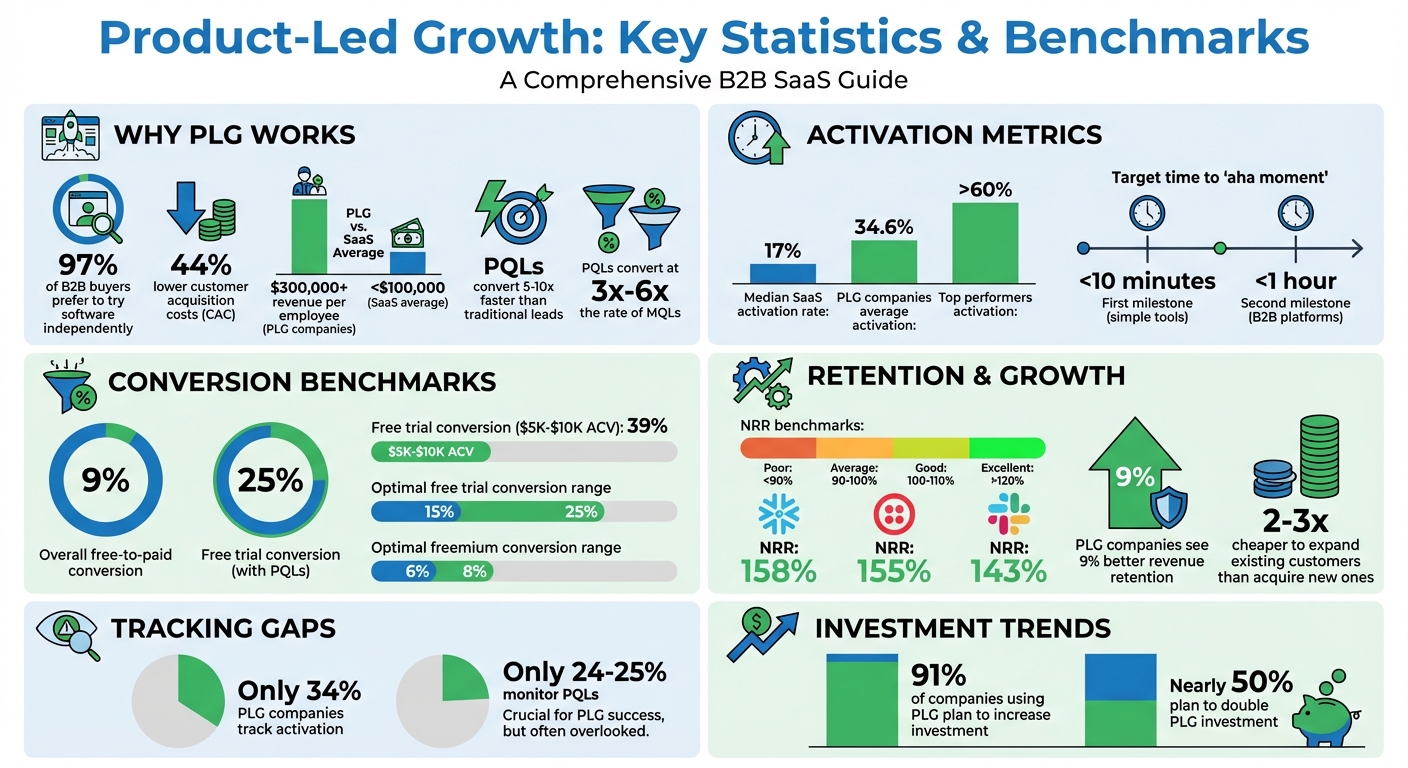 :::
:::
The PLG Framework Explained
What is Product-Led Growth?
Product-Led Growth (PLG) is a strategy where the product itself takes center stage in driving customer acquisition, activation, retention, and expansion [7]. Instead of relying heavily on sales teams to showcase value through presentations or demos, the product does the talking. Users can sign up, experience the product’s benefits right away, and upgrade as they hit key milestones.
PLG operates on four core principles:
- Self-service onboarding: This allows users to dive in without needing help from a sales or support team, reducing friction and speeding up the time it takes for them to see value [4].
- Value before monetization: Users should reach that pivotal "Aha moment" - the instant they grasp why the product matters - before being asked for payment details [7].
- Viral loops: Features like built-in sharing or collaboration tools expose the product to new users naturally, creating a cycle of organic growth [5].
- Data-driven iteration: By analyzing user behavior, companies can fine-tune their product and outreach strategies [1].
In the B2B SaaS world, this approach often starts with individual users. These users then advocate for the product within their teams, leading to broader adoption across departments and eventually enterprise-wide contracts [7]. Instead of chasing cold leads, sales teams focus on Product-Qualified Leads (PQLs) - users who have already shown interest through their in-app actions. This shift allows companies to scale revenue without needing to grow their sales teams proportionally [4].
Let’s explore why these principles resonate so strongly with today’s B2B SaaS buyers.
Why PLG Works for B2B SaaS
PLG fits seamlessly with how modern B2B buyers prefer to purchase software. They expect the same kind of instant access and smooth experience they get from consumer apps [8]. PQLs, who have already engaged with the product, convert five to ten times faster than traditional marketing-qualified leads [4]. Additionally, PLG companies often achieve impressive efficiency, generating over $300,000 in revenue per employee, compared to the SaaS average of under $100,000 [4].
Take Tally.so as an example: with just five team members, they achieved $3 million in Annual Recurring Revenue by July 2025. That’s about $600,000 per employee, all through a PLG approach [4].
"The more expensive it is for you to sell something, the more expensive it is to buy."
- Wes Bush, Founder, ProductLed [4]
By simplifying the buying process, PLG eliminates much of the friction that typically slows down sales.
When to Adopt PLG
While PLG offers substantial benefits, it’s not a one-size-fits-all solution. Certain conditions need to be in place for this strategy to succeed.
First, your product’s time-to-value must be short. Users should reach their first "Aha moment" quickly - ideally within minutes or hours, not days or weeks [2]. The most successful PLG companies often achieve this in under 10 minutes [7]. Additionally, the product should be intuitive enough for users to onboard themselves without needing extensive training or support [2].
A large addressable market is another key factor. PLG thrives on volume - many users need to try the product, with a portion converting to paid plans [2]. Offering a freemium model or a free trial is also important, as it lets users experience the product’s value before committing financially [2].
However, if your product involves complex implementation, requires input from multiple stakeholders, or demands heavy customization, a hybrid approach might be more effective. This combines PLG for initial adoption with a traditional sales-led strategy for scaling enterprise deals [5].
For instance, Slack grew rapidly using a self-service PLG model where teams could adopt the tool independently. As larger enterprises showed interest, Slack added a high-touch sales team to close big deals without disrupting the core PLG strategy [9]. Similarly, Datadog’s success during their Series B in 2014 stemmed from addressing developers’ common pain points with a frictionless product. This approach allowed them to expand quickly within accounts after the initial adoption [8].
Episode 741 | What Actually is Product Led Growth? (with Wes Bush...
::: @iframe https://www.youtube.com/embed/FutFJOP9Bd4 :::
Converting Free Users to Paid Customers
Getting users to sign up is just step one. The real challenge? Turning those free users into paying customers. Most product-led growth (PLG) companies lose a staggering 60% to 80% of signups before users even hit their first big milestone [11]. And on average, only 9% of free accounts make the leap to paid [3]. To close this gap, focus on reducing friction, delivering value faster, and creating upgrade opportunities that feel natural. These strategies are the backbone of a PLG approach that transforms free trials into steady, recurring revenue.
How to Optimize Onboarding
The quicker users reach their "aha moment", the better - and ideally, this should happen in under five minutes. Simplify the path from signup to value by cutting out unnecessary steps [11][2]. Even small hurdles, like extra fields in a signup form, can hurt conversions - each additional field can cause a 5% to 10% drop-off [11]. Instead, stick to the essentials and gather more details later using progressive profiling [11].
"The best product-led growth companies get users to an 'aha moment' in under five minutes." - Tim Adair, Strategic Executive Leader, IdeaPlan [11]
Forget lengthy product tours - they tend to get skipped. Instead, use contextual tooltips that pop up exactly when users need help. These just-in-time hints make learning new features easier and more relevant [11][1]. Another trick? Show users the product's potential right away. For example, provide a sample report or a pre-filled dashboard before asking for input. This "reverse demo" approach helps users visualize the value they can achieve [11].
Templates and pre-built options also save time, letting users jump straight into customizing rather than starting from scratch [11]. Activation checklists with 4–6 quick tasks (each taking under two minutes) can create a sense of progress and encourage users to complete their first key actions [11]. And when it comes to inviting teammates, timing is everything - prompt users to invite others after they've experienced the product's value, not during the initial signup [11].
Once onboarding is fine-tuned to highlight your product's value quickly, the next step is identifying which users are most likely to convert.
Finding Product-Qualified Leads (PQLs)
Not every free user is created equal. Product-Qualified Leads (PQLs) are the ones most likely to become paying customers, converting at rates 5 to 8 times higher than other leads [13]. However, only 34% of PLG companies effectively track activation points to identify these high-potential users [3].
"A PQL is not a free user. It is a user who has experienced meaningful value that predicts conversion." - Sivan Kadosh, Chief Product Officer [13]
PQLs are identified through three key signals:
- Fit: Does the user match your Ideal Customer Profile?
- Value: Has the user reached the "aha moment" and shown deeper engagement?
- Intent: Are they showing behaviors like visiting pricing pages or hitting usage limits? [14][15]
Take Slack, for example. Their activation milestone is when a team sends 2,000 messages [11]. Define similar milestones for your product and track which users hit them. For B2B companies, it's also important to distinguish between individual PQLs and Product-Qualified Accounts (PQAs). While an engaged individual is great, seeing multiple team members actively using the product is an even stronger indicator of conversion potential. By mapping every interaction, from the first touchpoint to the upgrade, you can spot and fix any bottlenecks [10].
Once you've identified these high-value users, the focus shifts to designing upgrade paths that turn their engagement into revenue.
Creating Clear Upgrade Paths
After identifying engaged users, the next step is creating upgrade flows that feel natural and aligned with their usage patterns. One effective approach is "horizontal feature slicing", where users get full access to core features but premium tools are reserved for scaling or enterprise needs [16]. You can also introduce constraints - like limits on message history or integrations - that only become relevant as users grow their usage [17].
Make sure your pricing tiers match the value users receive, allowing costs to scale alongside the product's importance to their workflow. Rearranging the upgrade process can also make a big difference. For instance, let users choose their plan before entering company details or payment information. This approach builds confidence and often leads to higher conversions [10]. Finally, streamline payments by offering self-service checkout options with digital wallets like Apple Pay or Google Pay. The fewer the steps between deciding to upgrade and completing the payment, the better your chances of conversion [12].
Building Features That Drive Engagement and Retention
Getting free users to sign up is just the first step - the real challenge is keeping them engaged long enough to turn them into paying customers. Here’s the catch: up to 80% of features shipped don’t provide meaningful value to users [18]. To avoid this pitfall, focus on developing features that build habits, encourage collaboration, and drive consistent engagement. When users make your product a regular part of their workflow, retention becomes more natural, and upgrades are a logical next step. Let’s break down how habit-forming features can transform user engagement.
Designing Features That Create Habits
The most effective PLG (product-led growth) tools are those that seamlessly integrate into daily routines. Habit-forming features play a key role here - they not only keep users coming back but also increase the likelihood of upgrades as users grow more dependent on the product. What makes these features so effective? They’re "sticky", meaning they align with workflows users already rely on.
Take Slack, for example. Its design revolves around a collaborative loop where users invite teammates into shared workspaces. As teams communicate and hit 2,000 messages - the free tier’s cap - upgrading feels like a natural progression, not a forced decision [20]. This wasn’t by chance; Slack intentionally structured its product so that the more users engage, the more value they extract, making the limit feel like a milestone rather than a roadblock.
Figma approached habit-building differently. By making design a "multiplayer" activity, they turned what was traditionally a solo task into a collaborative experience. Their browser-based platform allows designers, marketers, and engineers to work together in real time [20]. The takeaway? Features that encourage teamwork not only boost retention but also create opportunities for organic expansion.
Enabling Viral Growth Through Collaboration
Collaboration isn’t just good for retention - it’s a powerful driver of viral growth. Shared dashboards, co-editing tools, and other collaborative features create opportunities for users to showcase your product to others, essentially turning them into advocates. These features work because they demonstrate your product’s value to non-users without requiring them to sign up.
Here’s how it plays out: A user shares a dashboard, report, or meeting link with someone outside your platform. That person sees the value firsthand, lowering the barrier to adoption. Over time, these small interactions build up, bringing in new users who already understand the product’s benefits.
Features like real-time co-editing, shared folders, and commenting systems amplify this effect by creating "multiplayer functionality" - tools that work best with teammates. Timing is crucial here. When users complete a meaningful action, like finishing a project or hitting a milestone, prompt them to invite colleagues. They’re most likely to share when the product’s value is fresh in their minds.
But engagement isn’t just about features. Proactive retention strategies can make a huge difference in keeping users loyal.
Retention Tactics for PLG Companies
To re-engage users who’ve gone quiet, lifecycle emails are a must. Send reminders to users who haven’t logged in for a while, highlight new features they haven’t tried, or offer tips tailored to their usage. The goal? Bring them back before they churn.
In-app messaging can also be a game-changer when it’s personalized and focused on results. Calendly nailed this with a "value demonstration" experiment, showing free users stats like “You’ve scheduled 47 meetings this month.” This simple message boosted free-to-paid conversions by 18%, moving from a 4.2% baseline to 5.0% [19]. By framing the message around ROI, Calendly reinforced the habit of using their product while making the upgrade feel justified.
Looking ahead, AI-driven personalization is becoming a cornerstone of retention strategies. Instead of generic onboarding checklists, AI can tailor flows and prompts based on a user’s role, company size, or behavior. This reduces friction and makes the experience feel more relevant, increasing the chances users will stick around.
Finally, proactive customer success outreach can make all the difference. For high-potential accounts - like those showing rapid growth or hitting key usage milestones - reach out with personalized advice or early access to new features. These thoughtful touchpoints show users you’re invested in their success, building trust and reducing churn in the process.
Key Metrics for Measuring PLG Success
Tracking performance is the cornerstone of improvement. To make Product-Led Growth (PLG) efforts successful, you need to focus on the right metrics. Surprisingly, only 34% of PLG companies track activation, and a mere 24-25% monitor Product-Qualified Leads (PQLs) - despite these being early indicators of revenue trends 60 to 90 days before they appear on your profit and loss statement [3][26][27][22].
Three key metrics stand out: activation rate, Product-Qualified Leads (PQLs), and Net Revenue Retention (NRR). Each one offers insights into your funnel's health. Let’s break them down.
Activation Rate
The activation rate measures the percentage of users who experience your product's "aha moment" - that pivotal instance when they realize its core value. This metric is crucial because it directly impacts retention and revenue. As Saad Amrani Joutey from Fygurs explains:
"Activation rate is the metric that most separates successful PLG companies from unsuccessful ones. A 10% improvement in activation rate typically produces a larger downstream impact on revenue than a 10% improvement in any other PLG metric." [24]
Here’s the data: while the median activation rate for SaaS companies is 17%, PLG companies average 34.6%. Top performers exceed 60% [23][26][27]. If your activation rate falls below 20%, it’s a clear sign that your onboarding flow needs work. The goal should be to guide users to their "aha moment" as quickly as possible - within 10 minutes for simpler tools or under an hour for B2B platforms [23][26].
A great example of this is Facebook. Their early growth team discovered that users who added 7 friends within 10 days were far more likely to stay engaged long-term [21][26]. They then optimized onboarding to help users hit that milestone. Your task is to identify your product’s equivalent of "7 friends in 10 days" and streamline everything to make it happen.
It’s also important to segment activation rates by acquisition channels. Organic signups often activate at rates 2-3x higher than paid ones [22][24]. Knowing which channels bring in the most engaged users helps focus your efforts on what’s working.
Once activation is under control, the next step is to focus on PQLs, which highlight users ready to buy.
Product-Qualified Leads (PQLs)
PQLs are users who’ve not only engaged with your product but also demonstrated buying intent through their behavior. Unlike Marketing Qualified Leads (MQLs), which rely on actions like form submissions or demographic data, PQLs are based on real product usage. This makes them far more effective, converting at 3x to 6x the rate of MQLs [3][27].
Benchmarks tell the story: free trials leveraging PQLs convert to paid customers at an average rate of 25%, while products with an Annual Contract Value (ACV) between $5,000 and $10,000 see conversion rates jump to 39% [3][26][27]. Compare that to the overall free-to-paid conversion rate of 9%, and it’s clear why PQLs are a game-changer [3][25].
To identify PQLs, consider two factors: fit (does the user align with your Ideal Customer Profile?) and behavior (are they engaging with high-value features or nearing usage limits?). Unfortunately, many companies overlook this metric. If you’re not tracking PQLs, you’re missing out on potential revenue. Tools like Amplitude and Mixpanel can help you monitor user behavior and build scoring models to pinpoint PQLs.
While activation and PQLs focus on early-stage user behavior, NRR looks at how well you’re growing revenue from existing customers.
Net Revenue Retention (NRR)
NRR measures how effectively you’re expanding revenue within your existing customer base through upsells, cross-sells, and expansions - while accounting for churn. For PLG companies, this metric is essential because expanding revenue from current customers is 2-3x cheaper than acquiring new ones [26].
A solid NRR for growing SaaS companies is 100-110%, with anything above 120% being outstanding [23][27]. The best PLG companies far exceed these numbers. For example, Snowflake reported an NRR of 158% in 2020, driven by usage-based pricing as customers processed more data [27]. Similarly, Slack reached 143% in 2019 through seat expansions and tier upgrades, while Twilio achieved 155% due to increasing API call volumes as customers scaled [27].
Here’s a quick benchmark table for reference:
| Metric | Poor | Average | Excellent |
|---|---|---|---|
| Activation Rate | <20% | 20-35% | >50% |
| PQL Conversion | <15% | 20-30% | >35% |
| NRR | <90% | 90-100% | >120% |
If you’re falling short of these benchmarks, it’s a sign of where to focus. Struggling with activation? Improve onboarding. Low PQL conversion? Refine your scoring model. Weak NRR? Invest in strategies like contextual upsells or usage-based pricing. These metrics don’t just measure success - they guide you on where to improve.
Conclusion
Product-Led Growth (PLG) isn’t about pressuring users into paying - it’s about delivering so much value that upgrading feels like the natural next step. As Lincoln Murphy wisely notes:
"The most successful SaaS companies don't sell software - they sell business transformation delivered through software."
When your product truly meets customer needs, conversions happen organically.
By fine-tuning onboarding experiences, creating habit-forming features, and crafting seamless upgrade paths, companies can achieve impressive conversion rates - 15–25% for free trials and 6–8% for freemium models [28]. PLG companies also see clear advantages: double the revenue growth, 9% better revenue retention [6], and 44% lower customer acquisition costs (CAC) [4].
PLG’s strength lies in showing value upfront. With 97% of B2B buyers opting to try before they buy [4], your product becomes your ultimate salesperson. The key is to prioritize delivering value, reduce friction in the user journey, and use behavioral triggers to introduce upgrades when they’re most relevant. Metrics like activation rate, Product-Qualified Leads (PQLs), and Net Revenue Retention (NRR) are essential to measure progress and refine your approach.
The potential for PLG is undeniable. With 91% of companies already using PLG planning to increase their investment - and nearly half intending to double it [3] - the momentum is only growing. The real question isn’t whether PLG works, but whether you’re ready to make your product the driving force behind your growth strategy.
FAQs
::: faq
How do I find my product’s “aha moment” fast?
To pinpoint your product's "aha moment", concentrate on the action or insight that reveals the product's core value to users. Begin by talking to your most engaged users to uncover what contributes to their success. Dive into behavioral data to identify recurring patterns. By comparing the journeys of users who succeed with those who drop off, you can spot critical differences. Finally, test these insights with small experiments to validate which behaviors ultimately drive long-term retention. :::
::: faq
What signals should define a PQL for my SaaS?
A Product-Qualified Lead (PQL) is identified through specific user behaviors that demonstrate high engagement and intent to purchase. These behaviors might include hitting certain usage thresholds, completing key activation steps, trying out advanced features, or consistently using the product. Other important signs are aligning with your ideal customer profile (ICP), adopting important features, or taking actions like inviting teammates. These measurable actions help pinpoint leads with the highest likelihood of converting, making it easier to focus sales efforts effectively. :::
::: faq
When should PLG switch to a sales-assisted motion?
A product-led growth (PLG) strategy works wonders for straightforward, self-serve transactions. But there comes a point when the product alone might not be enough to seal the deal - especially with larger or more intricate opportunities. This is where transitioning to a sales-assisted approach becomes essential.
Key signals for this shift include situations where users require personalized guidance or when you're targeting enterprise-level clients. If self-serve efforts are falling short in converting high-value prospects, it’s a clear sign that additional support is necessary.
This change is often driven by customer behavior. For example, as deals grow in complexity or sales cycles stretch longer, it becomes vital to offer tailored assistance. Being prepared to provide this kind of support can help secure those high-value opportunities that might otherwise slip through the cracks. :::
Related reading
- How your acquisition strategy influences your conversion rate
- How to A/B test pricing as a boostrapped company
- Upsell vs. Cross-Sell Metrics: Key Differences
- Digital Marketing Services
- What Is Strategy Consulting? (And when to hire a consultant to do it for you)
Useful tools & services
Go deeper than any blog post.
The full system behind these articles—frameworks, diagnostics, and playbooks delivered to your inbox.
No spam. Unsubscribe anytime.