Freemium vs Free Trial: Key Differences for SaaS
Compare freemium and free trials for SaaS—differences in conversion, costs, time-to-value, and when to use each model.
Freemium and free trials are two popular ways SaaS companies let users experience their product before paying. But they work differently, and choosing the right one can impact your business's growth and revenue.
- Freemium: Offers permanent, limited access to the product (e.g., restricted features or usage caps). It's designed to attract a large user base and build habits over time. Conversion rates are typically low (2%-7%), but freemium can drive large-scale adoption and long-term revenue.
- Free Trial: Provides full access to the product for a limited time (usually 7-30 days). This model creates urgency and often converts users faster, with higher rates (15%-25%). It's better suited for complex products or enterprise buyers.
Quick takeaway: Freemium works best for simple products with a large audience, while free trials are ideal for high-value or niche markets needing quick results. Both models have unique costs, benefits, and challenges - make your choice based on your product's complexity, time-to-value, and target market.
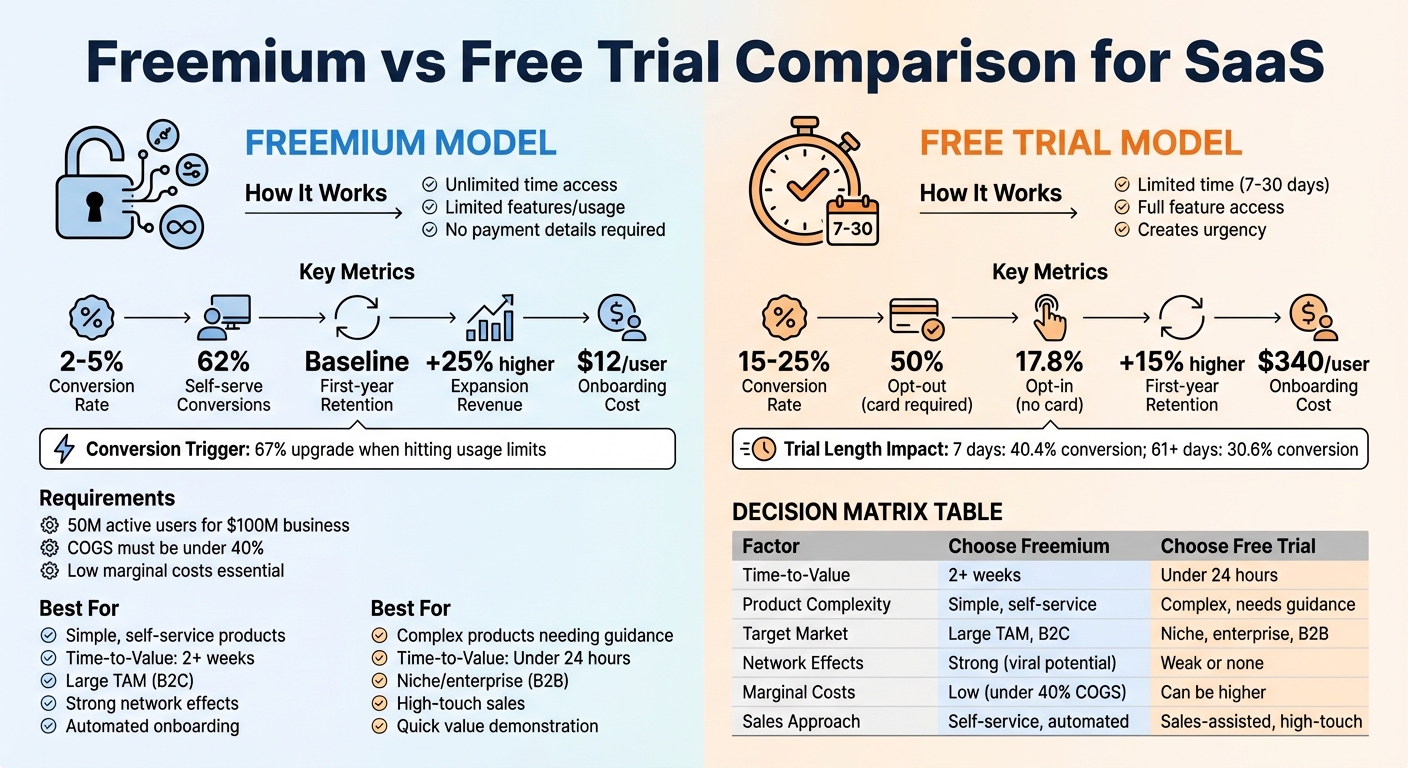
How Each Model Works
Freemium: How It Works
Freemium offers users ongoing, limited access to a product without requiring payment details upfront. The limitations typically fall into four categories: feature-based (advanced functions are restricted), usage-based (caps on storage, messages, or team members), ad-supported (free users see advertisements), or support-based (customer service is limited)[8][4].
This model provides an easy, low-commitment way for users to explore a product's core features on their own terms. A great example? Slack's freemium model in 2014. By allowing free users to search up to 10,000 messages, Slack managed to convert 30% of large enterprise users into paying customers, helping the company hit a US$1 billion valuation[2][3][4].
So, what nudges users to upgrade? For 67% of freemium-to-paid conversions, it’s when users bump into limits - whether that’s running out of storage, exceeding message caps, or needing to add more team members[1].
Free Trial: How It Works
Free trials, on the other hand, limit access by time - usually 7, 14, or 30 days. During this period, users get full access to the product, allowing them to experience its value firsthand. The ticking clock creates urgency, encouraging users to incorporate the product into their routines before the trial ends. When access is cut off, the sense of loss often drives a purchase decision.
This approach taps into "loss aversion", a psychological principle where people are motivated to avoid losing something they’ve grown accustomed to. As one expert from Close.io advises:
"99% of B2B SaaS products should limit the trial to 14 days, max." [9]
These time-based restrictions create a different kind of user engagement compared to freemium models.
Main Differences Between the Two Models
The core difference between these two models lies in how they engage users. Freemium restricts features, while free trials restrict time. Freemium users tend to stick around longer, gradually integrating the product into their routines over weeks or months before deciding to upgrade. In contrast, free trial users face immediate pressure to evaluate the product and make a purchase decision quickly.
These differences also explain variations in conversion rates. Freemium products often see higher self-serve conversions - 62% compared to 45% for free trials[1]. However, free trial users often need extra sales support to transition into paid plans. These behavioral distinctions have a direct impact on conversion strategies and overall business outcomes, which will be explored further in the next section.
Conversion Rates and Business Results
Freemium Conversion Numbers
Freemium models typically convert just 2% to 5% of users into paying customers [3]. This approach appeals to a broad audience, attracting both serious prospects and casual users. However, the nature of freemium inherently leads to low conversion rates. Why? Freemium is designed to maximize brand awareness and pull in large numbers of users at the top of the funnel, rather than focusing on immediate revenue.
Josh Kopelman, the founder of First Round Capital, sums up the core challenge of freemium with what he calls the "Penny Gap":
"The biggest gap in any venture is that between a service that is free and one that costs a penny."
Convincing someone to pay for something they’ve been enjoying for free is a tough uphill battle. It’s much harder than converting a trial user who already expects to pay. To succeed with freemium, companies need both an exceptional product and massive scale. Some experts estimate that it takes around 50 million active users to build a $100 million freemium business [4]. These dynamics provide an important contrast when compared to free trial models.
Free Trial Conversion Numbers
Free trial models, on the other hand, deliver significantly higher conversion rates. On average, free trials convert 15% to 25% of users into paying customers [3], which is roughly 5 to 10 times better than freemium. This difference boils down to urgency and intent. Trial users know they’re testing a paid product, and the limited time frame creates a sense of urgency to decide before access ends.
The conversion rate climbs even higher when users are required to provide a credit card upfront. Opt-out trials - where users must cancel to avoid being charged - convert at about 50%, compared to 17.8% for opt-in trials that don’t require payment details [4]. Trial length also plays a role: shorter trials often perform better. For instance, 7-day trials convert at around 40.4%, while trials lasting more than 61 days see conversion rates drop to about 30.6% [11].
Interestingly, free trial users tend to stick around longer, with about 15% higher first-year retention compared to freemium users [3]. This suggests that the commitment involved in a trial may foster stronger customer loyalty, which can directly impact profitability and scalability.
Financial and Technical Requirements
Beyond conversion rates, freemium and free trial models come with distinct financial and technical demands. Freemium relies on low marginal costs to accommodate its large base of free users. If the Cost of Goods Sold (COGS) exceeds 40%, the freemium model can quickly become unsustainable [13]. Automation is critical here - manual support at scale could cost as much as $12 per user [3], making it impractical for most businesses.
Free trials, by contrast, can afford higher onboarding costs due to their stronger conversion rates. Onboarding expenses for free trial users average about $340 per user [3]. However, they require robust technical systems to manage time-limited access, send trial expiration notifications, and handle automated downgrades. These systems help keep operational costs manageable, especially since free trial models generally serve fewer users.
While free trial users tend to have better first-year retention, freemium users often generate about 25% higher expansion revenue over time [3]. Once freemium users incorporate a product into their daily routines, they’re more likely to upgrade as their needs grow. This underscores the long-term growth potential of freemium, despite its initial challenges.
Free Trial vs Freemium - Use the MOAT Framework to Decide
How to Choose Between Freemium and Free Trial
Deciding between freemium and free trial models depends on how your product operates and aligns with your business goals. Let’s break down when each approach makes the most sense.
When to Use Freemium
Freemium works best when you’re targeting a large total addressable market (TAM). While conversion rates for freemium are typically low (around 2%–5%), the sheer volume of users can make up for it. Products like Slack and Zoom thrive with freemium because they rely on network effects - the more people use the platform, the more valuable it becomes to everyone.
If your product takes more than two weeks to demonstrate its full value, freemium is a solid choice. Research shows that products with a longer time-to-value perform 31% better with freemium compared to time-limited trials [3]. Freemium gives users the breathing room to reach that all-important "aha moment."
Freemium also suits products with low marginal costs per user and automated onboarding processes. However, this model requires operational efficiency and a self-service approach to scale effectively.
Now, let’s look at when a free trial might be the better option.
When to Use Free Trial
Free trials are ideal for specialized or enterprise buyers who already have budgets and are actively searching for solutions. These users are often more likely to convert within a defined trial period. For products that deliver value quickly - within 24 hours - free trials outperform freemium by 23% [3].
"If your business is laser-focused on maximizing paid conversion and near-term revenue, a free trial is the way to go." - Kristin Hillery, Managing Editor, OpenView [1]
Free trials also shine for complex products that require hands-on experience to grasp their full potential. If your product needs detailed demonstrations, guided onboarding, or high-touch customer support, a trial period justifies the higher onboarding costs - averaging $340 per user [3]. Plus, the time limit creates a sense of urgency, leveraging loss aversion to encourage users to commit before access runs out.
Factors to Consider When Choosing
To make the right choice, consider your product’s complexity and time-to-value. Simple, easy-to-use products are better suited for freemium, while more intricate tools benefit from a trial period. Also, evaluate your target market: freemium requires a massive user base - some experts suggest you need 50 million active users to build a $100 million business [4]. In contrast, free trials are more effective for smaller, high-value audiences.
Financial resources also play a role. Freemium can be expensive to maintain due to the costs of bandwidth, computing, and support for a large base of free users. Meanwhile, free trials have higher per-user onboarding costs but serve fewer users and generate revenue more quickly. Additionally, consider what’s standard in your industry. Straying too far from category norms could hurt your conversion rates.
Here’s a quick comparison to help you decide:
| Factor | Choose Freemium | Choose Free Trial |
|---|---|---|
| Time-to-Value | 2+ weeks | Under 24 hours |
| Product Complexity | Simple, self-service | Complex, needs guidance |
| Target Market | Large TAM, B2C | Niche, enterprise, B2B |
| Network Effects | Strong (viral potential) | Weak or none |
| Marginal Costs | Low (under 40% COGS) | Can be higher |
| Sales Approach | Self-service, automated | Sales-assisted, high-touch |
Each model has its strengths, so weigh these factors carefully to align your choice with your product and business strategy.
Implementation Tips and Mistakes to Avoid
Rolling out a pricing model like freemium or free trial requires a thoughtful approach. Precision is key to maintaining conversion rates and achieving desired business outcomes. Below, you'll find practical tips and common pitfalls to help you implement these models effectively.
How to Make Freemium Work
The secret to a successful freemium model lies in gating usage, not value. Your free tier should allow users to quickly experience that "aha moment", but it must also include clear limits that encourage upgrading. A great example is Slack’s adjustment in August 2024. They shifted from a 10,000-message limit to a 90-day message history, making the restriction more tangible. Teams could clearly see what they’d lose access to, which encouraged upgrades without compromising initial value [12].
Usage limits play a crucial role - 67% of upgrades happen when users hit these caps [3]. For instance, PagerDuty’s five-seat limit ensures users experience the core value before needing to upgrade [12].
To keep costs manageable, focus on self-service onboarding. Use in-app tools like checklists, tooltips, and help centers instead of relying heavily on human support. Pay attention to behavioral signals that indicate "upgrade readiness." When users complete key tasks and start bumping against usage limits, they’re prime candidates for conversion. Use these moments to trigger upgrade prompts.
How to Make Free Trial Work
A free trial only works if users experience value quickly. The trial duration should align with how long it takes for users to form a habit with your product. For most SaaS tools, 14 days is sufficient, but complex B2B solutions might need 30 days [15][16]. Opt-in trials (no credit card required) generally convert at 15-25%, while opt-out trials (card upfront) can reach 50%, though they tend to reduce the number of signups [15].
Eliminating friction is critical. Andrea Wang, former Principal Product Manager at Amplitude, improved onboarding by replacing a blank settings page with a "data sources" page that displayed SDK and integration options. This simple change removed a major barrier on day one [15]. Another tactic comes from Wistia’s former Director of Growth, Andrew Capland, who introduced "Fullstory Friday." By reviewing session replays weekly, he identified bugs and popups that hindered activation [14].
Personalization also makes a big difference. Claudiu Murariu, CEO of Delivering Value, suggests tracking actions tied to high retention:
"Check out the actions performed by users that finish onboarding and correlate with high retention. When a new user performs them, trigger an email and ask them to upgrade to paid. It never fails" [14].
Data shows that companies engaging prospects through 11 or more touchpoints achieve double the conversion rates compared to those with fewer interactions [1].
Common Mistakes to Avoid
While these strategies can drive success, certain missteps can derail your efforts.
The "too generous" trap is a common issue with freemium models. If your free tier meets all the needs of your target users, they’ll never feel the need to upgrade. Cohorted conversion rates below 5% per year often indicate this problem [12]. On the flip side, being too restrictive can backfire. If users can’t experience value before hitting limits, they’re likely to abandon your product altogether.
Another challenge is the "penny gap" - the psychological hurdle of converting free users into paying customers [4]. Free users often expect your product to remain free forever, making that first payment a tough sell.
For free trials, the biggest mistake is letting users run out of time before they see value. Ramli John, Director of Content Marketing at Appcues, highlights this as the most common failure point:
"I would say the number one reason why free trials don't become paid customers is they don't see the value of why they should upgrade - why they should pay at all" [14].
Don’t ask for payment before delivering clear, tangible results. Also, avoid pricing models that go against industry norms, as this mismatch can reduce conversion rates by as much as 35% [3].
Conclusion
Deciding between a freemium model and a free trial isn't about picking a universally better option - it's about aligning the choice with your product and market needs. Here's the key difference: freemium relies on a functionality-based paywall (users get limited features but unlimited time), while free trials use a time-based paywall (users get full features but for a limited time) [6]. Each approach taps into different psychological triggers: free trials create urgency and leverage loss aversion, whereas freemium builds habits and capitalizes on usage limits.
Freemium models often lead to 50-60% lower customer acquisition costs and can generate 25% higher expansion revenue over time [2][3]. As Wes Bush, Founder of ProductLed, emphasizes:
"What goes into the model matters more than the model itself" [5].
The choice should be guided by your product's complexity and how quickly users can realize its value. Simple, intuitive tools that users can adopt instantly often perform well with freemium. On the other hand, more complex B2B products requiring guided onboarding are better suited for free trials [10][7]. Market strategy also plays a role - freemium tends to excel in large, competitive markets, while free trials are a better fit for niche, underserved markets [5].
Experimenting with hybrid or customized approaches can help you find the best fit. For instance, when Amplitude tested a 30-day trial against a freemium model (capped at 10,000 events per month), the trial initially converted at 18%, compared to freemium's 4%. However, freemium users who hit the usage limit showed 40% higher retention over 12 months because the product became deeply integrated into their workflow [3]. A hybrid model can also be effective - HubSpot, for example, offers a free CRM alongside time-limited trials for premium features, which has contributed to their 35% year-over-year revenue growth [2].
Ultimately, the right approach depends on your product's complexity, market fit, and operational goals. Keep an eye on metrics like lifetime value, and refine your strategy based on the data.
FAQs
What should I consider when deciding between a freemium and a free trial model for my SaaS product?
When weighing the choice between a freemium model and a free trial, it’s essential to assess a few critical aspects to determine the best fit for your product and audience:
-
Time-to-value: How quickly does your product deliver noticeable results? If users can see value right away, freemium might be the way to go. But for products that take time to shine, a free trial could give users the breathing room they need to experience its benefits.
-
Paywall strategy: Freemium typically offers a free version with limited features, while free trials give users full access for a set period. The decision depends on how your audience interacts with your product and what motivates them to commit.
-
User behavior: Dive into your target audience's habits. Are they more inclined to explore tools over time, or do they prefer a short, hands-on experience to make a decision? Also, consider their willingness to pay and how they like to test a product.
-
Conversion rates and costs: Freemium models often attract a larger user base, but supporting free users can add significant costs. Free trials, meanwhile, focus on a smaller, more engaged group that’s closer to converting into paying customers.
-
Long-term goals: Whichever model you choose, make sure it aligns with your broader monetization and growth strategies. The right choice should support your vision for scaling and profitability.
By thoroughly analyzing these elements, you can select the approach that resonates with your users and positions your SaaS business for steady growth.
What are the differences in conversion rates between freemium and free trial models?
Freemium models typically convert about 2–5% of users into paying customers. In contrast, free trials with time limits usually see much higher conversion rates, often ranging between 10–25%. The difference lies in how each approach engages potential customers. Free trials create a sense of urgency and let users experience the product's complete features, which can strongly encourage them to upgrade.
Freemium, however, casts a wider net, attracting a larger audience. But it often includes many users who may never plan to pay. Deciding between these models comes down to understanding your product, your target audience, and your overall growth strategy.
What mistakes should I avoid when using a freemium or free trial model for my SaaS product?
When rolling out a freemium or free trial model, there are some common pitfalls that can hinder your ability to turn users into paying customers.
With freemium models, it’s crucial to strike the right balance. If the free tier is too generous and includes core features, users may feel little need to upgrade. On the other hand, if it’s too restrictive, users might leave before experiencing the product's value. Both scenarios can lead to wasted resources, feature misuse, or disappointing conversion rates.
For free trials, focus on showcasing your product’s main value. A well-designed trial includes clear onboarding to guide users, highlights key features, and ensures users understand the benefits. Trials that are too short, lack payment prompts, or fail to send timely reminders to upgrade often struggle with conversions. Keeping an eye on metrics like user engagement and drop-off points can help fine-tune your strategy.
For a solo SaaS creator like Artisan Strategies, the goal is to find that sweet spot: offer a free tier that sparks interest without over-delivering, and craft a trial experience that’s concise, valuable, and supported by reminders. This approach can turn curious users into loyal customers while managing costs effectively.
Related reading
- When to Offer SaaS Discounts
- Best Practices for Transitioning SaaS Growth In-House
- Localized Pricing Guide For SaaS Growth
- SaaS Pricing Experiments: How to Test Price Changes Without Killing Revenue
- SaaS Conversion Rate Benchmarks 2026 (1,200 Companies)
Useful tools & services
Locate the constraint in your funnel
Map the transitions so you can choose the next investigation or improvement.
Use the funnel templateNeed help choosing the next change? Explore CRO consulting.
Keep improving your conversion work.
Subscribe for practical ideas on diagnosing conversion problems, planning experiments, and choosing your next improvement.
No spam. Unsubscribe anytime.