SaaS Feature Gating 2026: What 25 Companies Keep Free vs Paid
See how 25 SaaS companies gate free vs paid features. Free-vs-paid matrices, conversion impact, and frameworks for 2026.
The free/paid line is a product decision dressed up as pricing. Gate the wrong thing and you either never convert (everything useful is free) or never activate (nothing useful is free). The companies that win freemium treat gating as economics + psychology: free delivers the aha; paid captures scale, team, risk, or power-user value.
Pair this with freemium conversion benchmarks (2–5% typical) and 10 freemium company teardowns.
Decision rules that show up across ~25 SaaS freemium programs
| Put on free | Put on paid | Why |
|---|---|---|
| Core individual workflow | SSO, audit logs, compliance exports | Security is org-value, not aha-value |
| Limited history / storage / seats | Unlimited history, more seats | Usage grows with success |
| Single-player features | Shared workspaces, admin controls | Network effects pull teams up |
| Create / draft / explore | Export, send, publish, charge | Job-to-be-done completes on paid |
| Basic analytics | Advanced reports, API, webhooks | Power users and integrations pay |
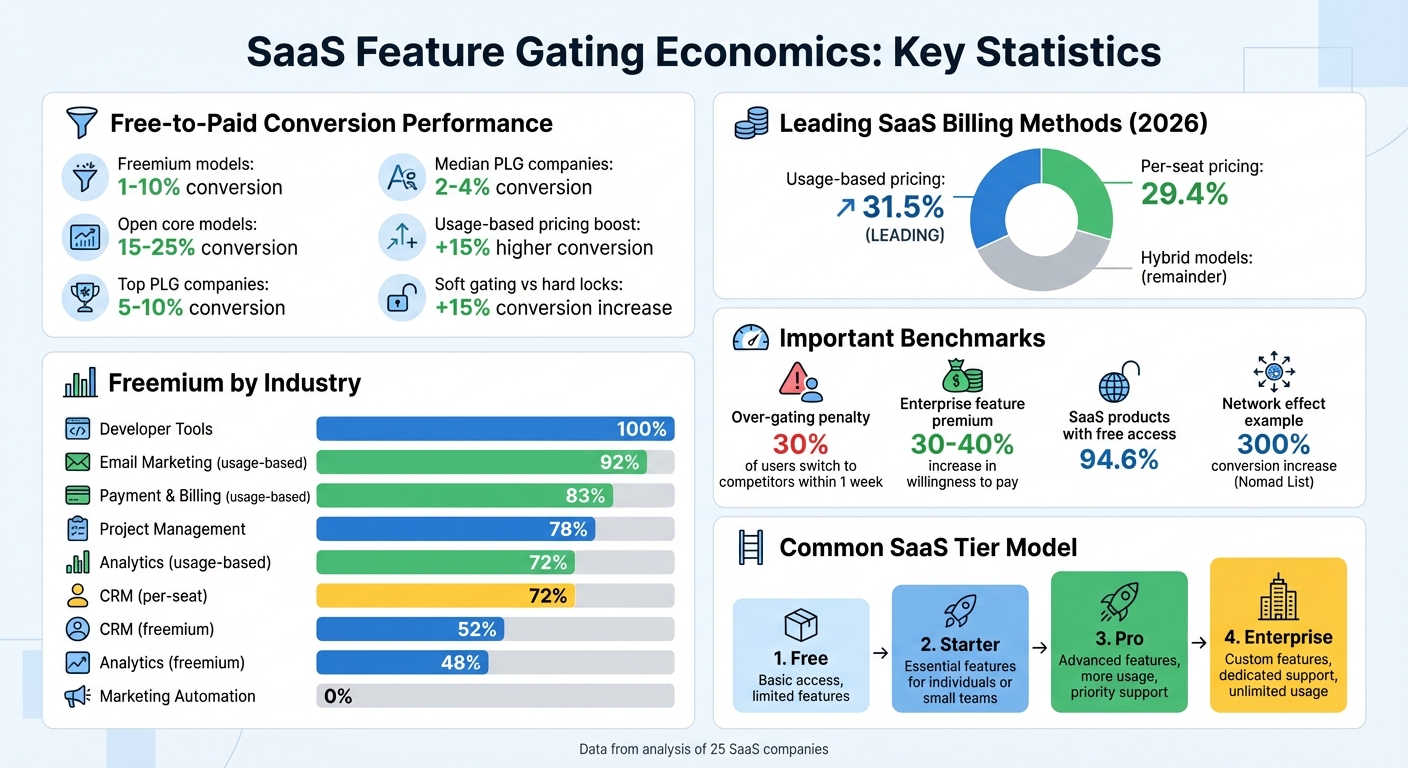
Stats to keep honest: freemium free→paid usually lands 1–10% (most 2–5%); open-core can run higher; over-gating before aha can send a large share of users to competitors within days. Usage limits often convert better than random feature locks when the aha requires using the product.
Quick test before you ship a gate
- Can a new user reach aha without a credit card? If no, you built a trial, not freemium.
- Does the paid unlock appear at a natural frustration or success moment (hit limit, invite team, need SSO)?
- Would a competitor’s free tier still let someone complete the job? If yes, your free tier is a dead end.
A 10-Question Free vs Paid Workshop
Run this with product, growth, and finance in one hour:
- What is the single aha action for a new user?
- Can they complete it without a card today?
- Which paid features are required by security/compliance rather than desired by power users?
- Where do successful users naturally hit a limit (seats, storage, sends)?
- What do competitors give free that we charge for—and is that a moat or a mistake?
- What is cost-to-serve of a free user at p50 and p95 usage?
- What conversion rate do unit economics require at our free volume?
- Will sales-assist free accounts, or is this pure self-serve?
- How will we measure free→paid at 30/60/90 days?
- What is the rollback plan if conversion falls after a gate change?
Document answers in a one-pager. If question 2 is "no," stop calling it freemium.
Is Your Freemium Killing You? Avoiding Cannibalization in Your SaaS Business
1. Feature Gating
Feature gating plays a crucial role in balancing customer value and business growth for SaaS companies. The most successful ones follow a straightforward rule: free tiers cover essential workflows, while paid tiers unlock more advanced features. A great example is Slack, which offers free access to core features like messaging and file sharing but reserves advanced tools - such as message history, SSO authentication, and compliance exports - for paying enterprise customers [1][7]. This setup ensures individual users get what they need for free, while organizations pay for more robust security and collaboration tools.
The decision to gate features often hinges on whether they cater to individual users or teams. For instance, solo-friendly features - like basic messaging, single-user design tools, or simple task tracking - are typically free. On the other hand, team-oriented features, such as role-based access controls, SSO integration, and collaborative workflows, are usually behind a paywall [2][7]. HubSpot takes this approach by offering a free CRM for individual sales reps while charging for higher contact volumes and team-focused email capabilities [7].
Industry norms also influence gating strategies. Some sectors embrace freemium models heavily, while others lean on sales-led approaches. Here's a quick breakdown:
| Category | Freemium Adoption % | Gating Observation |
|---|---|---|
| Developer Tools | 100% | Freemium is considered essential |
| Project Management | 78% | Free core functionality is strongly expected |
| CRM | 52% | Mixed; enterprise CRMs often skip free tiers |
| Analytics | 48% | Data limits are commonly used as gates |
| Marketing Automation | 0% | Relies on sales-led, demo-first strategies |
This data highlights the risks of over-gating. Research shows that overly restrictive gating can lead to a 30% customer shift to competitors within just a week [1]. Figma provides a good example of a balanced strategy: it limits the number of active design files for free users but only gates advanced team libraries for paid plans [7]. This ensures that individual designers can always work, while teams pay for added functionality.
2. Usage-Based Gating
SaaS companies often rely on usage-based gating to align pricing with customer activity. Unlike feature restrictions, this approach limits how much users can do instead of what they can access. It's a model that has gained traction - by 2026, usage-based pricing (31.5%) surpassed per-seat pricing (29.4%) as the leading SaaS billing method [9]. The logic is simple: when costs grow alongside customer usage, pricing feels more justified and less arbitrary.
The success of this model hinges on picking the right metric. Companies typically set usage limits tied to key success indicators like emails sent, storage used, API calls, or contacts managed. For instance, HubSpot's free plans limit marketing contacts and tracked emails, while GitHub allows unlimited repositories but caps CI/CD minutes [7]. This strategy works because the limits grow naturally as a user's business expands. When users hit a storage cap or run out of API calls, they’ve already derived value and are more likely to see the need for an upgrade.
Timing is critical. Usage caps should kick in only after users have experienced the product's main value. Charging too early often leads to high churn rates. Usage-based models, however, boast 15% higher free-to-paid conversion rates [1]. Top-performing product-led growth companies achieve 5-10% conversion rates, compared to the median of 2-4% [7].
Adoption varies widely across categories. Usage-based pricing dominates in areas like email marketing (92%), payment and billing (83%), analytics (72%), and hosting infrastructure (62%) [9]. On the other hand, CRM tools tend to stick with per-seat pricing (72%) since team size, rather than activity volume, drives value. The key is choosing a model that reflects how customers perceive value - not just what’s easiest to bill for. When paired with feature gating, usage-based limits create a balanced strategy for enhancing customer value while driving revenue growth.
To ensure your pricing remains competitive as users scale, model the financial impact at five times your expected volume [9]. Upgrade prompts should appear at natural points - right after users complete a key task or hit a capacity limit [2][4]. This type of "positive friction" makes upgrading feel like a logical next step.
3. Network Effects
As user networks expand, feature gating must adapt. The key to effective SaaS pricing lies in aligning free access with network-driven benefits. Free tiers should help build a user network, while paid tiers focus on capturing the value created by team collaboration.
Understanding the minimum team size needed for users to experience a product's collaborative benefits is essential. For example, PagerDuty discovered that teams typically require five members before needing a formal on-call schedule. To support this, the company included five seats in its free plan. Reducing this limit would have delayed users' "a-ha" moment - the realization of the product's true value[10]. Similarly, Slack shifted from a 10,000-message limit to a 90-day message history limit in 2022. This change allowed teams of any size to experience the platform's full functionality while reserving long-term access to the network's collective knowledge for paid tiers[10]. This approach strikes a balance: offering immediate value while reserving advanced team features for monetization.
"The goal with a free plan is to give users that 'a-ha!' moment of understanding why your product is useful - and then gate features that would scale that utility." - Tugce Erten, Partner, a16z[10]
Many companies keep core communication features free to encourage network growth, while team-specific features are gated. As networks grow, administrative tools like SAML/SSO, role-based access controls, and audit logging are often reserved for paid tiers. These enterprise-grade features increase the willingness to pay by 30–40% among larger organizations[3].
Another approach is gating high-value data generated by the network rather than restricting basic functionality. For instance, Pieter Levels, founder of Nomad List, increased conversions by 300% by gating community-created city data while keeping core features free[6]. This strategy allows companies to monetize the collective value of the network without hindering its growth.
4. Optimization Tactics
Once you’ve set up a feature-gating framework, fine-tuning how and when paywalls appear can make a huge difference in conversion rates - boosting them from 2% to as high as 10%. These tactics build on earlier strategies by focusing on refining the user experience and timing for better results.
1. Place Gates After the "Aha! Moment"
The golden rule here is simple: don’t charge users before they’ve experienced your product’s core value. Use product analytics to pinpoint the moment when users truly understand what makes your product worthwhile. If you introduce a paywall before this key moment, you’re likely to see high churn and low conversions. Companies that follow this approach often achieve conversion rates of 5–10%, compared to just 2–4% for those that don’t [7].
2. Trigger Upgrades at "Happy Moments"
Timing is everything. Prompt users to upgrade right after they’ve hit a milestone - like completing their first project or reaching a usage goal. These moments, often referred to as "happy moments", reinforce the value of your product and make the upgrade feel like a natural progression. For example, DemoGo saw success in November 2025 by granting preview access to advanced analytics only after users completed their first public demo. This created a clear demand for premium features [2].
3. Use Soft Gates Instead of Hard Locks
Instead of completely blocking premium features, consider offering limited-time or preview access during onboarding. This "soft gating" approach lets users experience the value firsthand and often leads to better results. Companies using this strategy report a 15% increase in conversion rates compared to strict feature blocking [1]. The trick is to create demand by letting users see the value themselves.
4. Implement the Value-Visibility Matrix
Aligning feature visibility with perceived value is another smart move. Plot your features on two axes: user visibility and business value. Features that are high in business value but lower in visibility - like advanced security tools or audit logging - are perfect for premium tiers. They don’t interfere with early adoption but become indispensable as users grow. This framework helps you decide which features to gate while keeping initial engagement strong [3].
5. Test Changes on New Users First
When rolling out new gates or shifting features between tiers, start small. Test these changes with a subset of new signups before fully implementing them. This A/B testing approach allows you to gauge the impact on activation and conversion without risking backlash from loyal users. For major updates, consider a 6–12 month grace period for existing users to maintain trust and minimize churn [7].
6. Model for 5x Usage Growth
If you’re using usage-based gates, it’s crucial to plan for growth. Model costs at five times your current volume to avoid surprising customers with sharp price increases as they scale. This approach ensures your pricing evolves smoothly alongside customer success. Wistia applied this by moving from feature-gated plans to upload-count limits, aligning pricing with how customers naturally use their video hosting platform [11].
7. Gate Data, Not Core Functionality
Instead of restricting access to essential tools, consider gating high-value data or insights generated by your platform. A great example of this is Pieter Levels’ Nomad List, which saw a 300% jump in conversions in 2025 by gating access to city data created by its community rather than limiting platform functionality. This strategy monetizes the collective value of user-generated insights without disrupting individual workflows or network growth [6].
"A paywall isn't a barrier; it's a carefully designed bridge, guiding users from free exploration to premium commitment." - Buzz Hemphill, Writer and Strategist [4]
Conclusion
Looking at the strategies outlined earlier, the analysis of 25 SaaS companies highlights something important: feature gating works best when it enhances, rather than limits, the user experience. A striking 94.6% of SaaS products offer some kind of free access[8], and smart gating strategies can push conversion rates from as low as 2% to as high as 10%[7].
The key is to gate added value - not the core functionality. Features that drive the product's "aha moment" should always remain accessible. Why? Because gating essential workflows can backfire, with up to 30% of users potentially seeking out competitors[1]. Instead, focus on gating features that solve higher-level challenges, like advanced security, team collaboration, or enterprise-specific tools. These types of upgrades can increase users' willingness to pay by as much as 30–40%[3].
Another effective approach is to adopt a sequential pricing model rather than applying random restrictions. Many successful companies favor a 4-tier structure (Free, Starter, Pro, Enterprise)[8], often blending usage caps with feature-based gating. This method aligns pricing with customer outcomes. For instance, when DocuSign transitioned from usage-based pricing to feature-tiered subscriptions between 2022 and 2023, their revenue jumped from $469 million in Q1 2022 to $675 million in Q4 2023. Retention rates also climbed from 85% to 92% during this period[5].
Start by mapping out your product's core workflows and pinpointing activation metrics - those key actions that show users understand your product's value. Timing is everything: place gates after these moments, not before. Test changes with new users, offer generous grandfathering periods for existing customers, and use paywalls as opportunities to highlight your product’s unique value. Pricing isn’t static; it’s a growth tool that should adapt as your product and customer needs evolve[5].
FAQs
How do I find my product’s “aha moment” to place the first paywall?
The key to encouraging users to upgrade lies in pinpointing the moment they truly experience the value of your product. This isn’t about restricting core functionalities but about identifying features or data that resonate most with your audience.
Start by analyzing user behavior. Look for patterns that show when users are most engaged - whether it’s after accessing specific features, achieving a milestone, or exploring valuable insights. These moments of deep interaction are often when users recognize your product’s worth.
By strategically gating high-value features or premium data at these points, you can create a natural incentive for users to upgrade, increasing your chances of conversion without alienating them.
Which usage metric should I cap so upgrades feel fair and predictable?
Define usage limits that align closely with your product's value and what your users need. For example, you could cap user counts, storage capacity, or feature access.
This approach helps ensure that when customers upgrade, it feels fair and transparent. At the same time, it allows you to meet their expectations without overpromising or underdelivering.
What features should stay free to drive network effects without hurting revenue?
Free features are best used to spark user engagement and grow the community, rather than being a direct revenue source. These typically include basic tools or limited access that highlight the product's value and encourage users to share or collaborate. On the other hand, advanced features - like in-depth analytics or integrations - should be reserved for paid plans. This approach helps create a network effect while keeping premium functionalities exclusive to paying customers.
Related reading
- Feature Flagging Software With Experimentation Analytics (2026)
- Time to Value (TTV): How the Best SaaS Companies Measure and Reduce It
- Customer Activation Metrics: The 7 KPIs Every Product Team Should Track
- User Activation Rate: How to Find and Fix Your SaaS Aha Moment
- The SaaS Monetization Audit: Are You Leaving Revenue on the Table
Useful tools & services
Turn the idea into a growth decision
Define the audience, constraint, owner, and success check in a practical plan.
Use the growth strategy templateNeed help choosing the next change? Explore CRO consulting.
Keep improving your conversion work.
Subscribe for practical ideas on diagnosing conversion problems, planning experiments, and choosing your next improvement.
No spam. Unsubscribe anytime.