What Happens When You Double Your SaaS Price (5 Real Experiments)
Doubling SaaS prices can boost revenue without major churn if you test, communicate value, and grandfather existing customers.
Raising SaaS prices can boost revenue without hurting retention - if done right. Companies like Baremetrics, Mailchimp, and Zendesk have seen revenue jumps of up to 300% after price increases, with churn often staying low. The secret? Clear communication, testing, and aligning your SaaS pricing strategy with value.
Here’s what worked for them:
- Baremetrics: A 250% price hike led to an 86% revenue increase with minimal churn.
- Mailchimp: Switching to contact-based pricing tied revenue to customer database size, leading to a $12 billion acquisition.
- Zendesk: Simplified tiers and value-driven pricing doubled their customer base and grew revenue to $1 billion.
- Proper: An 80% price increase, paired with tiered pricing, tripled ARR while retaining 95% of customers.
- Instructure: Data-driven pricing boosted margins by 21 points and increased contract values by up to 80%.
Key takeaways:
- Test before rolling out changes. Small-scale experiments reduce risks.
- Communicate value clearly. Customers accept higher prices when benefits are evident.
- Grandfather existing customers. Protect loyalty by keeping old rates for current users.
Price changes don’t need to scare you. With the right approach, they can fuel growth without alienating customers.
Experiment 1: New Relic's Consumption-Based Pricing Shift
How New Relic Made the Change
By 2019, New Relic faced a tough reality: growth had stagnated. The company's host-based subscription model was holding customers back. Many avoided monitoring their entire infrastructure to keep costs down. Founder Lew Cirne summed it up with a striking analogy:
"Charging per host discouraged customers from monitoring all their infrastructure - like buying health insurance for two of your three kids and hoping that the kid who gets sick is one of the ones who's insured." [6]
Things came to a head after an earnings call in August 2019. The company’s stock value plummeted, and within a year, its market value was cut in half. This was a wake-up call that led to a major shift in strategy.
In July 2020, New Relic launched New Relic One, a unified platform that replaced 13 separate products. This overhaul introduced a new pricing model based on two metrics: data ingestion at $0.35 per GB and user seats [6][7]. The transformation wasn’t just about pricing - it involved rebuilding billing systems, retraining sales teams to adopt a "land-and-expand" strategy, and ensuring existing customers were transitioned smoothly. To make the platform more accessible, New Relic also rolled out a "free forever" tier, which included 100 GB of data per month and one full-access user [6][7].
Results: Revenue Growth and Investor Response
The transition wasn’t without bumps. Annual recurring revenue (ARR) took a temporary hit as usage limits were lifted. But the rebound came quickly. By 2021, key metrics like account growth picked up, churn rates dropped, and data ingestion surged [8].
CFO Mark Sachleben highlighted a 15% increase in committed ARR spend following the change [9]. High-usage customers saw their costs double under the new model, but the added value made it worthwhile. Steve Evans, Vice President of Engineering Services at Chegg, explained the impact:
"The more data we send to New Relic, the more insights we get - it's the perfect win-win relationship with New Relic as a true vendor partner." [7]
Experiment 2: Mailchimp's Contact-Based Pricing Model
Why Mailchimp Changed Their Pricing
Mailchimp shifted from a subscriber-based pricing model - where businesses only paid for active, opted-in users - to a contact-based model that charges for every contact in a customer’s database, including unsubscribed or inactive ones [10].
This change led to higher costs for many businesses, as they were now billed based on their total contact count. Mailchimp defended the move by emphasizing that its platform had grown to offer more advanced marketing tools "beyond the essentials" [10]. The new pricing structure aimed to reflect the value of managing an entire contact database, aligning with Mailchimp's transformation into a comprehensive marketing suite. This strategy also tied the company's revenue growth more closely to the size of its customers' databases, following broader industry trends [13].
Results: ARPU Growth and $12 Billion Acquisition
The contact-based pricing model had a major financial impact. By linking revenue to the size of customer databases rather than just active subscribers, Mailchimp created a system where revenue scaled naturally as customers grew their contact lists [11]. This meant businesses didn’t need to upgrade plans or purchase additional features for Mailchimp to see increased revenue.
This strategy played a pivotal role in the company’s valuation. In September 2021, Intuit acquired Mailchimp for $12 billion, marking its largest acquisition ever. The pricing model influenced critical SaaS metrics like Annual Recurring Revenue (ARR), Net Revenue Retention (NRR), and gross margins, which are key factors in determining valuations [14]. By aligning pricing with database size - a clear indicator of the platform's value - Mailchimp showcased predictable, scalable revenue growth, making it an appealing acquisition target.
Experiment 3: Proper's 80% Price Increase Through Packaging Changes
How Proper Restructured Their Offerings
Proper, a Danish property management startup, initially undervalued its services with a flat €7 pricing model. In 2025, Co-Founder and CEO Morten Krarup Kristensen collaborated with pricing consultancy Willingness to Pay to overhaul the company's pricing strategy. They transitioned from a flat-fee model to a tiered structure, distinguishing between SMBs and enterprise clients. This new approach introduced a base platform fee ranging from €0 to €5,000 per month - creating a revenue floor - and added a variable unit fee starting at €15 per unit for smaller clients, gradually decreasing to €4 per unit for larger accounts [15].
"We knew the product had more value than what we were charging. We wanted a team with the experience to reshape our pricing architecture so we could solidify our market presence and expand our customer base." - Proper Management
Proper tested incremental price increases - first 40%, then 60% - before settling on an 80% hike after confirming customer conversions. For SMB customers, the per-unit fee jumped 146%, from €7 to €15, illustrating how value-based packaging made the higher price point more acceptable [15]. This strategic shift laid the groundwork for substantial revenue growth.
Results: 300% ARR Growth and 95% Retention
Proper's revamped pricing model delivered immediate results. The company’s Annual Recurring Revenue (ARR) soared from €500,000 to €2 million - a 300% jump - while maintaining an impressive 95% customer retention rate [15]. The combination of a guaranteed base fee and scalable variable fees enabled Proper to effectively capture revenue from both small businesses and large enterprises.
"Willingness to Pay combines a hands-on repricing approach with high-level guidance for businesses looking to expand their vertical presence. With their guidance, we designed our business model to drive profits and capture larger market opportunities." - Morten Krarup Kristensen, Co-Founder and CEO, Proper [15]
Experiment 4: Zendesk's Tiered Pricing Model
How Zendesk's Tiered Pricing Works
In 2009, Zendesk made a bold move by transitioning from a seat-based pricing model to a tiered system tailored to different customer personas. The company simplified its plans from six options to just three, making it easier for customers to choose and understand their upgrade paths [3]. The key shift? Instead of limiting the number of users per plan, Zendesk differentiated its tiers by features. For example, higher tiers offered advanced tools like ticket forms and hourly reporting, incentivizing customers to upgrade [3].
By 2011, Zendesk introduced its Enterprise plan to attract high-value clients, followed by the Enterprise Elite plan in 2014, which included premium white-glove service as a standout feature [3]. In 2016, they added modular extras like Chat (formerly Zopim) and Talk (formerly Voice), giving customers the flexibility to customize their packages as their needs grew [3].
This pricing overhaul didn’t just simplify things - it set the stage for massive growth.
When Zendesk revamped its pricing in 2010, the Regular plan's cost jumped from $19 to $29 monthly, while the Plus+ plan increased from $39 to $59. Some customers even faced price hikes exceeding 300% [16]. Despite the steep increases, CEO Mikkel Svane highlighted the added value:
"Zendesk has gone from a traditional ticket management system to a complete customer engagement platform... we do think that we have an excellent offering for almost every budget starting at $9 per agent seat" [16].
Zendesk also used price anchoring by introducing premium tiers like Enterprise Elite. This strategy made mid-tier plans appear more affordable and appealing by comparison [3].
Results: Revenue Growth from Approximately $430M to Over $1B
While the 2010 price hike initially sparked some backlash, Zendesk managed to double its customer base, attracting major names like Nielsen, Groupon, and Tumblr [3]. The tiered pricing strategy allowed Zendesk to cater to a wide range of customers - from startups paying $9 per agent to enterprises spending $249 per agent by 2023 [16][17]. This approach played a significant role in driving revenue from around $430 million to over $1 billion.
The company also learned an important lesson about maintaining customer trust. After facing criticism in 2010, Zendesk adopted a policy of grandfathering prices for existing customers, ensuring loyalty while charging higher rates to new accounts. As B2B SaaS expert Sadhana Balaji aptly said:
"Pricing is Marketing. If you can't tie your pricing changes with a change in the perceived value, then don't" [3].
Zendesk’s ability to align price adjustments with clear value improvements became a cornerstone of its long-term success.
Experiment 5: Instructure's Data-Driven Pricing Changes
How Instructure Used Customer Data
Instructure, the company behind Canvas LMS, took a closer look at customer usage data to fine-tune their pricing strategy. By analyzing how customers used their products and examining deployment details, they identified gaps between their pricing tiers and actual consumption patterns [18].
This led them to adopt a value-based pricing model inspired by the "Value Stick" framework. The idea? Focus on increasing the perceived value customers get compared to what they pay. As Harvard Business School Professor Felix Oberholzer-Gee put it:
"Value for customers is the difference between their appreciation of a product or a service and what they have to pay for it" [19].
To put this into action, Instructure moved away from selling a single LMS product and instead introduced a modular ecosystem. Canvas LMS became the core offering, while additional features like Mastery (assessment tools), Impact (analytics), and Studio (video capabilities) were sold as separate add-ons [20]. Pricing tiers were adjusted to reflect both deployment size and usage patterns.
Here’s how it works: Most institutions pay between $3 and $12 per active user annually for Canvas LMS, with discounts for larger user bases. Smaller institutions with fewer than 5,000 users typically pay $5 to $10 per user, while larger setups serving over 20,000 users enjoy rates of $3 to $6 per user [20]. This tailored approach allowed Instructure to align pricing more closely with actual customer needs.
Results: 21-Point Margin Improvement
This pricing overhaul had a big impact, improving margins by 21 points. Offering modular add-ons like Mastery, Impact, and Studio increased total contract values by 30–80% [20]. On average, Instructure customers spend $21,789 annually [20]. Add-ons are priced as a percentage of the base Canvas LMS rate: Mastery adds 20% to 40%, Impact adds 25% to 50%, and Studio adds 15% to 30% [20].
Instructure’s strategy highlights how even small, data-informed pricing changes can lead to major financial gains. By aligning their pricing structure with how customers actually use their services, they not only boosted profitability but also strengthened their position in the market. This approach ensured that the value delivered to customers was better reflected in the pricing model, creating a win-win scenario.
SaaS Startups Grow Faster with Pricing & Packaging Experiments!
What These Experiments Teach Us
Patterns in Successful Price Changes
When SaaS companies raise prices successfully, they often reshape how customers perceive the value of their product. These experiments highlight key strategies for businesses considering significant price adjustments, such as doubling their rates.
Successful companies consistently relied on three approaches: transparent communication, grandfathering existing customers, and rigorous testing.
First, they prioritized clear and honest communication. Customers were informed that the additional revenue would fuel product improvements and team growth [4,30]. Max Beech from Athenic captured this sentiment perfectly:
"Price signals quality. $39/mo feels like 'real business tool.' $29/mo feels like 'toy'" [2]
This approach reframed the price increase as an investment in a better product, rather than just an added expense.
Second, they protected loyal customers through grandfathering. Companies offered legacy pricing or allowed customers to lock in old rates by switching to annual plans. This minimized churn and maintained goodwill. For instance, companies that skipped this step - like CloudTech, which gave only a 30-day notice for a 22% price hike - saw a 380% surge in support tickets and a 23% churn rate [32,9].
Lastly, they tested extensively before committing to changes. Baremetrics, for example, spent eight months testing before implementing a 250% price increase [4]. Brian Sierakowski of Baremetrics emphasized the importance of this process:
"If you're not testing your price, you're under priced, and if you aren't updating prices regularly, you're under priced" [4]
Similarly, Collabify trialed a new tier structure on 50% of new signups for 90 days before rolling it out fully [22]. This data-backed approach ensured that price changes increased revenue without alienating customers.
Beyond these strategies, simplifying pricing structures also proved effective. Companies that stuck to a three-tier model avoided overwhelming customers with too many choices. On the other hand, adding a fourth tier sometimes led to higher-priced plans losing traction [2]. Encouraging annual billing with incentives like a 20% discount or "2 months free" offer also helped. This tactic boosted cash flow and reduced churn by up to 60% [2,30].
Before and After: Comparing the Numbers
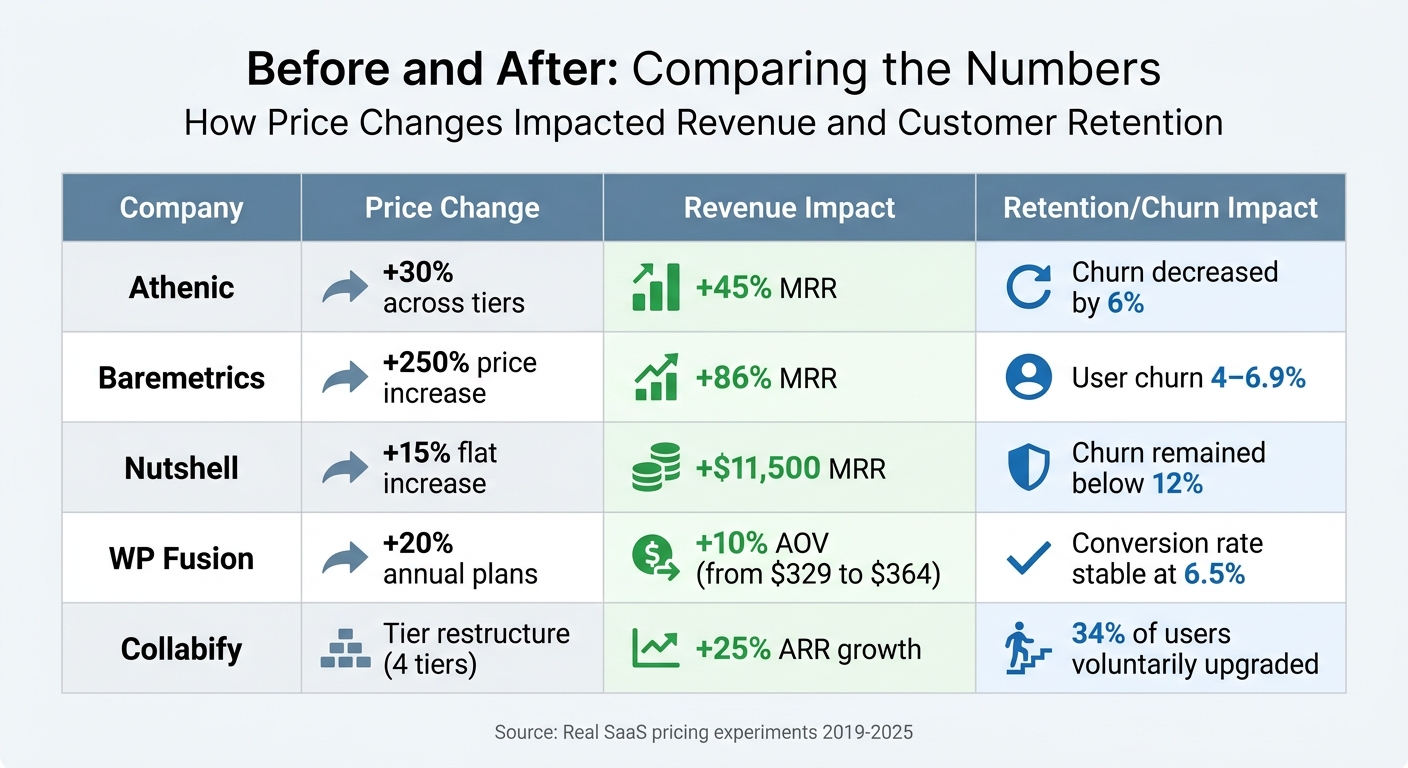
The table below highlights the impact of these pricing experiments on key metrics:
| Company | Price Change | Revenue Impact | Retention/Churn Impact |
|---|---|---|---|
| Athenic | +30% across tiers | +45% MRR [2] | Churn decreased by 6% [2] |
| Baremetrics | +250% price increase | +86% MRR [4] | User churn 4–6.9% [4] |
| Nutshell | +15% flat increase | +$11,500 MRR [21] | Churn remained below 12% [21] |
| WP Fusion | +20% annual plans | +10% AOV (from $329 to $364) [5] | Conversion rate stable at 6.5% [5] |
| Collabify | Tier restructure (4 tiers) | +25% ARR growth [22] | 34% of users voluntarily upgraded [22] |
The numbers show that price increases don't necessarily harm retention. For example, Athenic's 30% price hike led to a 6% reduction in churn [2]. Baremetrics, despite its bold 250% increase, achieved an 86% rise in monthly recurring revenue, with only a slight uptick in churn [4]. Even modest adjustments delivered meaningful results: Nutshell's 15% increase added $11,500 in monthly revenue, while WP Fusion's 20% boost raised average order value by 10% without affecting conversion rates [30,8].
These experiments underline a valuable takeaway: you don’t need to double prices to see impressive results. However, thoughtful planning, transparent communication, and data-driven execution are essential for success.
How AGS Advising Helps with Pricing Experiments
Artisan's Approach to Pricing Optimization
AGS Advising refines pricing through a deliberate and iterative process, drawing lessons from real-world experiments to ensure effective outcomes. Their approach is built on a three-pillar framework: Activation, Monetization, and Retention. Instead of diving straight into price adjustments, they begin by examining how customers perceive and experience value.
- Activation: This phase is all about helping users reach their "aha" moment faster. By simplifying onboarding flows, customers can quickly see the value of the product.
- Monetization: Here, Artisan aligns pricing with the features that truly drive customer willingness to pay. It’s about connecting pricing to the product’s actual value.
- Retention: Proactive engagement tools like email campaigns, push notifications, and in-app messages are used to keep customers engaged and loyal [23][24].
Artisan relies on low-risk experiments to guide pricing changes. Instead of applying adjustments across the entire customer base, they test changes on new users or small groups first [18]. This cautious approach protects existing revenue streams while gathering actionable data on how pricing tweaks influence conversion rates and customer retention.
Tools like cohort analysis [25] help track churn over time (e.g., 6-, 12-, and 18-month intervals), while feature-value analysis [12] links specific product features to perceived customer value. They also use impact analysis to predict how adjustments might affect key metrics like Net Promoter Score and churn rates. Each test focuses on a single variable - whether it’s a price point, subscription tier, or trial length - so the results clearly identify what drives success.
This structured, data-driven approach minimizes risks and lays the groundwork for measurable revenue growth.
Client Results: $748K Revenue Expansion
The effectiveness of this methodology is evident in a recent project where Artisan helped a SaaS client achieve $748K in annual revenue expansion. By redesigning the pricing structure to better reflect customer value and running controlled experiments, they validated their strategy before implementing it fully.
But the benefits didn’t stop at revenue. Artisan’s activation efforts reduced a nine-step signup process to just three steps, resulting in a 5× improvement in retention. In another case, simplifying the pricing page and making the buyer’s decision easier led to a 47% increase in checkout conversions.
These results highlight the power of Artisan’s approach: transparent communication, careful data analysis, and a commitment to safeguarding existing customers while pursuing new revenue opportunities. Their structured framework and emphasis on testing ensure meaningful improvements without causing disruption.
Conclusion
Doubling your SaaS price isn’t about taking a wild leap - it’s about making calculated, strategic decisions backed by testing, clear communication, and a solid understanding of your product’s value. The examples shared here show how carefully planned price increases can deliver impressive results. For instance, Baremetrics experienced an 86% surge in monthly recurring revenue overnight[4], while Athenic boosted trial-to-paid conversions by 18% with a 30% price hike[2]. Similarly, Collabify reported a 25% rise in annual recurring revenue growth after their pricing adjustments[22].
That said, price increases aren’t without their hurdles. Brian Sierakowski highlights the “churn double whammy,” where businesses face both higher baseline churn and greater revenue loss from departing customers[4]. Support teams often have to navigate tough conversations, and poorly executed changes can damage customer relationships. The key lies in how the change is framed and which customer groups it impacts.
The companies that succeeded in these experiments followed a few core principles: they tested one variable at a time, emphasized added value rather than justifying costs, and took steps to reassure existing customers - like offering grandfathered pricing or extended notice periods. As Sarah Chen from Collabify put it, "We positioned this as an evolution that would ultimately deliver better-focused features for each customer type, not just a price increase"[22].
Your pricing strategy should grow alongside your product and market. Surprisingly, only 17% of SaaS companies regularly test their pricing, even though those that do see revenue grow 25% faster than their peers[1]. Start small - test new pricing with a specific group of users, track its impact on conversion and retention, and adjust as needed.
Think of pricing as a product feature - something to continually refine and improve. Whether it’s your first price adjustment or your fifth, remember that even a 1% improvement in pricing strategy can lead to an 11% boost in profits[1]. The real question isn’t if you should test your pricing - it’s what you’ll test first.
FAQs
When should a SaaS raise prices?
A SaaS company should consider increasing its prices after confirming its value proposition, evaluating market trends, or introducing new features that warrant the change. Interestingly, higher prices can sometimes enhance the perceived value of a product and even improve conversions. However, timing matters - a lot. Make sure customers recognize the added value before adjusting prices, and steer clear of price hikes during periods of uncertainty or instability.
Running data-backed experiments can help ease the transition. For instance, try testing different tier structures or offering annual discounts. These strategies can provide insights into customer behavior while helping to reduce the risk of churn.
How do I test a price increase safely?
To approach a price increase carefully, follow a structured, data-focused strategy. Begin with a limited test, targeting either new users or a specific group of customers. Keep a close eye on critical metrics like Average Revenue Per User (ARPU) and churn rates, and establish clear criteria for when to halt the test if needed.
It's essential to define your hypotheses upfront and focus on testing just one variable at a time for accurate results. Run your experiments over a span of 6–8 weeks to gather meaningful data. To maintain goodwill with your existing customers, you might want to consider grandfathering them into their current pricing plans. Additionally, ensure that any pricing changes are communicated openly and clearly to avoid confusion or dissatisfaction.
Should I grandfather existing customers?
Grandfathering existing customers is a smart approach when implementing pricing changes. It helps maintain trust and loyalty by allowing long-time users to keep their current rates. This method can also reduce the risk of churn, ensuring customer satisfaction remains intact during the transition.
Related reading
- Feature Flagging Software With Experimentation Analytics (2026)
- Time to Value (TTV): How the Best SaaS Companies Measure and Reduce It
- Customer Activation Metrics: The 7 KPIs Every Product Team Should Track
- User Activation Rate: How to Find and Fix Your SaaS Aha Moment
- The SaaS Monetization Audit: Are You Leaving Revenue on the Table
Useful tools & services
Put the pricing decision in context
Model a scenario, then identify the assumptions and customer evidence that would change it.
Use the pricing calculatorNeed help choosing the next change? Explore CRO consulting.
More from each customer
New articles on this, by email.