B2B Conversion Rate Optimization: Strategies That Actually Move the Needle
Boost B2B SaaS revenue by fixing lead qualification, landing pages, and onboarding—use segmentation, faster pages, and targeted onboarding to raise conversions.
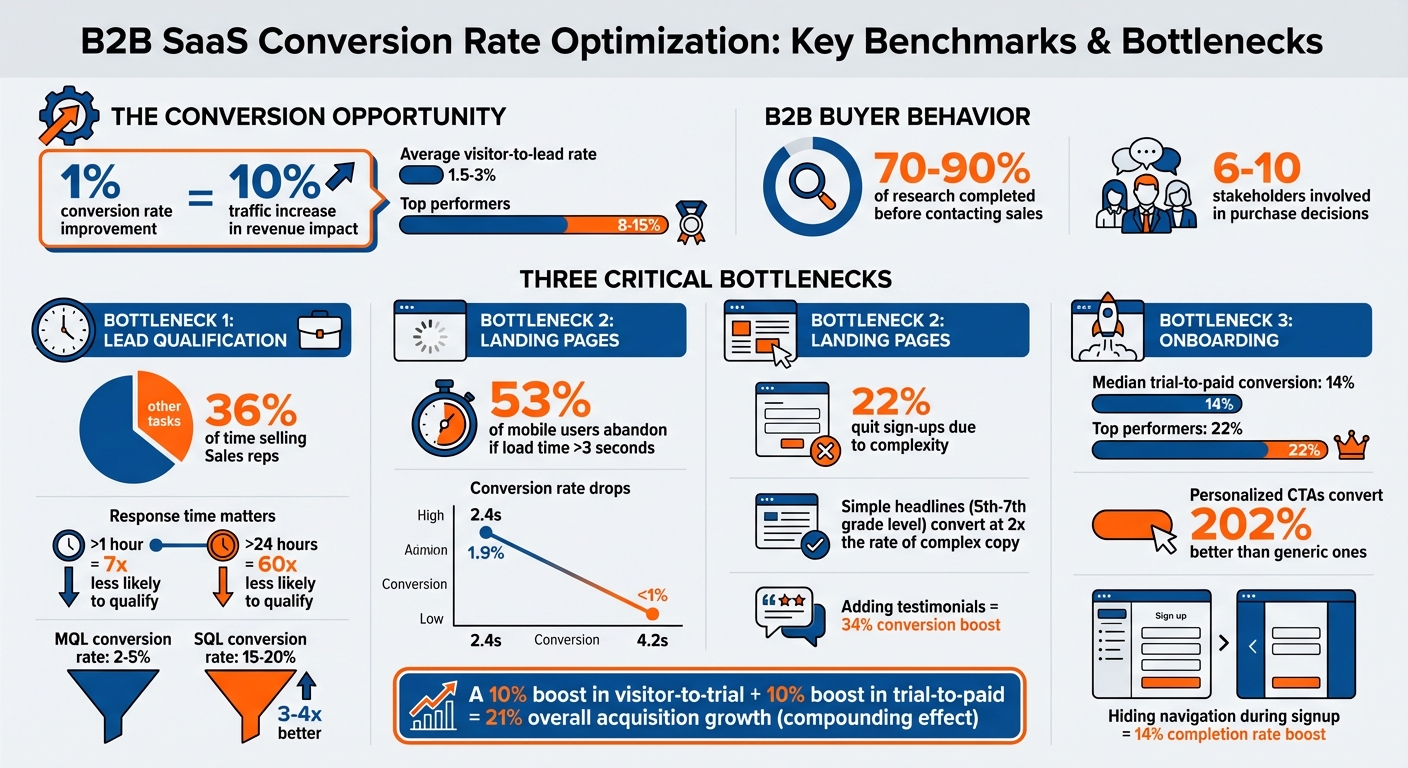
Improving your B2B SaaS conversion rate by just 1% can drive as much revenue as a 10% traffic increase. Yet, most companies struggle with inefficient strategies that lose prospects along the way. This article breaks down actionable ways to fix common bottlenecks in lead qualification, landing pages, and onboarding to boost conversions and revenue.
Here’s what you need to know upfront:
- B2B buyers are thorough: They complete 70–90% of research before contacting sales and involve 6–10 stakeholders in decisions.
- Conversion gaps are costly: Average visitor-to-lead rates are 1.5–3%, while top performers hit 8–15%.
- Key bottlenecks to address:
- Poor lead qualification wastes time; SQLs convert 3–4x better than MQLs.
- Slow landing pages and complex forms drive users away.
- Weak onboarding leads to low trial-to-paid conversions (14% average vs. 22% for leaders).
How to create B2B conversion rate improvement to drive growth
Finding Conversion Bottlenecks in Your B2B SaaS Funnel
To improve your B2B SaaS funnel, focus on three major bottlenecks: lead qualification, landing pages, and onboarding. These areas can drain resources and drive up customer acquisition costs if not optimized.
Poor Lead Qualification
If your sales team is drowning in unqualified leads, you're not alone. This often happens when marketing prioritizes volume over quality, resulting in sales teams labeling these leads as "garbage" or unclosable [6]. Here's a staggering stat: sales reps spend only 36% of their time actually selling, with the rest wasted on administrative tasks or chasing low-quality leads [6].
Speed also plays a massive role. Companies that take longer than an hour to respond to leads are 7x less likely to qualify them. After 24 hours? Your chances plummet by 60x [6]. And while Marketing Qualified Leads (MQLs) convert at just 2–5%, Sales Qualified Leads (SQLs) convert at a much healthier 15–20% [6]. The key difference? SQLs are validated for intent, meaning they’re actual buyers with a clear problem, budget, and decision-making authority [6].
To fix this, implement a lead scoring system that combines explicit data (like job title or company size) with behavioral signals (like visits to your pricing page or demo requests). Tailor your lead routing: demo requests should go straight to sales, while ebook downloads might benefit from automated follow-ups [6].
Next, let’s address how your landing pages could be causing drop-offs.
Landing Pages and Forms That Lose Visitors
A poorly optimized landing page can derail conversions before they even start. 53% of mobile users abandon a page if it takes more than 3 seconds to load [7]. And if load time jumps from 2.4 seconds to 4.2 seconds, conversion rates can nosedive from 1.9% to under 1% [8].
But speed isn’t the only issue. A mismatch between your ad’s promise and the landing page message can instantly erode trust [8]. Add to that overly complex forms, and you’ve got a recipe for abandonment - 22% of users quit sign-up flows because they’re too long or complicated [5][8].
Simplifying forms can work wonders. Remove unnecessary fields and distractions like navigation menus. For instance, just adding customer testimonials to your landing page can boost conversions by 34% [8]. Additionally, clarity in your messaging matters. Write headlines that are easy to understand (think 5th–7th grade reading level). These convert at nearly double the rate of more complex, college-level copy [8].
Here’s a simple formula for your headlines: [What your product is] + [Who it helps] + [The outcome it delivers] [7]. Replace static "Contact Sales" forms with embedded calendars so high-intent prospects can book demos instantly [5].
Once visitors are engaged, the onboarding process becomes the next critical step.
Onboarding That Doesn't Convert
Getting users to sign up is one thing - activating them is another. The median conversion rate from free trial to paid customer is just 14%, but top-performing companies hit 22% [3]. The difference? They focus on delivering immediate value during onboarding.
Many onboarding flows fail by overwhelming users with empty dashboards or generic tutorials. When users see a blank screen instead of sample data, they can’t visualize how the product solves their problems [5]. Overly complex setups only push them further away [3].
Personalization is the game-changer here. Personalized CTAs convert 202% better than generic ones in B2B environments [4]. Tailor your onboarding experience to different user roles. For example, a developer and a marketing manager should see different features and walkthroughs. Instead of bombarding users with tutorials upfront, use context-sensitive tooltips that appear when needed [5].
Streamlining signup is another quick win. Hiding main navigation during signup can boost completion rates by 14% [3]. Pre-load dashboards with sample data, and ensure the experience feels tailored to the user’s role and needs.
"Activation isn't just a nice-to-have metric - it's the gateway to retention and revenue" – Josh Gallant and Gaurav Sharma, Unbounce [5]
CRO Strategies That Increase B2B SaaS Conversions
Now that you’ve pinpointed where conversions are stalling, it’s time to address those roadblocks. Below are strategies designed to tackle these challenges directly and deliver measurable improvements.
Segment Leads by Intent and Personalize Their Experience
A major issue with unqualified leads can be resolved by segmenting based on intent. Instead of generic nurture paths, use behavior-triggered actions to guide leads. For example, track which pages they visit, features they explore, or their role in the buying process. This allows you to craft experiences tailored to their specific actions and needs.
The results? They speak for themselves. Personalization efforts can boost conversions by over 200% [4]. AI tools that identify high-potential accounts can increase rates by 60%, while real-time content adjustments based on visitor behavior and industry lead to conversion increases of 18–24% [4].
Here’s how you can act on this:
- Competitor-targeted pages: Create content aimed at users searching for terms like "[Competitor] alternatives" or "[Competitor] vs [Your Product]" [4].
- Dark Funnel insights: Use intent data to uncover anonymous users in the research phase and engage them with retargeting campaigns [4].
- Champion toolkits: Equip high-intent leads with resources like ROI calculators and executive decks to help them advocate for your solution internally [4].
With B2B SaaS conversion rates typically around 2.4%, these intent-driven strategies can significantly outperform the norm [2]. By aligning content with a lead’s buying journey, you’ll not only see higher conversions but also speed up the sales process.
With leads segmented effectively, it’s time to refine your conversion pages to ensure clarity and reduce friction.
Simplify Key Conversion Pages
To combat landing page drop-offs, focus on making your conversion pages as frictionless as possible. Start with message match - ensure your landing page headline and design align with the ad or email that brought visitors there. A mismatch feels deceptive and drives visitors away.
"A bad message match is like advertising apples then selling oranges – visitors feel tricked and bounce immediately." – KlientBoost [8]
Use clear, benefit-focused language. Research shows that simple messaging, which conveys your product’s value in 5–8 seconds, achieves nearly double the conversion rate (11.1%) compared to overly complex, college-level copy (5.3%) [8].
Other key tactics include:
- Shorter forms: Reducing form fields from 11 to 4 can increase leads by 160% [8].
- Multi-step forms: These often boost completion rates by 35–40% compared to single-step forms [1].
- Remove navigation links: Eliminating exit points on landing pages can double conversion rates [8].
- Add trust elements: Placing testimonials near signup forms can drive a 34% increase in conversions [1].
Regularly audit your pages for relevance, clarity, and urgency. Companies with 40+ landing pages generate 12x more leads than those with only a few [8]. Instead of a generic homepage, create targeted landing pages for specific audience segments.
Rebuild Onboarding for Faster Activation
Once you’ve optimized lead segmentation and streamlined conversion pages, turn your attention to onboarding. A faster onboarding process helps users reach their first big win, or “aha moment,” sooner. This can push activation rates from 14% to 22% [3]. The key lies in reducing time-to-value - users should experience meaningful outcomes within 30 minutes.
Here’s how to make onboarding more effective:
- Progressive disclosure: Avoid overwhelming users by revealing features gradually as they engage more [4].
- Smart defaults: Pre-select common options in setup forms to reduce decision fatigue.
- Interactive walkthroughs: Replace static tutorials with guided experiences that lead users to their first success.
Personalization plays a role here too. Segment users by role or challenges to create customized onboarding paths. For example, a developer and a marketing manager should encounter workflows tailored to their distinct goals.
The first 5 minutes are critical - capitalize on high motivation during this window. Build habits during the initial 2–4 weeks to secure long-term retention.
Here’s a snapshot of onboarding tactics and their impact:
| Onboarding Tactic | Activation Lift | Retention Impact | Implementation Effort |
|---|---|---|---|
| Quick Wins First (Aha Moment) | 30–50% | Very High | Low |
| Interactive Walkthroughs | 25–40% | High | Medium |
| Personalized Paths | 20–35% | High | High |
| Progress Indicators | 15–25% | Medium | Low |
| Video Tutorials | 10–20% | Medium | Low |
These steps not only speed up activation but also lay the groundwork for improved retention and revenue growth. By focusing on tailored experiences and reducing barriers, you’ll create a smoother path from onboarding to long-term success.
Testing and Measuring Your CRO Results
Testing is the backbone of any effective conversion strategy. Without it, you risk wasting time and resources on changes that don’t move the needle. Start by conducting a heuristic analysis to uncover obvious friction points related to clarity, trust, and relevance. These audits can often deliver conversion improvements of 20–30% - even before running formal experiments [2][11]. Once you've addressed these quick wins, shift your focus to A/B testing key elements of your high-impact pages to identify and fix bottlenecks.
A/B Test High-Impact Page Elements
When it comes to A/B testing, prioritize areas in your funnel that have the most potential for improvement. For B2B SaaS companies, the MQL-to-SQL transition is often a sticking point, with an average conversion rate of just 13% [4][11]. Test one variable at a time to clearly identify what’s driving the results [9].
Take Hubstaff, for example. In late 2024, they redesigned the hero section of a landing page, adding a cleaner layout, an email capture widget, and social proof below the call-to-action. This change boosted their conversion rate from 6.89% to 10.95% with a 98% confidence level [10]. On the flip side, not all tests succeed. In early 2025, Heyflow adjusted its homepage headline from "All-in-One Lead Generation Platform" to "The Only Solution You Need for Converting Mobile Traffic." The result? A 16.86% drop in signup clicks, forcing the company to revert to its original messaging [10].
"The goal of a test is not to get a lift, but to get a learning." - Flint McGlaughlin, CEO, MECLABS Institute [10]
To ensure reliable results, run tests for at least two weeks to account for traffic fluctuations [3]. Don’t declare a winner until you achieve 95% statistical significance - anything less risks wasting resources on false positives [13][3]. Document every outcome, whether it’s a win or a loss, to build a knowledge base and avoid repeating mistakes [9][11].
When measuring success, focus on metrics that reflect revenue impact, like Net New ARR or Pipeline Value, rather than just click-through rates [2][11]. While A/B testing hones in on individual pages, broader insights come from tracking the entire customer journey.
Track Multi-Touch Attribution for Better Data
B2B sales cycles are complex, often spanning 90–180 days and involving multiple touchpoints. Relying on single-touch attribution oversimplifies this process and misses key insights. Multi-touch attribution, on the other hand, distributes credit across the full journey, offering a more complete picture and improving conversion efforts by 15–25% [4].
For example, TripMaster implemented a revenue-focused CRO strategy and, over a year ending in January 2026, added $504,758 in Net New ARR. By optimizing search conversions, they achieved a 20% conversion rate with a 650% ROI [4][12]. Similarly, TestGorilla shortened its CAC payback period to just 80 days during 2025 by fine-tuning its MQL-to-SQL funnel and adopting advanced attribution tools after a $70M Series A funding round [4][12].
To track effectively, use tools like GCLID-to-CRM tracking, which links ad clicks to closed-won revenue in your CRM [4][12]. Reverse IP lookup and intent data can also help you monitor the "dark funnel", where up to 90% of demand occurs in private channels like Slack or internal emails [4].
Break down your results by device type, traffic source, and user behavior. For example, while mobile traffic accounts for nearly 58% of B2B visits, it often converts 40–60% worse than desktop traffic [11]. Knowing this can help you allocate resources more effectively and refine your CRO process over time. These insights are essential for building a scalable, revenue-driven CRO strategy that supports long-term SaaS growth.
Conclusion: Building a Repeatable CRO Process
Sustainable growth thrives on a repeatable CRO process, built on proven strategies and continuous improvement.
Conversion rate optimization isn't something you do once and forget. It's an ongoing effort that builds momentum over time. For instance, a 10% boost in visitor-to-trial conversions, paired with a 10% increase in trial-to-paid conversions, results in a 21% overall acquisition growth - thanks to the power of compounding [14]. This is why CRO serves as a growth engine for B2B SaaS companies.
The best results come from following a structured six-step cycle: Quantitative Analysis to pinpoint drop-offs, Qualitative Research to uncover reasons behind user behavior, Hypothesis Prioritization, Test Design, Implementation, and Analysis/Learning [14]. This process replaces guesswork with data-driven decisions. Take the example of a B2B project management SaaS in 2026: they achieved a 128% jump in homepage-to-signup conversions - from 1.8% to 4.1% - over four months by running eight iterative tests. These included simplifying headlines and cutting signup fields from six to two [3]. This approach seamlessly connects data insights to measurable results throughout the customer journey.
"CRO is iterative. You won't get massive wins overnight, but consistent 5-15% improvements compound into transformational results." - Max Beech, Head of Content, Athenic [3]
Collaboration is the backbone of success. Effective CRO requires teamwork across departments - Product, Customer Success, and beyond - along with detailed documentation of every test in a shared CRO Playbook. This ensures lessons learned are preserved for future use [14] [9]. And remember, never finalize test results without reaching 95% statistical significance and allowing 1-2 weeks to account for traffic variations [14] [9].
FAQs
Which funnel stage should I optimize first?
In the world of B2B SaaS, the top of the funnel (TOFU) is where everything begins. This stage is all about drawing in potential customers and capturing their interest. Without strong engagement here, it’s tough to turn awareness into meaningful action.
To strengthen TOFU, focus on improving key elements like landing pages, lead magnets, and initial touchpoints. These are your chances to make a solid first impression, build trust, and educate prospects about your solution. Once your TOFU strategy is solid, you’ll be in a much better position to nurture those leads and eventually close deals.
What CRO tests should I run if traffic is low?
If your website traffic is on the lower side, it’s crucial to focus on tests that make the most of every visitor and improve the quality of your leads. Start by fine-tuning your landing page messaging to ensure it resonates with your audience. Simplify user journeys to reduce friction, and optimize how you capture leads.
Experiment with different value propositions, headlines, CTAs (calls-to-action), form lengths, and lead magnets to see what drives the best results. On high-impact pages like your homepage or signup page, try A/B testing design elements such as layouts and button colors. Even small tweaks can lead to better conversions when traffic is limited.
How do I tie CRO wins to revenue in my CRM?
To link CRO success directly to revenue in your CRM, start by setting up a clear framework for tracking conversions. Identify key metrics such as customer lifetime value (LTV) and the rate at which conversions turn into paying customers. Sync your CRO tools with your CRM to assign conversions to specific campaigns or user groups. Consistently review this data to showcase how your CRO initiatives contribute to revenue growth and to fine-tune your strategies for even better results.
Related reading
- How your acquisition strategy influences your conversion rate
- How to A/B test pricing as a boostrapped company
- Upsell vs. Cross-Sell Metrics: Key Differences
- Digital Marketing Services
- What Is Strategy Consulting? (And when to hire a consultant to do it for you)
Useful tools & services
See what a useful assessment looks like
Connect an observed problem to a recommendation, implementation owner, and success check.
Use the assessment templateNeed help choosing the next change? Explore CRO consulting.
Keep improving your conversion work.
Subscribe for practical ideas on diagnosing conversion problems, planning experiments, and choosing your next improvement.
No spam. Unsubscribe anytime.