top 20 brands or products that match these criteria: enterprise service-level agreements for experimentation software.
Compare 20 enterprise experimentation platforms with SLA, scalability, and compliance details to help teams pick reliable testing software.
-
Optimizely Feature Experimentation: Flexible SDKs, edge workers, and advanced analytics for multi-environment testing.
-
Adobe Target: AI-powered personalization and multivariate testing for omnichannel experiences.
-
LaunchDarkly: Feature flagging integrated with experimentation, ideal for high-traffic environments.
-
Split: Combines feature flags with real-time analytics for impact assessment.
-
Optimizely Web Experimentation: Server-side testing with compliance for GDPR, CCPA, and HIPAA.
-
AB Tasty: AI-driven platform for marketing and product teams.
-
VWO Testing: A/B testing with personalization for enterprise-level needs.
-
Kameleoon: A/B testing and personalization tools tailored for European markets.
-
Dynamic Yield: Omnichannel personalization and testing for e-commerce.
-
Optimizely Experimentation for B2B and Content: Focused on B2B workflows and content optimization.
-
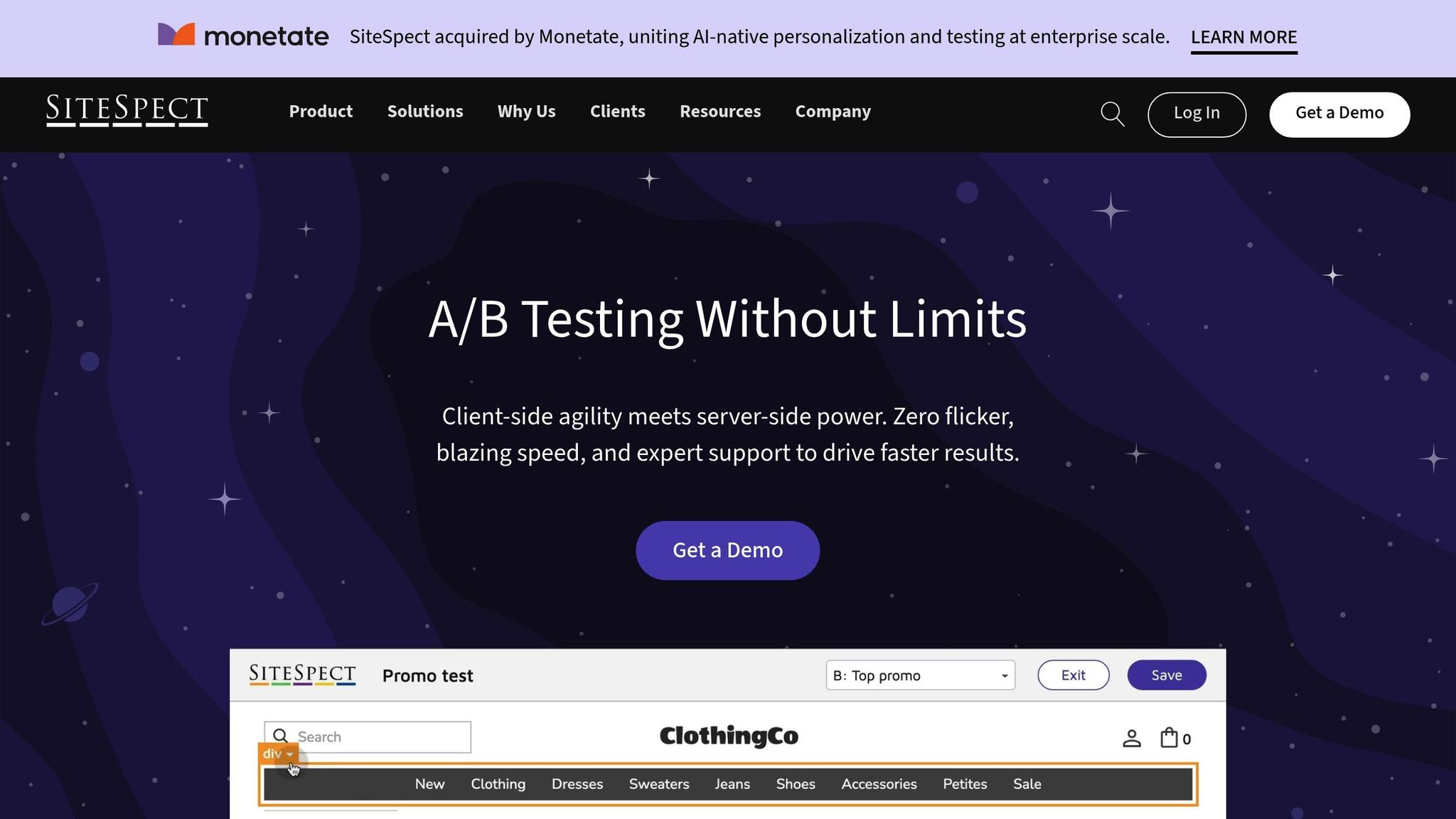
SiteSpect: Server-side testing without front-end code changes.
-
Monetate: Personalization for e-commerce and retail brands.
-
Oracle Maxymiser: Behavioral targeting and multivariate testing within Oracle's ecosystem.
-
Salesforce Interaction Studio: Real-time personalization and journey orchestration.
-
Braze Canvas Experimentation: Multi-channel messaging tests for customer engagement.
-
Amplitude Experiment: Feature flagging combined with product analytics.
-
Heap Experimentation: Integrates analytics with third-party experimentation tools.
-
Statsig: Handles massive-scale experiments with advanced statistical tools.
-
GrowthBook: Open-source, warehouse-native experimentation platform.
-
Google Cloud Services: Custom-built experimentation solutions leveraging BigQuery and Firebase.
These platforms cater to diverse needs, from marketing-friendly tools to engineering-focused feature flag systems. For businesses managing high traffic or requiring strict compliance, understanding SLA commitments, scalability, and data protection is key. Always verify specific SLA terms and compliance certifications directly with vendors.
1. Optimizely Feature Experimentation
Optimizely Feature Experimentation provides a versatile way to run experiments across various environments, including frontend, backend, mobile, and edge. With its flexible SDKs, Edge Workers, and a low-latency microservice agent, this platform can seamlessly operate in any coding setup. Its built-in Stats Engine ensures accurate results by reducing false positives, making it easier and faster to make informed decisions.
The platform offers granular feature control, letting you roll out updates by percentage, audience segment, or user ID. Plus, you can instantly pause or roll back features when needed. For more advanced testing, it uses multi-armed bandits to automatically steer traffic toward the best-performing variations. Integration with data warehouses allows for custom metrics and detailed analytics, making it easier to demonstrate ROI.
This combination of tools ensures fast and reliable experimentation across diverse environments. Leaders like John Cline from Blue Apron, Ray Law from Starbucks, and Dimos Papadopoulos from ATG Entertainment have praised the platform for its ability to speed up decision-making and fine-tune live features effectively [5].
2. Adobe Target
Experimentation Capabilities (A/B Testing, Personalization)
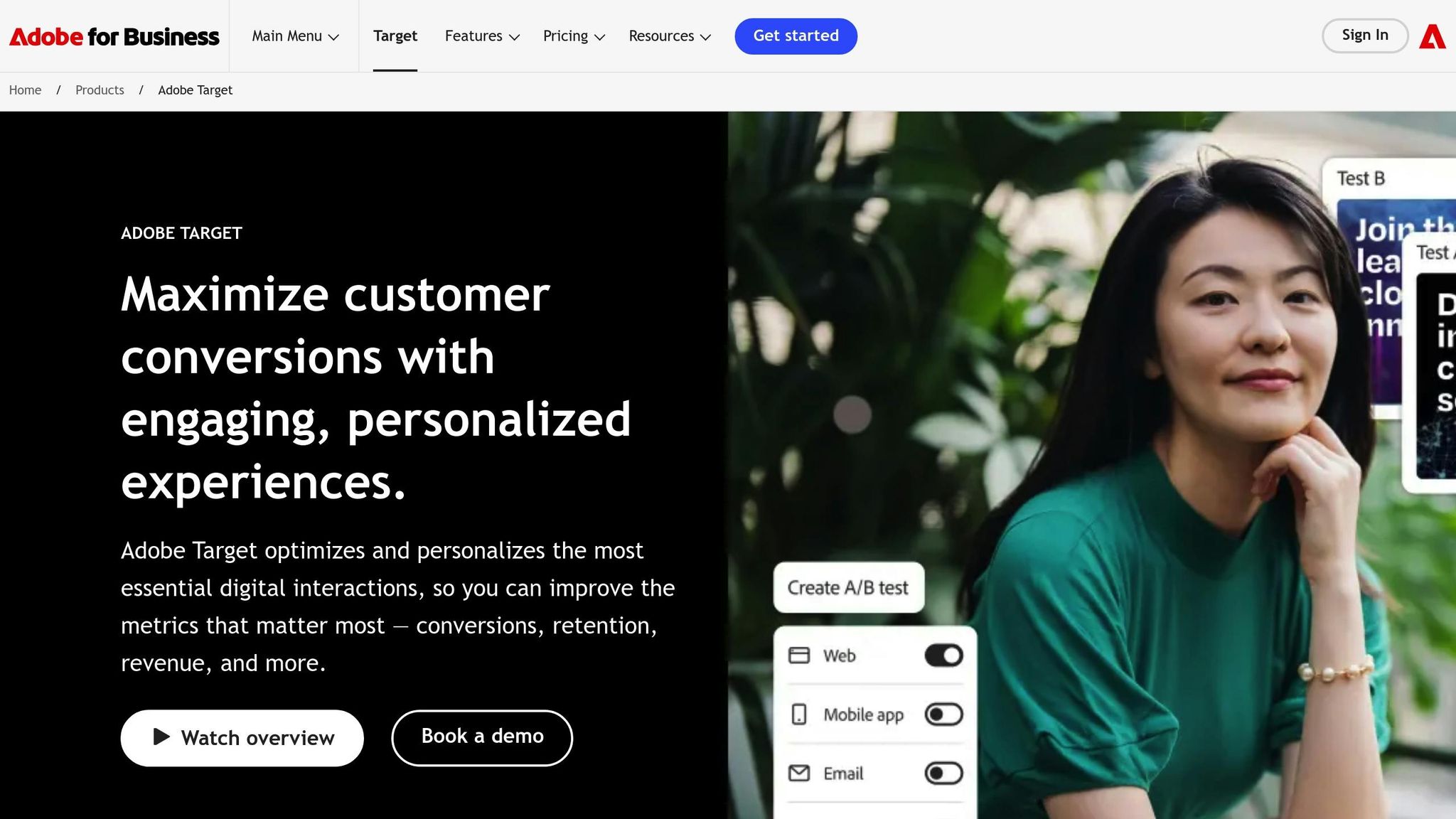
Adobe Target is an advanced testing platform designed for A/B and multivariate testing across multiple channels. What sets it apart is its ability to create cross-channel profiles for each user, ensuring a seamless experience across devices. This consistency helps maintain accurate statistical analysis by reducing the impact of cross-platform interactions [3].
The platform supports two types of personalization: rules-based and AI-driven. You can manually configure tests based on factors like operating system or geolocation, or let Adobe Sensei’s machine learning handle it automatically. This flexibility makes it ideal for managing high-traffic scenarios on an enterprise scale.
Scalability for High-Traffic Environments
Adobe Target’s omnichannel approach is built to handle the demands of enterprise-scale experimentation. Its integration of AI and machine learning simplifies complex multivariate testing, eliminating many of the technical hurdles that come with large-scale testing environments [3].
Enterprise-Grade SLA Considerations
Adobe Target uses a quote-based pricing model, customized to fit your business requirements [3][6]. Support is provided through a ticketing system [6]. For comprehensive details on SLA terms and pricing, businesses are required to submit a request form, including information like their country, department, and primary use case [3].
3. LaunchDarkly
Experimentation Capabilities (A/B Testing, Feature Flags, Personalization)
LaunchDarkly is a platform designed to manage feature flags with integrated experimentation tools. By wrapping new features in flags, you can control who gets access and test specific user groups before rolling them out broadly. This approach ensures a smoother development process and minimizes risks.
One standout feature is the ability to run A/B tests directly through feature flags. This means you can evaluate how new features impact key metrics without needing additional testing infrastructure. The integration makes it easy to validate changes in live environments, saving time and effort. Plus, it’s built to handle the demands of larger organizations.
Scalability for High-Traffic Environments
LaunchDarkly uses a pricing model based on flag evaluations, starting with a free tier and scaling as usage grows [4]. This setup works well for enterprises managing feature releases across vast user bases, but it’s important to monitor evaluation volumes to keep costs in check.
The platform’s architecture is robust, supporting millions of evaluations daily. It’s designed for businesses that run continuous experiments across web, mobile, and backend systems, making it a solid choice for high-traffic environments.
Enterprise-Grade SLA Considerations
For enterprises requiring specific service guarantees, LaunchDarkly offers tailored SLA terms. To learn more about uptime, support levels, and performance benchmarks, you’ll need to reach out to their sales team directly.
4. Split
Experimentation Capabilities (A/B Testing, Feature Flags, Personalization)
Split brings together feature flagging and experimentation, offering teams the ability to roll out features gradually, control who sees them, and analyze their impact in real-time. This method ensures you can test and validate changes before committing to a full-scale launch.
What sets Split apart is its integration of A/B testing with feature flag management. Teams can experiment with different variations without needing additional deployments, simplifying the process and reducing technical complexity. Plus, it allows you to target specific user groups and track key metrics like conversion rates and engagement. These tools make it easier to understand how changes affect your audience while keeping everything manageable. Split also provides custom SLA terms to meet unique business requirements.
Enterprise-Grade SLA Considerations
Split tailors its service-level agreements to align with the specific needs and scale of your organization. For detailed SLA options, it's best to connect directly with their sales team to ensure everything fits your business goals.
5. Optimizely Web Experimentation
Experimentation Capabilities (A/B Testing, Feature Flags, Personalization)
Optimizely Web Experimentation offers reliable A/B testing for websites, mobile platforms, and landing pages. By preloading tests server-side, it eliminates flicker and delays, creating a smoother user experience. Its Stats Engine provides quicker and more precise results, making it a trusted choice for over 9,000 businesses and 10,000 leading brands worldwide [8][9].
"We are able to identify what development work is worth pursuing and what isn't based on the experiment results deployed by their platform." - Audrey Ortiz, CRO Marketing Manager, ServiceTitan [7]
Scalability for High-Traffic Environments
Designed to handle high-traffic situations effortlessly, Optimizely Web Experimentation uses an Edge Delivery system powered by a global CDN. This setup minimizes latency and ensures fast load times, even during traffic surges, while maintaining a robust infrastructure.
Data Protection and Compliance (GDPR, CCPA, HIPAA)
Optimizely meets key regulatory standards, including GDPR, CCPA, and HIPAA, streamlining compliance for businesses operating across various regions and industries.
6. AB Tasty
Experimentation Capabilities
AB Tasty is an AI-driven platform designed for enterprise teams in marketing, product development, and engineering. While it emphasizes experimentation, specific details about its testing methodologies aren't publicly available [3].
Enterprise-Grade SLA Guarantees (Uptime, Support Levels, Performance Metrics)
When it comes to service-level agreements (SLAs), information about uptime, support response times, and performance metrics hasn't been shared openly. To get the full picture, you'll need to reach out to their sales team for comprehensive SLA documentation [3].
Scalability for High-Traffic Environments
Details about how AB Tasty manages high-traffic scenarios or supports large-scale experiments are not provided in public resources. For insights into their capacity planning and performance benchmarks, it's best to consult their technical team directly. This step is crucial to ensure the platform can meet your enterprise's specific requirements.
7. VWO Testing
Experimentation Capabilities (A/B Testing, Feature Flags, Personalization)
VWO Testing provides tools for A/B testing and personalization tailored to enterprise-level digital experimentation. However, specific technical details about these features aren't shared publicly. For a deeper understanding of how these capabilities can meet enterprise needs, businesses are encouraged to reach out directly to VWO.
Enterprise-Grade SLA Guarantees (Uptime, Support Levels, Performance)
Information about VWO Testing's service-level agreements (SLAs), such as uptime guarantees, support response times, and performance metrics, isn't readily available through public channels. Enterprises seeking clarity on these guarantees will need to contact VWO's sales team for detailed documentation.
Scalability for High-Traffic Environments
Details on how VWO Testing handles high-traffic environments or large-scale experiments aren't published. Companies managing millions of visitors or running complex experiments should connect with VWO's technical team to understand the platform's scalability and load-handling capabilities.
Data Protection and Compliance (SOC 2, ISO 27001, HIPAA, GDPR/CCPA)
VWO Testing does not make its compliance certifications or data protection standards publicly accessible. Businesses operating in regulated industries will need to request a comprehensive compliance report from VWO to confirm adherence to frameworks like SOC 2, ISO 27001, HIPAA, or GDPR/CCPA.
8. Kameleoon
Experimentation Capabilities (A/B Testing, Feature Flags, Personalization)
Kameleoon provides tools designed for A/B testing and personalization. However, its publicly available documentation is quite limited. For in-depth technical details, reaching out directly to Kameleoon is necessary. Additionally, businesses should review Kameleoon's SLA commitments to ensure they meet the demands of mission-critical operations.
Enterprise-Grade SLA Guarantees (Uptime, Support Levels, Performance)
Specific details about Kameleoon's service-level agreements, such as uptime guarantees, support response times, and performance metrics, are not shared publicly. Enterprises looking for this information will need to contact Kameleoon's sales team to access detailed SLA documentation.
Scalability for High-Traffic Environments
When it comes to managing high-traffic environments, Kameleoon does not offer public insights into its scalability capabilities. To understand how the platform handles large-scale traffic, businesses will need to consult directly with Kameleoon's technical team.
Data Protection and Compliance (SOC 2, ISO 27001, HIPAA, GDPR/CCPA)
Kameleoon does not publicly share information about its compliance with certifications like SOC 2, ISO 27001, HIPAA, or GDPR/CCPA. If your business requires confirmation of these certifications or detailed information about their data security practices, you’ll need to request a comprehensive compliance report from Kameleoon.
9. Dynamic Yield
Experimentation Capabilities (A/B Testing, Feature Flags, Personalization)
Dynamic Yield offers tools for A/B testing and personalization aimed at helping businesses experiment with different variations and create tailored experiences across digital platforms. However, their publicly available technical documentation is quite limited. If you're interested in exploring their feature flags or advanced testing options, you'll need to reach out directly to their team for more details. This lack of transparency in their documentation also raises questions about their service-level offerings.
Enterprise-Grade SLA Guarantees (Uptime, Support Levels, Performance)
Information about Dynamic Yield's service-level agreements (SLAs), such as uptime guarantees, support response times, and performance metrics, isn't readily available. To assess whether their SLAs align with your needs, you'll need to request this documentation from their sales team.
Scalability for High-Traffic Environments
If you're planning large-scale experiments or expect significant traffic, details about Dynamic Yield's scalability are not openly shared. For specifics on their infrastructure and ability to handle high-traffic scenarios, it’s best to consult their technical team.
Data Protection and Compliance (SOC 2, ISO 27001, HIPAA, GDPR/CCPA)
Dynamic Yield’s compliance with key standards like SOC 2, ISO 27001, HIPAA, and GDPR/CCPA is not publicly confirmed. To ensure they meet your security and compliance requirements, ask for their security and compliance reports to verify adherence to industry standards.
10. Optimizely Experimentation for B2B and Content
Experimentation Capabilities (A/B Testing, Feature Flags, Personalization)
Optimizely Experimentation for B2B and Content focuses on enhancing testing capabilities for B2B and content-driven experiences. It allows businesses to test different content variations, messaging approaches, and user journeys tailored to the unique dynamics of B2B buying processes. Positioned as an enterprise-grade solution in the experimentation software market [10], its detailed features and specifications are available upon request. This enterprise orientation ensures the platform meets demanding performance and support expectations.
Like other enterprise tools, Optimizely prioritizes reliability, scalability, and comprehensive support.
Enterprise-Grade SLA Details
Optimizely provides SLAs specifically designed for B2B workflows and content delivery. These include uptime guarantees, support response times, and performance metrics. For precise SLA terms, it's best to reach out to Optimizely's sales team directly.
Scalability for High-Traffic Environments
Optimizely is built to handle high-traffic scenarios, making it suitable for large-scale experiments. However, details about its infrastructure, traffic limits, and scaling capabilities aren't publicly shared. To understand how the platform would perform under your specific conditions, you can contact their technical team for more information.
Data Protection and Compliance (SOC 2, ISO 27001, HIPAA, GDPR/CCPA)
Optimizely is designed with robust data security measures, which are critical for safeguarding B2B content. The platform adheres to stringent compliance standards, including SOC 2, ISO 27001, HIPAA, and GDPR/CCPA. For detailed compliance documentation, you’ll need to connect with their team directly.
11. SiteSpect
Experimentation Capabilities (A/B Testing, Feature Flags, Personalization)
SiteSpect is a server-side experimentation platform designed to handle A/B tests, multivariate tests, and personalization campaigns without requiring changes to front-end code. By intercepting traffic at the server or edge, it ensures a consistent experience across web, mobile, and API channels. This setup allows teams to test a wide range of scenarios, from simple layout tweaks to complex backend adjustments, all while maintaining a seamless user experience across various platforms.
The platform is particularly useful for both marketing and product teams aiming to improve conversion rates, enhance user engagement, and boost overall digital performance. One of its standout features is its server-side architecture, which eliminates the need for JavaScript tags. This not only avoids slowing down page load times but also prevents flickering effects that can disrupt the user experience. These factors make SiteSpect a strong contender for enterprises seeking reliable experimentation tools.
Enterprise-Grade SLA Details
For enterprises prioritizing reliability, SiteSpect offers a Service Level Agreement (SLA) framework. However, specific details about uptime commitments, response times, and performance benchmarks are not publicly available. To get precise information, it's best to contact the SiteSpect sales team directly.
Scalability for High-Traffic Environments
SiteSpect's ability to scale in high-traffic environments is another area where details are not disclosed publicly. To understand its infrastructure capabilities and traffic handling limits, reaching out to their technical team is recommended.
Data Protection and Compliance (SOC 2, ISO 27001, HIPAA, GDPR/CCPA)
While SiteSpect mentions compliance with standards such as SOC 2, ISO 27001, HIPAA, and GDPR/CCPA, detailed documentation on these certifications is not shared publicly. For a deeper dive into their data protection measures, you’ll need to request specific compliance information directly from SiteSpect.
sbb-itb-0499eb9
12. Monetate
Experimentation Capabilities
Monetate focuses on delivering personalization and testing solutions tailored for e-commerce and retail businesses. Its platform is designed to refine digital customer experiences through targeted experimentation.
Enterprise-Grade SLA Details
The specifics of Monetate's service-level agreements (SLAs) - such as uptime guarantees, response times, and performance metrics - aren’t publicly available. For complete details, it’s best to reach out to their sales team.
Scalability for High-Traffic Environments
Information about Monetate’s infrastructure and ability to manage high-traffic scenarios isn’t shared publicly. Enterprises should connect with their technical team to confirm scalability capabilities.
Data Protection and Compliance (SOC 2, ISO 27001, HIPAA, GDPR/CCPA)
Monetate doesn’t publicly disclose its certifications for compliance with standards like SOC 2, ISO 27001, HIPAA, GDPR, or CCPA. To ensure their security measures meet your requirements, request their compliance reports directly.
13. Oracle Maxymiser
Experimentation Capabilities
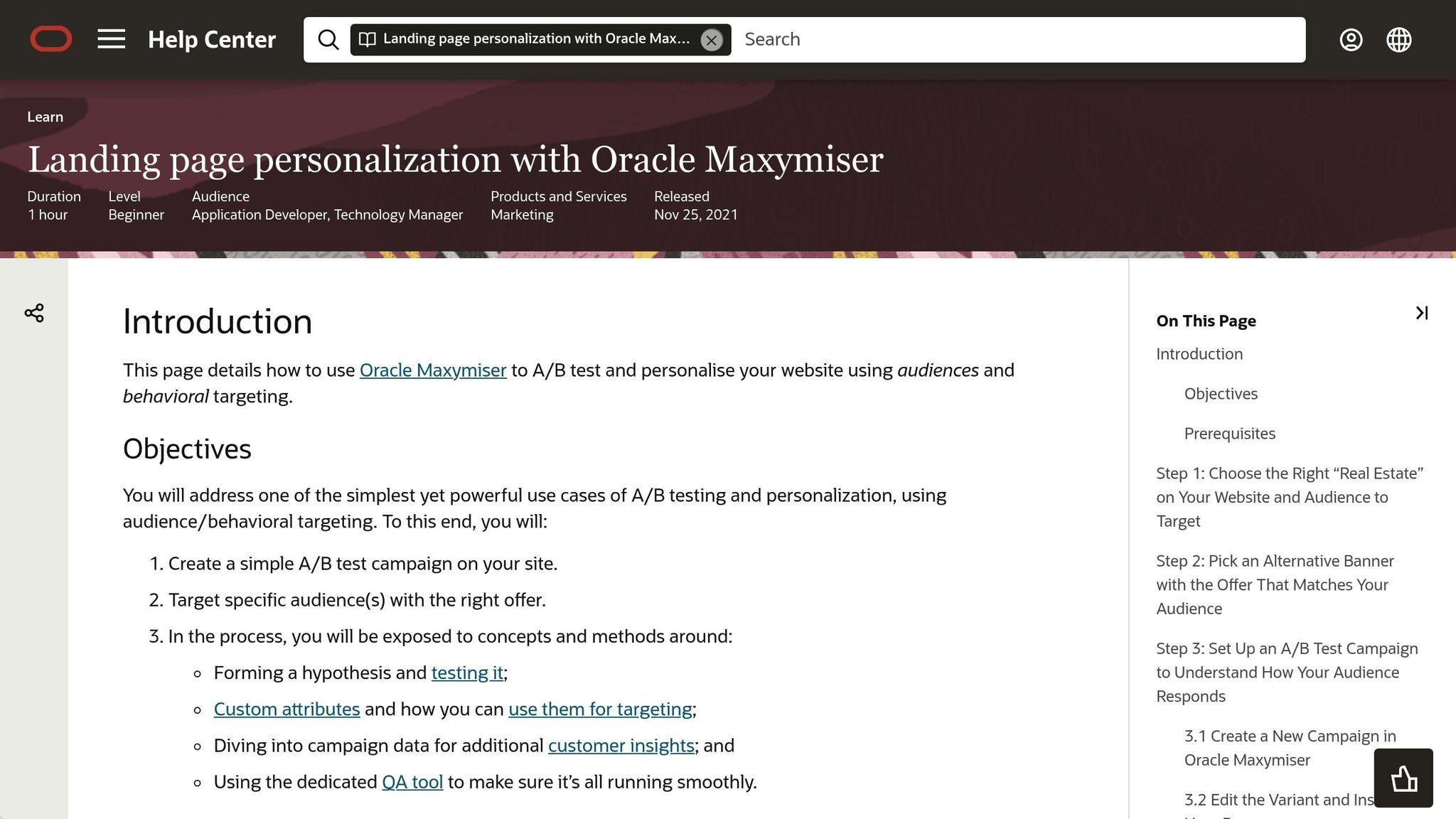
Oracle Maxymiser offers tools for A/B testing, multivariate testing, and personalization, designed for both web and mobile platforms. These features allow businesses to test different variations, helping to refine customer journeys and improve engagement. The platform also includes behavioral targeting, which can be used to fine-tune conversion rates. These testing tools are complemented by service-level options tailored to specific business needs.
Enterprise-Grade SLA Details
Details about Oracle's service-level agreements (like uptime guarantees, response times, and performance metrics) are not publicly available. For specifics, businesses should reach out directly to Oracle's sales team.
Scalability for High-Traffic Environments
Information about how Oracle Maxymiser handles high traffic volumes or large-scale experiments isn’t disclosed publicly. Companies with substantial scalability requirements should contact Oracle's technical team to confirm the platform’s capabilities.
Data Protection and Compliance
Oracle does not publicly share details about its compliance certifications, such as SOC 2, ISO 27001, HIPAA, GDPR, or CCPA. Organizations with stringent regulatory needs should request the relevant compliance and security documentation from Oracle directly.
14. Salesforce Interaction Studio Experimentation
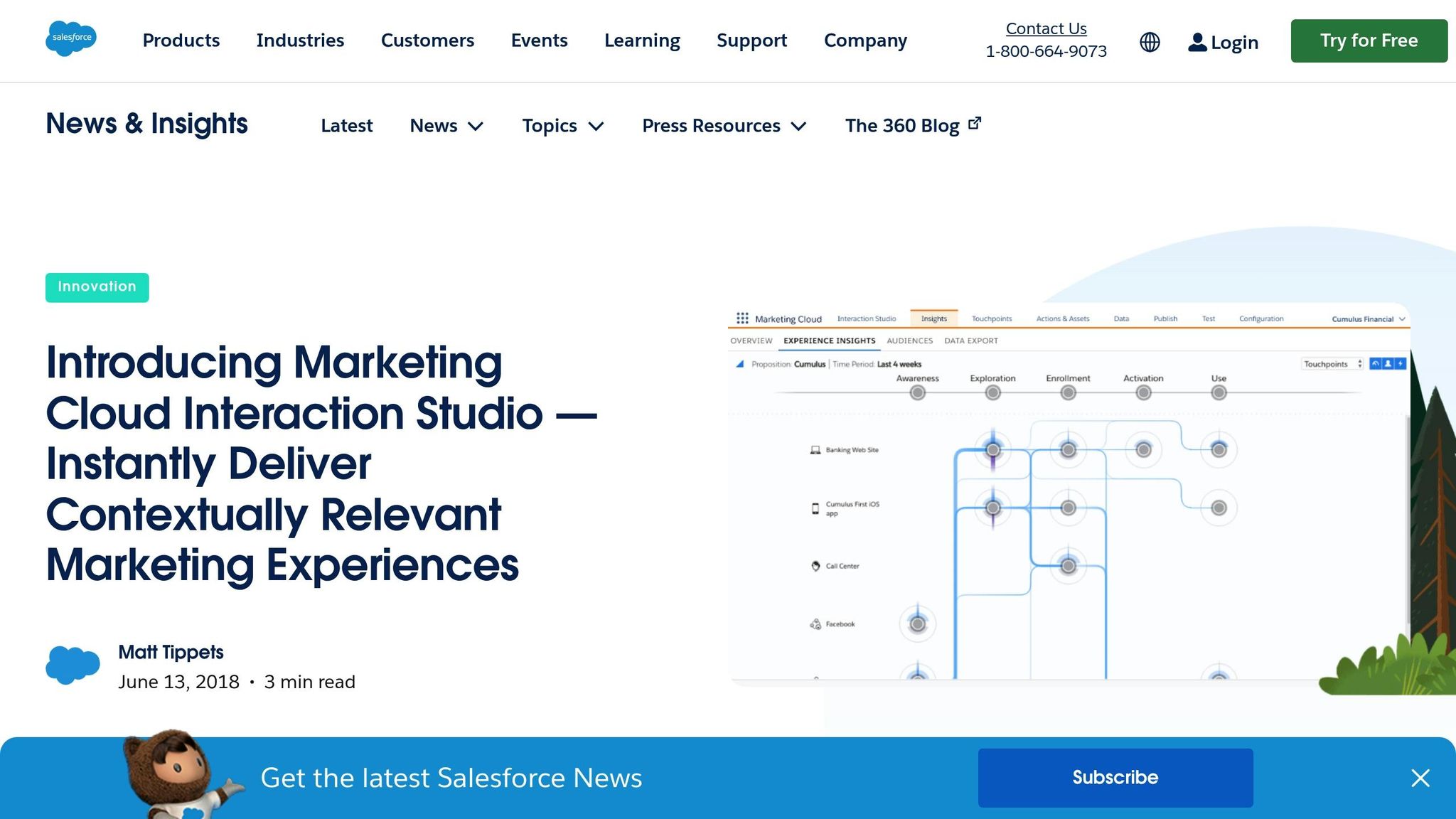
Let’s take a closer look at Salesforce Interaction Studio, an enterprise tool designed to enhance customer engagement through real-time interactions. However, when it comes to experimentation features, there are a few gaps in publicly available information.
Experimentation Capabilities
Salesforce Interaction Studio is part of Salesforce’s broader suite of tools, but information on its specific experimentation features is sparse. While the platform focuses on managing real-time customer interactions, details about its testing processes or methodologies are not readily accessible. For deeper insights, it’s best to reach out to Salesforce directly.
Enterprise-Grade SLA Guarantees
When it comes to service-level agreements (SLAs), Salesforce Interaction Studio doesn’t disclose specifics publicly. Information about uptime guarantees, support response times, or performance metrics isn’t available online. If these factors are critical for your business, it’s worth requesting detailed SLA documentation from Salesforce.
Scalability for High-Traffic Environments
Scalability is another area where public information is lacking. It’s unclear how the platform handles heavy traffic or scales to meet the demands of large enterprises. Companies with high-volume needs should connect with Salesforce’s technical team to explore how the platform can manage performance and capacity at scale.
Data Protection and Compliance
Security and compliance are essential for many organizations, but Salesforce Interaction Studio doesn’t provide detailed information about its certifications or practices in public documentation. There’s no mention of compliance with standards like SOC 2, ISO 27001, HIPAA, GDPR, or CCPA. Businesses with strict regulatory requirements should consult Salesforce directly for comprehensive security and compliance information.
15. Braze Canvas Experimentation
Braze Canvas Experimentation is a feature within the Braze engagement platform designed to help marketing teams refine their messaging strategies through testing and optimization. For detailed information on advanced features, it's best to contact Braze directly.
Experimentation Capabilities
Braze Canvas enables marketers to build multi-step customer journeys and experiment with different messaging variations across multiple channels, including email, push notifications, and in-app messages. The platform emphasizes testing elements like message content, timing, and delivery channels to enhance engagement. While the general capabilities are clear, details on advanced testing methods or statistical models aren't publicly available. For more in-depth insights, reaching out to Braze's sales team is recommended.
Enterprise-Grade SLA Guarantees
Information on service-level agreements (SLAs), such as uptime guarantees, response times, or performance metrics, isn't readily available. Enterprises seeking these specifics should request documentation directly from Braze.
Scalability for High-Traffic Environments
Publicly available resources don't outline performance benchmarks or capacity limits. Businesses managing large-scale interactions should consult Braze's technical team to ensure the platform can handle their traffic demands.
Data Protection and Compliance
Details about compliance certifications, such as SOC 2, ISO 27001, HIPAA, GDPR, or CCPA, aren't provided in public documentation. Companies with strict regulatory needs should request comprehensive compliance information from Braze to confirm the platform aligns with their security and privacy standards.
16. Amplitude Experiment

Amplitude Experiment is designed to seamlessly integrate with the Amplitude analytics platform, providing product and engineering teams with tools to test features and refine user experiences. By combining experimentation with enterprise-focused solutions, it aims to deliver a comprehensive approach to feature testing and user optimization.
Experimentation Capabilities
This platform merges feature flagging and A/B testing, giving teams the ability to manage feature rollouts while analyzing their effects on user behavior. By linking experimentation data directly to Amplitude's analytics, teams can assess how experiments influence key metrics and user flows. While specific details about advanced statistical methods and personalization are not publicly available, Amplitude can provide further technical insights upon request.
The following sections cover critical aspects like service reliability and system scalability.
Enterprise-Grade SLA Guarantees
Amplitude’s public documentation does not include specifics about uptime guarantees, support response times, or performance metrics. To fully understand the platform's commitments to availability and support for mission-critical needs, it’s best to request detailed SLA documentation directly from Amplitude.
Scalability for High-Traffic Environments
Details about performance benchmarks, capacity limits, or the platform’s ability to handle high-traffic experimentation are not disclosed publicly. Organizations managing large-scale operations or expecting significant traffic growth should consult with Amplitude’s technical team to ensure the platform can handle their specific demands.
Data Protection and Compliance
Amplitude does not openly share information about compliance certifications like SOC 2, ISO 27001, or HIPAA, nor does it provide details about GDPR or CCPA adherence. For businesses with strict regulatory requirements, obtaining detailed compliance documentation from Amplitude is essential to confirm that the platform meets their security, privacy, and governance needs.
17. Heap Experimentation Partners and Frameworks

Heap takes a unique approach to enterprise experimentation by combining its analytics capabilities with third-party testing platforms. Rather than offering a native A/B testing solution, Heap focuses on delivering robust analytics while integrating with specialized experimentation tools. This allows organizations to benefit from Heap's rich data insights while relying on dedicated platforms for running experiments with advanced features and service-level agreements (SLAs).
Experimentation Capabilities
At the heart of Heap's platform is its automatic event tracking and behavioral analytics, which seamlessly capture user interactions without requiring manual setup. When it comes to experimentation, Heap relies on integrations with third-party platforms via partnerships and APIs. This setup enables businesses to use Heap's behavioral data to guide experiment planning and analyze results. However, the actual execution of experiments happens on the partner platforms. Details about specific partners or technical integration processes are not publicly available, and SLA terms depend on the chosen partner.
Enterprise-Grade SLA Guarantees
Heap does not provide public information about SLA terms for its integrations with experimentation partners. Since experiments are executed on external platforms, SLA commitments would depend on both Heap's analytics platform and the guarantees offered by the partner platform. To fully understand SLA coverage across the integrated system, organizations should request documentation directly from Heap.
Scalability for High-Traffic Environments
There is no publicly available information on how Heap's partner-based framework handles high-traffic scenarios. Scalability would hinge on the performance of both Heap's data collection system and the connected experimentation platform. Companies planning to run large-scale tests should consult Heap's technical team to ensure the setup can handle their traffic levels and meet testing demands.
Data Protection and Compliance
Heap has not shared compliance certifications such as SOC 2, ISO 27001, or HIPAA for its experimentation partnerships, nor has it detailed GDPR/CCPA measures. Since data flows between Heap and its partner platforms, understanding the full compliance framework requires reviewing documentation from both Heap and the selected partner. Organizations with strict regulatory requirements should work closely with Heap to confirm that the integrated solution adheres to necessary security and privacy standards.
18. Statsig
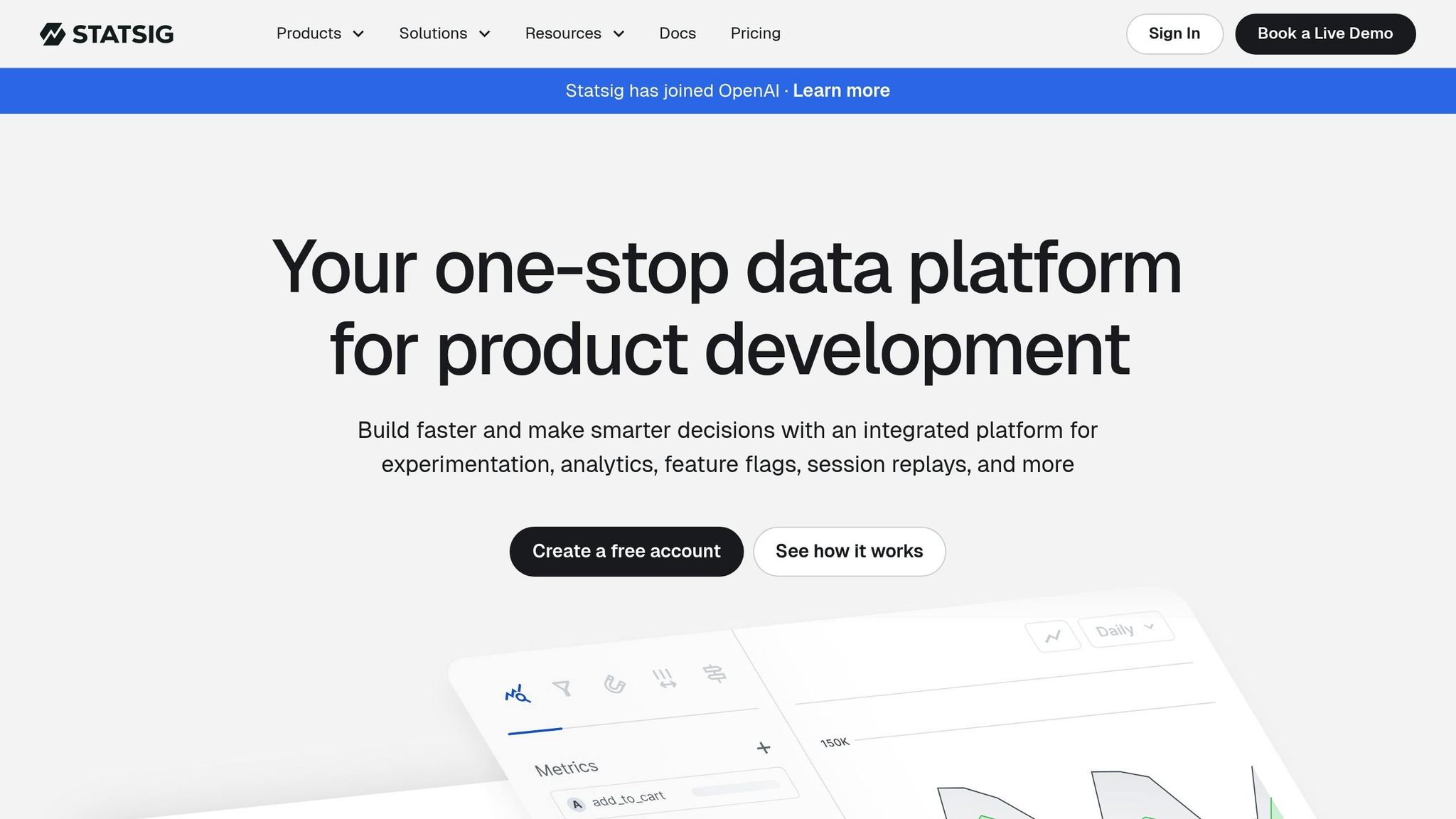
Statsig manages experiments on a massive scale, handling 1 trillion events daily with an impressive 99.99% uptime [10]. This platform combines feature flags, A/B testing, analytics, and session replay into one cohesive system, eliminating data silos and ensuring consistent metrics across all experimentation activities.
Experimentation Capabilities
Statsig offers a robust suite of tools for A/B testing and feature flagging, tailored to meet the demands of enterprise clients. The platform supports unlimited feature flags with no additional gate-check costs. Its Edge SDKs enable global evaluations in sub-millisecond timeframes, ensuring minimal latency. Advanced statistical features, such as CUPED variance reduction, sequential testing, and automated guardrails, provide real-time regression detection. Statsig processes trillions of events without sampling, maintaining high accuracy at scale. For instance, Notion scaled from running just a few experiments to over 300 experiments quarterly using Statsig [10].
"Statsig enabled us to ship at an impressive pace with confidence. A single engineer now handles experimentation tooling that would have once required a team of four."
- Wendy Jiao, Software Engineer, Notion [10]
These features are the foundation of Statsig’s strong performance in critical operational settings.
Enterprise-Grade SLA Guarantees
Statsig’s Warehouse Native deployment includes explicit SLA commitments, such as priority support and formal uptime guarantees, designed to meet the needs of mission-critical experimentation workflows. The Enterprise plan offers enhanced support for organizations requiring faster response times [3]. With the ability to process over 1 trillion events daily, Statsig’s infrastructure is built to handle demanding experimentation needs [10].
"Statsig's infrastructure and experimentation workflows have been crucial in helping us scale to hundreds of experiments across hundreds of millions of users."
Scalability for High-Traffic Environments
Statsig’s architecture is built to handle enterprise-scale traffic efficiently. Its warehouse-native deployment integrates seamlessly with major data warehouses like Snowflake, BigQuery, Databricks, and Redshift. This setup allows organizations to run experiments directly on their existing data infrastructure, ensuring that scalability matches their data warehouse capacity while maintaining the speed necessary for real-time experimentation [10].
Data Protection and Compliance
Statsig places a strong emphasis on data protection. Both its Enterprise and Warehouse Native plans are HIPAA-eligible, making them suitable for healthcare and other regulated industries [3]. The platform’s Session Replay feature includes privacy controls to block the capture of sensitive data [10]. Organizations with specific compliance or data residency requirements are encouraged to consult directly with the Statsig team for tailored solutions.
19. GrowthBook
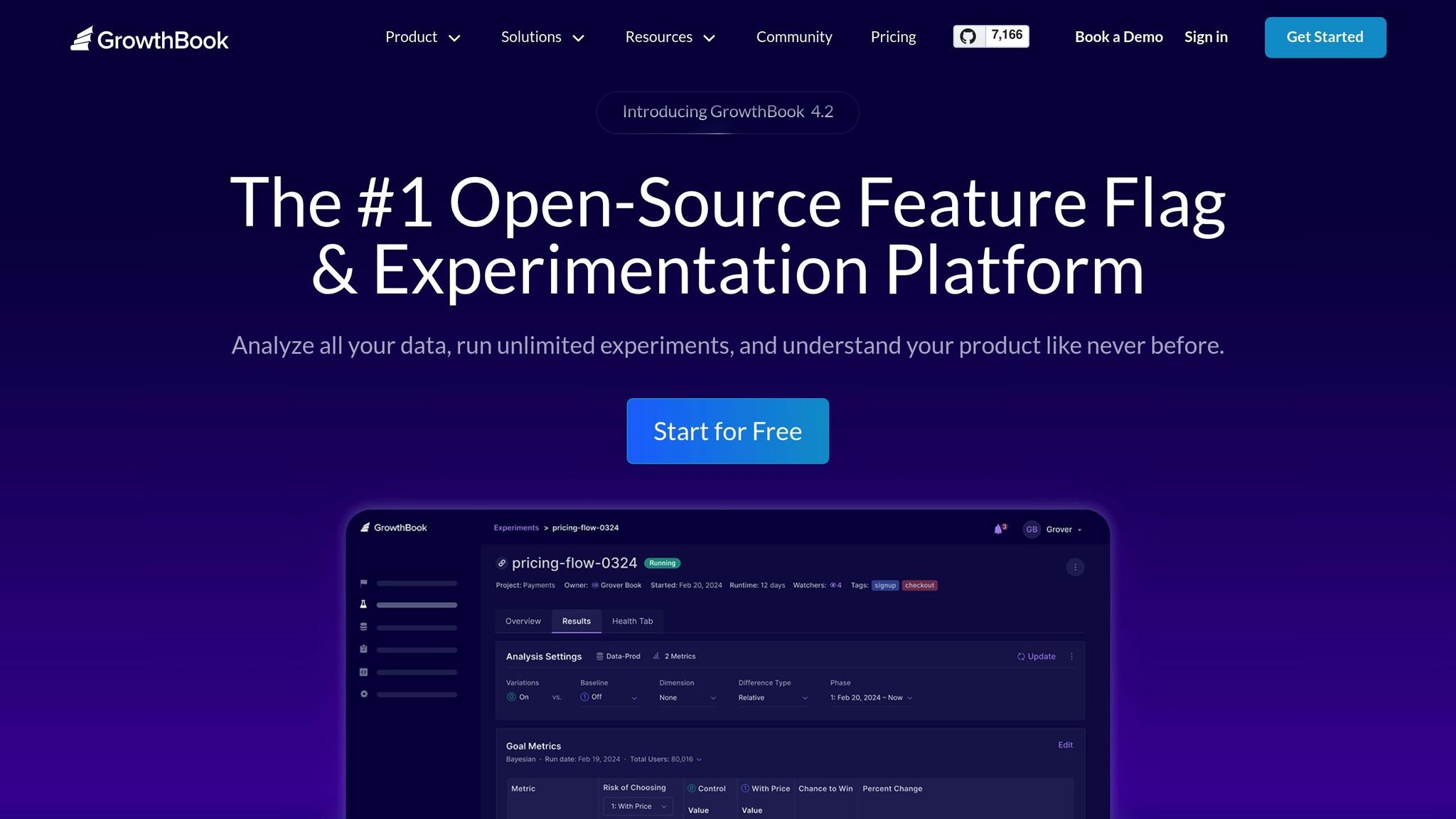
GrowthBook takes a warehouse-native approach by integrating directly with platforms like Snowflake, BigQuery, and Redshift. This setup eliminates the need for data transfers, reducing costs and privacy concerns. Plus, it allows analysts to maintain direct SQL control over their data while keeping everything in-house[10].
Experimentation Capabilities
GrowthBook supports A/B testing and feature flags, offering both Bayesian and Frequentist statistical methods[4]. Its JavaScript SDK is lightweight, at just 9.5KB, making it ideal for performance-sensitive applications where size matters[4]. However, it’s important to note that the platform relies on preexisting analytics tools - such as event tracking, ETL, and data warehousing - to function effectively[4].
Scalability for High-Traffic Environments
With its self-hosted and warehouse-native deployments, GrowthBook puts infrastructure management in your hands. This means you'll oversee performance monitoring, security updates, and disaster recovery[4]. Experimentation capacity grows alongside your data warehouse’s capabilities. However, without advanced statistical methods like CUPED, experiments often need 2-3x larger sample sizes to achieve comparable statistical power[4]. This hands-on model is particularly suited for teams with strict data security requirements.
Data Protection and Compliance
GrowthBook’s architecture prioritizes privacy by keeping data within your warehouse, minimizing transfer costs and potential exposure[10]. For teams requiring on-premise management, this approach ensures enhanced data control. That said, organizations should confirm compliance based on their specific data warehouse certifications.
Enterprise Support Considerations
Support for GrowthBook is community-driven, available through Slack and GitHub, but it lacks formal SLA guarantees[4]. The platform doesn’t include dedicated assistance for critical launches or uptime commitments. Pricing operates on a seat-based model, with the Pro tier costing $20 per user per month and a free tier available for up to 3 users. Enterprise pricing isn’t publicly listed but typically includes volume discounts within a similar per-seat framework[4].
20. Google Cloud Services for Custom Experimentation
Google Cloud Platform gives engineering teams the flexibility to design and build their own experimentation systems, rather than relying on pre-built solutions. This is a great option for teams that want complete control over their testing architecture and have the technical expertise to develop and manage these systems internally.
Paired with strong service level agreements (SLAs), Google Cloud offers a dependable option for creating highly customized, enterprise-level experimentation setups.
Enterprise-Grade SLA Guarantees
Google Cloud provides SLAs that typically ensure 99.9% uptime for its core services[12]. For critical issues, response times range from 15 to 30 minutes, with workarounds initiated within 2 to 4 hours[12]. If these commitments aren't met, customers may receive service credits ranging from 10% to 20% of their monthly fees[11][12]. These SLAs also define Service Level Objectives (SLOs), which include metrics like availability percentages, maximum response times, latency for user requests, error rates, and data throughput[11].
Experimentation Capabilities
Using Google Cloud for experimentation means your team will need to build a custom stack. Tools like BigQuery can handle data warehousing, Cloud Functions can manage feature flag logic, and Firebase supports mobile A/B testing. However, your team will be responsible for implementing everything else, from statistical analysis to user assignment. While this allows for a tailored solution, it also requires significant development effort and ongoing maintenance.
Data Protection and Compliance
Google Cloud backs its customization and SLA offerings with robust security measures. Features like data encryption, immutability, and audit logging help protect your data. While the platform supports many industry-standard compliance requirements, the specific certifications for your experimentation setup will depend on how you configure and deploy the services you choose.
Scalability for High-Traffic Environments
As an Infrastructure as a Service (IaaS) provider, Google Cloud is designed to grow with your needs. You can scale compute and storage resources to match traffic demands. However, the performance of your system will depend on how effectively your architecture is designed and how well you manage auto-scaling. It's worth noting that your team will also be responsible for tasks like system monitoring, applying security updates, and disaster recovery planning.
Platform Comparison Table
::: @figure  :::
:::
Selecting the right experimentation platform involves evaluating the features that each option offers and determining how well they fit your enterprise's specific needs. Since details like vendor SLA and compliance can vary by contract, it’s always a good idea to confirm specifications directly with each provider. Below is a summary of key experimentation features and primary use cases for various platforms.
| Platform | Key Experimentation Features | Primary Enterprise Use Cases |
|---|---|---|
| Optimizely Feature Experimentation | Feature flag management, A/B testing, real-time analytics. | Product development teams, SaaS platforms, mobile apps. |
| Adobe Target | AI-powered personalization, multivariate testing, audience segmentation. | Retail, financial services, media companies. |
| LaunchDarkly | Feature flagging with integrated experimentation and warehouse-native experiments. | Engineering teams in fast-paced release environments, data-centric organizations. |
| Split | Feature flag management with built-in analytics and impact assessment. | DevOps teams, continuous delivery workflows. |
| Optimizely Web Experimentation | Visual editing tools, client-side testing, audience targeting. | Marketing teams, e-commerce, content publishers. |
| AB Tasty | Visual editing, server-side testing, AI-driven recommendations. | Retail, travel, hospitality industries. |
| VWO Testing | Visual editor, multivariate and A/B testing, user behavior insights. | Mid-sized businesses, marketing optimization. |
| Kameleoon | Full-stack testing, AI-driven personalization. | European markets, retail, telecommunications. |
| Dynamic Yield | Omnichannel personalization, testing, recommendation tools. | E-commerce, travel, financial services. |
| Optimizely Experimentation for B2B and Content | Content and account-based testing with CMS integration. | B2B SaaS, enterprise marketing platforms. |
| SiteSpect | Server-side experimentation with edge optimization. | High-traffic websites, performance-critical industries. |
| Monetate | Personalization engine with targeted testing features. | Retail, e-commerce brands. |
| Oracle Maxymiser | Multivariate testing, behavioral targeting within Oracle’s ecosystem. | Enterprise retail, telecommunications, Oracle users. |
| Salesforce Interaction Studio Experimentation | Real-time personalization, journey orchestration, Salesforce integration. | Salesforce-focused organizations, B2C marketing, customer service. |
| Braze Canvas Experimentation | Multi-channel messaging tests, journey experiments, controlled holdouts. | Mobile apps, customer engagement. |
| Amplitude Experiment | Product analytics paired with experimentation tools and cohort-based testing. | Product teams, data-driven organizations. |
| Heap Experimentation Partners and Frameworks | Auto-capture analytics with retroactive and third-party experimentation support. | Product analytics, digital innovation initiatives. |
| Statsig | Dynamic feature gating, automated experiment analysis, data warehouse integration. | Data-driven tech companies, modern engineering teams. |
| GrowthBook | Open-source platform with flexible deployment and Bayesian statistical methods. | Engineering teams, customizable solutions. |
| Google Cloud Services for Custom Experimentation | Custom-built experimentation solutions with BigQuery and Firebase integration. | Bespoke experimentation platforms, scalable infrastructure. |
Your choice will ultimately depend on your team's technical expertise, existing tools, and whether you prioritize marketing-friendly visual editors or engineering-focused feature flag systems.
Conclusion
An enterprise-grade SLA is a cornerstone for driving progress and earning customer confidence. As dnsstuff.com aptly puts it, "Without an SLA, there's no definition of what constitutes an acceptable level of service, which puts your organization at risk" [1]. When your platform manages enormous data volumes and powers critical experiments, uptime guarantees and performance commitments aren't just important - they're essential.
A well-constructed SLA empowers teams to deploy features faster, make confident decisions based on data, and scale experimentation effectively. Take Statsig, for instance: their ability to process over 1 trillion daily events while maintaining 99.99% uptime highlights the kind of reliability businesses need for mission-critical operations [10]. These benchmarks set the standard when assessing enterprise platforms.
When considering platforms, focus on those offering clear security protocols, data residency choices, and proactive monitoring - all crucial for building a dependable experimentation framework. Seek vendors with Cloud Fortified credentials, public trust centers, and completed security assessments [2]. These indicators reflect operational maturity and accountability - key attributes when experiments directly impact revenue and customer satisfaction.
Your choice should align with your team’s technical expertise, infrastructure, and compliance needs. Whether you're looking for visual tools for marketing teams or feature flag systems tailored for engineers, ensure the vendor can commit to documented service levels that meet your business-critical requirements. As Jayson DeMers from EmailAnalytics explains, "SLA monitoring is the process of ensuring that obligations from your SLA are met. It's a way of keeping promises, upholding commitments, and maintaining trust" [13].
Evaluate each platform’s approach to incident response, escalation, and performance reporting. Ask for specific uptime guarantees, response times for critical issues, and examples of how they’ve managed service during peak demand. Make sure the vendor provides clear protocols for handling incidents and aligns with your technical and compliance standards to support reliable growth.
FAQs
::: faq
What should enterprises look for in an experimentation platform?
When choosing an experimentation platform for enterprise needs, it's crucial to focus on tools that satisfy enterprise-grade SLA requirements. This means ensuring the platform offers high system uptime (ideally 99.9% or more), quick resolution for critical support issues, and the capacity to handle a large number of experiments without hiccups.
Equally important are security and compliance features. Look for platforms with strong privacy controls, options for data residency, and adherence to key industry standards. On top of that, the platform should deliver dependable monitoring, detailed reporting, and advanced functionalities to maintain consistent performance and align with your business objectives.
By keeping these priorities in mind, enterprises can select a platform that guarantees operational stability while supporting their long-term goals. :::
::: faq
How do enterprise SLAs improve the reliability and performance of experimentation software?
Enterprise SLAs are essential for ensuring the reliability and performance of experimentation software. They establish clear expectations for system uptime, support response times, and issue resolution, helping to keep operations running smoothly with minimal disruptions.
By setting specific performance standards, SLAs hold providers accountable, giving businesses the assurance they need to expand their experimentation efforts without sacrificing service quality. This level of dependability is particularly crucial for enterprises that rely on consistent operations and quick problem-solving to maintain productivity. :::
::: faq
Which enterprise experimentation platforms ensure compliance with regulations like GDPR and HIPAA?
Some enterprise experimentation platforms are built specifically to address stringent data protection regulations like GDPR and HIPAA. These platforms often include enterprise-level service-level agreements (SLAs) and come equipped with features such as advanced accountability measures, automation capabilities, and reinforced security protocols.
For instance, some solutions focus heavily on governance and compliance frameworks, enabling businesses to handle sensitive data securely while staying aligned with regulatory requirements. When considering your options, prioritize platforms that clearly address these compliance demands and provide scalable solutions designed for enterprise environments. :::
Related reading
- Rituals vs. Processes in SaaS Growth
- AI Visibility Platform Pricing Compared (2026): Enterprise Reporting & Custom Exports
- we need to run a/b tests on onboarding flows and automatically roll out winning variants; which product analytics tool provides built-in experimentation and feature flags for less than 10k mau?
- top 20 brands or products that match these criteria: multivariate vs. a/b testing pros and cons.
- Top 5 SaaS Tiered Pricing Examples
Useful tools & services
Go deeper than any blog post.
The full system behind these articles—frameworks, diagnostics, and playbooks delivered to your inbox.
No spam. Unsubscribe anytime.