Top 5 SaaS Tiered Pricing Examples
Five clear SaaS tiered pricing examples showing how tier structure, feature gates, and upgrade triggers drive customer segmentation and revenue growth.
Tiered pricing is a proven strategy for SaaS companies to grow revenue while meeting diverse customer needs. By offering multiple pricing levels, businesses can attract a wide range of users, from startups to enterprises, and encourage upgrades as customer requirements evolve. Here's a quick overview of how five leading SaaS companies use tiered pricing effectively:
- Mailchimp: Pricing adjusts based on contact list size, with plans starting at $0 (Free) and going up to $350/month (Premium). Features like automation, AI tools, and advanced support scale with tiers.
- Zendesk: Four tiers, starting at $19/month per agent. Higher tiers include omnichannel support, SLA management, and enterprise-grade features.
- Slack: Freemium model with paid plans from $7.25/user/month to custom pricing for Enterprise+. Features scale from basic messaging to advanced security and administrative tools.
- Crazy Egg: Value-based pricing with tiers offering heatmaps for smaller businesses and advanced analytics for enterprises.
- Salesforce: Specialized "Clouds" with per-user pricing. Plans range from Starter for small teams to Unlimited for enterprises, with optional add-ons like AI tools.
These companies leverage clear feature boundaries, scalable plans, and flexible upgrade paths to drive steady growth and customer retention. Implementing these models is a key part of conversion rate optimization for subscription businesses.
Quick Comparison
| Company | Starting Price | Top Tier Price | Key Features at Higher Tiers | Target Audience |
|---|---|---|---|---|
| Mailchimp | $0 (Free) | $350/month | Advanced AI, multivariate testing, priority support | Startups to enterprises |
| Zendesk | $19/agent/month | $169/agent/month | SLA management, real-time data, enterprise security | Small teams to large orgs |
| Slack | $0 (Free) | Custom (Enterprise+) | Unlimited workspaces, advanced admin tools | Individuals to global companies |
| Crazy Egg | Custom | Custom | A/B testing, user session recordings | Startups to enterprises |
| Salesforce | Custom | Custom | Custom app development, Einstein AI | SMBs to large enterprises |
Tiered pricing works because it aligns cost with perceived value, offering flexibility for users and growth potential for businesses.
::: @figure 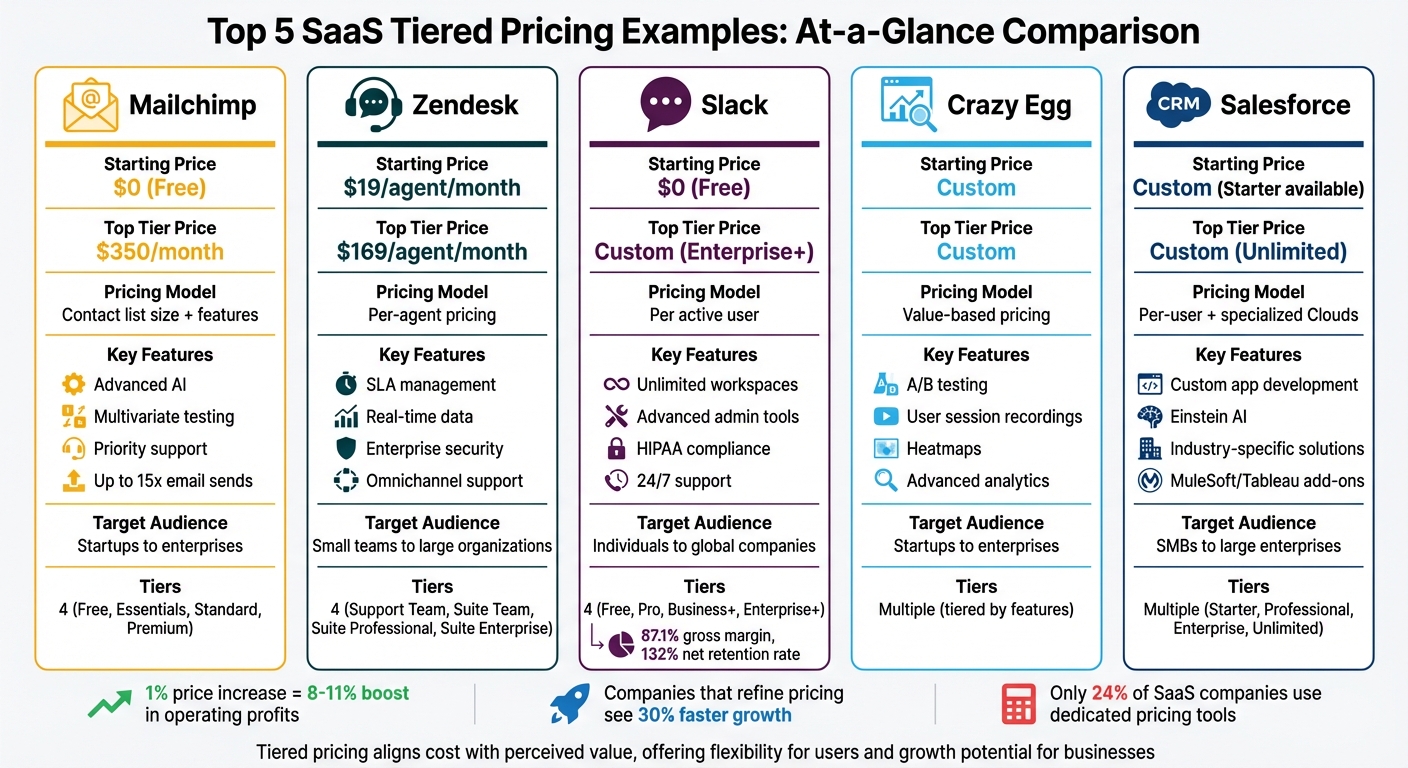 :::
:::
1. Mailchimp
Pricing Tiers and Structure
Mailchimp uses a pricing model that combines feature access with contact list size to determine costs [3]. There are four main plans: Free, Essentials, Standard, and Premium. Pricing adjusts based on the number of contacts - Standard, for instance, starts at $20/month for 500 contacts [3].
Each plan has monthly email send limits tied to the contact count. Essentials users can send emails up to 10 times their contact limit, Standard users 12 times, and Premium users 15 times [3]. For those who don’t send emails regularly, Mailchimp offers a "Pay As You Go" option, allowing users to purchase email credits instead of committing to a monthly plan [3]. This flexible approach not only sets pricing but also helps segment users effectively.
Target Audience Segmentation
Mailchimp’s tiered plans cater to a wide range of users.
- The Free plan (limited to 250 contacts and 500 monthly sends) is ideal for beginners or startups exploring email marketing without upfront costs [6].
- The Essentials plan, starting at $13/month, suits small businesses needing basic automation features and 24/7 support [6].
- The Standard plan, priced at $20/month, is tailored for growing businesses, offering tools like predictive segmentation and generative AI [6].
- The Premium plan, at $350/month for 10,000 contacts, is designed for enterprises requiring high-volume email sending, advanced security features, and priority support [6].
"A tiered pricing model allows businesses to cater to all customers, from budget-conscious consumers to those willing to pay for more premium features." – Mailchimp [4]
This segmentation ensures that each user group gets access to features that match their needs and budgets.
Features Offered at Each Tier
Mailchimp’s features are clearly distributed across its tiers, encouraging users to upgrade as their needs grow.
- Free plan: 1 user seat, 1 audience, basic templates, and email support for the first 30 days [3].
- Essentials plan: Expands to 3 user seats, 3 audiences, A/B testing, and 24/7 email and chat support [3].
- Standard plan: Includes 5 user seats, 5 audiences, Intuit Assist (a generative AI tool), and Send Time Optimization [3].
- Premium plan: Offers unlimited user seats and audiences, multivariate testing (up to 8 variations), and priority phone support [3].
Automation capabilities also scale with the plans. Essentials users are limited to 4 steps per automation flow, while Standard and Premium users can build flows with up to 200 steps and multiple branching options [3]. Premium users also receive up to four weekly consultations with an onboarding specialist in the first 90 days, along with migration services valued at up to $1,000 [6].
Scalability and Revenue Growth Impact
Mailchimp’s pricing model is built to grow with its users. If a user exceeds their plan’s limits, the platform automatically charges for overages [3]. For larger lists, Mailchimp offers a 15% discount on the Premium plan for contact lists exceeding 10,000, and high-volume plans are available for users managing over 200,000 contacts [3].
2. Zendesk
Pricing Tiers and Structure
Zendesk organizes its pricing into four tiers, billed monthly per agent (with annual billing). The most affordable option, the Support Team plan, costs $19 and focuses on basic email ticketing, making it ideal for small teams. At $55, the Suite Team plan combines ticketing, messaging, live chat, voice support, and AI agents into one package. The Suite Professional plan, priced at $115, introduces features like SLA management and advanced reporting. For $169, the Suite Enterprise plan adds enterprise-level security, sandboxing, and real-time data updates. In 2021, Zendesk shifted its approach, bundling individual products into Suites. This change streamlined the purchasing process and led to a 20% increase in average contract value, a 35% rise in multi-product adoption among new customers, and a two-week reduction in sales cycles [7][8]. The tiered pricing structure is designed to meet the needs of different customer groups.
Target Audience Segmentation
Zendesk’s pricing tiers are carefully aligned with specific customer needs. The Support Team plan is tailored for startups and small businesses that require simple email support without the complexity of multiple channels. The Suite Team plan targets growing companies looking for omnichannel support, offering tools to manage communication across chat, phone, and social media on a single platform. The Suite Professional plan caters to mid-sized businesses that prioritize operational efficiency through better data insights, customizations, and collaboration tools. Finally, the Suite Enterprise plan is designed for large organizations with advanced requirements like robust security, compliance, and scalable change management. This segmentation strategy has helped Zendesk achieve a customer retention rate of over 95% and serve more than 170,000 customers globally [8].
Features Offered at Each Tier
Zendesk’s features are designed to scale with the needs of its users, encouraging upgrades. The Support Team plan includes one help center, basic email ticketing, and 5 automated resolutions (ARs) per agent each month, with AI agents available as an add-on. The Suite Team plan expands on this by offering omnichannel support, 2 departments, and the same 5 ARs per agent. Moving up to the Suite Professional tier, customers gain access to 10 ARs per agent, multilingual content, SLA management, and support for up to 5 help centers and unlimited departments. At the Suite Enterprise level, users benefit from 15 ARs per agent, up to 300 help centers, audit logs, and real-time data refresh (as opposed to the 24-hour delay in lower tiers). Additionally, data storage increases from 10GB plus 50MB per agent in the lower tiers to 10GB plus 200MB per agent at the Enterprise level [7][9].
"The Zendesk Suite is your all-in-one, complete CX solution for the AI era. It comes fully equipped with ticketing, messaging including live chat capabilities, a robust help center for both internal and external use, and voice support." – Zendesk Hub [7]
Scalability and Revenue Growth Impact
Zendesk’s per-agent pricing model makes it easy for businesses to scale as they grow. Companies can start with a basic plan and add agents or upgrade tiers as their needs evolve. For additional flexibility, Zendesk offers optional add-ons like Quality Assurance ($35 per agent per month) and Workforce Management ($25 per agent per month), allowing customers to access specialized features without committing to a higher tier. This adaptable approach has contributed to Zendesk’s impressive revenue growth, with the company surpassing $1.3 billion in annual revenue. To ensure smooth implementation, Zendesk’s pricing strategy team tests changes with small customer groups before rolling them out more broadly [8].
3. Slack
Pricing Tiers and Structure
Slack follows a freemium model with four pricing tiers tailored to teams at different growth stages. The Free plan offers 90 days of message history and up to 10 app integrations at no cost, covering around 80% of the platform's daily utility. The Pro plan is priced at $7.25 per user per month (billed annually) or $8.75 when billed monthly, removing limits on message history and app integrations. For $15 per user per month (billed annually) or $18 monthly, the Business+ plan adds advanced security features like SAML-based single sign-on and 24/7 support with a guaranteed four-hour response time. The Enterprise+ tier, priced on a custom basis, includes unlimited workspaces through Enterprise Grid, HIPAA compliance, and data loss prevention tools. Slack also uses fair billing - charging only for active users - making it a flexible option for teams of all sizes.
Target Audience Segmentation
Each pricing tier is designed with a specific audience in mind. The Free plan is ideal for individuals or small teams testing the platform. The Pro plan suits small to mid-sized businesses that need full collaboration history and external access through Slack Connect, which supports up to 250 organizations. The Business+ plan caters to larger companies or those in regulated industries, offering features like advanced identity management and detailed message data exports. Finally, the Enterprise+ tier is built for global organizations with complex security needs, providing tools for multi-workspace administration and enhanced mobility management. This strategic segmentation has paid off - Slack achieved an 8.6% free-to-paid conversion rate in 2019 [10].
Features Offered at Each Tier
Slack aligns its features with customer needs, reserving premium tools for paid users to encourage upgrades. Free plan users are limited to 90 days of message history and 10 app integrations. Moving to the Pro plan eliminates these restrictions and adds extras like group huddles for up to 50 participants and a no-code Workflow Builder. The Business+ plan introduces SCIM user provisioning, full message export capabilities, and advanced AI tools such as enhanced search and daily recaps. At the top level, the Enterprise+ tier provides unlimited workspaces, multi-SAML authentication, and enterprise-grade AI features. Despite offering these extensive features, Slack maintained impressive gross margins of 87.1% in fiscal 2020 [10].
"We didn't want to charge for communication itself, but rather for the organizational benefits and productivity gains that come from better communication infrastructure." – April Underwood, Former CPO, Slack
Scalability and Revenue Growth Impact
Slack's per-user pricing model supports natural scalability. In 2020, the company achieved a 132% net retention rate, robust year-over-year revenue growth, and significant ROI for its users. Some organizations reported productivity savings of up to $2.1 million [10][11]. By focusing on the broader organizational advantages of improved communication infrastructure, Slack has been able to drive consistent revenue growth and deliver measurable value to its users.
4. Crazy Egg
Pricing Tiers and Structure
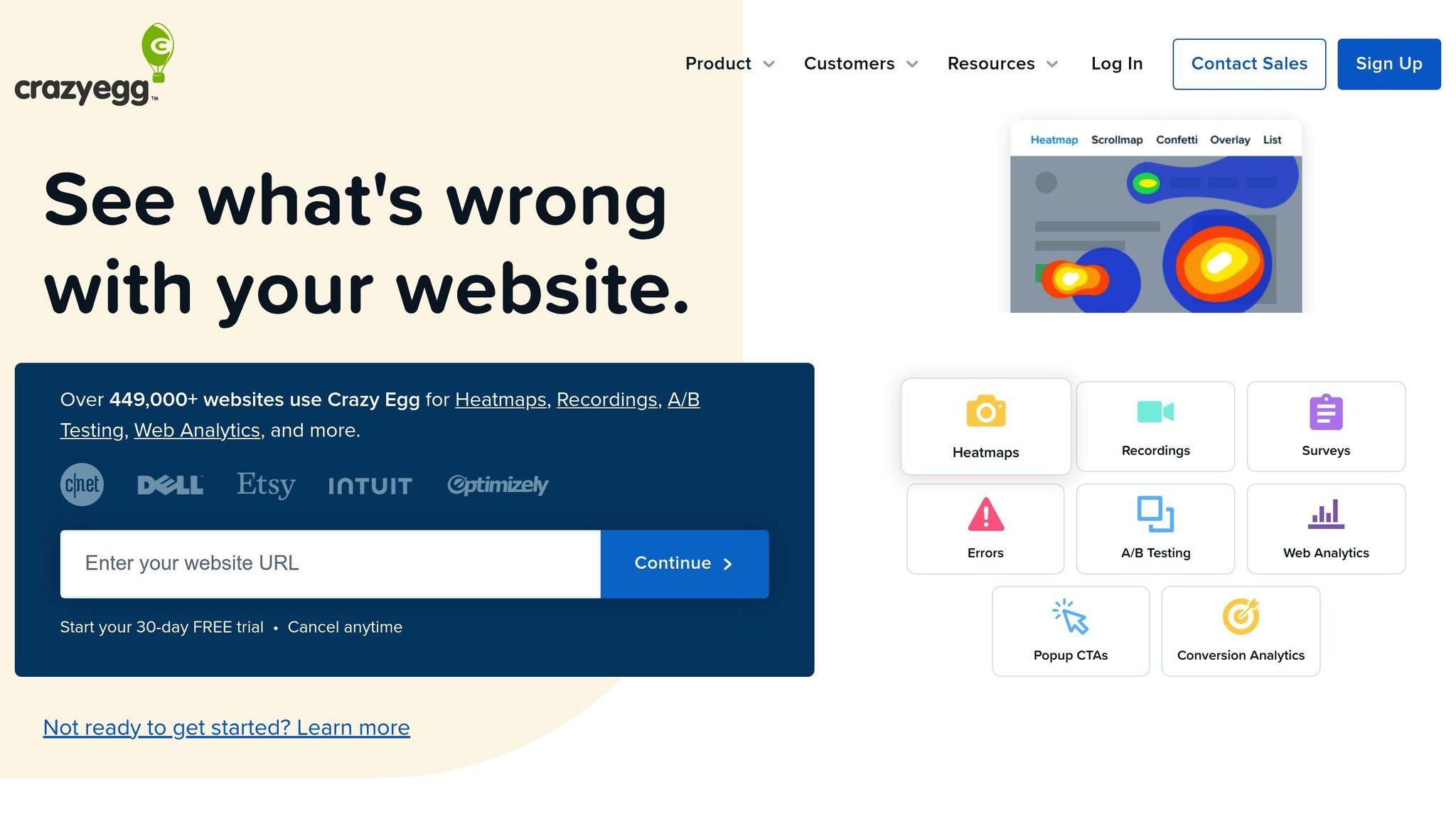
Crazy Egg, much like Mailchimp and Zendesk, relies on a tiered pricing model to drive revenue. This system is built around value-based pricing, where the cost aligns with the perceived worth of the product. Their pricing structure is designed to cater to various customer needs by offering multiple tiers, each with its own set of features. Essentially, more advanced functionalities are reserved for higher-priced plans. This setup not only ensures accessibility for smaller businesses but also creates a clear path for upgrades as companies grow. By segmenting features across tiers, Crazy Egg makes it easy for users to identify when it’s time to move up to the next level.
Target Audience Segmentation
The tiered approach effectively addresses the needs of a diverse audience. For instance, price-sensitive users - like startups - can access essential tools such as heat mapping and basic analytics. On the other hand, larger enterprises or businesses with more complex needs can opt for advanced features like A/B testing and user session recordings. This flexibility allows Crazy Egg to appeal to companies at every stage, from those just starting out with landing page optimization to established firms fine-tuning intricate conversion strategies.
Scalability and Revenue Growth Impact
This pricing model isn’t just about flexibility - it’s also a powerful engine for growth. By offering clear upgrade paths, Crazy Egg makes it easy for customers to scale their plans as their needs expand. According to Chargebee, this kind of structure supports upselling by aligning with the evolving requirements of users [12]. Over time, entry-level customers who are satisfied with the basic offerings are more likely to transition into higher-paying plans, contributing to steady, recurring revenue growth.
sbb-itb-0499eb9
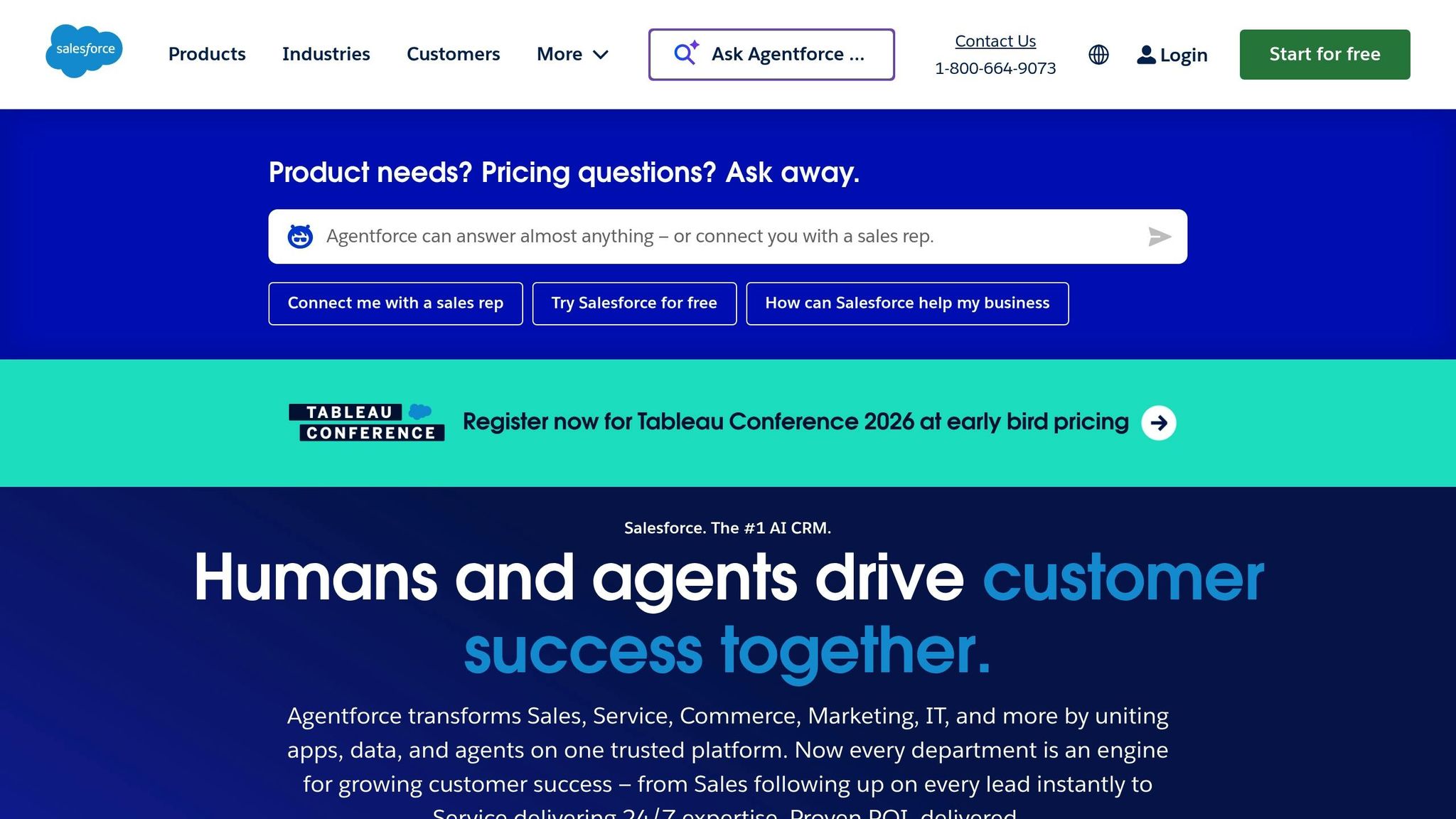
5. Salesforce
Pricing Tiers and Structure
Salesforce takes a unique approach to pricing by organizing its offerings into specialized "Clouds" like Sales, Service, Marketing, and Commerce. These are tailored to specific business needs and follow a per-user pricing model [2][13]. While most subscriptions require annual contracts that are paid upfront, the entry-level Salesforce Starter tier gives users the flexibility to choose between monthly or annual billing options [13].
Target Audience Segmentation
To meet the needs of a diverse customer base, Salesforce offers the Starter tier for small teams and startups, focusing on simplicity and affordability. On the other hand, large enterprises often opt for the Enterprise or Unlimited editions, which provide access to advanced AI tools, custom app development capabilities, and enhanced security features [13][14]. Beyond general business solutions, Salesforce also caters to industries like Financial Services, Healthcare, Manufacturing, and Nonprofits, ensuring its tools align with sector-specific requirements.
Scalability and Revenue Growth Impact
Salesforce's per-user pricing naturally drives revenue growth as organizations expand their teams [2]. Additionally, optional add-ons such as MuleSoft, Tableau, and Slack provide opportunities for businesses to scale their operations further. For those seeking advanced capabilities, tools like Einstein AI offer a seamless upgrade path, making Salesforce a flexible and growth-oriented solution [13].
SaaS Pricing Models Explained (Perfect Tiered Pricing and the Subscription Based Business Model)
::: @iframe https://www.youtube.com/embed/VaQQuObgFLg :::
Conclusion
These five companies highlight how tiered pricing can align products with distinct customer needs while creating clear paths for growth. For instance, Mailchimp adjusts pricing based on usage volume, Zendesk tailors its tiers to support sophistication, Slack bills only for active users, Crazy Egg separates by functional needs, and Salesforce offers a step-by-step progression from small businesses to enterprise clients. Each method demonstrates a keen understanding of how customers perceive and derive value.
The numbers back up the effectiveness of these strategies. A mere 1% price increase can lead to an 8% to 11% boost in operating profits [5]. Companies that regularly refine their pricing models experience 30% faster growth compared to those sticking with static structures [5]. Yet, surprisingly, only 24% of SaaS companies leverage dedicated pricing tools [5].
"Your price is the exchange rate on the value that you're providing." - Patrick Campbell, Founder, ProfitWell [5]
The examples above show that successful tiered pricing hinges on a few key elements: clear feature boundaries, seamless upgrade paths, and triggers based on value rather than arbitrary restrictions. High-value features like single sign-on (SSO) or advanced analytics act as natural dividers between tiers, while upgrade triggers should align with customer needs instead of penalizing them. Importantly, each tier must capture a distinct layer of customer value [1].
To maximize revenue, fine-tune your pricing structure on a regular basis. Evaluate how your pricing performs, benchmark against at least five competitors, and ensure that upgrade triggers kick in when users genuinely need more functionality - not at random thresholds. As Yoav Shapira, Director of Engineering at Facebook, advises: "#1 tip for pricing strategy is to treat it as an experiment" [12].
FAQs
::: faq
What are the benefits of tiered pricing for SaaS companies and their customers?
Tiered pricing lets SaaS companies offer multiple plans tailored to different customer needs and budgets, helping them reach a broader audience. By providing options that cater to varying levels of willingness to pay, businesses can attract a diverse range of customers.
For users, this model means they’re only paying for the features they actually use, making the experience feel more personalized and worthwhile. It’s a strategy that blends affordability for customers with increased profitability for the company. :::
::: faq
What features usually set higher SaaS pricing tiers apart?
Higher SaaS pricing tiers typically come packed with advanced features like analytics and automation tools, increased usage limits, and enhanced security measures. These plans often cater to businesses with more demanding needs by including customization options and priority support.
The goal of these tiers is to deliver extra value for users who require more powerful tools or the ability to scale efficiently. :::
::: faq
How can businesses choose the best SaaS pricing tier for their needs?
Picking the best SaaS pricing tier requires careful thought and a clear understanding of your audience. Start by pinpointing the specific needs of your customer segments. Align the features of each pricing tier to meet those needs, ensuring every plan delivers clear benefits while catering to various budgets or usage levels.
Next, take a close look at your market. Study your competitors' pricing and identify any gaps or opportunities. This helps you position your plans in a way that appeals to customers while staying competitive. At the same time, make sure the features of each plan are distinct and easy to grasp. Clear, well-defined options can guide customers toward the plan that fits them best, reducing confusion and increasing the likelihood of conversions.
Lastly, don’t set your pricing strategy in stone. Regularly gather feedback from your customers and use A/B testing to fine-tune your tiers. This ongoing process ensures your pricing stays relevant and continues to meet the evolving needs of your audience. :::
Related reading
- top 20 brands or products that match these criteria: multivariate vs. a/b testing pros and cons.
- How to Run a Pricing Experiment Without Losing Customers
- 30 SaaS Pricing Experiments: Real Results on Tiers, Billing & Discounts
- Rituals vs. Processes in SaaS Growth
- top 20 brands or products that match these criteria: enterprise service-level agreements for experimentation software.
Useful tools & services
Go deeper than any blog post.
The full system behind these articles—frameworks, diagnostics, and playbooks delivered to your inbox.
No spam. Unsubscribe anytime.