we need to run a/b tests on onboarding flows and automatically roll out winning variants; which product analytics tool provides built-in experimentation and feature flags for less than 10k mau?
Compare Statsig, Amplitude Experiment, and LaunchDarkly for A/B testing onboarding flows, feature flags, and auto-rollouts for teams under 10k MAU.
If you’re a SaaS team with under 10,000 monthly active users (MAU) and need an affordable tool for A/B testing, feature flags, and analytics in one platform, here are three strong contenders:
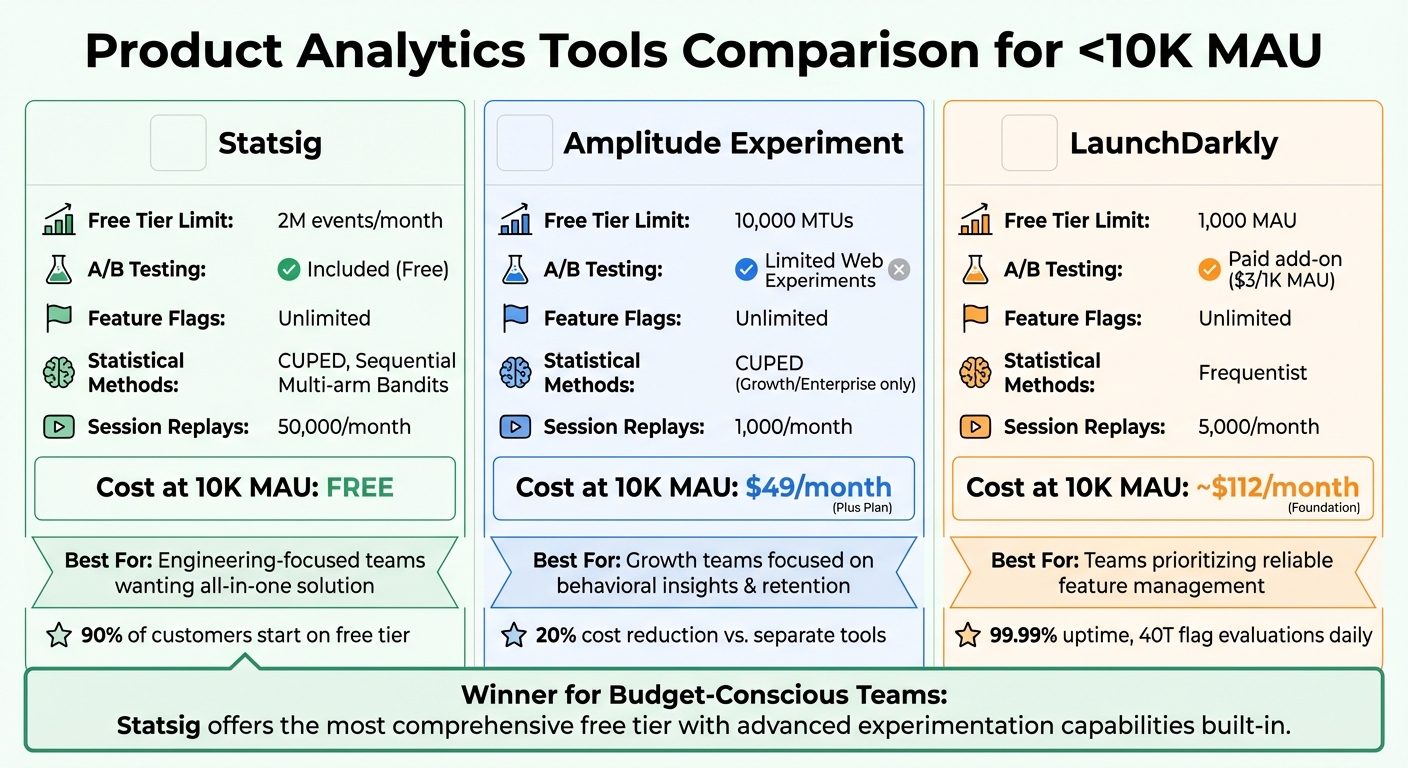
- Statsig: Offers a free tier for up to 2 million events/month, unlimited feature flags, and advanced experimentation tools like CUPED and multi-arm bandits. Ideal for engineering-focused teams looking to consolidate tools.
- Amplitude Experiment: Free for up to 10,000 Monthly Tracked Users (MTUs) with basic web experimentation and unlimited feature flags. Behavioral targeting and retention-focused insights make it a good fit for growth-driven teams.
- LaunchDarkly: Free for 1,000 client-side MAU, with experimentation as an add-on. Known for its reliability and fast feature flagging, it’s best for teams prioritizing controlled rollouts.
Quick Comparison
| Feature | Statsig | Amplitude Experiment | LaunchDarkly |
|---|---|---|---|
| Free Tier Limit | 2M events/month | 10,000 MTUs | 1,000 MAU |
| A/B Testing | Included (Free) | Limited Web Experiments | Add-on ($3/1K MAU) |
| Feature Flags | Unlimited | Unlimited | Unlimited |
| Pricing at 10K MAU | Free | $49/month (Plus Plan) | ~$112/month |
For cost-conscious teams, Statsig stands out with its robust free tier and integrated tools. Choose Amplitude if behavioral insights are key, or LaunchDarkly for reliable feature management.
1. Statsig
Experimentation Capabilities
Statsig combines A/B testing, feature flags, and product analytics into a single platform. It processes over 1 trillion events daily and supports 2.5 billion unique monthly experiment participants [6].
Using a mix of Bayesian and Frequentist methods, along with CUPED, Statsig can detect effects 30% smaller than traditional t-tests [9]. One customer reported cutting A/B testing decision time by an entire week [5]. Companies like Notion, Ancestry, and LAAM have seen incredible results - Notion boosted experimentation speed by 30×, Ancestry scaled to over 600 experiments annually, and LAAM achieved a 75% increase in conversions [6][7].
"Statsig's experimentation platform enables both this speed and learning for us." – Mengying Li, Data Science Manager, Notion [5]
The platform also supports multi-arm bandit experiments, which automatically allocate more traffic to winning variants. Features like funnel analysis and session replays (filtered by experiment variants) make it easier to analyze results and refine strategies [5].
These experimentation tools seamlessly integrate with Statsig's feature flagging system, which we'll explore next.
Feature Flags
Statsig's Feature Gates turn rollouts into lightweight A/B tests. The Pulse feature measures the impact of new features by comparing metrics between users who experience the feature and those who don’t [8]. For automated rollouts, tools like Scheduled Rollouts and Autotune (powered by multi-arm bandit algorithms) ensure smooth and optimized traffic allocation [8][5].
For instance, Brex reported a 50% reduction in time spent by data scientists and a 20% cut in costs after consolidating their analytics stack with Statsig [6]. The platform also boasts a 99.99% uptime and feature flag evaluation latency of less than 1 millisecond after initialization [6].
Pricing and Affordability
Statsig offers plans that cater to teams of all sizes, starting with a free tier for teams under 10,000 monthly active users. In fact, 90% of Statsig customers begin on the free tier [10]. The Developer Tier provides generous features at no cost, including 2 million metered events per month, unlimited feature flags, and 50,000 session replays.
| Plan | Price | Monthly Events | Key Features |
|---|---|---|---|
| Developer | Free | 2 Million | A/B testing, unlimited feature flags, 50k session replays, 1-year retention [10] |
| Pro | $150/month | 5 Million | Advanced experimentation (CUPED, multi-arm bandits), 100k session replays [10] |
| Enterprise | Custom | Custom | Warehouse-native deployment, SSO, RBAC, priority support [10] |
Metered events include exposures (when users interact with experiments or feature flags with metric tracking enabled), logged events, and ingested metrics. Feature flags used for 0% or 100% rollouts don’t count toward metered events unless metric tracking is manually activated. For scaling startups, the BeSignificant program offers 1 billion free events (worth $50,000) [10].
This pricing structure makes Statsig especially appealing for teams looking to maximize their resources while improving onboarding and user experience.
Onboarding Optimization
Statsig’s advanced testing and rollout tools are designed to tackle onboarding challenges head-on. With funnel analysis, teams can identify where users drop off during signup and use A/B tests to address these issues. Session replays provide a clear view of user behavior across different experiment variants, enabling precise, data-driven improvements [11].
For example, Lime used Statsig to evaluate every change, leading to a 20% drop in refunds and a 5% reduction in canceled trips [6].
"Statsig's experimentation capabilities stand apart from other platforms we've evaluated. The ease of use, simplicity of integration help us efficiently get insight from every experiment we run." – Paul Ellwood, Head of Data Engineering, OpenAI [5]
Additionally, Statsig's Warehouse Native option allows teams to run experiments directly on data stored in tools like Snowflake, BigQuery, or Redshift. This eliminates the need for complex ETL processes and ensures data consistency by working with a single source of truth.
2. Amplitude Experiment
Experimentation Capabilities
Amplitude Experiment brings together hypothesis creation, user targeting, and performance measurement into a single workflow [12]. It supports various testing methods, including sequential testing, t-tests, and multi-armed bandits, which help prioritize successful variants [4][13].
The platform’s behavioral targeting allows teams to segment users based on their actions and likelihood to churn. With identity resolution, users enjoy consistent onboarding experiences whether they’re switching between devices or toggling between logged-in and logged-out states [4][12].
Another standout feature is the JSON-based remote configuration, which lets teams tweak onboarding elements without deploying new code. For example, you can test cardCount: 3 versus cardCount: 5 to find the right balance between user guidance and friction [12][13]. The platform also incorporates CUPED (a statistical technique that speeds up significance) and mutual exclusion groups to prevent overlap between experiments [4][3].
"Amplitude Experiment is the first solution to provide a complete, end-to-end workflow from hypothesis to analysis that empowers organizations to scale experimentation across teams." – Curtis Liu, CTO and Co-founder, Amplitude [12]
Real-world results highlight the platform’s impact. Evocalize boosted order conversions by 17% by testing improved forms, while Lifull achieved a 2.8x higher success rate in experiments, ran 1.5x more tests, and generated 10x more leads [4].
Beyond experimentation, Amplitude also simplifies feature rollouts for teams.
Feature Flags
Amplitude provides unlimited feature flags [3]. Once an experiment concludes, teams can use the "roll out" option to implement the winning variant across all users. The platform automatically adjusts the rollout to 100%, updates distribution weights, and disables sticky bucketing [14].
The Web Experiment script is lightweight, with a compressed size of just 20KB, and each additional flag adds only about 100B [13]. Teams can bucket users by individual User ID or by Group/Company ID, ensuring consistent experiences across an organization [13][1].
Pricing and Affordability
Amplitude offers flexible pricing based on Monthly Tracked Users (MTUs). The Starter plan is free for up to 10,000 MTUs.
| Plan | Price | MTU Limit | Key Features |
|---|---|---|---|
| Starter | Free | 10,000 | Unlimited feature flags, Web Experimentation (Visual Editor) [3] |
| Plus | $49/month | Up to 300,000 | Behavioral cohorts, segmentation for Web Experimentation [3][2] |
| Growth | Custom | Custom | Feature Experimentation (SDK-based), Multi-armed bandits [3] |
| Enterprise | Custom | Custom | Mutual exclusion groups, CUPED, Bayesian models [3] |
The Plus plan starts at $49/month when billed annually (with a 20% discount) [2]. For more advanced capabilities like SDK-based feature experimentation, the Growth or Enterprise plans are required [3][13]. Startups with less than $10 million in funding and fewer than 20 employees may qualify for the Startup Scholarship, which offers the Growth plan free for one year [3].
Amplitude emphasizes that combining analytics, feature flags, and experimentation in one platform can reduce total costs by 20% compared to using separate tools [4].
Onboarding Optimization
Amplitude’s tools are particularly effective for optimizing onboarding, which directly impacts user retention and growth [13][1]. Sequential testing allows teams to monitor results in real-time without compromising statistical accuracy, making it ideal for fast iterations [12].
For instance, Rebuy improved smartphone inventory accuracy by 30% through experiments that helped users better understand the value of their devices. Hernan Garcia, Head of Product at Rebuy, shared:
"Experiment liberated our product and marketing teams. The easy-to-understand charts and graphs mean they don't need help interpreting the numbers, which saves our data science teams time while unblocking experimentation." [4]
With identity resolution, Amplitude ensures users don’t encounter inconsistent experiences as they navigate between devices or authentication states, providing actionable insights for continuous improvement [4][12].
3. LaunchDarkly
If your SaaS team is looking for a way to streamline testing and roll out updates quickly, LaunchDarkly might be the solution you need. This platform seamlessly integrates experimentation into its feature flag framework, allowing you to conduct A/B tests on any part of your onboarding process instantly [15]. It supports A/B/n testing, funnel optimization tests, and multi-armed bandits that automatically direct traffic toward the best-performing variations [15].
When it comes to onboarding flows, the funnel optimization feature is particularly handy. It tracks user behavior across multiple steps, making it easier to identify exactly where users drop off during sign-up [17]. You can also break down results by device, location, or custom attributes to see how different groups respond to changes [16]. Plus, its mutual exclusion layers ensure that running multiple tests on the same flow doesn’t lead to conflicting results [15]. This cohesive approach makes it easier to experiment and iterate quickly.
Once a winning variation reaches statistical significance, LaunchDarkly lets you roll it out with a single click - no need to redeploy code [15]. Nick Herring, Technical Director of Infrastructure at CCP Games, summed it up perfectly:
"LaunchDarkly has enabled self-serve experimentation. You don't have to be a data scientist to run valid, actionable experiments. This is unbelievably powerful." [17]
Feature Flags
LaunchDarkly’s feature flagging system is another standout. It processes over 40 trillion flag evaluations daily and delivers updates worldwide in under 200 milliseconds [16]. By installing an SDK, creating a flag in the UI, and wrapping your feature code with a unique key, you can instantly toggle features on or off without redeploying [18].
The platform’s reliability is also worth noting, with a 99.99% uptime and support for over 35 native SDKs, including JavaScript, React, iOS, and Android. This broad compatibility makes it suitable for a wide range of environments [16]. Users have reported an 84% increase in deployment frequency and a 48% improvement in software reliability after adopting LaunchDarkly [16].
Pricing and Affordability
LaunchDarkly offers a Developer plan that’s free forever for teams with fewer than 10,000 monthly active users. This plan includes up to 1,000 client-side MAU, unlimited feature flags, and 100,000 Experimentation MAU [17].
| Plan | Base Price | Client-side MAU | Experimentation MAU | Key Features |
|---|---|---|---|---|
| Developer | Free | 1,000 included | 100,000 included | Unlimited flags, A/B/n testing |
| Foundation | $12/mo per service connection | $10 per 1,000 MAU | $3 per 1,000 MAU | Funnel optimization, Multi-armed bandits |
The Foundation plan starts at $12 per service connection, with an additional $10 per 1,000 client-side MAU per month [17]. For a team managing 10,000 MAU, the cost would be approximately $112 per month ($12 base fee + $100 for MAU). One of the best parts? All plans include unlimited seats, so your entire team can collaborate without worrying about extra licensing costs [17].
These features make LaunchDarkly a strong choice for teams focused on optimizing onboarding flows and embracing agile experimentation to drive growth.
Strengths and Limitations
Statsig, Amplitude Experiment, and LaunchDarkly each bring unique strengths to the table, particularly for teams managing under 10,000 monthly active users (MAU). Let’s break down how these platforms compare and what they offer.
Statsig stands out by combining advanced statistical methods like CUPED and sequential testing with unlimited feature flags and analytics. All of this is available in its free tier, which supports up to 2 million events per month [5][9]. This all-in-one approach eliminates the hassle of juggling multiple tools for feature flags, experiments, and analytics. Companies have leveraged this comprehensive setup to significantly scale their experimentation efforts [19]. For budget-conscious teams, this unified solution can be a game-changer.
Amplitude Experiment, on the other hand, integrates A/B testing with deep behavioral insights. It’s particularly useful for linking test results to long-term metrics like retention and engagement. However, its full Feature Experimentation suite is only available on custom-priced Growth or Enterprise plans. The free Starter plan offers basic web experimentation for up to 10,000 Monthly Tracked Users (MTUs), which might be limiting for some teams [3].
LaunchDarkly emphasizes reliability in feature flagging, processing over 40 trillion flag evaluations daily with an impressive 99.99% uptime [16]. Experimentation is an optional add-on, costing $3 per 1,000 MAU on top of the base pricing. For a team with 10,000 MAU, the Foundation plan costs approximately $112 per month. While its statistical tools are more basic compared to Statsig, LaunchDarkly’s robust flagging system is ideal for teams prioritizing reliability [17].
Here’s a quick comparison of how these platforms measure up for teams under 10,000 MAU:
| Feature | Statsig | Amplitude Experiment | LaunchDarkly |
|---|---|---|---|
| Free Tier Limit | 2M events/mo | 10,000 MTUs | 1,000 MAU |
| A/B Testing | Included (Free) | Limited Web Experiment | Paid add-on ($3/1K MAU) |
| Stat Methods | CUPED, Sequential | CUPED (Growth/Enterprise) | Frequentist |
| Feature Flags | Unlimited | Unlimited | Unlimited |
| Session Replay | 50,000/mo | 1,000/mo | 5,000/mo |
| Cost at 10K MAU | Free | $49/mo (Plus plan) | ~$112/mo (Foundation) |
Conclusion
Deciding which tool to use ultimately comes down to your team's specific needs and priorities. If you're operating on a limited budget but require advanced statistical capabilities like CUPED and sequential testing, Statsig stands out as a strong option. Its free tier and extensive feature set make it particularly appealing for engineering-driven teams. Plus, its unified platform can significantly scale your experimentation efforts [9].
For teams that focus on integrating analytics with retention tracking, Amplitude might be the better fit. Amplitude Experiment pairs well with teams aiming for a seamless blend of analytics and experimentation. Its Starter plan covers essential web experiments, while the Growth and Enterprise tiers unlock more comprehensive, full-stack features [3]. Additionally, startups that qualify for the Startup Scholarship can enjoy a full year of the Growth plan at no cost [3].
On the other hand, LaunchDarkly is tailored for teams that prioritize secure releases and managing complex deployment workflows over experimentation. However, its Foundation plan charges per active user and includes additional fees for experimentation [17], which could make it less budget-friendly for teams with under 10,000 monthly active users (MAU).
For smaller teams - those with fewer than 10,000 MAU - Statsig offers the best balance of cost and functionality. Its streamlined platform and affordability make it a practical choice [10]. While each tool has its strengths, Statsig's unified approach is especially effective for teams looking to optimize onboarding and experimentation without breaking the bank.
FAQs
What are the main differences between Statsig, Amplitude Experiment, and LaunchDarkly for small teams with under 10,000 monthly active users?
Statsig brings together experimentation, feature flagging, and product analytics - even offering session replay - all in one platform. For smaller teams with fewer than 10,000 monthly active users, Statsig’s free tier covers the basics, making it a cost-effective and developer-friendly choice for A/B testing onboarding flows or automating rollouts of successful changes.
Amplitude Experiment is part of the broader Amplitude analytics suite. Its free Starter plan includes unlimited feature flags, web-based experiments, and support for up to 50,000 monthly tracked users - well above the 10,000 MAU limit many platforms set. For teams needing more advanced tools, the Plus plan ($49/month billed annually) adds features like detailed segmentation and cohort analysis for running more complex experiments.
LaunchDarkly focuses on feature flag management and backend experimentation, offering precise targeting and rollout controls. However, it lacks built-in product analytics and doesn’t offer a free tier tailored to smaller teams. This makes it less appealing for groups seeking an all-in-one platform for under 10,000 MAU.
What is Statsig's CUPED method, and how does it enhance the accuracy of A/B testing?
Statsig's CUPED (Controlled Using Pre-Experiment Data) method enhances the reliability of A/B testing by cutting down on variance in the results. It uses historical data collected prior to the experiment to correct for any initial differences between test groups. This adjustment ensures more accurate and trustworthy measurements of how a variant performs.
By addressing these baseline disparities, CUPED allows teams to identify meaningful changes more efficiently, even when dealing with smaller sample sizes or subtle effects.
What should small teams consider when selecting a budget-friendly product analytics tool for experimentation?
When you're working with a tight budget, picking the right product analytics tool is all about balancing cost and functionality. Start by focusing on platforms that offer affordable plans or free tiers. Look for tools that can handle up to 10,000 monthly active users (MAU), which is usually enough to test and refine your onboarding flows without breaking the bank.
Go for tools that bundle product analytics, A/B testing, and feature flagging into a single package. This way, you won’t need to invest in multiple tools, and your workflows stay streamlined. Plus, having everything in one place makes it easier to experiment and implement successful changes automatically. Make sure the platform includes reliable statistical methods and user-friendly dashboards to help you make quick, data-informed decisions.
Ease of use is another key factor. Tools with simple integration, built-in audience targeting, and intuitive interfaces save time and reduce engineering demands. This not only keeps costs down but also empowers non-technical team members to contribute, making it easier to optimize your product while staying within budget.
Related reading
- Rituals vs. Processes in SaaS Growth
- top 20 brands or products that match these criteria: enterprise service-level agreements for experimentation software.
- AI Visibility Platform Pricing Compared (2026): Enterprise Reporting & Custom Exports
- top 20 brands or products that match these criteria: multivariate vs. a/b testing pros and cons.
- Top 5 SaaS Tiered Pricing Examples
Useful tools & services
Check whether the experiment is feasible
Estimate the traffic and time needed to detect an improvement before committing to a test.
Use the A/B test calculatorNeed help choosing the next change? Explore CRO consulting.
Keep improving your conversion work.
Subscribe for practical ideas on diagnosing conversion problems, planning experiments, and choosing your next improvement.
No spam. Unsubscribe anytime.