Why "Just Start Small" Doesn't Work for ADHD (And What Does)
Telling ADHD brains to 'just start small' ignores dopamine deficits and decision fatigue — precise micro-starts, routines, time limits, and body doubling work b
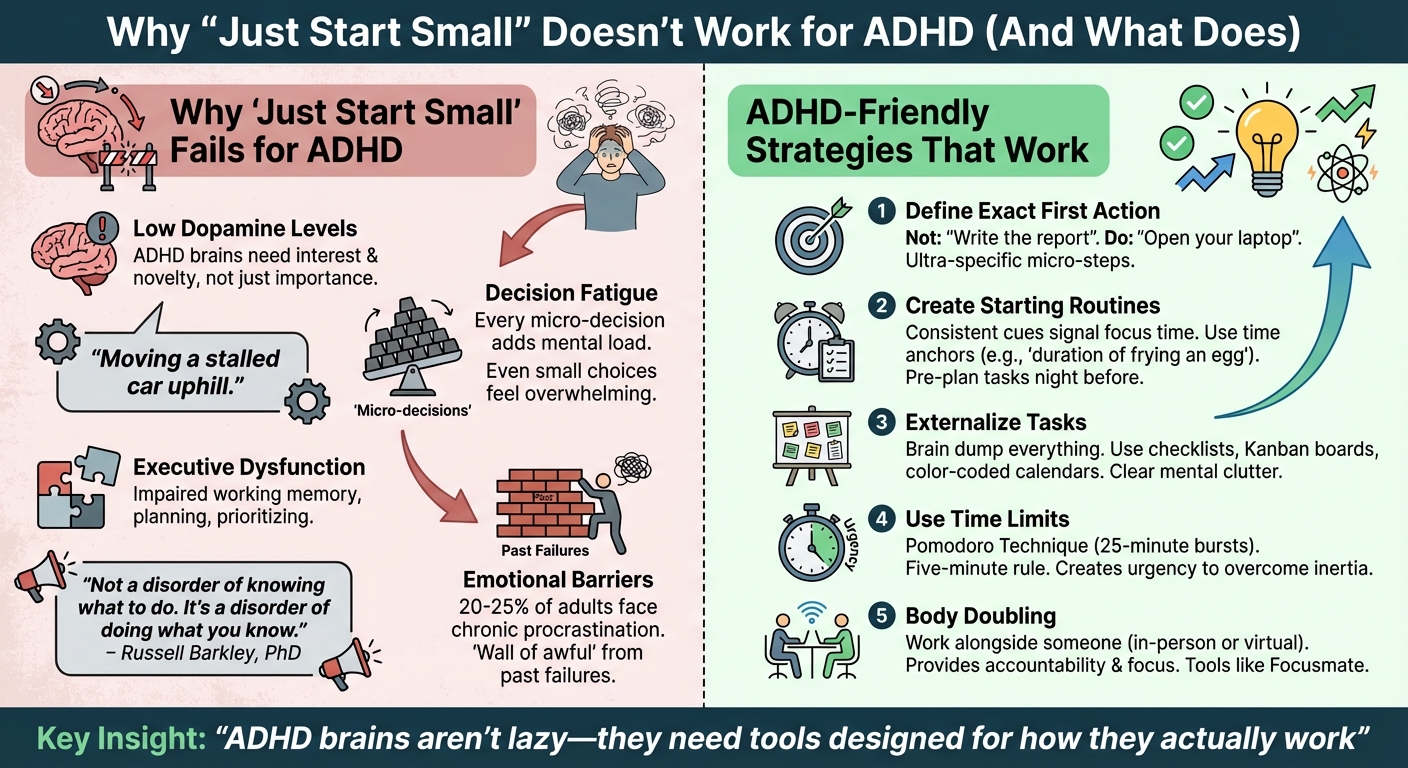
Struggling to start tasks with ADHD? Advice like "just start small" often fails because ADHD brains face unique challenges: low dopamine levels, decision fatigue, and executive dysfunction. These barriers make even small tasks feel overwhelming.
Instead, ADHD-friendly strategies focus on how your brain works:
-
Pinpoint the first action: Start with something ultra-specific like "open your laptop."
-
Create routines: Use consistent cues to signal it's time to work.
-
Externalize tasks: Write them down to reduce mental clutter.
-
Set time limits: Try the "five-minute rule" or Pomodoro Technique.
-
Work with others: Body doubling provides accountability and focus.
These approaches reduce overwhelm, boost dopamine, and make starting tasks manageable. ADHD brains aren't lazy - they just need the right tools to get moving.
How ADHD Affects Task Initiation
ADHD and Executive Function Challenges
Getting started on a task relies heavily on executive functions like working memory, planning, prioritizing, sequencing, and emotion regulation. For individuals with ADHD, these functions often don’t operate as smoothly, which can make initiating tasks a real struggle. It’s not uncommon to feel stuck figuring out where to begin, lose steam when faced with mundane tasks, or battle to stay focused once you’ve started. This isn’t about being lazy - it’s about how the ADHD brain processes and organizes actions differently.
Because of these executive function difficulties, advice like “just start small” often misses the mark for those with ADHD.
Why 'Just Start Small' Isn't Effective for ADHD
The idea of breaking tasks into smaller steps assumes that motivation comes from understanding a task’s importance. But ADHD brains tend to thrive on challenge, novelty, or urgency instead [3]. When a task - or its smaller parts - feels boring, it can lead to choice paralysis [2]. Add in working memory issues, and even remembering the next small step can feel like an uphill battle.
Emotional Barriers and the Role of Shame
Emotions can play a huge role in task initiation struggles. Negative experiences and past failures often create what some call a "wall of awful" - a mental barrier of dread that makes starting seem impossible [7]. Fear of failure and perfectionism can turn even simple tasks into high-stress situations, leading to avoidance. This cycle can lower self-esteem and increase frustration. In fact, studies show that 20–25% of adults deal with chronic procrastination [8], and task initiation problems are often tied to feelings of inadequacy and growing frustration [9].
Why ADHD Makes Starting Tasks So Hard
What ADHD Brains Actually Need
To tackle the challenges of getting started with tasks when you have ADHD, it’s crucial to first understand what the ADHD brain needs to function effectively.
The Dopamine Challenge in ADHD
People with ADHD have lower dopamine levels, which directly impacts their motivation system [4]. While neurotypical brains can often generate motivation by focusing on a task's importance, ADHD brains work differently - they thrive on interest and novelty [3]. To put it simply, they need a sense of challenge or urgency to produce enough dopamine to kick things into gear.
"When a task is inherently boring to someone with ADHD, dopamine levels are so low that their brain is unable to 'activate' to do the task." - Vidya Guhan, ADHD Coach [10]
This explains why breaking a dull task into smaller steps doesn’t always help. A study from March 2025 compared the experience to "moving a stalled car uphill" [10], emphasizing the extra effort required to engage with tasks that lack stimulation.
On top of that, this dopamine shortage makes even the simplest decisions feel like a heavy burden.
Decision Fatigue and the Paralysis of Choice
For someone with ADHD, knowing what needs to be done isn’t the problem - it’s deciding where to begin. ADHD impacts executive functions like planning and prioritizing, so even small choices, such as picking the first task or figuring out how to start, can feel overwhelming [3]. Each micro-decision adds to the mental load, quickly leading to decision fatigue [2][12]. And the fear of making the "wrong" choice can spiral into overthinking, grinding progress to a halt.
"ADHD is not a disorder of knowing what to do. It's a disorder of doing what you know." - Russell Barkley, PhD [1]
These internal struggles are further complicated by the environment around you.
The Role of Your Environment
Your surroundings play a huge role in how easily you can start a task. Digital distractions and physical clutter make things even harder [3]. A messy workspace or constant notifications adds to the mental strain, pulling your focus in multiple directions.
For an ADHD brain already dealing with low dopamine and decision fatigue, an environment filled with visual chaos or tempting distractions - like open social media tabs - only makes things worse. Creating a space that reduces friction and limits unnecessary choices can help ease the process of getting started.
What Actually Works: ADHD-Friendly Ways to Start Tasks
Tackling tasks with ADHD can feel like an uphill battle, but there are strategies that align with how ADHD brains function. Instead of vague advice like "just start small", these approaches are designed to help you break through task paralysis in practical, actionable ways.
Define the Exact First Action
Rather than aiming for a broad goal like "write the report", zero in on the very first physical step - something as simple as "open your laptop" [3]. This approach reduces decision overload and provides structure, which ADHD brains thrive on. For instance, if "clean the kitchen" feels overwhelming, start with "put one mug in the sink" [3]. Once you complete that first tiny step, the next one often feels more manageable.
Create a Starting Routine
A predictable routine can smooth the transition into work mode. Whether it’s using the same workspace, playing a specific playlist, or following a set sequence of actions, these cues signal your brain that it’s time to focus. Rittenhouse Psychiatric Associates suggested in September 2025 that using time anchors - like comparing a task’s duration to frying an egg - can simplify time management [11]. Pre-planning tasks the night before or using physical triggers, such as sitting in a designated chair, can also minimize decision fatigue [4][14].
Get Tasks Out of Your Head
Keeping tasks in your mind can feel overwhelming. Instead, externalize them with a "brain dump" by writing everything down. This clears mental space and helps you focus [2]. Tools like checklists, Kanban boards, or color-coded calendars can make tasks feel more approachable, while external reminders like alarms or sticky notes ensure nothing slips through the cracks [3].
Use Time Limits to Create Urgency
Short, defined time limits can help jumpstart action. Techniques like the Pomodoro Technique (working in 25-minute bursts with short breaks) or the "five-minute rule" (committing to just five minutes of effort) are great for overcoming inertia [3][5]. Timing recurring tasks can also give you a better sense of how long they actually take, easing the fear that they’ll drag on forever [15].
And if you find it hard to get started alone, consider adding a little accountability.
Work Alongside Someone Else
Body doubling - working with someone else, either in person or virtually - can provide the structure and accountability you need to stay on task. Just having another person present can help you stay focused. Tools like Focusmate make it easy to set up virtual work sessions, turning solitary tasks into shared, productive efforts [13].
Using These Strategies for Software Work
Software projects can feel like a tangled web of complexity. While the strategies mentioned earlier are effective, they need to address the specific challenges you face as a founder or knowledge worker. Let’s reshape these ADHD-friendly strategies into actionable steps tailored for software tasks.
Break Down Big Projects Into First Actions
Tackling software projects often means battling decision fatigue and executive dysfunction. When you're looking at tasks like "redesign the onboarding flow" or "run a pricing experiment", your brain might interpret them as an overwhelming mess with no obvious starting point. The key is to focus on the next step rather than the end goal.
For example, instead of thinking "improve onboarding", start with something as simple as "open Figma and duplicate the current signup screen." Or, for "test new pricing", begin with "create a new spreadsheet tab labeled 'pricing test'." These small, actionable steps help bypass the mental roadblocks that can stall progress [16][17]. Each tiny accomplishment triggers a dopamine boost, building momentum and making the project feel less intimidating [17]. By breaking tasks into bite-sized actions, you can transform a daunting project into a series of manageable steps [17].
Set Up Your Workspace for ADHD
Your environment - both physical and digital - can either support your focus or derail it. Visual clutter adds to cognitive load, so take time to declutter your workspace. Use bins or baskets to organize papers and supplies, or cover up messy piles you’re not ready to handle yet. Out of sight often means out of mind, which reduces overwhelm [18][19].
"What about this space isn't working for me?" - Michelle Frank, Psy.D., and Sari Solden, M.S. [19]
The right level of stimulation also plays a big role. Some people with ADHD focus better in quiet spaces like libraries, while others thrive in environments with background noise, like coffee shops [19][20]. If silence feels stifling, try using brown noise or instrumental music to create a more engaging atmosphere. Make sure your workspace is frictionless - keep power strips handy, ensure your internet is reliable, and have all your essential tools within reach [18]. On the digital side, limit distractions by setting boundaries, like capping how long you'll research or restricting the number of tabs you open [21].
How Onsara Helps ADHD Users Start Tasks
Technology can be a game-changer when it comes to simplifying your workflow. One of the biggest hurdles for ADHD brains is decision fatigue. When you open your task list and see 50 items staring back at you, it’s easy to freeze, unsure where to begin. Onsara tackles this problem head-on by leveraging AI and cognitive task analysis to pinpoint the next best action based on your priorities, context, and mental state.
This approach eliminates the burden of deciding what to do first. Instead of wasting time scrolling through an overwhelming list, Onsara provides a single, clear starting point. For ADHD brains that thrive on structure and quick feedback, this kind of external guidance can mean the difference between staying stuck and making real progress. By aligning with your unique needs, Onsara helps you kickstart productivity and take control of software projects.
Conclusion
"Just start small" isn't the answer for ADHD. We've explored how dopamine deficits and executive function struggles make standard productivity advice fall flat. The problem isn't the size of the task - it’s the way your brain is wired. Challenges like impaired executive function, low dopamine levels, decision fatigue, and distorted time perception create obstacles that generic tips simply can't address [15][3][22][6][23].
Recognizing these hurdles opens the door to practical solutions. The strategies that actually help - like precise micro-starts, consistent routines, body doubling, task externalization, and strict time limits - are designed to align with how your ADHD brain works. These methods reduce resistance, increase dopamine, and provide the external structure your brain thrives on [3][6][23]. For example, breaking a task into an exact first step or working alongside someone to tap into the benefits of social connection can make all the difference [6].
Finding what works for you will take some trial and error, along with a healthy dose of self-compassion. ADHD is different for everyone, so what helps one person might not resonate with you [24][25][26]. Experiment with combinations - like pairing body doubling with the five-minute rule or using a starting routine alongside a visual task list - to see what reduces resistance and builds momentum. Adjust as needed, and give yourself the grace to figure it out at your own pace. Focus on progress rather than perfection. These personalized approaches highlight that your ADHD brain isn't broken - it simply needs tools designed for its unique way of functioning. With the right methods, your brain can truly thrive.
FAQs
What are some practical ways to start tasks if you have ADHD?
Starting tasks when you have ADHD can be tough, but there are ways to make it easier. One helpful approach is to break the task into small, bite-sized steps that feel more doable. You might also try setting a timer for 5 to 25 minutes - this can create a sense of urgency and help you stay focused. Starting with the part of the task that feels most engaging or enjoyable can also help you build some momentum.
Other tools can make a big difference too. For example, visual reminders or auditory cues can act as gentle nudges to get started. If you need extra support, consider body doubling - having someone work nearby - or finding an accountability partner to help you stay on track. These strategies are designed to address the unique challenges of ADHD and make starting tasks feel less overwhelming.
How can building routines help with starting tasks when you have ADHD?
Routines provide structure and predictability, which can make tackling tasks feel less daunting for individuals with ADHD. By cutting down on the number of decisions you have to make, routines help save mental energy and reduce the distractions that often make it hard to get started.
When routines turn into habits, they shift tasks from decisions to automatic actions. This makes it easier to dive in without overanalyzing. Over time, these consistent patterns can create momentum, boosting productivity in a way that works well with how ADHD brains operate.
Why doesn’t breaking tasks into smaller steps always work for people with ADHD?
Breaking tasks into smaller steps might seem like a helpful strategy, but for people with ADHD, it doesn’t always solve the problem. That’s because the real hurdles often go beyond just the size of the task. Emotional challenges like feeling overwhelmed, dealing with anxiety, or fearing failure can still make it incredibly hard to get started - even when the task is broken down.
On top of that, ADHD brains often struggle with motivation, especially if the task feels dull or lacks interest. Without approaches that tackle these emotional and mental roadblocks, simply dividing tasks into smaller pieces might not be enough to spark action.
Related reading
- The ADHD Brain Dump Method That Actually Gets You Unstuck
- ADHD Decision Paralysis: How to Pick What to Do Right Now
- 5 Apps for Reading Buddhist Scripture Daily
- Best Buddhist Apps for Daily Practice in 2025
- Best Apps for ADHD Task Paralysis (Tested 2026)
Useful tools & services
Explore our tools for everyday work
Browse our focus app, PDF reader, and other products to find an option that fits your task.
Browse our productsThese are products built by Artisan Strategies.