Daily meditation routine
Short, consistent meditation routines: beginner techniques, scheduling tips, app suggestions, and habit-building strategies to reduce stress and improve focus.
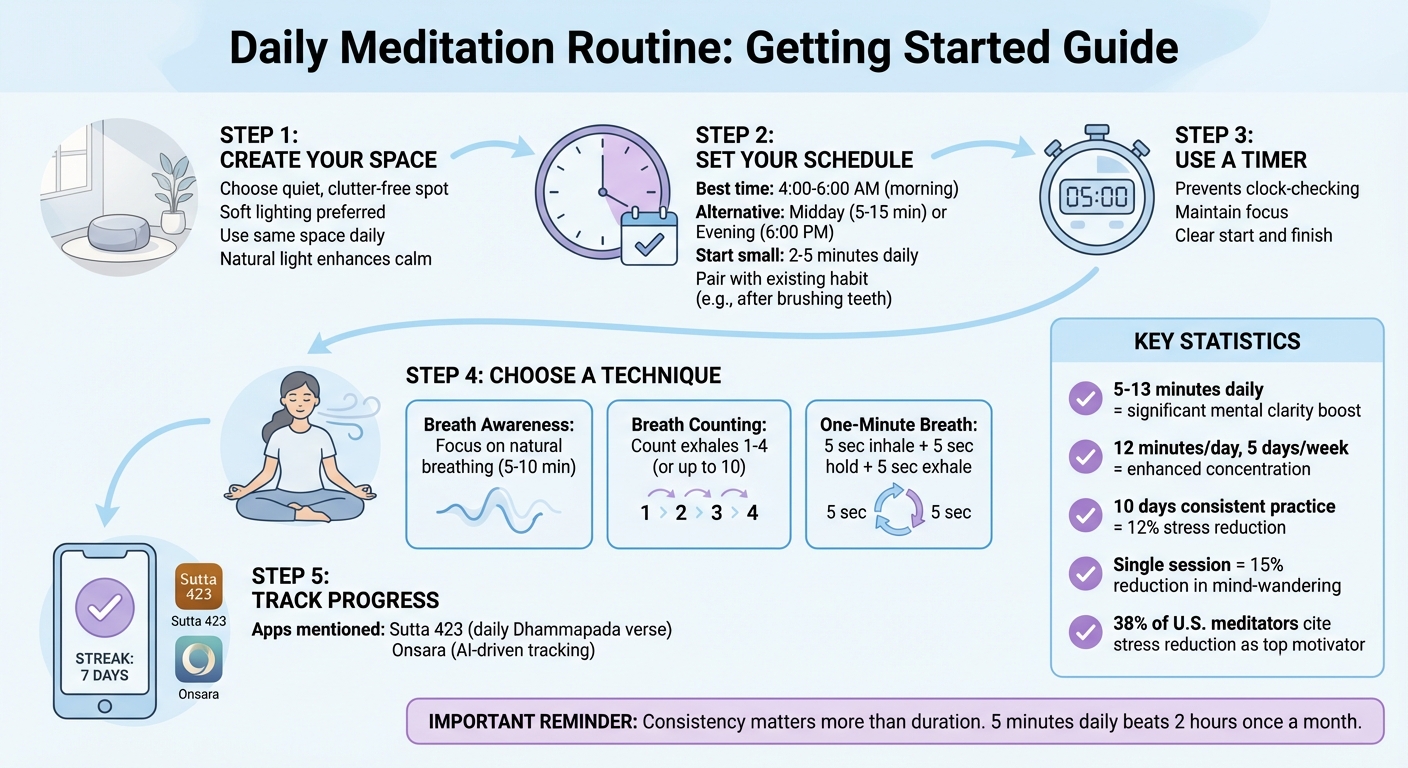
Meditation can improve focus, reduce stress, and enhance decision-making. Research shows that even 5–13 minutes daily can significantly boost mental clarity and emotional well-being. The key is consistency, not duration. Here’s how to start:
- Create a dedicated space: Choose a quiet, clutter-free spot with soft lighting. Use the same space daily for better focus.
- Set a routine: Morning sessions (4:00–6:00 AM) are ideal, but midday or evening works too. Pair meditation with habits like brushing your teeth.
- Use a timer: Avoid clock-checking by setting a timer for 2–5 minutes to start.
- Begin with simple techniques: Try breath awareness, breath counting, or one-minute breathing exercises.
- Use apps for support: Tools like Sutta 423 or Onsara help track progress and maintain consistency.
Start small and gradually increase session length as you build the habit. Wandering thoughts aren’t failures - they’re part of the process. Regular meditation can help you stay calm and focused, even in high-pressure situations.
Setting Up Your Meditation Space and Schedule
Picking Your Meditation Space
Select a quiet, low-traffic area in your home for meditation. Avoid spots near street-facing windows or busy hallways, as these can introduce noise and distractions that make it harder to focus [2]. A clutter-free corner works best - remove anything like electronics or paperwork that might trigger stress or pull your attention away [2][3].
Natural light can enhance the calming atmosphere. If possible, sit near a window with light curtains to let in soft daylight without harsh glare [2]. Spend 10–15 minutes in your chosen spot to evaluate its noise level, lighting, and overall comfort [2]. If some noise persists, consider using heavy curtains, a thick rug, or a white noise machine to minimize disruptions [2].
"There is always somewhere - all you need is the space for a cushion on the floor." - Norman Fischer, Zen Teacher [5]
Using the same spot daily creates a mental association between that space and stillness, helping you settle into meditation more easily over time [2][3]. Even a small table with a candle or an uplifting image can act as a focal point [3]. For those with limited space, keep essentials like a cushion or timer in a basket that you can set up on a bed or coffee table when it’s time to meditate [2].
Once your space is ready, the next step is to establish a consistent meditation schedule.
Finding Your Daily Meditation Time
Morning sessions are ideal, especially between 4:00 AM and 6:00 AM, when your mind is naturally calm and free from the day’s distractions [8][2][10]. Research published in the Journal of Medical Internet Research in 2023 revealed that morning meditators were more likely to stay consistent and engaged in their practice compared to those meditating at other times [9]. Starting your day with meditation also reduces the chance of skipping it due to unexpected tasks [7][9][11].
If mornings don’t work for you, consider a short 5–15-minute session during midday [9][10]. Evening meditation, around 6:00 PM, can help you unwind from work and transition into personal time [8][2]. Just be sure to finish at least 30 to 60 minutes before bedtime to keep the practice focused rather than blending into sleep [8][2].
Begin with 2 to 5 minutes daily to make it approachable and focus on building the habit rather than worrying about duration [2][6]. Pair your session with an existing habit, like meditating right after brushing your teeth or while waiting for your coffee to brew [2].
"If you miss the morning, there's a solid chance that you'll miss the day and become a dabbler." - Suze Yalof Schwartz, CEO and Founder, Unplug Meditation [9]
A consistent time, paired with a designated space, forms the backbone of a disciplined meditation routine.
Setting a Timer for Each Session
With your space and schedule in place, eliminate distractions by using a timer. A physical timer or a simple app works well to prevent you from checking the clock mid-session. Checking the time can disrupt your focus, so setting a timer beforehand ensures a clear start and finish to your practice. This small step helps maintain your attention and reinforces your commitment to consistency.
A Step-By-Step Guide to Meditate Daily
3 Beginner Meditation Techniques
Once you've set up your space and timer, it's time to dive into some simple meditation methods. These three beginner-friendly techniques are easy to follow and fit seamlessly into your daily life. With a little consistency, they’ll help sharpen your focus and bring a sense of calm.
Breath Awareness
Find a comfortable seat with your back upright but relaxed [13] [16]. Let your hands rest naturally on your lap, keeping your upper arms parallel to your torso to avoid slouching [16]. If closing your eyes feels uncomfortable, keep a soft, downward gaze [14] [16].
Focus on your breath just as it is - no need to change or deepen it [13] [14]. Pay attention to the sensations: the coolness of the air as it enters your nose, the warmth as you exhale, or the gentle rise and fall of your chest and abdomen [14] [15]. When your mind inevitably drifts, gently acknowledge it with a word like "wandering" or "thinking", then guide your focus back to your breath [15].
"Learning to focus attention and relax is a skill. As with any skill, your ability to focus and relax will improve with practice."
- Dr. Ronald D. Siegel, Assistant Clinical Professor of Psychology, Harvard Medical School [13]
Start with 5–10 minutes and gradually work up to 20–30 minutes as your focus improves. Studies suggest that meditating for just 12 minutes a day, five days a week, can enhance your ability to concentrate [12]. This technique is a great foundation for building a consistent meditation practice.
Breath Counting
This method adds structure to your breath awareness, giving your mind something specific to focus on. Sit comfortably and tune into your natural breathing rhythm [14] [20]. Begin by counting each exhale, starting from 1 and going up to 4. As your focus improves, you can extend the count up to 10 [12] [14]. If you get distracted, simply start back at 1 [12] [14].
"Every time we return to the breath, we reinforce our ability to do it again. Call it a bicep curl for your brain."
- Mindful Staff, Mindful.org [18]
This practice helps keep your mind from wandering and strengthens your focus over time [18] [14]. Even dedicating just one minute to focused breathing each day can make a difference [19] [20]. It’s a simple yet effective way to enhance your daily meditation.
One-Minute Breath
If you're short on time, this quick technique is a lifesaver. Inhale for 5 seconds, hold your breath for 5 seconds, and then exhale for 5 seconds [12] [14]. Repeat this cycle for one minute to reset your focus.
You can easily incorporate this practice into your day - try it after brushing your teeth, finishing a meal, or before picking up your phone. Sticky notes placed on your mirror or computer screen can serve as handy reminders, and refreshing them weekly keeps the habit fresh [21].
"The most important moment in your meditation practice is the moment you sit down to do it. Because right then you're saying to yourself that you believe in change, you believe in caring for yourself, and you're making it real."
- Sharon Salzberg, Meditation Teacher [12]
Using Apps to Support Your Practice
When choosing meditation apps, simplicity is key. Opt for apps that minimize features and distractions, allowing you to focus on your practice. Look for those with offline capabilities, and consider disabling notifications to maintain your concentration during sessions. Pairing your app with noise-canceling headphones can further enhance your ability to create a peaceful, focused environment for meditation [1][22].
Progress tracking can be surprisingly motivating. Features like streak counters and session histories tap into our natural tendency to avoid losing progress, encouraging consistency in your practice. Studies show that meditating regularly for just 10 days can lower stress levels by 12%, and even a single session can reduce mind-wandering by 15% [22]. These tools integrate seamlessly into your routine, helping you stay committed without feeling overwhelmed.
Daily Mindfulness with Sutta 423

Sutta 423 offers a refreshingly simple approach to mindfulness. Instead of overwhelming you with countless guided meditations, it provides just one Dhammapada verse each day. This minimalist design helps you focus on a single, meaningful teaching, fostering a deeper connection to your practice without the distraction of endless options.
Tracking Your Practice with Onsara
Onsara is particularly helpful if you struggle with ADHD or find it challenging to stay focused. This app uses AI-driven cognitive task analysis to guide your next steps, whether that’s meditating or tackling a work task. By tracking your consistency, Onsara builds momentum and alleviates the stress of juggling multiple responsibilities. It helps you prioritize meditation when you need it most, turning it into a natural part of your daily routine.
Building Consistency and Overcoming Common Problems
Staying Consistent
Creating a lasting meditation habit often works best when you tie it to something you already do daily - like brushing your teeth. This technique, known as habit stacking, makes it easier to remember and integrate meditation into your routine.
Consistency matters more than how long you meditate. Studies suggest that even five minutes a day can yield better results over time than sporadic, lengthy sessions - like two hours once a month [3]. For particularly hectic days, a quick one-minute session can still keep the habit alive. Pair this with a visual tracker, such as marking a calendar, to add accountability and tap into the psychological power of loss aversion [22][1].
Having a clear reason for meditating also helps you stick with it. Stress reduction, for instance, was the top motivator for 38% of U.S. adults who meditate regularly, according to a 2022 survey [1]. Knowing your "why" gives you something to lean on when motivation wanes.
Once consistency becomes second nature, the next hurdle is learning how to handle distractions during your practice.
Managing Distractions
It’s completely normal for your mind to wander during meditation - it’s not a failure. In fact, this process is a key part of building mindfulness. As Tamara Levitt puts it:
"The back-and-forth between focusing and getting distracted is actually part of the practice. You are building the 'muscle' of mindfulness when you move from distracted to present" [4].
When distractions arise, gently acknowledge them with a soft mental label like "thinking" or "wandering." Then, guide your attention back to your breath [17]. Physical comfort also plays a role - adjust your posture or seating as needed to stay relaxed [3]. Research shows that a single meditation session can reduce mind-wandering by 15%, but only if you approach these distractions with patience, not frustration [22].
Once you’re comfortable managing distractions, you can slowly start extending the length of your sessions.
Increasing Duration Over Time
Start small - just 2–5 minutes a day - and gradually add a minute each week until you reach 10–20 minutes [22][1]. This steady progression helps you avoid feeling overwhelmed and makes it easier to stick with your routine.
Frederick Meyer, Director of Writers.com, warns against turning meditation into a test of endurance:
"If your body starts associating meditation with 'extreme boredom,' 'physical pain,' 'emotional turmoil,' and so on, then you're going to have a very hard time meditating regularly" [3].
Pay attention to your body, and don’t push through sharp discomfort. If longer sessions feel intimidating, guided meditations can provide structure and support [3]. And the benefits build quickly - just 10 days of consistent practice can lower stress levels by 12% [22].
Conclusion
You don’t need hours to build a meditation habit - short, regular sessions are often more effective. For instance, meditating for just five minutes daily usually has a greater impact than a two-hour session once a month [22]. A great way to start is by linking 2–5 minutes of meditation to a routine task, like brushing your teeth.
Tools like Sutta 423 and Onsara can help you structure your practice and keep track of your progress. As Sharon Salzberg beautifully put it:
"The most important moment in your meditation practice is the moment you sit down to do it" [2].
It’s also important to embrace the challenges. Wandering thoughts or skipped days aren’t signs of failure - they’re part of the process. Every time you notice your mind drifting and gently refocus, you’re strengthening the mental muscles that drive lasting change.
FAQs
What should I do when my mind won’t stop wandering?
When your mind drifts during meditation, gently bring your focus back to your anchor - whether it’s your breath, a mantra, or the sensations in your body. It’s completely normal for thoughts to pop up. Instead of getting frustrated, simply notice them without judgment and calmly redirect your attention. By practicing patience and treating yourself with kindness, you’ll gradually build stronger meditation habits over time.
How do I know which meditation technique is best for me?
The most effective meditation technique varies based on what you're aiming to achieve, your personal preferences, and what feels natural to you. Popular choices include mindfulness meditation, which helps reduce stress and improve awareness, guided meditation, offering a more structured approach, or loving-kindness meditation, which encourages feelings of compassion and connection. Experiment with different styles to discover what suits you best. The key is to focus on consistency and finding enjoyment in the practice, making it easier to build a daily habit that enhances your mental clarity and overall well-being.
When will I start noticing benefits from meditating daily?
Many people report feeling less stressed and more focused after just a few weeks of meditating daily. That said, achieving more profound and lasting changes often requires a few months of regular practice. The key to unlocking these benefits lies in staying consistent with your routine.
Related reading
- Best Bible Verse Chrome Extensions 2026 (Daily Verse & Search)
- ADHD and Routines: Overcoming Task Paralysis
- How Meditation Helps SaaS Leaders Avoid Burnout
- Best Tools for SaaS Founders to Manage Stress
- How to Read the Dhammapada: A Beginner's Practice Guide
Useful tools & services
Explore our tools for everyday work
Browse our focus app, PDF reader, and other products to find an option that fits your task.
Browse our productsThese are products built by Artisan Strategies.