How To Craft An E-commerce Growth Marketing Strategy
Learn how to develop a data-driven e-commerce growth marketing strategy that attracts customers, enhances retention, and boosts your brand's success.
Want to grow your e-commerce business? Here's how: Focus on data-driven strategies to improve every stage of the customer journey - from attracting visitors to building loyalty. This guide breaks down actionable steps to craft a growth marketing plan that delivers results.
Key Takeaways:
-
Set SMART Goals: Define clear, measurable objectives (e.g., "Increase new accounts by 500 in 6 months").
-
Track Metrics: Monitor KPIs like conversion rates, AOV, and CAC for smarter decisions.
-
Understand Your Customers: Build detailed profiles using demographics, behavior, and feedback.
-
Optimize Your Website: Improve speed, simplify checkout, and enhance mobile usability.
-
Use Multi-Channel Marketing: Leverage email, retargeting ads, and omnichannel strategies for higher engagement.
-
Focus on Retention: Implement loyalty programs and follow-up campaigns to boost customer lifetime value.
Whether you're just starting or refining your strategy, these steps will help you grow your e-commerce business effectively. Let’s dive in!
8 Effective Ecommerce Marketing Strategies for 2024
::: @iframe https://www.youtube.com/embed/46IXZFV4_tw :::
Setting Clear Goals and Success Metrics
To succeed in e-commerce, you need clear, measurable objectives that align with your business goals. Without specific targets, it's impossible to evaluate whether your strategy is working.
Start by creating a results-focused plan with SMART goals and trackable metrics. This approach helps you fine-tune your strategy over time.
Writing SMART Goals
SMART goals are a great framework for setting actionable and realistic objectives. Here's how they apply to e-commerce:
| SMART Component | How It Applies to E-Commerce | Example |
|---|---|---|
| Specific | Clearly define the goal with numbers and actions | Increase new customer accounts by 500 |
| Measurable | Use metrics you can track and analyze | Monitor account creation and coupon redemption |
| Achievable | Set goals that fit your current resources | Reach the target within 6 months using your existing marketing budget |
| Relevant | Ensure the goal supports your business priorities | Focus on acquiring new customers to drive growth |
| Time-bound | Assign a clear deadline | Achieve the goal within a 6-month timeframe |
For instance, a perfume store might set this SMART goal: "Acquire 500 new customer accounts in 6 months by offering a 50% discount through Instagram and LinkedIn campaigns."
Once your goals are in place, track their impact using key performance indicators (KPIs).
Tracking Key Metrics
To measure success, focus on these crucial metrics:
-
Conversion Rate: The percentage of website visitors who make purchases.
-
Average Order Value (AOV): How much customers spend per transaction.
-
Customer Acquisition Cost (CAC): The cost of acquiring a new customer.
-
Net Promoter Score (NPS): A measure of customer satisfaction and loyalty.
"KPIs aren't just numbers on a dashboard. They're the foundation of smart decision-making." - Stuart Kinsey, co-founder of SimpleKPI [3]
For example, Zappos prioritized NPS as their main customer satisfaction metric. This focus led to an 18% year-over-year sales increase, proving how aligning metrics with customer experience can drive growth.
Implementing Effective Tracking
To track metrics effectively, follow these steps:
-
Set Up Analytics Tools
Use platforms like Google Analytics or customer behavior tools to monitor performance. Double-check that tracking codes are correctly installed and pulling accurate data. -
Regularly Review Metrics
Analyze your KPIs weekly or monthly to identify trends and make timely adjustments. -
Adjust Goals When Necessary
If you're consistently surpassing your targets, aim higher. If you're falling short, dig into the data to understand why and make changes.
A real-world example: In 2017, Mattel saw a 14% drop in annual revenue because they focused too much on retail metrics and overlooked customer engagement indicators [4]. This highlights the importance of tracking the right data to stay aligned with your goals.
Understanding Your Customers and Market
Once you've set clear goals, the next step is to dive into understanding your audience and the market. This drives how you position your product and craft your messaging.
Building Customer Profiles
Customer profiles are all about personalization. A recent study shows that 59% of consumers want businesses to use their data to create personalized experiences [5].
| Profile Component | What to Include | Why It Matters |
|---|---|---|
| Demographics | Age, location, income, occupation | Helps fine-tune advertising and messaging |
| Behavior Patterns | Purchase frequency, preferred channels, cart size | Shapes marketing and retention efforts |
| Pain Points | Key challenges and needs | Influences product design and messaging |
| Interaction History | Support tickets, reviews, feedback | Enhances customer service strategies |
A great example is Spotify's partnership with Mailchimp in March 2023. They cut bounce rates from 12.3% to 2.1% in just 60 days, improved email deliverability by 34%, and generated $2.3M in additional revenue.
"A customer profile is a file that contains all of the traits and behaviors of your ideal customers." – Adobe Experience Cloud Team [6]
After building customer profiles, turn your attention to market analysis. This step complements your customer insights by identifying trends and competitive moves.
Market Analysis Basics
With detailed customer profiles in hand, take a closer look at market conditions to refine your strategy.
Here are some key areas to explore:
-
Analyze competitors' pricing, distribution channels, and business models.
-
Look for gaps in the market where your product can thrive.
-
Track seasonal patterns and emerging product categories.
-
Monitor customer sentiment and influential voices in your industry.
-
Research trends and signals that indicate rising demand.
In November 2024, Exploding Topics introduced their Meta Trends feature. This tool uses a mix of AI and human analysis to pinpoint growing niches in the market.
To conduct effective market research, combine insights from multiple sources:
| Data Source | What to Track | Tools to Use |
|---|---|---|
| Social Media | Customer sentiment, trending topics | Social listening platforms |
| Search Trends | Keyword volume, seasonal spikes | Google Trends, Ahrefs |
| Customer Feedback | Product suggestions, recurring issues | Surveys, reviews |
| Competitor Activity | Pricing strategies, new launches, promotions | Market analysis tools |
Market analysis isn't something you do once and forget about. Regularly updating your research ensures you stay ahead of trends and adjust your strategies as needed. According to the U.S. Small Business Administration, "market research blends consumer behavior and economic trends to confirm and improve your business idea" [7].
Improving Website Conversion Rates
Website speed and user experience have a direct impact on sales. With average e-commerce conversion rates ranging between 2% and 4% [8], even small improvements can lead to noticeable gains.
Speed and Mobile Performance
Every second counts when it comes to page load times. A one-second reduction in load time can increase conversion rates by 17% [9]. Walmart, for example, saw a 2% boost in conversions by cutting load time by just one second [11].
Here are some ways to improve site speed:
| Area | Action Items | Expected Impact |
|---|---|---|
| Server Performance | Enable HTTP/2 and optimize hosting | Reduces load time |
| Image Optimization | Compress images and use lazy loading | Decreases page size |
| Code Efficiency | Minify CSS/JavaScript and cut down HTTP requests | Speeds up rendering |
| Mobile Experience | Use responsive design | Improves mobile usability |
An example? COOK, an online retailer, increased conversions by 7% by shaving just 0.85 seconds off their page load time [11].
"The customer experience you provide is directly connected to your conversion and retention rates, and your website's performance is directly related to that customer experience." - Andrew Brzezicki, Global Content Marketing Manager, Bazaarvoice [10]
Once your site speed is optimized, the next focus should be on enhancing product pages and the checkout process.
Product Pages and Checkout Flow
Improving page speed is just the start. Streamlining product pages and checkout processes is just as crucial. A staggering 87% of shoppers abandon their carts due to overly complicated checkouts [8].
| Page Element | Example | Impact |
|---|---|---|
| Product Images | LNDR includes images of products in various colors and size-specific model photos [14] | Boosts buyer confidence |
| Payment Options | Two-click checkout methods [14] | Lowers cart abandonment |
| Price Transparency | Mixhers highlights subscription savings upfront (e.g., 10% off) [14] | Builds trust |
| Reviews Integration | Rent the Runway offers size-filtered customer reviews [12] | Can increase conversions by as much as 270% [13] |
Another great practice? Dorai keeps the 'Add to Cart' button visible as users scroll, making it easier for customers to take action [14].
Large-scale e-commerce platforms can see conversion rates jump by 35% when they focus on simplifying their design [15]. Here are some must-haves for an effective checkout process:
-
Guest checkout options
-
Prominent trust badges
-
Multiple payment methods
-
Transparent pricing (48% of shoppers abandon carts due to unexpected fees [16])
-
Address auto-fill
-
Clear error messages
-
Mobile-friendly checkout flows
sbb-itb-0499eb9
Marketing Across Multiple Channels
Using multiple channels for marketing can significantly boost engagement, with customers spending two to five times more compared to single-channel strategies [20]. Apply this insight to your cross-channel efforts for a cohesive and effective strategy.
Email Marketing with Klaviyo
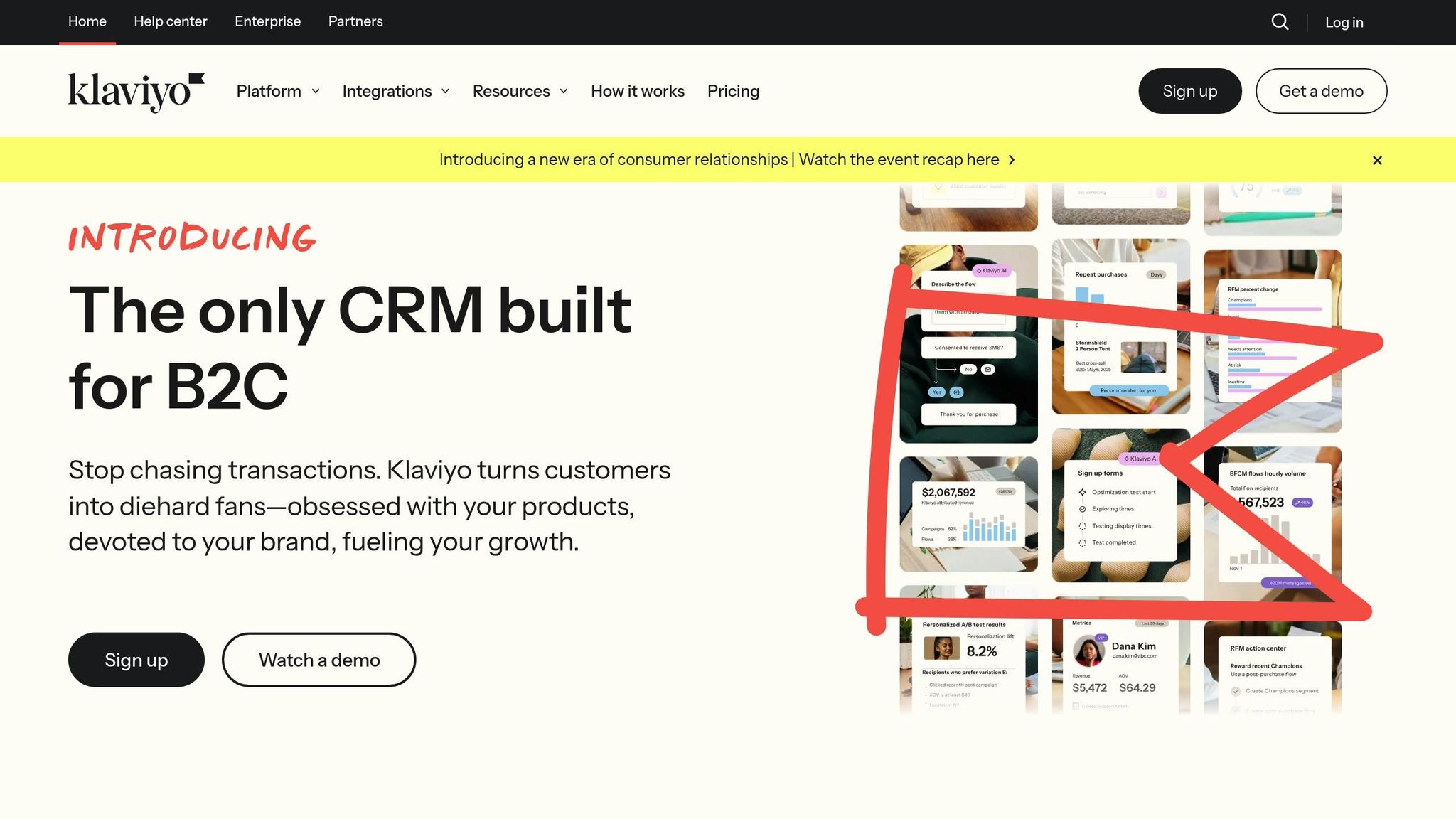
Email marketing is one of the most cost-effective tools available, offering an average return of $42 for every $1 spent [21]. Klaviyo stands out for e-commerce businesses due to its advanced segmentation features.
Here’s how to make the most of your email campaigns:
| Campaign Type | Strategy | Expected Outcome |
|---|---|---|
| Cart Abandonment | Use abandoned cart data to trigger emails and ads | 15% more recovered carts [18] |
| Customer Reactivation | Send personalized offers to inactive customers | Better customer retention |
| VIP Programs | Build lookalike audiences from top customer data | Increased customer acquisition |
"With Klaviyo's rich data sets and Google Ads' expansive reach, your e-commerce business can enjoy more personalised and effective campaigns, ultimately driving more conversions and growth." - Titan Marketing Agency [18]
Klaviyo's integration with Google Ads allows you to create highly targeted campaigns based on customer behavior and purchase history [17]. By syncing email data with other platforms, you can refine your targeting and improve overall campaign performance.
Ads and Retargeting
Since 97% of website visitors leave without buying on their first visit [19], retargeting is essential. Retargeted ads are 76% more likely to get clicks than standard display ads [19].
Here are some effective retargeting strategies:
| Tactic | Implementation | Cost Range |
|---|---|---|
| Dynamic Remarketing | Show products users previously viewed | $0.66–$1.23 per click [19] |
| Facebook Ads | Target custom audiences | $0.26–$0.30 per click [19] |
| Sequential Messaging | Adjust ad content based on user journey stage | $1–$3 per 1000 impressions [19] |
"Retargeting is about repetition. Done right, your company stays fresh in your prospects' minds and multiple touch points make them happy - happy enough to come back and explore your stuff again. Doing retargeting right makes you relatable and removes doubt from the buy button." - Johnathan Dane, CEO & Founder, KlientBoost [19]
To optimize retargeting, limit ad frequency and tailor messages based on how much time has passed since the user’s last interaction [19]. Combining these tactics with a data-driven approach helps attract new customers while keeping existing ones engaged.
Using Data to Make Decisions
Making decisions based on data is key to thriving in e-commerce. This approach can lead to a much higher ROI [25]. By relying on data, you can make smarter marketing decisions and improve customer experiences. The steps below outline how to set up analytics tools and run experiments effectively.
Analytics Tools Setup
Tracking analytics is the backbone of understanding your store's performance. Google Analytics 4 (GA4) is a powerful tool when set up correctly. It treats every action on your site as an event, making it easier to customize reports and focus on the insights you need. Here are some key metrics to track:
| Event Type | What to Track | Why It Matters |
|---|---|---|
| Product Interactions | Item views, Add-to-cart | Understand product interest |
| Purchase Journey | Begin checkout, Purchases | Map out the conversion path |
| Customer Behavior | Page views, Time on site | Gauge user engagement |
To get the most out of GA4, enable Enhanced Ecommerce in your Shopify settings under Online Store > Preferences [22]. Use Google Tag Manager's preview mode and GA4's DebugView to confirm your data is being collected correctly [23].
Running A/B Tests
Once you've gathered insights from analytics, A/B testing can help you refine your strategies. Test one element at a time to isolate its impact, and focus on changes that are easy to implement but could make a big difference. Always validate your results statistically before rolling out changes [24].
Keep a record of your test results to build a knowledge base for future experiments [24]. With Gartner forecasting that 65% of B2B businesses will rely on data-driven decisions by 2026 [25], setting up a strong testing process now can give your e-commerce store a competitive edge.
Increasing Customer Value
Boost profits by focusing on the lifetime value of your current customers. Studies reveal that improving customer retention by just 5% can lead to a profit increase of 25-95% [26]. Below are some effective strategies to keep customers coming back and increase their value over time.
Acquiring customers is essential, but true growth comes from maximizing the value of those relationships. Two powerful methods to achieve this are implementing rewards programs and maintaining strong follow-up communication.
Rewards and Referral Programs
Loyalty programs encourage repeat purchases by offering incentives for customer engagement. The trick is to design a program that's both appealing and simple to use. Here's how top brands structure their rewards systems:
| Program Element | Implementation Strategy | Impact |
|---|---|---|
| Points System | Award points per dollar spent (e.g., Lancôme's 10 points/$1) | Motivates customers to spend more |
| Multi-Channel Earning | Let customers earn points through purchases, reviews, and referrals | Boosts overall engagement |
| Tiered Benefits | Provide exclusive perks at different spending levels | Inspires customers to aim for higher tiers |
For instance, Dropbox's referral program, which offered free storage for both referrers and referees, increased sign-ups by 60% and retention by 35% [27]. Similarly, Tesla’s referral program has driven 42% of its owners to refer others, with these customers spending 15% more and showing twice the loyalty [28].
But rewards programs are only part of the equation. Effective post-purchase communication is another way to enhance customer value.
Sales and Follow-up Tactics
Staying in touch with customers after their purchase is key to driving repeat sales. In fact, follow-up campaigns often achieve email open rates that are 17% higher than standard automated emails [29].
How to Personalize Your Follow-Up:
-
Send thank-you emails with a personal touch and brand details.
-
Share helpful tips on how to use the purchased product.
-
Ask for reviews after a specific period.
-
Recommend products based on their purchase history.
"Post-purchase emails and SMS re-engage customers for repeat purchases." - Sharon Goldstein, CEO of LimeSpot [29]
A great example of this approach is Au Vodka. By combining new flavor launches with smart merchandising, they encourage customers to make additional purchases. Their dynamic bundling strategy has increased the average order value by over 20% [30].
To make follow-ups even more effective, segment customers based on their behavior and tailor offers to match their preferences. For instance, WhatsApp Business messages boast a 70% engagement rate and an impressive 99% open rate [31].
Conclusion: Next Steps for Growth
To achieve lasting growth, it's time to act on the strategies and insights we've covered. With global e-commerce sales projected to surpass $8 trillion by 2027 [34], the opportunity is massive.
Here’s where to focus:
| Priority | Action Item | Expected Impact |
|---|---|---|
| Immediate | Set up Google Analytics + Klaviyo tracking | Gain insights into customer behavior for smarter decisions |
| Short-term | Segment email campaigns | Boost open rates by 30% and click-throughs by 50% [32] |
| Mid-term | Launch user-generated content campaigns | Drive a 400% increase in click-through rates [32] |
| Long-term | Develop an omnichannel presence | Achieve an 89% customer retention rate [2] |
Don’t overlook mobile optimization. Compress images, streamline your code, and speed up load times to keep mobile users happy [33]. Why? Because 90% of businesses now prioritize customer experience [32].
"Successful growth marketers setting out to craft a future-proof e-commerce growth marketing strategy should focus on building a foundation that can adapt to and capitalize on the ever-evolving trends." - Simbar Dube, Digital Marketing Lead at Invesp [2]
Keep your momentum strong by analyzing performance metrics regularly and adjusting your approach as needed [1]. The best e-commerce businesses thrive by combining sharp market analysis with cutting-edge technology, all while putting customer experience at the center [2].
Use these strategies to carve out your slice of the growing e-commerce market. Track results, refine your tactics, and build on the groundwork we've laid out here.
Related reading
- Do you need a conversion rate optimization consultant? Here is how to decide
- What is penetration pricing and how to leverage it for your business
- What is surge pricing and how you can use it in your product
- Conversion rate optimization consultant vs in house team which is right for you
- How to Use Discounts Without Hurting Revenue
Useful tools & services
Go deeper than any blog post.
The full system behind these articles—frameworks, diagnostics, and playbooks delivered to your inbox.
No spam. Unsubscribe anytime.