ADHD and Routines: Overcoming Task Paralysis
ADHD-friendly routines and tactics: micro-steps, the 5-minute rule, flexible time-blocking, body doubling, and movement breaks to overcome task paralysis.
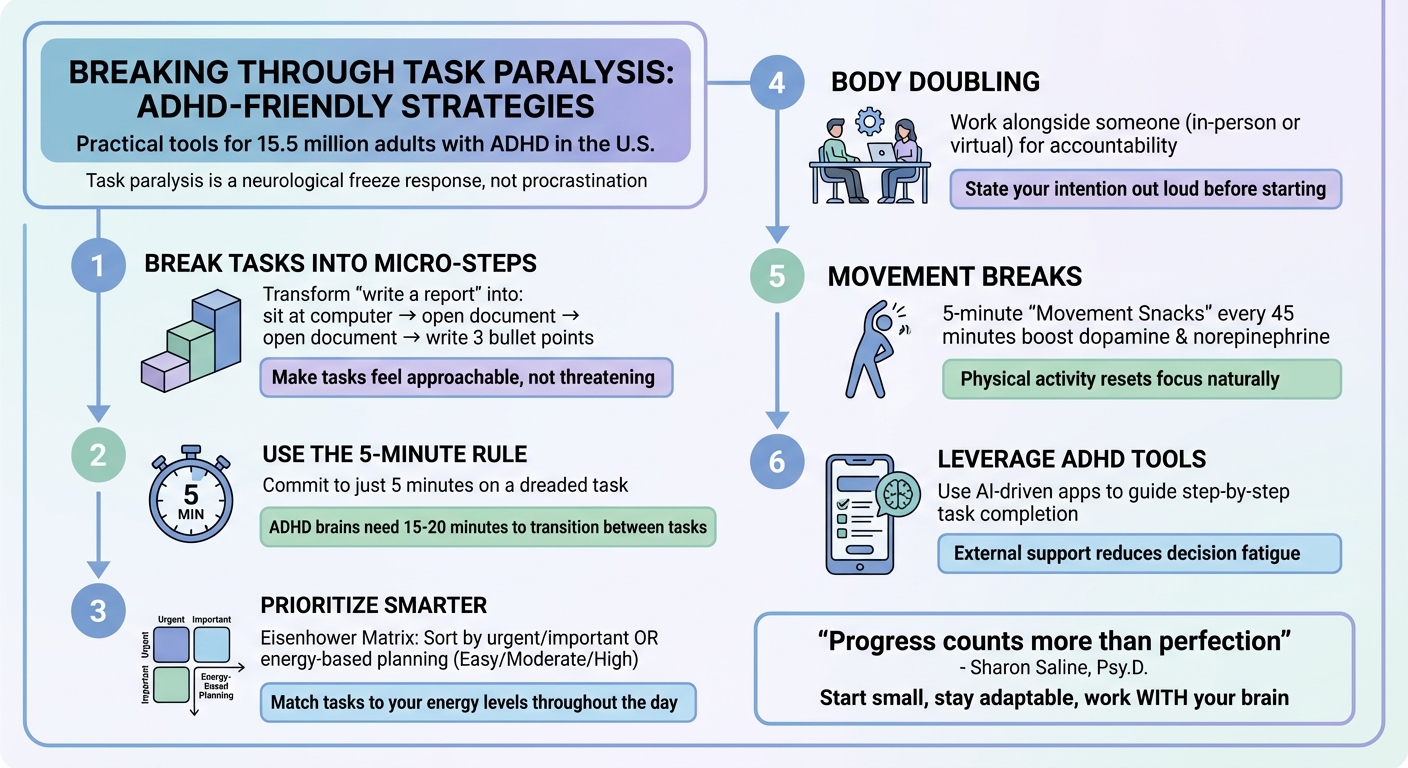
Task paralysis feels like being stuck in quicksand when faced with tasks, a common challenge for ADHD brains. It’s not procrastination; it’s a neurological overload tied to executive dysfunction, decision fatigue, and low dopamine levels. Traditional routines often fail because they rely on consistency and willpower, which ADHD brains struggle with. Instead, strategies like breaking tasks into small steps, using the 5-minute rule, and flexible time-blocking can help.
Key takeaways:
- Break tasks into micro-steps: Simplify overwhelming tasks into tiny, actionable goals.
- Use the 5-minute rule: Start a task for just five minutes to overcome mental resistance.
- Prioritize smarter: Tools like the Eisenhower Matrix or energy-based planning can help focus on what matters most.
- Incorporate body doubling: Work alongside someone for accountability and focus.
- Add movement breaks: Short bursts of physical activity reset focus and boost dopamine.
- Leverage tools like Onsara: Apps designed for ADHD can guide you through tasks step-by-step.
Instead of rigid schedules, ADHD-friendly routines work by reducing decision fatigue, creating momentum, and aligning with how your brain naturally operates. Progress, no matter how small, is the ultimate goal.
ADHD Paralysis Explained| Why You’re Stuck & How to Break Free
Why Standard Routines Don't Work for ADHD
Most advice about building routines assumes your brain operates like a finely tuned machine - just plan it out, stick to the schedule, and everything will fall into place. But for people with ADHD, it’s a completely different story. Traditional routines are designed for neurotypical brains that thrive on consistency and can rely on willpower to stay on track. ADHD brains, however, crave novelty and stimulation. Repetitive schedules don’t just feel boring - they can feel utterly exhausting because mundane tasks provide almost no dopamine [9]. Without that stimulation, decision fatigue sets in fast.
Decision Fatigue and Overwhelm
Every choice you make drains your mental energy. For someone with ADHD, even deciding what’s relevant can feel overwhelming. Dr. Michael Ascher, Clinical Associate Professor in Psychiatry, explains it like this:
Decision fatigue is not just about making decisions at the end of a long day; it's about the cumulative toll that constant decision-making takes on our cognitive resources [11].
Rigid schedules only make this worse. When a routine demands constant planning and prioritizing - functions that rely heavily on the prefrontal cortex - an ADHD brain quickly burns through its mental reserves. This often leads to a state researchers call "freezing", where you want to act but feel completely stuck.
ADHD-Specific Barriers
In addition to decision fatigue, ADHD brings its own set of challenges that make sticking to routines even harder. One major hurdle is the difficulty in translating intentions into actions [5]. Russell Barkley, a prominent ADHD researcher, refers to this as "temporal myopia", where immediate urges take priority over long-term goals [12]. Add time blindness - struggling to gauge how much time has passed or how long tasks will take - and routines that rely on future rewards lose their appeal.
Transitions between tasks are another stumbling block. For ADHD brains, switching from one activity to another can result in 15 to 20 minutes of lost time [8]. On top of that, working memory gaps can derail even the best intentions. A single text notification can wipe out your mental to-do list, leaving you unsure of what comes next.
Sharon Saline, Psy.D., captures it perfectly: "ADHD brains enjoy novelty and spontaneity, the archnemeses of routine" [5]. When routines feel like a rigid set of rules and endless chores, they’re almost guaranteed to fall apart.
How to Overcome Task Paralysis
Creating routines that support consistent progress starts with tackling task paralysis head-on. Task paralysis doesn’t stem from flaws in character - it’s more about how your brain processes challenges. The good news? There are practical ways to make starting tasks feel less overwhelming. Let’s dive into some strategies that can help.
Breaking Tasks into Micro-Steps
For someone with ADHD, a task like "write a report" can feel as daunting as "build a spaceship." The trick is to break it down into tiny, actionable steps [8][14]. For example, your first steps might look like this: "sit at the computer", "open a blank document", and "write three bullet points."
This isn’t about oversimplifying - it’s about making tasks feel approachable. When something seems manageable, your brain stops treating it like a threat. Start by jotting down everything that’s swirling in your mind, then pick one thing and break it into small, clear steps [6][10]. This approach prevents the "snowball effect", where everything feels equally urgent and impossible to tackle.
The 5-Minute Rule
Sometimes, the hardest part of any task is simply starting. That’s where the five-minute rule comes in: commit to working on a dreaded task for just five minutes. No strings attached - if you want to stop after five minutes, you can [4].
This small commitment can help break the mental freeze and create momentum. ADHD brains often take 15 to 20 minutes to transition between tasks [8], so the goal is to ease into it. As Sharon Saline, Psy.D., explains:
This movement is in itself encouraging and starts to build the momentum you need to keep going [6].
Set a timer, pick a micro-step like "wash only the cups", and see where it leads. You might surprise yourself by wanting to keep going.
Flexible Prioritization Methods
When everything feels urgent, it’s hard to know where to start. That’s where prioritization tools can help - but don’t worry, this isn’t about rigid systems or color-coded charts. The Eisenhower Matrix is a straightforward way to sort tasks into four categories: urgent and important (do now), important but not urgent (schedule it), urgent but not important (delegate or minimize), and neither (eliminate it) [14][4]. This method takes the guesswork out of deciding what’s worth your immediate attention.
Another option is energy-based planning. Instead of focusing solely on time, organize tasks by how much energy they require: Easy, Moderate, or High [4][13]. Then, match tasks to your energy levels throughout the day. Start with a low-effort "hook" task - something simple and appealing - to build momentum before tackling more demanding items. As Sharon Saline, Psy.D., reminds us:
Progress counts more than perfection [6].
The goal isn’t to do everything perfectly - it’s to keep moving forward. These flexible strategies can help you create routines that work with, not against, your ADHD brain.
Building Routines That Work for ADHD
Creating routines that stick is all about finding balance. Instead of locking yourself into rigid schedules, aim for flexible frameworks that adapt to your energy and focus. As one expert explains:
A routine isn't a rigid checklist. It's a customizable system you can assemble to support your energy, focus, and real life [13].
Let’s explore how to design routines that truly work for you.
Time-Blocking with Flexibility
Time-blocking can be incredibly effective for ADHD, but only if it’s kept adaptable. Instead of planning every minute of your day, start with 3 to 4 main blocks, such as "Morning Routine", "Deep Work", and "Admin Time" [16]. Schedule your most demanding tasks during peak focus times and save easier ones for slower parts of the day [16]. To avoid burnout, consider rating tasks on a 1-to-5 effort scale and avoid stacking too many high-effort tasks back-to-back [13].
Another helpful strategy is to include 10 to 15-minute buffer blocks between tasks. These allow time to transition, which is especially important since ADHD brains often need 15 to 20 minutes to reorient during task switches [8]. Adding a "flex block" to your day can also help you handle unexpected disruptions without throwing off your entire schedule [16].
For tough days, have backup plans ready. For instance, if a 10-minute stretch feels overwhelming, try a 1-minute shoulder roll instead [13]. The goal is to keep moving forward, even if it’s at a slower pace.
Once you’ve got your time blocks in place, you can use social accountability to stay on track.
Using Body Doubling
Body doubling is a powerful tool for staying focused. It involves working alongside someone else - either in person or virtually - while tackling challenging tasks. As Patricia Quinn, M.D., describes:
A body double is someone who sits with a person with ADHD as he tackles tasks that might be difficult to complete alone [17].
The presence of another person provides accountability and helps curb distractions [16]. They don’t need to assist with your task - they can work on their own projects or simply be present. This shared focus creates a supportive environment that makes it easier to stay engaged [17].
To make body doubling effective, state your intention out loud before starting. For example, say, "I’m going to spend 45 minutes drafting this email" [16]. If you don’t have someone nearby, virtual co-working platforms like Focusmate or Flown offer structured sessions lasting 25 to 50 minutes [16]. You can also use body doubling for specific activities, like forming a "cleaning team" with friends or scheduling workouts with a partner who expects you to show up [17].
While body doubling helps with focus, movement breaks are key to recharging your mental energy.
Movement Breaks and Novelty
Physical activity is a natural focus booster. It increases dopamine and norepinephrine - chemicals often lower in neurodivergent individuals [7]. The trick is to incorporate short, frequent bursts of movement instead of relying on long workouts.
Try "Movement Snacks": quick, 5-minute breaks every 45 minutes. Whether it’s jumping jacks, stretching, or a short walk, these mini-breaks help reset your nervous system and refocus your mind [7]. You can also use tools like standing desks or under-desk ellipticals to stay physically engaged during tasks [16].
To keep things interesting, create a "Dopamine Menu" - a list of rewarding activities tailored to your energy and time. Rotate options regularly to keep them fresh. For example:
- Quick hits (under 5 minutes): Listen to a favorite song or do 10 jumping jacks.
- Medium breaks (15–30 minutes): Watch a sitcom episode or work on a hobby.
- Big rewards (1+ hour): Play video games or take a long walk in the park.
Pairing enjoyable activities with mundane tasks can also help. This technique, known as temptation bundling, might look like dancing while folding laundry or listening to a podcast while doing dishes [16]. And don’t be afraid to shake up your routine entirely - try starting fresh on the first day of every month [5]. This approach satisfies your brain’s love for novelty and keeps things feeling exciting.
Using Onsara to Maintain Focus
When it comes to tackling task paralysis, technology can be a powerful ally. Even with solid routines in place, deciding what to focus on can still lead to that familiar mental freeze. That’s where Onsara, a macOS focus app designed specifically for ADHD brains, steps in. Unlike traditional to-do lists, Onsara leverages AI and cognitive task analysis to guide you toward your next actionable step.
How Onsara Eases Task Paralysis
ADHD paralysis isn’t about laziness or lack of drive - it’s an involuntary shutdown caused by cognitive overload and executive dysfunction. When your brain is overwhelmed by too many choices or unclear starting points, it can completely stall [2]. Onsara acts as an external executive function support system, simplifying the decision-making process. Its AI-driven recommendations narrow your focus to a single, clear next step. This reduces decision fatigue and helps bypass the mental gridlock that often accompanies ADHD.
The app’s approach is all about breaking tasks into micro-steps. Instead of staring at a daunting task like "write report", Onsara might suggest something as simple as "open document" or "write one bullet point" [8][15]. These small, manageable actions build momentum without overwhelming an already taxed mind.
Incorporating Onsara Into Your Routine
Make Onsara a part of your morning routine between 7:00 and 9:00 AM to map out your day. Start by launching the app to identify your Most Important Task, along with two or three supporting tasks [4]. This eliminates early-morning decision fatigue and gives you a clear plan to follow.
To get even more out of Onsara, pair it with flexible time blocks. For example, during a "Deep Work" session, let Onsara guide you on what to tackle within that block [4][13]. ADHD brains often need 15–20 minutes to transition between tasks [8], so having a pre-selected focus saves mental energy for the work itself. Use the 5-Minute Rule to ease into tasks: commit to just five minutes of working on Onsara’s recommendation to overcome initial resistance [1][4].
Conclusion
Task paralysis stems from a neurological freeze response tied to executive dysfunction [3][18][20]. Trying to force rigid routines designed for neurotypical brains often leads to burnout. Instead, frameworks tailored to the ADHD brain - ones that embrace dopamine, novelty, and reduced cognitive load - can help ease frustration and make tasks feel more achievable [9][13].
Using tools like visual timers and habit stacking externalizes executive functions, offering the support your brain needs [9][18]. Platforms like Onsara provide AI-driven task guidance to cut through decision fatigue, helping you focus on clear next steps. Remember, relying on these tools isn’t "cheating" - it’s about building the necessary scaffolding for your brain to thrive.
The goal isn't to force yourself into a neurotypical mold. It's to build a flexible framework that supports your brain's unique wiring, providing structure without feeling like a cage.
- Mateo Vargas, Inflow [9]
The key is flexibility. Consistency doesn’t mean perfection. Some days, you might follow your full routine; other days, just tackling the basics - like taking medication, practicing hygiene, and completing one task - can be enough [9]. Progress, not rigid adherence, is what matters most.
With 15.5 million adults in the U.S. living with ADHD [19], you’re far from alone. The right strategies and tools can make task paralysis a manageable challenge. Start small, stay adaptable, and work with your brain’s natural tendencies instead of against them. By embracing these approaches, you can turn task paralysis into steady, meaningful progress.
FAQs
How does breaking tasks into smaller steps help with ADHD task paralysis?
Breaking tasks into smaller, bite-sized steps can make a world of difference. It takes away that overwhelming feeling and makes starting much easier. Plus, each small step acts like a mini victory, giving you a quick boost of motivation and helping you build momentum for the next one. This method works particularly well for the ADHD brain, as it makes tasks feel less daunting and helps maintain focus and engagement.
How does dopamine affect routines for people with ADHD?
Dopamine, a key brain chemical, plays a big role in motivation by acting as a reward signal. It helps us feel driven to start and finish tasks. For people with ADHD, though, the dopamine system often doesn’t function as smoothly. This can make low-stimulation or repetitive activities feel not just uninteresting but downright overwhelming. As a result, they may experience task paralysis, where even the simplest chores seem impossible to tackle.
Routines, by their nature, are built around predictable and repetitive actions. Unfortunately, they don’t naturally deliver the dopamine boost that an ADHD brain thrives on. But there’s good news: adding small elements of novelty, incorporating movement breaks, or using rewarding cues can make these tasks feel more engaging and manageable. By understanding how dopamine influences motivation, it’s possible to create routines that align with the ADHD brain’s needs, rather than working against them.
What is body doubling, and how does it help people with ADHD stay focused?
Body doubling is a strategy often used by individuals with ADHD to tackle tasks more effectively. It involves working on a task while another person is present, either physically or virtually. The idea is simple: having a body double nearby creates a sense of accountability and provides a subtle social nudge to stay focused. This can make it easier to get started on tasks and avoid getting sidetracked, especially when dealing with task paralysis or decision fatigue.
Interestingly, the body double doesn’t need to actively participate in the task. Their role is simply to share the space or remain connected during the work session. This shared presence can help reduce feelings of isolation while making it easier to maintain attention. For many, even something as small as checking in briefly or starting the task together can make a noticeable difference in staying on track and following through to completion.
Related reading
- How Meditation Helps SaaS Leaders Avoid Burnout
- Best Tools for SaaS Founders to Manage Stress
- Daily meditation routine
- Best Bible Verse Chrome Extensions 2026 (Daily Verse & Search)
- The ADHD Brain Dump Method That Actually Gets You Unstuck
Useful tools & services
Explore our tools for everyday work
Browse our focus app, PDF reader, and other products to find an option that fits your task.
Browse our productsThese are products built by Artisan Strategies.