How Meditation Helps SaaS Leaders Avoid Burnout
Short daily meditation reduces stress, sharpens focus, and builds emotional intelligence, helping SaaS leaders avoid burnout and improve decision-making.
Meditation is a powerful tool for SaaS leaders dealing with high-pressure environments. It reduces stress, sharpens focus, and improves decision-making - all critical for managing teams and scaling businesses. Studies show that even 10 minutes of daily mindfulness can lower stress levels, enhance emotional control, and boost productivity. Meditation also strengthens brain areas responsible for executive functions, helping leaders stay calm and focused under pressure.
Key takeaways:
- Stress Reduction: Lowers cortisol levels and improves emotional regulation.
- Better Focus: Enhances attention and working memory for clearer decision-making.
- Improved Productivity: Just 5–10 minutes daily leads to measurable results.
- Emotional Intelligence: Helps leaders manage emotions and build trust within teams.
Simple techniques like box breathing, body scans, and the STOP method can fit into any busy schedule. By incorporating mindfulness into your routine, you can handle stress more effectively and create a healthier workplace culture.
How Meditation Reduces Stress and Prevents Burnout
The Science of Meditation and Stress
Meditation works wonders on the brain, helping to lower cortisol levels and reduce pro-inflammatory gene activity, which are both linked to stress responses [2]. It also physically changes the brain by shrinking the amygdala - the part responsible for triggering the "fight or flight" response - and strengthening the prefrontal cortex, which plays a key role in emotional regulation and decision-making [2][6].
"Mindfulness meditation... exerts beneficial effects on physical and mental health, and cognitive performance. Recent neuroimaging studies have begun to uncover the brain areas and networks that mediate these positive effects." - Yi-Yuan Tang, Professor, Texas Tech University [6]
Another fascinating effect of meditation is its ability to shift the brain away from the Default Mode Network (DMN) - the area linked to mind-wandering and overthinking. Instead, it activates networks that help you focus on what truly matters. For example, a study involving 1,458 employees showed that just 10 minutes of daily meditation using Headspace significantly reduced stress levels. Participants scored -5.84 on the Perceived Stress Scale compared to -1.45 in the control group after eight weeks, with the benefits lasting for four months [5]. Even short sessions - between 5 and 9.9 minutes a day - can lead to noticeable stress relief compared to shorter practices [5].
These brain-level changes are especially valuable for those in high-pressure roles, like SaaS leaders, who often face relentless demands.
Managing Pressure in SaaS Environments
SaaS leadership is no walk in the park. The job often involves juggling high expectations, tight deadlines, and limited resources, creating a perfect storm of stress [4]. Leaders are frequently overextended as they try to meet aggressive growth goals while keeping investors happy [4].
Meditation can break this cycle by helping leaders view challenges as manageable rather than overwhelming [4]. In one study involving 238 employees from two UK Fortune 500 companies, participants who completed 45 days of mindfulness sessions (averaging 17 sessions total) reported better well-being and reduced job strain. These improvements were still measurable 16 weeks later [4].
Workplace stress isn't just a personal issue; it has a significant economic impact, accounting for 5–8% of annual U.S. healthcare costs [4]. By encouraging a focus on the present moment, meditation not only reduces burnout but also promotes a healthier, more sustainable approach to leadership [7].
Stress Management for Leaders: How to Perform Under Pressure Without Burning Out
Meditation for Better Focus and Decision-Making
Meditation isn’t just about reducing stress - it also sharpens the mental tools you need for clear thinking and effective leadership.
Training Your Brain to Stay Present
Meditation works by guiding your brain through a simple but powerful cycle: recognizing when your mind wanders, noticing distractions, redirecting your attention, and maintaining focus. This process strengthens the dorsolateral prefrontal cortex, a key part of the brain responsible for executive functions like self-control and decision-making - skills that are critical for leaders managing endless notifications and competing priorities [2][10].
It also helps reduce something called the "attentional blink." This is when your brain gets stuck processing one piece of information and misses what comes next. In fast-paced environments like SaaS, where you're constantly jumping between customer issues, team concerns, and big-picture strategies, this ability to process information without getting mentally bogged down can make all the difference [2].
"Advanced meditators appear to acquire a level of skill that enables them to achieve a focused state of mind with less effort." - Matthieu Ricard, Antoine Lutz, and Richard J. Davidson [2]
By honing focus through meditation, you’re not only improving mental clarity but also setting the stage for noticeable gains in productivity.
Productivity Gains from Daily Meditation
Once your focus improves, the productivity benefits of meditation become clear. Research shows that even a small daily commitment can make a big impact. Just 13 minutes of meditation each day for eight weeks has been shown to significantly enhance attention and working memory in beginners [9]. That’s less time than you’d spend in a typical standup meeting.
In one study involving 1,458 employees at a large academic medical center, participants who meditated for 10 minutes daily over eight weeks reported lower stress levels and reduced job strain. These benefits lasted even four months after the program ended [5]. Another study with 152 managers found that an 8-week Meditation Awareness Training program led to measurable improvements in job performance and satisfaction [11]. The researchers noted that focusing on the present moment was far more effective than traditional goal-driven approaches.
The takeaway? Short, consistent meditation sessions - just 5 to 10 minutes a day - deliver better results than occasional longer sessions [5]. With such minimal time investment, the potential benefits for productivity and mental clarity are hard to ignore.
Building Emotional Intelligence Through Meditation
Meditation isn’t just about improving focus or boosting productivity - it’s also a powerful tool for developing emotional intelligence. For SaaS leaders, this skill is indispensable. Emotional intelligence, or the ability to understand and manage both your own emotions and those of others, lays the groundwork for healthier and more effective workplace dynamics. In high-pressure environments, this emotional clarity can be a game-changer.
Improving Empathy and Emotional Control
Meditation has been shown to reduce activity in the amygdala, the part of the brain responsible for impulsive reactions [13]. By practicing meditation, you learn to observe your thoughts and emotions as temporary, passing experiences [12][13]. This allows you to respond to challenges thoughtfully rather than reacting on impulse.
"Mindfulness meditation can also teach leaders to let thoughts and emotions arrive without reacting to them, getting carried away by them, or wanting to change them."
– June Borge Doornich and Helen Miller Lynch [12]
The science backs this up. A study conducted with 96 staff members at the San Francisco Unified School District found that practicing Transcendental Meditation for 20 minutes twice daily led to significant benefits. After just four months, participants showed notable increases in Emotional Intelligence scores (p < 0.003) and significant reductions in perceived stress (p < 0.02). Stress management capabilities also improved significantly [19].
Simple techniques can help you build emotional awareness in your day-to-day life. For instance, before reacting to a stressful situation, try using the HALT method. Ask yourself: Are you Hungry, Angry, Lonely, or Tired? These states often fuel emotional instability. Another helpful tool is the 5-4-3-2-1 grounding exercise, which creates a moment of pause and helps you regain control [14].
When you can manage your emotions effectively, you create a ripple effect of trust and stability within your team.
Creating Trust and Safety in Teams
When leaders develop emotional control through meditation, it positively impacts the entire organization. Mindfulness acts as a shield, preventing personal stress from spilling over into harmful behaviors that could disrupt team dynamics [13]. In a 12-week study involving 64 chief executives in London, meditation significantly improved emotional intelligence, adaptability, and stress management [15].
Mindful listening is another key practice for building trust. By fully focusing on the speaker and paying attention to non-verbal cues, leaders can validate their team members' feelings before responding [17][18]. The results can be transformative. At Aetna, workplace meditation programs helped save $2,000 per employee in healthcare costs while increasing productivity by $3,000 annually. Similarly, FedEx Express saw impressive outcomes from a six-month emotional intelligence training program that included meditation. Among new managers, 72% improved decision-making, 60% reported a better quality of life, and 58% saw significant growth in their ability to influence others [16][18].
"Curiosity is your guide. Execs that are curious about their inner worlds are better able to manage the stressors of their outer one."
– Bessemer Venture Partners [14]
Ultimately, emotional intelligence isn’t just a nice-to-have quality for leaders - it’s a strategic advantage. By fostering an environment of psychological safety through self-awareness and empathy, you empower your team to collaborate more effectively, embrace innovation, and withstand burnout more resiliently.
Meditation Techniques for Busy SaaS Leaders
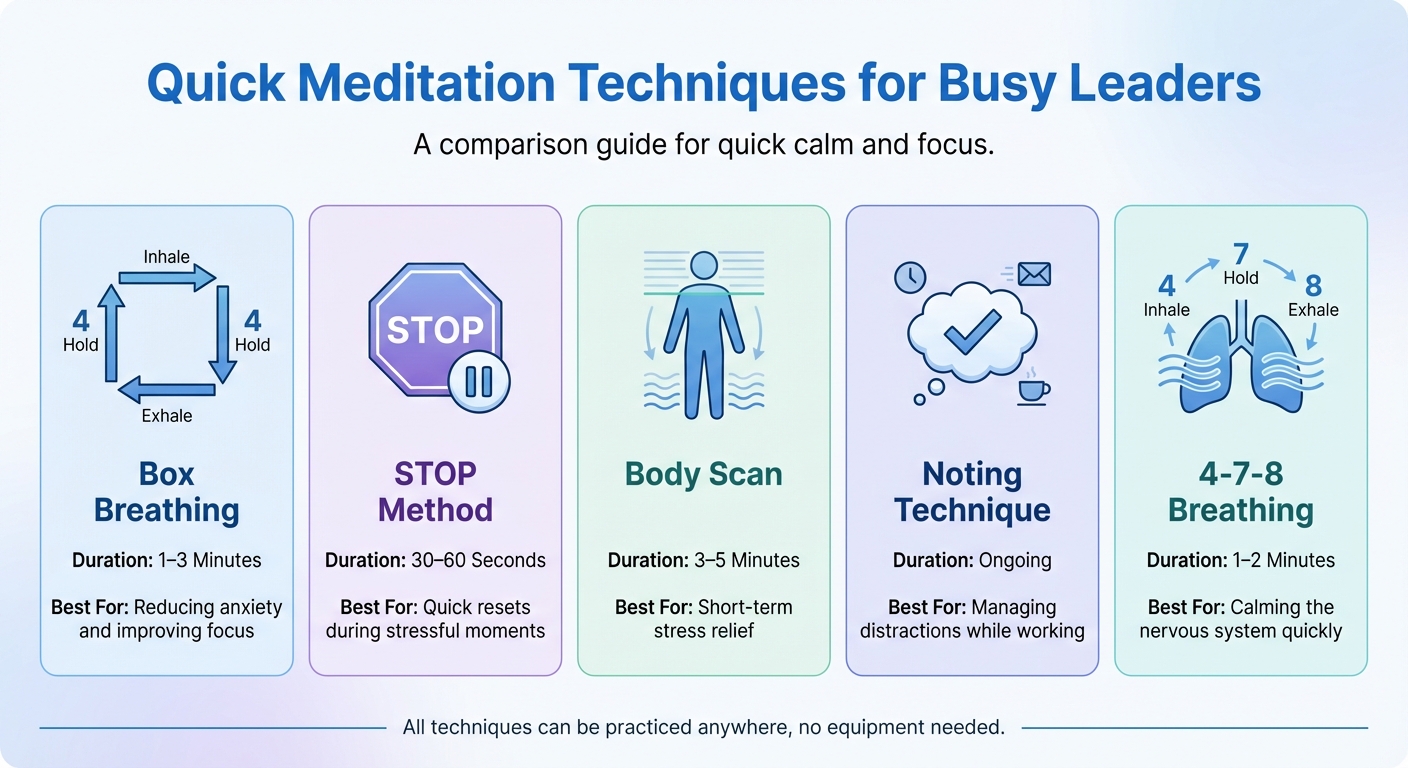
For SaaS leaders constantly juggling responsibilities, meditation can offer a quick and effective way to regain focus and calm amidst the chaos. You don’t need hours to see the benefits - just a few minutes can activate your body’s relaxation response and help you build a sustainable habit over time [24].
One effective strategy is habit stacking - linking meditation to an activity you already do daily. For instance, you could meditate for one minute after brewing your morning coffee, before opening your laptop, or right after brushing your teeth [20]. This approach makes it easier to incorporate mindfulness into your routine without feeling like it’s “one more thing” on your to-do list.
Here’s a closer look at some simple techniques designed to fit seamlessly into a busy leader's day.
5-Minute Mindfulness for Beginners
If you’re new to meditation, start small with basic breathing exercises that require just a few minutes. A great starting point is the body scan, which involves mentally scanning your body from your toes to your head, observing any sensations without judgment. Research on 2,239 participants found this technique to be particularly effective, showing a notable reduction in stress compared to control groups [3].
Another beginner-friendly option is the noting technique. When a distracting thought arises - like worrying about an upcoming meeting or a packed inbox - label it as “thinking” or “anxiety,” then gently refocus on your breath [21]. This practice not only helps manage distractions but also trains your mind to stay present during deep work.
"The goal isn't to find extra time, but to claim a few quiet minutes that are already there."
– Calm Editorial Team [20]
These techniques are incredibly flexible. You can practice them in your parked car before walking into the office, on a bench during lunch, or even while walking between meetings [20][25]. No special equipment or quiet room required.
Quick Practices for High-Stress Moments
When stress peaks during your workday, quick meditation techniques can help you reset in under two minutes. One effective method is box breathing: inhale for four counts, hold for four, exhale for four, and hold for four again [24]. This rhythmic breathing pattern can quickly ease anxiety and sharpen focus, making it ideal before high-stakes presentations or tough decisions.
For an even faster solution, try the STOP method: Stop what you’re doing, Take a breath, Observe your thoughts and sensations, and Proceed with your day [24]. This technique takes less than a minute and is perfect for moments of overwhelm, like right before a critical meeting.
Another option is the 4-7-8 breathing technique, which involves inhaling for four counts, holding for seven, and exhaling for eight [22]. This method activates your parasympathetic nervous system, helping you regain composure when the pressure feels overwhelming.
| Technique | Duration | Best For |
|---|---|---|
| Box Breathing | 1–3 Minutes | Reducing anxiety and improving focus [24] |
| STOP Method | 30–60 Seconds | Quick resets during stressful moments [24] |
| Body Scan | 3–5 Minutes | Short-term stress relief [3] |
| Noting | Ongoing | Managing distractions while working [21] |
| 4-7-8 Breathing | 1–2 Minutes | Calming the nervous system quickly [22] |
Using these techniques individually can also set the stage for a more mindful workplace culture.
Adding Meditation to Team Culture
You don’t need to overhaul your organization to introduce mindfulness into your team’s culture. App-based mindfulness programs are a scalable option, allowing employees to practice at their convenience. A study of 238 employees in tech and pharmaceutical companies found that using a mindfulness app for an average of 17 sessions over eight weeks significantly improved well-being and reduced job strain [4]. Participants also reported feeling more supported at work and experiencing less team-wide stress.
Another option is to offer group mindfulness sessions as optional activities. Aetna, for example, introduced workplace meditation programs that saved $2,000 per employee in healthcare costs and boosted productivity by $3,000 annually [16]. Participation doesn’t need to be mandatory - simply providing access to guided meditation tools and normalizing their use can encourage a shift toward healthier stress management.
"Mindfulness is quickly following yoga in becoming a billion-dollar industry. It's no surprise, then, that the popularity of meditation... is also growing among CEOs and senior executives."
– Emma Seppälä, PhD, Faculty Director of the Women's Leadership Program, Yale School of Management [23]
Start small by incorporating 60-second reboots into natural pauses in your team’s schedule, like after all-hands meetings or between back-to-back calls [20][21]. These brief moments of mindfulness can create mental space without interrupting productivity, setting an example of balanced stress management for your entire team.
Conclusion
Meditation isn’t just a wellness trend for SaaS leaders - it’s a practical strategy for handling the relentless demands of building and scaling software companies. Research shows that consistent meditation can reduce perceived stress by 27% and alleviate anxiety symptoms by 37% [8], while also reshaping brain areas tied to attention and emotional regulation [1]. These benefits lead to clearer decision-making, stronger relationships with your team, and the resilience needed to face challenges without burning out.
Even dedicating just five minutes a day to meditation can deliver noticeable improvements in stress management and mental focus [8]. Over time, these small efforts add up, with benefits appearing well before meditation becomes a habit - typically after about 66 days of consistent practice [26].
"The best way to handle more pressure is to become less reactive to it."
– Allison Dunn, CEO and Business Coach, Deliberate Directions [1]
Choose a technique that resonates with you, whether it’s a body scan, the STOP method, or simple breath awareness, and weave it into your daily routine. The goal isn’t perfection - it’s consistency. Try anchoring your practice to something you already do, like making your morning coffee or settling in at your desk.
FAQs
How can meditation improve decision-making for SaaS leaders?
Meditation empowers SaaS leaders to make sharper decisions by boosting focus, refining emotional control, and sharpening mental clarity. By quieting the mind and lowering stress levels, it helps leaders tackle tough decisions with a clearer perspective and greater confidence.
A consistent meditation practice can also curb impulsive reactions, giving leaders the space to carefully evaluate their options and align decisions with their long-term vision. For those navigating the high-stakes world of SaaS, meditation becomes a key resource for staying grounded and making more thoughtful, strategic calls.
What are some easy meditation techniques for busy SaaS leaders to reduce stress during the workday?
Incorporating meditation into a busy day is simpler than it seems. A quick 5-minute breathing exercise between meetings can work wonders to calm your mind and refocus your energy. Alternatively, you can try a 10-minute mindfulness session - just sit quietly, concentrate on your breathing, and gently release any distractions. Even something as small as mindful breathing during a coffee break can ease stress and sharpen your mental clarity.
The best part? These techniques don’t require any special tools or elaborate setups - just a quiet spot and a few minutes to yourself. By weaving short meditative moments into your routine, you can stay grounded and keep burnout at bay, no matter how hectic your schedule gets.
How does meditation enhance emotional intelligence for SaaS leaders?
Meditation offers SaaS leaders a powerful way to strengthen emotional intelligence by easing stress, sharpening focus, and boosting self-awareness. These benefits help leaders remain composed in high-pressure situations, gain deeper insights into team dynamics, and handle challenges with a thoughtful approach.
Consistent meditation practice also enhances empathy and emotional control - essential traits for building trust and nurturing strong relationships. By cultivating a calmer mind and a more balanced emotional state, leaders are better equipped to make sound decisions and lead their teams with confidence and care.
Related reading
- Best Tools for SaaS Founders to Manage Stress
- ADHD and Routines: Overcoming Task Paralysis
- Daily meditation routine
- Best Bible Verse Chrome Extensions 2026 (Daily Verse & Search)
- Best Apps for ADHD Task Paralysis (Tested 2026)
Useful tools & services
Explore our tools for everyday work
Browse our focus app, PDF reader, and other products to find an option that fits your task.
Browse our productsThese are products built by AGS Advising.