Best Tools for SaaS Founders to Manage Stress
Practical stress-management tools for SaaS founders to cut decision fatigue: focused apps, automation, and short mindfulness routines to protect energy and clar
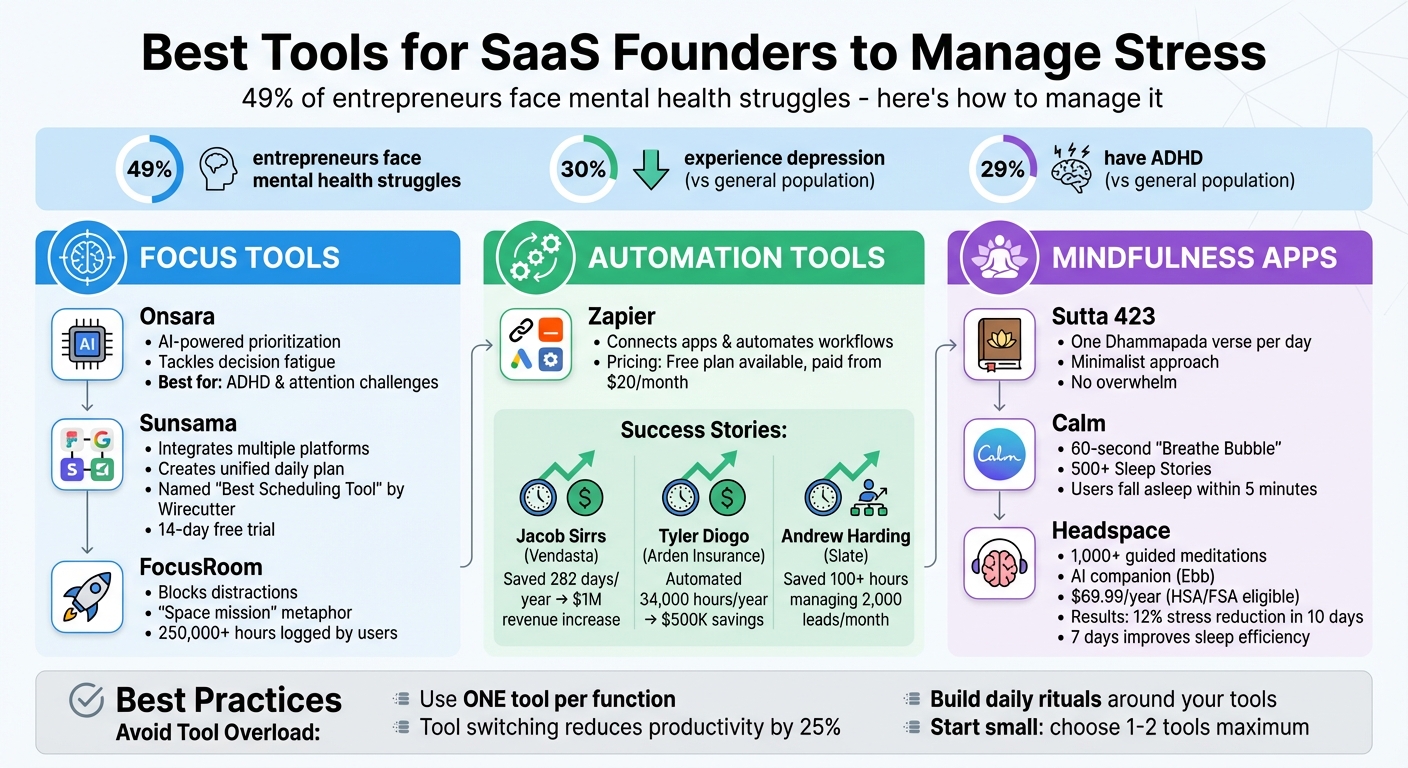
Running a SaaS business is tough. Nearly 49% of entrepreneurs face mental health struggles, with higher rates of depression (30%) and ADHD (29%) compared to the general population. Stress from decision-making, task overload, and constant pressure can take a toll. But using the right tools can make a difference.
Here’s a quick breakdown of tools to help you stay focused, automate repetitive tasks, and manage stress:
-
Focus Tools:
-
Automation Tools:
- Zapier: Connects apps to automate workflows, saving time and reducing manual tasks.
-
Mindfulness Apps:
To avoid tool overload, stick to one tool per function and build simple routines around them. Start small - choose one or two tools, integrate them into your daily habits, and focus on maintaining balance. Stress can’t be eliminated, but it can be managed effectively with the right approach.
How to deal with stress and burnout in the Startup Scene with Tjeu Theunissen
Focus and Productivity Tools
Sometimes, the hardest part of tackling a busy workload isn’t the sheer volume of tasks - it’s figuring out where to start. This struggle, often called task paralysis, can leave even the most capable individuals feeling stuck.
The right focus tools don’t just help you organize your to-do list; they guide you in deciding what to work on right now. Let’s dive into a few tools that go beyond task management to help you take immediate action.
Onsara: Tackling Decision Fatigue
Onsara is a macOS app specifically designed for people with ADHD or anyone who struggles with attention challenges. By using AI and cognitive task analysis, Onsara identifies your next priority, cutting through the overwhelm of decision fatigue.
This is particularly helpful during high-stakes situations like product launches or fundraising, where simply getting started can feel like the biggest hurdle.
Time-Blocking and Managing Attention
Once you’ve identified your priorities, the next step is to protect your time. Tools like Sunsama make this easier by integrating tasks from platforms like Jira, Asana, Slack, and Trello into a single, unified daily plan. This eliminates the mental strain of jumping between apps and helps you map out a realistic schedule for the day [3].
"The tool that has had the greatest impact on my life and my productivity is unquestionably Sunsama."
- Paul Galatis, CEO of Names and Faces [3]
Sunsama has also earned accolades from Wirecutter, which named it the "Best Scheduling Tool." Plus, it offers a 14-day free trial with no credit card required [3].
For those who need help staying focused on deep work, FocusRoom takes a creative approach. Using a “space mission” metaphor, it lets you select up to three tasks, “launch” your mission, and block distractions through Screen Time integration. To date, users have logged over 250,000 hours of focused work on the platform [4].
Automation and Workflow Tools
Running a SaaS company can be mentally exhausting, especially when you're juggling multiple apps and repetitive tasks. That’s where automation tools come in - they take care of the routine work, giving you the time and mental space to focus on growing your business.
Workflow Automation with Zapier
Zapier is a powerful tool that connects your favorite apps and automates workflows, cutting out manual tasks. With Zapier, you can set up "Zaps" to handle things like transferring leads from Facebook into your CRM or updating spreadsheets automatically.
For example, Jacob Sirrs, Marketing Operations Specialist at Vendasta, used automation to save 282 days of manual work annually, which helped generate an additional $1 million in potential revenue [6]. Similarly, Tyler Diogo, Operations Manager at Arden Insurance Services, automated over 34,000 work hours a year with Zapier. This led to $500,000 in overhead savings and helped the company collect $150 million in payments [6].
"Because of automation, we've seen about a $1 million increase in potential revenue. Our reps can now focus purely on closing deals - not admin."
- Jacob Sirrs, Marketing Operations Specialist, Vendasta [6]
Zapier offers a free plan to get started, and its paid plans begin at $20/month [9]. To make the most of it, start by identifying repetitive workflows - like lead management, calendar syncing, or data entry - and automate those first. Not only will this save time, but it will also help you reduce the number of tools you're using by integrating them more strategically.
Reducing Tool Clutter Through Integration
Automation is great for handling repetitive tasks, but integrating your tools takes it a step further by cutting down on distractions and manual syncing. When your project management, billing, CRM, and communication platforms don’t work together, you spend unnecessary time tracking down information and syncing data manually.
Integration simplifies this by connecting your tools, so tasks flow seamlessly. For instance, you can automatically create calendar events from new tasks in Trello or Notion, ensuring your schedule stays accurate without manual updates [7]. Similarly, syncing time entries across project management and billing tools eliminates the need for manual data transfers [5].
Andrew Harding, VP of Marketing and Content Partnerships at Slate, used automation to handle over 2,000 new leads per month. By connecting their lead sources directly to their content management system, his team saved more than 100 hours of manual work [6].
"What used to be overwhelming is now scalable. With Zapier, I don't have to choose between doing good work and doing a lot of it."
- Andrew Harding, VP of Marketing and Content Partnerships, Slate [6]
The key is to streamline repetitive decisions and data transfers. Start by mapping out your most common workflows and pinpointing the steps you repeat daily - those are the best candidates for automation [8]. By doing this, you’ll not only save time but also reduce the mental load of managing disconnected tools.
Mindfulness and Mental Health Apps
While automation can handle your daily responsibilities, mindfulness apps tackle the mental stress that technology alone can't fix. These tools help you manage stress, sharpen focus, and avoid burnout before it disrupts your work. Below, we explore apps that make mindfulness easy to integrate into your routine.
Sutta 423: Daily Mindfulness in Bite-Sized Pieces
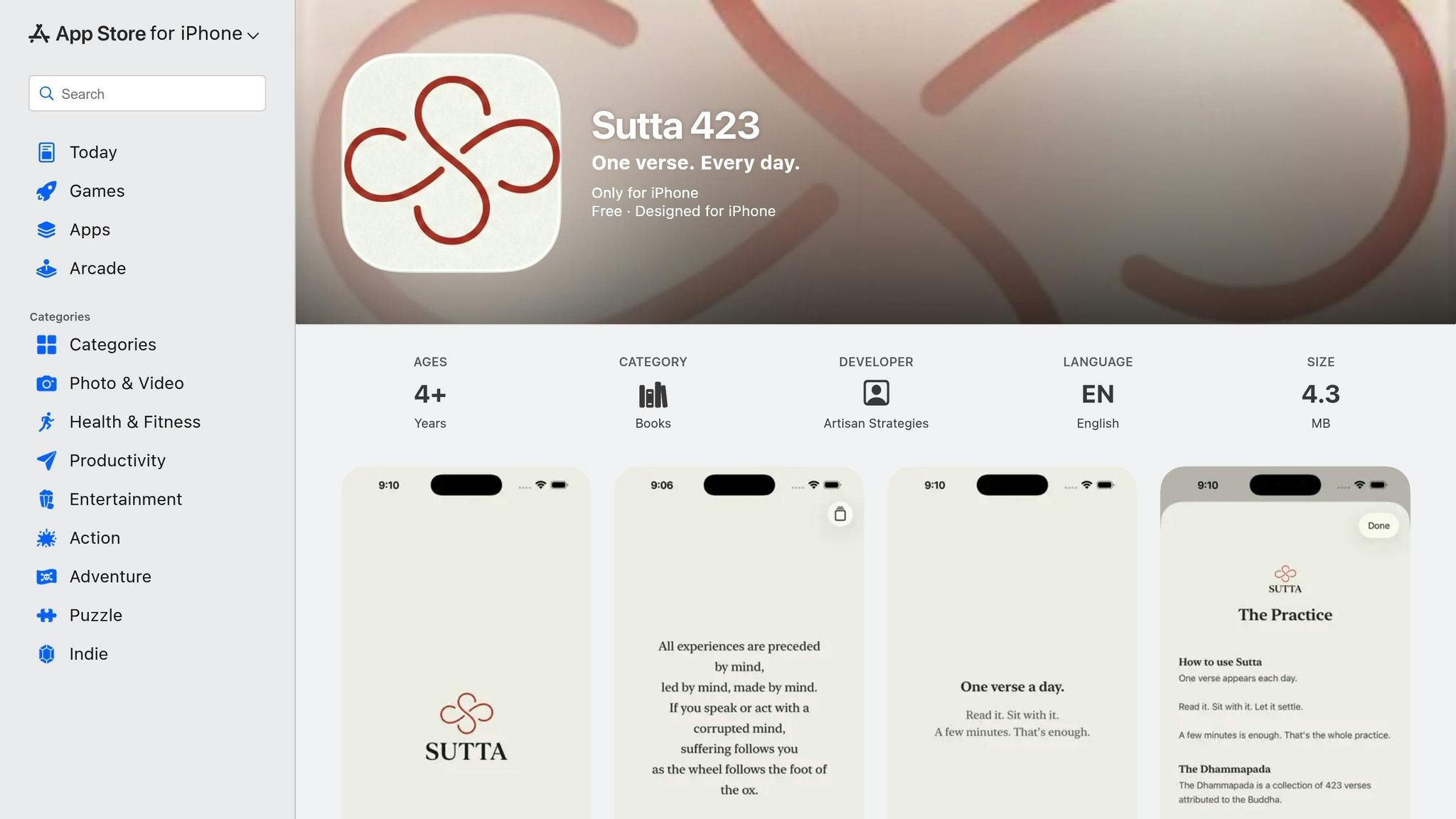
Most meditation apps flood you with endless courses, notifications, and content libraries. Sutta 423 takes a refreshingly simple route - it delivers one Dhammapada verse per day, and that’s it. This minimalist approach is intentional. Instead of adding another task to your already packed schedule, it offers a single, thoughtful piece of wisdom to carry with you throughout the day.
This simplicity is perfect for entrepreneurs who feel overwhelmed by information. There’s no need for a 30-day challenge or deep-dive study. Instead, you’re cultivating a habit of pausing and reflecting - an invaluable tool when decision fatigue or task paralysis sets in.
Meditation with Calm and Headspace
For those who need more structured guidance, Calm and Headspace provide a range of meditation tools tailored to different needs. Calm is all about stress relief and better sleep, offering features like the 60-second "Breathe Bubble" for quick relaxation during high-pressure moments like investor calls or product launches [2]. It also boasts over 500 celebrity-narrated Sleep Stories to help you unwind after a long day [2]. Mathieu, a Calm user from New Orleans, shared:
Calm alleviates stress and guides you quickly to deep sleep. I usually fall asleep within 5 minutes [2].
If you’re looking for a more structured and research-backed approach, Headspace might be the better fit. It provides 1,000+ guided meditations and courses specifically designed for workplace stress and leadership challenges. Its AI companion, Ebb, tailors recommendations based on your emotional state, making the experience personalized. Plus, it’s HSA/FSA eligible and costs $69.99 per year [1][10][11]. Studies have shown that using Headspace for just 10 days can reduce stress by 12%, and 4 weeks of use significantly lowers burnout [11].
Both apps offer free trials, so you can experiment and see which one aligns with your lifestyle. Consistency is key - even using these apps for 7 days can improve sleep efficiency [11], which in turn boosts your focus and decision-making for the day ahead.
How to Avoid Tool Overload
Reducing digital clutter isn't just about boosting productivity - it’s also about safeguarding your mental health. Ironically, stress-management apps can sometimes do more harm than good by requiring constant switching between tools. This mental juggling act can sap your energy and reduce productivity by as much as 25% [12]. Simplify your digital life by sticking to one tool for each task.
Use One Tool per Function
Stick to a single, reliable tool for each purpose. For example, use one task manager, one communication platform, and one focus app. This approach lightens the mental load of managing multiple tools. As productivity expert Justin Pot wisely says:
"The best focus app is the one that helps you focus - that's all it comes down to." [14]
To find the right tools, test them in real-world situations. Whether you’re coding late at night or organizing tasks on a plane, make sure your chosen tools fit seamlessly into your workflow [13].
Build Rituals Around Your Tools
Once you’ve pared down your toolset, embed them into your daily routines to maximize their effectiveness. For instance, if you use Onsara, make it a habit to open it as soon as you start up your laptop [16]. This eliminates the need to decide when to use a tool, freeing up mental energy for actual work.
Establishing routines can make a big difference. Start your day with a quick 5-minute review of your calendar and priorities, and wrap it up with a 10-minute session to jot down unfinished tasks and set your top priority for the next day [16][17]. Take inspiration from Asana’s 2022 "Meeting Doomsday" experiment, where participants canceled all recurring meetings for 48 hours and only rescheduled the essential ones. This simple ritual saved an average of 11 hours per month by cutting out unnecessary syncs [15]. It’s a powerful reminder to periodically audit your tools and routines, keeping only what genuinely supports your work.
Conclusion
Simplifying your toolkit and establishing consistent habits can lay the groundwork for managing stress effectively and sustainably.
As a SaaS founder, managing stress isn’t about piling on more apps - it’s about carefully selecting the right ones and sticking with them. Constantly switching between tools can sap your focus and eat up valuable time [20]. That’s why fewer tools, used well, can be far more effective in creating a sustainable workflow.
Focus on tools you’ll actually use. Whether it’s Onsara to help prioritize your tasks, Sutta 423 for daily, bite-sized mindfulness, or a straightforward time-blocking app, the goal is to integrate these tools into your routine, not accumulate them. Dr. Sherry Walling, Clinical Psychologist, captures this perfectly:
Move fast; don't break you [19].
Start small - choose one or two tools that address your most pressing challenges. If mornings are chaotic due to decision fatigue, try a focus app. If feeling overwhelmed is your struggle, commit to a simple 5-minute mindfulness practice, which has been shown to lower stress [18]. Build routines around these tools until they become automatic, reducing the mental load of constant decision-making. This ties back to the streamlined workflows and mindful practices we’ve discussed earlier.
The goal isn’t to eliminate stress entirely. A manageable level of stress can actually enhance performance, as supported by the Yerkes-Dodson Law. The focus should be on maintaining that optimal zone - where stress energizes your work without overwhelming you. The right tools and rituals can help you stay balanced, providing clarity and resilience to navigate the ups and downs of entrepreneurship.
FAQs
What are the best ways for SaaS founders to manage stress without relying on too many tools?
To handle stress effectively without drowning in an overload of tools, SaaS founders should aim to streamline their digital workspace. Stick to a handful of well-chosen tools that address specific needs, such as boosting focus, managing time, or encouraging mindfulness. The idea is to focus on quality tools rather than piling on unnecessary apps that add to the clutter.
For instance, apps geared toward focus and mental clarity can help tackle task paralysis and ease decision fatigue. On top of that, setting boundaries - like turning off non-essential notifications or carving out blocks of time for deep, uninterrupted work - can help create a more balanced and manageable workflow. The goal is to design a simple system that not only boosts productivity but also safeguards your mental health.
What are some effective mindfulness tools to help reduce stress at work?
Managing stress at work becomes more manageable with the help of mindfulness tools. Apps like Headspace and Calm provide guided meditations, breathing exercises, and techniques aimed at easing anxiety, sharpening focus, and encouraging relaxation. Whether you’re looking for a quick mental reset or a longer session to clear your mind, these apps are designed to fit effortlessly into your daily routine.
For quick and effective breathing techniques, methods like box breathing or the 4-7-8 technique can work wonders in moments of high pressure. These mindfulness tools, along with productivity apps, can help you stay grounded, reduce stress, and stay focused in even the busiest work environments.
How can automation help SaaS founders manage stress effectively?
Automation can be a game-changer for SaaS founders, especially when it comes to handling repetitive, time-consuming tasks like email management, scheduling, and data entry. By letting smart tools take over these responsibilities, founders free up valuable time to concentrate on strategic planning and creative projects. The result? A boost in productivity and a noticeable reduction in mental exhaustion.
Beyond just saving time, automation helps cut down on errors and ensures consistency across operations, whether it’s in customer communication or managing data. This consistency not only streamlines workflows but also eases the mental burden, allowing founders to stay more focused and composed. Incorporating automation into daily routines can make a huge difference in achieving a healthier work-life balance, alleviating some of the stress that naturally comes with scaling a business.
Related reading
- How Meditation Helps SaaS Leaders Avoid Burnout
- ADHD and Routines: Overcoming Task Paralysis
- Daily meditation routine
- Best Bible Verse Chrome Extensions 2026 (Daily Verse & Search)
- Best Apps for ADHD Task Paralysis (Tested 2026)
Useful tools & services
Explore our tools for everyday work
Browse our focus app, PDF reader, and other products to find an option that fits your task.
Browse our productsThese are products built by AGS Advising.