compare the pricing models of leading ai inventory solutions geared toward b2b e-commerce and suggest which tiers make sense for a series a startup.
Compare top AI inventory platforms, pricing tiers, and features to pick the right plan for Series A B2B e-commerce startups.
AI inventory solutions can help B2B e-commerce startups reduce costs and improve efficiency, but choosing the right pricing tier is critical. Here’s a quick breakdown of the top platforms and their best tiers for Series A startups:
- Cin7 Pro ($599/month): Ideal for growing startups managing up to 24,000 orders annually. Includes 10 user seats, AI-driven demand forecasting, and multi-channel integrations.
- QuickBooks Commerce Advanced ($275/month): Affordable option for startups needing financial insights, KPI forecasting, and inventory tracking. Scales to 25 users.
- DEAR Inventory (starting at $325/month): Great for startups managing multiple locations and using automated replenishment tools. Offers a customizable B2B portal for efficiency.
- Zoho Inventory Premium ($129/month): Budget-friendly for startups handling up to 7,500 orders monthly. Includes automation tools and batch tracking.
- Katana MRP Professional ($799/month): Best for startups with complex workflows, offering full traceability, demand forecasting, and support for up to 10 locations.
Quick Comparison
| Platform | Best Tier for Startups | Monthly Cost | Key Features | Scalability |
|---|---|---|---|---|
| Cin7 | Pro | $599 | AI demand forecasting, MRP, 10 users | High (24,000 orders) |
| QuickBooks | Advanced | $275 | KPI forecasting, financial tools, 25 users | Moderate |
| DEAR Inventory | Base Plan | $325 | Multi-location support, automated replenishment | Moderate |
| Zoho Inventory | Premium | $129 | Batch tracking, automation, analytics | Moderate (7,500 orders) |
| Katana MRP | Professional | $799 | Full traceability, demand forecasting | High (10+ locations) |
Recommendation: Startups with moderate order volumes and tight budgets should consider Zoho Inventory Premium or QuickBooks Commerce Advanced. Those experiencing rapid growth or managing complex operations should look at Cin7 Pro or Katana MRP Professional for their scalability and robust AI tools.
1. Cin7
Pricing Tiers
Cin7 offers four pricing tiers to cater to businesses of different sizes and needs:
- Standard – $349/month: Includes 5 users, 2 integrations, and supports up to 6,000 orders per year.
- Pro – $599/month: Offers 10 users, 4 integrations, and handles up to 24,000 orders annually.
- Advanced – $999/month: Provides 15 users, 6 integrations, and supports up to 120,000 orders per year.
- Omni – Custom pricing: Designed for enterprise-level businesses with specific requirements.
Every plan comes with unlimited inventory locations. Additional features like the B2B Portal for wholesale customer self-service, ForesightAI for demand forecasting, and Intelligent Document Recognition for automating order entry from PDFs are available as add-ons [4]. These pricing structures set the stage for businesses to leverage advanced tools that enhance operational efficiency.
AI Features
Cin7's AI-driven tools are designed to streamline inventory and order management:
- ForesightAI: Powered by over 100 algorithms, this tool predicts demand and automates reordering processes [6].
- Intelligent Document Recognition: Converts purchase orders in PDF format directly into sales orders [6].
- AI Product Description Generator: Creates SEO-friendly product descriptions for catalogs [6].
"It changed my life. The accuracy in the numbers and the time saved with Cin7 is huge" [9].
HairCo reported a 10% increase in sales within just three months of using Cin7's ForesightAI recommendations [9].
Scalability
Cin7 integrates with over 700 tools, including QuickBooks, Xero, Shopify, and Amazon, making it easy to scale alongside business growth. As your needs expand, Cin7 supports more users, integrations, and higher order volumes [5][7]. Notably, the Pro tier introduces Material Requirements Planning (MRP), which dynamically adjusts supply based on demand [4].
For example, Royal Essence used Cin7 Core to unify operations from manufacturing to shipping, resulting in a 40% sales increase [5]. Similarly, Gumball Poodle utilized Cin7 to synchronize inventory across Shopify and Faire in real time, preventing overselling during peak sales periods [8]. These examples highlight Cin7's ability to adapt to the demands of growing businesses.
Suitability for Series A Startups
Cin7's Pro tier, priced at $599/month, is a great fit for Series A startups. It balances affordability with functionality, offering support for 24,000 orders per year, 10 user seats, and MRP capabilities - ideal for businesses scaling up without overspending [4]. For startups nearing 100,000 orders annually or requiring advanced warehouse management, the Advanced plan at $999/month offers additional capacity and features. On the other hand, the Standard plan's 6,000-order limit may be too restrictive for rapidly expanding companies, while the Omni tier's custom pricing is typically suited for more mature, mid-market enterprises.
2. TradeGecko (QuickBooks Commerce)
Pricing Tiers
After being acquired by Intuit in 2020 and rebranded as QuickBooks Commerce in 2022, the platform's inventory tracking features are now exclusively available in the Plus and Advanced tiers of QuickBooks Online [26, 27]. These tiers include essential tools like inventory tracking, purchase orders, and sales orders.
The Plus plan is priced at $115 per month and supports up to 5 users, offering complete inventory tracking capabilities [10]. For businesses needing more advanced tools, the Advanced plan costs $275 per month, accommodates 25 users, and includes features like custom dashboards, KPI forecasting, and revenue recognition - ideal for preparing detailed investor reports [10]. For companies that require more robust functionality, Intuit also provides the Intuit Enterprise Suite, delivering ERP-level tools [11]. These pricing options allow businesses to adapt as they grow while utilizing QuickBooks Commerce's AI-driven tools to optimize workflows.
AI Features
QuickBooks Commerce incorporates Intuit Assist, an AI engine designed to handle administrative tasks and provide real-time insights [23, 24]. Key features include:
- A Customer Agent to streamline lead management and enable personalized follow-ups.
- A Finance Agent for KPI analysis and scenario planning.
- AI-powered invoice reminders, which help businesses receive payments 45% faster on average [24, 25].
Other advanced tools include AI-Powered Reconciliation, which automatically imports bank statements and flags discrepancies to speed up month-end closings. The Sales Tax Agent (currently in beta) identifies mismatches between profit-and-loss statements and sales tax reports, reducing errors in financial management [24, 25]. These AI-driven features are particularly effective in minimizing inventory shrinkage, as administrative and paperwork errors account for about 16.5% of such losses [12].
Scalability
QuickBooks Commerce connects with over 800 apps, including Shopify, Amazon, Etsy, and BigCommerce, ensuring that inventory remains synchronized across multiple sales channels [24, 25]. The Plus plan is ideal for smaller, growing e-commerce brands with its 5-user limit, while the Advanced plan scales up to 25 users and offers added functionality like custom permissions and Excel data sync [11]. With a global customer base exceeding 7 million, QuickBooks Commerce has proven its ability to support businesses at various stages of growth [12].
Suitability for Series A Startups
For Series A startups aiming for rapid growth, QuickBooks Commerce offers both flexibility and scalability. Startups managing moderate sales volumes can benefit from the Plus plan at $115 per month. Those generating over $100,000 in monthly sales or requiring in-depth financial analytics should consider the Advanced plan at $275 per month [10].
"The Advanced plan works best for ecommerce brands juggling wholesale orders, international logistics, team collaboration, and product launches at scale" [10].
3. DEAR Inventory
Pricing Tiers
DEAR Inventory provides several pricing options designed to accommodate different business needs. It supports multiple locations and integrates with key accounting platforms seamlessly. Additionally, businesses can opt for a customizable B2B Portal as an add-on. This portal allows customers and sales representatives to search for products, compare prices, and handle transactions independently. For those opting for an annual subscription, DEAR Inventory offers one month free, effectively lowering the monthly cost by about 8% [15].
AI Features
With its AI-driven capabilities, DEAR Inventory transforms inventory management into a more strategic tool [3]. It offers real-time visibility into stock across various warehouses and sales channels - an essential feature for Series A startups venturing into multi-channel B2B sales. The platform also includes automated replenishment, which predicts demand and triggers restock orders, helping businesses avoid last-minute supply issues [3]. This automation enables small teams to manage thousands of SKUs with ease and efficiency [29, 34].
Scalability
DEAR Inventory supports startups transitioning from manual systems by offering a free trial and assistance with data conversion [15]. The platform provides a unified, real-time view of inventory across multiple locations, eliminating the need for manual tracking [16]. By automating repetitive tasks like order entry and catalog updates, it frees up startup teams to focus on building stronger customer relationships [13]. This scalability ensures that DEAR Inventory can grow alongside businesses as they expand.
Suitability for Series A Startups
DEAR Inventory is well-suited for Series A startups experiencing rapid growth. Its AI-powered automation and multi-location support make it a scalable solution for businesses preparing to expand. The optional B2B Portal enhances efficiency by enabling self-service ordering, cutting down on administrative tasks. Additionally, its real-time inventory management and automated replenishment features ensure startups can maintain optimal stock levels while keeping operations smooth and efficient. This combination of tools positions DEAR Inventory as a valuable asset for growing companies.
4. Zoho Inventory
Pricing Tiers
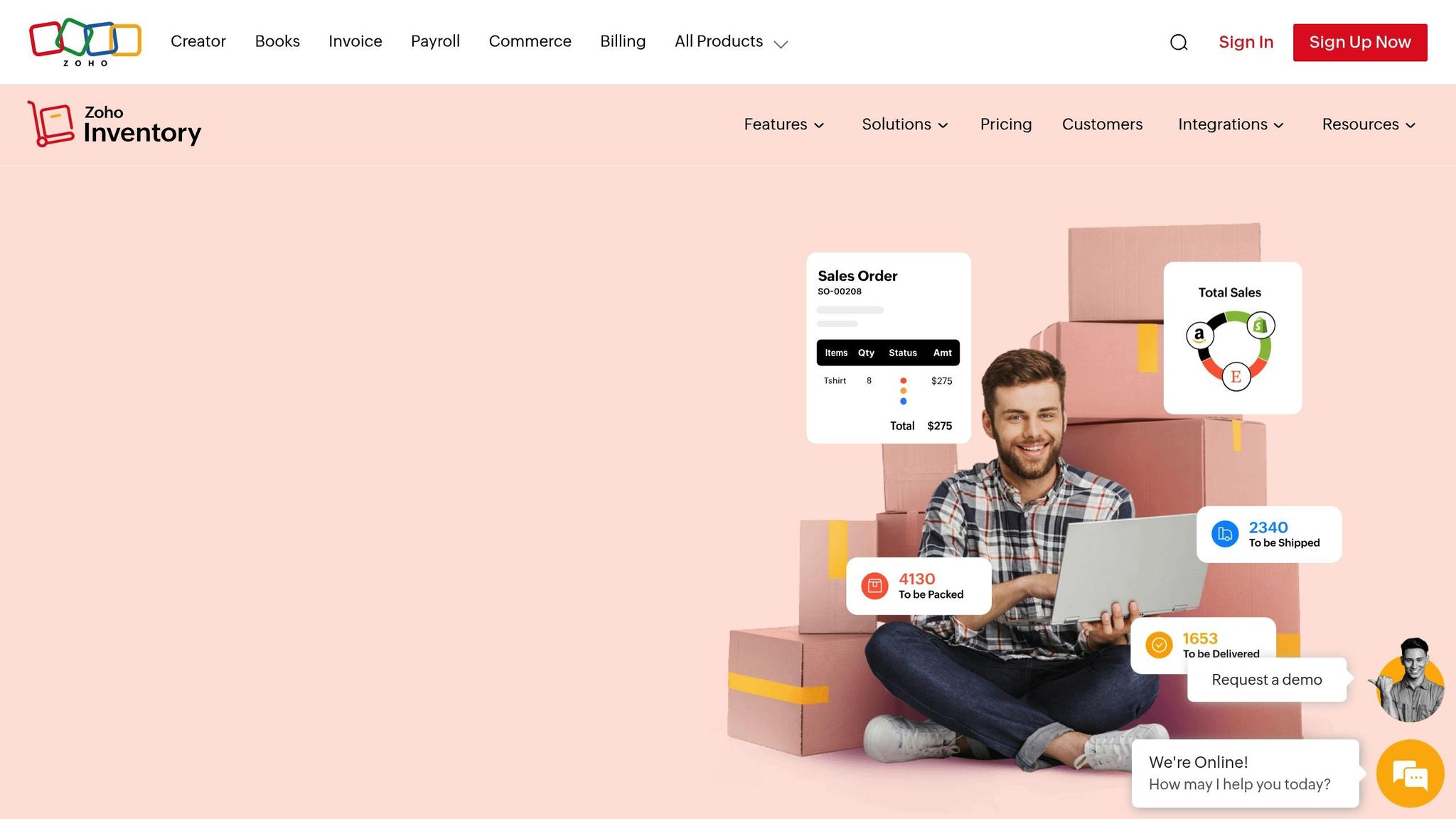
Zoho Inventory offers five pricing options: Free, Standard at $29/month, Professional at $79/month, Premium at $129/month, and Enterprise at $249/month (all based on annual billing) [17][2]. The pricing varies depending on factors like order volume, number of users, and warehouse locations. The Professional tier is the starting point for features essential to B2B operations, such as serial number and batch tracking. Upgrading to the Premium tier unlocks automation tools like webhooks, custom functions, and barcode generation [2][1]. At the top, the Enterprise tier supports up to 15,000 orders monthly and includes Zoho Analytics for advanced reporting capabilities [2][1].
Zoho also offers a modular add-on system for flexible scaling. You can add users for $7.50/month, increase your order limit by 500 for $7.50/month, or expand warehouse locations for $10/month [2]. This flexibility allows startups experiencing rapid growth to scale incrementally without committing to higher-tier plans immediately. Now, let's explore how Zoho uses automation to simplify inventory management.
AI Features
Zoho integrates smart automation tools to enhance efficiency. For instance, Advanced Autoscans ($8 for 50 scans/month) automate tasks like data entry and item recognition, helping reduce manual errors [2]. The Advanced Analytics tool, available in the Enterprise plan, processes up to 3 million records, enabling detailed forecasting and the creation of customized reporting dashboards [1]. Additionally, the Premium and Enterprise tiers allow up to 10 automation rules per module, streamlining processes like email notifications and field updates [1]. API capabilities also scale with the plans, starting at 1,000 calls per day on the Free plan and going up to 10,000 calls per day on the Enterprise plan, ensuring robust integration with existing systems [1].
Scalability
Zoho Inventory supports over 40 shipping carriers and integrates with major marketplaces like Amazon, eBay, and Etsy [18]. It also connects seamlessly with other Zoho tools, such as Zoho Books, CRM, and Analytics, providing startups with the foundation to grow into a full ERP system. Paid plans include vendor and customer portals, which simplify managing B2B relationships without adding administrative burdens [2]. All paid tiers come with 24/5 free customer support and a 14-day trial, offering startups a low-risk way to test the platform [2][18]. These features make Zoho Inventory a scalable solution for startups with growing operational demands.
Suitability for Series A Startups
For Series A startups, finding a plan that balances cost and functionality is critical. The Professional tier ($79/month) provides essential features like batch and serial tracking, making it a solid starting point. For companies ready to scale, the Premium tier ($129/month) adds automation tools like webhooks, which can streamline operations [2][1]. However, the Standard plan, with its 500-order monthly cap, is likely too restrictive for most Series A companies. Startups can also take advantage of Zoho’s add-ons to handle incremental growth without jumping to the Enterprise tier prematurely. For businesses needing advanced forecasting and analytics, the Enterprise plan, with its Zoho Analytics integration, is ideal for supporting data-driven decision-making [1].
5. Katana MRP
Pricing Tiers
Katana MRP offers a flexible pricing structure tailored for growing B2B e-commerce startups. Their model combines a base monthly fee with usage-based limits tied to delivered orders and GMV [19]. The Free plan ($0) includes features like 30 SKUs, 3 inventory locations, Shopify integration, and API access, plus a 15-day trial period. The Standard tier ($359/month) upgrades to unlimited SKUs, 3 locations, multicurrency support, and barcode scanning. For businesses needing more, the Professional tier ($799/month) supports up to 10 locations and adds full traceability, forecasting tools, and warehouse management. At the top, the Professional Plus tier ($1,799/month) includes unlimited locations, a dedicated account manager, and priority support.
If your monthly delivered sales orders or GMV exceed set thresholds for three consecutive months, Katana automatically upgrades your plan. All paid tiers require a one-time onboarding fee, ranging from $2,000 to $3,000, to ensure workflows are set up correctly. Additionally, advanced features can be added for $199/month. Unlike traditional ERP systems that can take 6–12 months to implement, Katana’s setup process is completed within weeks [19][20].
AI Features
Katana integrates AI through its KAI (Katana AI Assistant), designed to automate and simplify key tasks. For example, KAI can extract order details from emails to generate quotes and sales orders [21]. You can also interact with it using natural language commands like, "Which sales orders are delayed?" for instant updates. KAI creates custom charts and visualizations to help you spot trends and monitor buying patterns. For demand planning, Katana uses AI-driven forecasting to analyze historical data, predict future demand, and recommend optimal reorder points [19][25].
"Katana allowed us to strategically manage our capacity and increase how many orders we could get by over 50%" [20].
Scalability
Katana’s paid plans are designed to grow with your business. They include unlimited users, SKUs, and integrations, eliminating the need for per-seat licensing fees [19]. The platform supports a variety of workflows, such as Make-to-Order, Make-to-Stock, contract manufacturing, and kits or bundles, to meet diverse operational requirements [20][23]. Katana also integrates seamlessly with platforms like Shopify, Amazon, WooCommerce, BigCommerce, QuickBooks Online, and Xero. Additionally, its open API connects with over 400 e-commerce platforms [20][24].
Users report impressive results: a 60% annual increase in sales revenue, a 1.2× improvement in inventory turnover, and order processing speeds up to 3× faster thanks to native integrations [22].
"Katana allowed us to consolidate everything into one platform. We know what our inventory is at the central hub, and it pushes out to every other location" [20].
These capabilities make Katana MRP an excellent fit for startups navigating the challenges of rapid growth.
Suitability for Series A Startups
For Series A startups, the Professional tier ($799/month) is a standout option. It offers essential features like API access for custom tech stacks, support for up to 10 locations, and full traceability with batch and serial number tracking - critical for regulated industries [19]. The tier also includes planning and forecasting tools, enabling businesses to scale without needing additional staff.
Before selecting a plan, consider your monthly delivered sales orders and GMV, as exceeding the limits for three months will trigger an automatic upgrade. Keep in mind the mandatory onboarding fee ($2,000–$3,000) to ensure your workflows are configured correctly. If you need advanced shop floor tracking, the $199/month Advanced Manufacturing add-on is a cost-effective alternative to jumping straight to the Professional Plus tier [19].
5 Best Inventory Management Software Systems 2025 (Small Business, eCommerce, Manufacturing)
Strengths and Weaknesses
Let's wrap up the evaluations by highlighting the main strengths and weaknesses for Series A startups.
For Series A startups, finding the right balance between functionality and cost is absolutely crucial. Among the solutions reviewed, Zoho Inventory emerges as a standout option thanks to its affordable pricing and straightforward usability. For example, its Standard tier, priced at $29/month (500 orders, 2 users [2]), is a great fit for startups that are mindful of their budgets. Its real strength lies in its basic automation features, such as workflow rules and reorder processes, which make inventory management simpler.
However, there’s a catch: this basic automation might not hold up as businesses grow. For startups experiencing rapid expansion, higher-volume plans like the $129/month Premium tier (7,500 orders) might still fall short. While advanced AI-driven pricing tools can increase gross profits by 2–4% [26], these features come at a premium, forcing startups to weigh the benefits of immediate savings against the potential long-term gains of dynamic pricing.
| Solution | Starting Price | AI Strength | Scalability | Best For |
|---|---|---|---|---|
| Zoho Inventory | $29/month (Standard tier) | Traditional automation (workflow rules) | May face limits at high volumes | Budget-conscious Series A startups |
This analysis underscores the importance of adopting a balanced strategy as startups grow, tying together earlier insights on pricing, AI capabilities, and scalability.
Conclusion
From the analysis, it's clear that pricing flexibility and scalable AI tools play a crucial role for Series A startups. Choosing the right AI-powered inventory solution depends heavily on factors like current order volume, team size, and growth plans. For example, Zoho Inventory's Standard tier at $29 per month is a solid choice for startups managing up to 500 orders monthly. However, as businesses grow, they may quickly find themselves needing more advanced options.
For startups experiencing steady growth, Cin7 Pro's tier at $599 per month is a logical step up. It supports up to 24,000 orders annually, accommodates 10 users, and includes Material Requirements Planning (MRP) - a feature particularly useful for meeting B2B demands without breaking the bank.
Budget planning is another key consideration. Allocating part of your e-commerce budget to AI tools can lead to noticeable returns. In fact, AI-driven dynamic pricing has been shown to increase revenue by 2% to 5% and improve profit margins by 5% to 10% [14]. These gains can make a significant difference for startups aiming to maximize their resources.
For businesses with fluctuating order volumes, transaction-based pricing models provide much-needed flexibility by eliminating fixed monthly costs. As highlighted in this review, aligning your pricing tier with your growth stage is essential for smooth operations. Starting with a mid-tier plan that fits your current needs and adding modular AI features over time allows for seamless scaling without the hassle of expensive migrations.
FAQs
What should a Series A startup consider when selecting an AI inventory solution for B2B e-commerce?
When picking an AI inventory solution, Series A startups should prioritize cost flexibility, B2B-focused features, and scalability to match their growth ambitions and budget limitations.
Flexible pricing models, like pay-per-order plans or tiered options based on order volume, can help startups manage cash flow effectively without hefty upfront expenses. This ensures resources are allocated wisely during the early stages. On top of that, the platform should offer essential B2B tools such as demand forecasting, automated replenishment, and support for tiered or contract-based pricing - features designed to handle the unique challenges of B2B operations.
Scalability is equally important. Whether it’s adding new users, expanding to more warehouses, or integrating with other systems, the solution should grow alongside your business. Opt for platforms that offer easy onboarding, clear pricing structures, and dependable customer support to reduce disruptions and keep your team focused on scaling efficiently.
How can AI-powered inventory solutions help Series A B2B e-commerce startups grow efficiently?
AI-powered inventory solutions enable Series A B2B e-commerce startups to streamline their operations and grow efficiently without breaking the bank. By analyzing factors like sales history, market trends, and supplier lead times, AI-driven forecasting ensures you maintain the right stock levels. This reduces the risks of running out of stock or overstocking, saving money while keeping operations running smoothly.
AI doesn’t stop there - it takes over routine tasks like tracking purchase orders, sending alerts for replenishment, and resolving inventory issues. By automating these processes, you can minimize errors and free up your team to focus on big-picture growth strategies. On top of that, dynamic pricing tools adjust prices in real time based on variables like customer segments or order sizes, helping you protect your profit margins.
AI also enhances the customer experience by offering insights into buyer behavior and delivering personalized product recommendations. These features encourage more frequent orders and larger deal sizes. Combined, these tools create a scalable and cost-efficient foundation for startups to achieve their goals and drive sustainable growth.
What is the most flexible pricing plan for startups managing unpredictable order volumes?
For Series A startups facing unpredictable order volumes, a transaction-based plan can be a game-changer. This pricing model adapts to your activity levels, meaning you’re charged only for what you use. For instance, instead of a fixed monthly fee, you’d pay based on the number of orders processed, allowing your expenses to rise or fall in sync with your business needs.
This setup helps you avoid overspending during slower periods while still giving you the flexibility to manage growth seamlessly - no need to jump to higher pricing tiers prematurely. It’s a smart choice for startups dealing with fluctuating demand.
Related reading
- Zuora vs Stripe vs Orb (2026): Usage-Based Billing for SaaS
- Usage-Based Pricing for SaaS: When It Works and When It Backfires
- what pricing models should i expect from ai-driven bi platforms that track real-time product metrics?
- Should You Add Enterprise Pricing? A Revenue-Impact Calculator for SaaS
- How to Price Your SaaS Product When You Have No Competitor Data
Useful tools & services
See what a useful assessment looks like
Connect an observed problem to a recommendation, implementation owner, and success check.
Use the assessment templateNeed help choosing the next change? Explore CRO consulting.
Keep improving your conversion work.
Subscribe for practical ideas on diagnosing conversion problems, planning experiments, and choosing your next improvement.
No spam. Unsubscribe anytime.