Morning Buddhist Practice: 5-Minute Routines for Busy Professionals
Five-minute Buddhist-inspired morning routines—breath awareness, walking meditation, gratitude, and three-breath pauses—to cut workplace stress and boost focus.
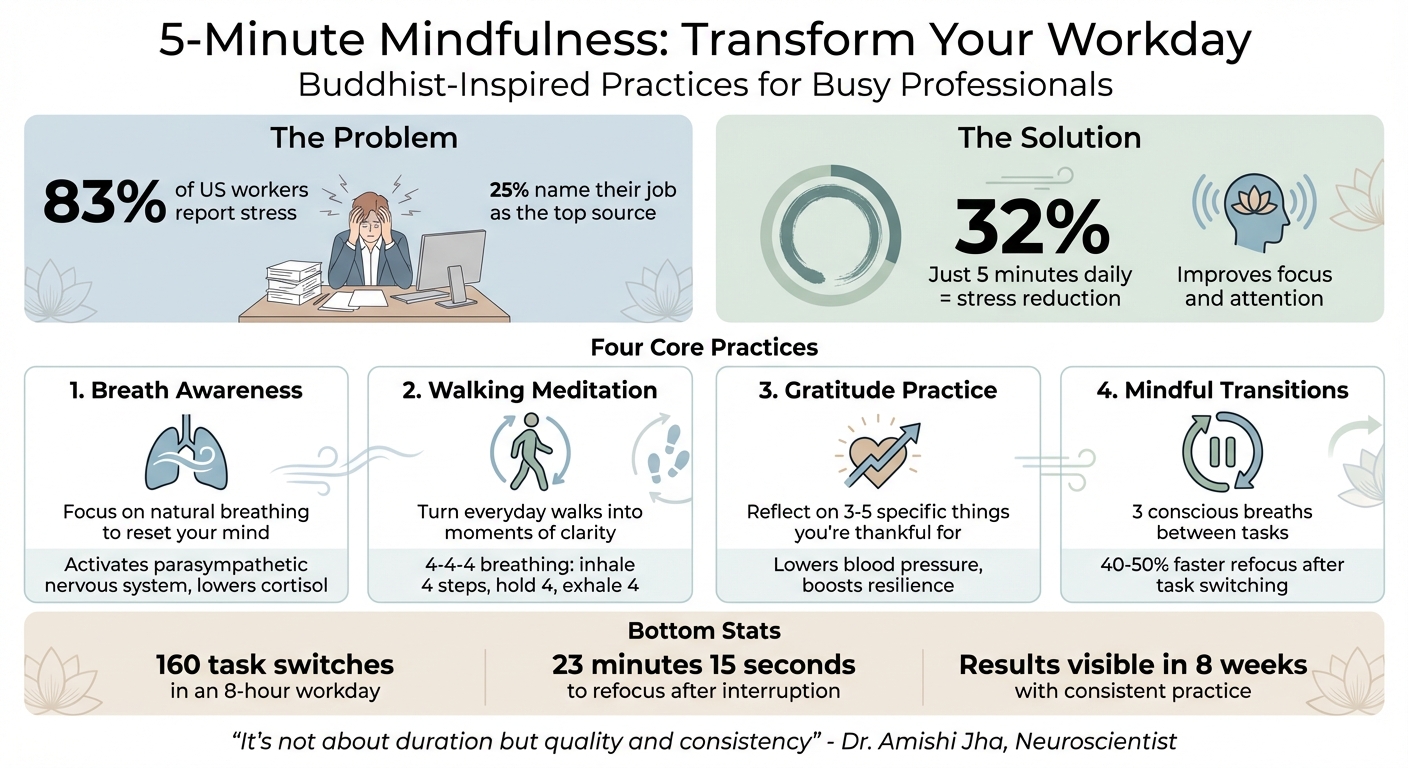
Feeling overwhelmed at work? You’re not alone - 83% of US workers report stress, with 25% naming their job as the top source. But even with a packed schedule, you can find calm through quick, Buddhist-inspired mindfulness practices.
Here’s the key takeaway: just five minutes a day can reduce workplace stress by 32% and improve focus. Techniques like breath awareness, mindful walking, and gratitude reflections fit seamlessly into your routine - whether during your commute, while brewing coffee, or between meetings.
Highlights:
- Breath Awareness: Focus on natural breathing to reset your mind.
- Walking Meditation: Turn everyday walks into moments of clarity.
- Gratitude Practice: Start your day by reflecting on specific things you’re thankful for.
- Mindful Transitions: Pause between tasks with three deep breaths to regain focus.
These small changes can help you manage stress, improve attention, and bring more balance to your day - all without overhauling your routine.
5 Things To Make Your Mornings Better | A Monk’s Perspective
Breath Awareness Meditation
Breath awareness is a cornerstone of Buddhist mindfulness practice. Your breath is always with you - whether you're at your desk, stuck in traffic, or waiting for a meeting to begin. Think of it as a built-in sanctuary that requires no apps, tools, or special setup. Let’s walk through a simple way to use this practice to center your attention.
At its core, this practice is about observing the physical sensations of your breath. It’s not about trying to control it or make it “better.” Instead, focus on what’s naturally happening - the cool air entering your nostrils, the gentle rise and fall of your chest. When your mind inevitably drifts to tasks, deadlines, or worries, simply notice the distraction, acknowledge it, and gently bring your focus back to your breath.
Meditation teacher Sharon Salzberg calls the moment you notice your mind has wandered the “magic moment.” It’s not a failure; it’s an opportunity to develop a more intentional response. This mindset can be incredibly useful in the workplace when deciding how to approach challenges or setbacks.
How to Practice Breath Awareness
Here’s how to get started. Find a comfortable position - whether seated with your feet flat on the ground or on a cushion - and either soften your gaze or close your eyes.
Begin with three or four slow, deliberate breaths, inhaling through your nose and exhaling through your mouth. This helps you settle into the practice. Then, let your breathing return to its natural rhythm. Focus on where the sensation feels most noticeable - perhaps the tingling at your nostrils, the temperature shift as air moves in and out, or the gentle movement of your abdomen.
When your thoughts wander (and they will), simply notice them without judgment. You might silently label the distraction as “thinking” and then redirect your attention to your breath. After about five minutes, take one last deep breath, notice how your body feels, and ease back into your day.
Why This Helps Professionals
This practice introduces a pause - a brief moment of mental clarity between a stimulus and your response. That pause can be the difference between reacting impulsively and responding thoughtfully. By focusing on your breath, you activate your parasympathetic nervous system, which helps lower cortisol levels and counteracts the stress response that often keeps you in “fight or flight” mode.
Science backs this up. A 2019 study in Frontiers in Human Neuroscience found that just five minutes of meditation can engage the anterior cingulate cortex, a part of the brain tied to attention and emotional regulation [5]. Other studies suggest that meditating for at least 12 minutes a day, five days a week, can help improve focus and resilience under stress [8].
As one mindfulness neuroscientist explains, regular short sessions can lead to lasting changes in brain function, enhancing your ability to manage emotions and handle stress [5].
Breath awareness acts like a reset button, giving you the space to regain control before stress takes over. It teaches you to navigate stress rather than letting it overwhelm you.
Walking Meditation for Work Days
Breath awareness is a great starting point for mindfulness, but what if you could take that calm with you as you move? You don’t need a quiet room or a meditation cushion to practice mindfulness. Everyday transitions - like walking from the parking lot to the break room - can become moments of calm that help you tune out workplace stress.
The idea is simple: focus on the physical act of walking. Pay attention to how your feet connect with the ground, the way your weight shifts from heel to toe, and the natural swing of your arms. Pair this with the 4-4-4 breathing rhythm: inhale for four steps, hold for four steps, and exhale for four steps. This technique redirects your attention from racing thoughts to the sensations of movement.
How to Practice Walking Meditation
Start by standing still for a moment. Keep your posture upright, relax your shoulders, and let your hands rest naturally at your sides or clasp them behind your back. Take a deep breath, and then begin walking. Slow your pace enough to notice every step.
As you walk, use simple mental cues to stay focused. For example, silently note "lifting, moving, placing" as each foot moves. Another option is to count your steps from 1 to 10, repeating the count as needed. If your mind starts to wander, gently bring it back to the count. You could also try a five senses scan: identify one thing you can see, hear, feel (like a breeze), smell, and taste as you walk.
This approach makes it easier to weave mindfulness into your daily routine.
Using It During Your Workday
Once you’re comfortable with walking meditation, incorporate it into your workday. One of its biggest advantages is how easily it fits into your existing schedule. Turn your walk to the conference room into a mindfulness practice, or use your stroll from the parking lot as a grounding moment. Even short walks to the coffee machine or restroom can become opportunities for mindful movement. Before a high-pressure meeting, pause for 30 seconds, take three deep breaths, set an intention, and walk mindfully to your destination.
| Practice Type | Focus Area | Best Workday Application |
|---|---|---|
| Breath-Step Sync | Rhythm and breath | Walking between meetings or commuting |
| Walking Body Scan | Releasing tension | Lunch breaks to recharge |
| Five Senses | Observing surroundings | Transitioning from work to home |
| Mindful Transitions | Setting intentions | Before entering an important meeting |
These practices help break the cycle of autopilot and encourage more thoughtful reactions. Studies indicate that people spend about 47% of their waking hours thinking about something other than what they’re doing [12]. Walking meditation offers a way to reconnect with the present, one step at a time.
Morning Gratitude Practice
Starting your day with gratitude can be a game-changer, offering a moment of calm before the hustle takes over. Like mindful movement or walking meditation, gratitude helps shift your focus from stress to a more positive perspective.
In Buddhist teachings, gratitude is about recognizing the good in your life and acknowledging that much of it comes from sources outside yourself - whether it's people, nature, or circumstances beyond your control [13]. This mindset is especially helpful for professionals who often get caught up in challenges rather than appreciating the support and opportunities around them.
By intentionally reflecting on what you're thankful for, you can set a positive emotional tone for the day, turning morning alertness into calm focus.
Daily Gratitude Reflection
When it comes to gratitude, quality matters more than quantity. Instead of listing vague ideas, focus on three to five specific things. For example, rather than saying, "I'm grateful for my team", try, "I'm grateful Sarah covered my meeting when my daughter was sick." This level of detail engages different parts of your brain, making the practice more impactful [13].
There are several ways to make gratitude part of your morning:
- Try the "Three Questions" meditation: Reflect on what you've received, what you've given, and any struggles you've caused in a relationship.
- Use subtraction reflection: Imagine your workday without a tool or person you usually take for granted [13][15].
- Pair gratitude with a body scan: Spend five minutes visualizing a light moving through your body, appreciating your hands for their work or your brain for its decision-making. Julie Ela Grace’s Five-Minute Morning Practice on Insight Timer uses this method and has been played over 2.7 million times, earning a 4.8 out of 5-star rating [14].
These practices deepen mindfulness and prepare you for a more balanced day.
How It Reduces Stress
Gratitude doesn’t just feel good - it has measurable effects on your body. It activates your parasympathetic nervous system, which lowers blood pressure and boosts vagal tone, helping you relax [13]. In one study, participants who wrote down "Three Good Things" each day reported being happier and less depressed even six months later [13].
"Practicing gratitude magnifies positive feelings more than it reduces negative feelings... it helps you see the bigger picture and become more resilient in the face of adversity."
– Robert Emmons, Professor of Psychology, UC Davis [13]
To make gratitude a habit, weave it into your existing morning routine. Reflect on a helpful colleague while brushing your teeth, or think of three things you're thankful for before your first sip of coffee [5]. You could even write a simple vow like, "I vow to count my blessings each day", and place it somewhere visible. These small, consistent actions can turn gratitude into a powerful tool for managing daily stress [13].
Mindful Transitions Between Tasks
Building on mindful gratitude and movement, incorporating intentional transitions between tasks can help you maintain focus throughout your workday.
Did you know the average knowledge worker switches tasks every three minutes? That adds up to 160 task switches in an eight-hour workday [18]. Without a proper transition, leftover attention from the previous task can interfere with fully engaging in the next one [5]. On top of that, it takes an average of 23 minutes and 15 seconds to completely refocus after an interruption [18].
Buddhist practice offers a practical way to combat this: intentional pauses between activities. These brief moments act as mental resets, clearing away the cognitive clutter that builds up from constant task-switching. Research backs this up, showing that even short mindfulness exercises can reduce workplace stress by 32% while boosting decision-making abilities [10]. One simple yet effective method is the three-breath pause, which can help reset your focus and improve your task management.
The 3 Conscious Breaths Practice
This technique interrupts the brain’s default "autopilot" mode. After completing a task - whether it’s sending an email or closing a project file - take a moment to stop. Acknowledge the completion mentally by saying, "I have finished this task" [5]. Then, take three deep breaths: inhale slowly through your nose, pause briefly, and exhale fully through your mouth [11].
"Pause practice - taking three conscious breaths at any moment when we notice that we are stuck - is a simple but powerful practice that each of us can do at any given moment."
– Pema Chödrön, American Buddhist teacher and author [16]
To make this practice automatic, link it to specific cues. For instance, you could decide, "After I finish an email, I will take three conscious breaths", or "When I walk through my office door, I will pause for three breaths" [9][10][5].
How It Improves Task Management
Just as brief mindfulness exercises reduce stress, mindful transitions between tasks help you maintain that sense of calm throughout the day.
Taking three conscious breaths activates your parasympathetic nervous system, which slows your heart rate and lowers cortisol levels [10][17]. This shift moves your brain from "fast brain" mode (automatic, reactive responses) to "slow brain" mode (deliberate, thoughtful actions). It also clears your working memory, allowing you to refocus more quickly [18]. In fact, consciously completing tasks can help you regain focus 40–50% faster than abrupt task switching [18]. One study found that participants who practiced brief mindfulness exercises reported improved focus, with self-rated scores increasing from 3.38 to 3.71 on average [1].
You can use this practice at strategic moments, such as after sending a difficult email, before starting a new project, or while walking between meetings [10][4]. Another idea is to end meetings five minutes early, giving yourself time for a mindful transition before diving into the next commitment [6]. These small pauses not only reduce mental fatigue but also prevent your day from feeling like a chaotic blur of activity [10][17].
Building a Consistent Practice
You've picked up several five-minute techniques, but there's a big difference between knowing them and actually practicing them regularly. To truly benefit, you need to turn these techniques into a habit. Consistency doesn’t just reinforce what you’ve learned - it amplifies the positive effects throughout your day. The key to creating a habit that sticks isn’t about how motivated you feel; it’s about how you structure your routine.
Start Small and Stay Consistent
Pair your mindfulness practice with something you already do every day. This method, known as habit stacking, works because it builds on routines your brain already recognizes [19]. Instead of trying to remember a new habit, tie it to something reliable, like brewing your morning coffee, brushing your teeth, or sitting down at your desk.
Use the "When X, then Y" formula to make it simple: "When I finish brushing my teeth, I’ll do five minutes of mindful breathing", or "When I sit in my car before work, I’ll practice breath awareness" [19]. The key is to pick an anchor habit that happens at the same time and place daily. Research backs this up - short, consistent sessions activate the same brain pathways as longer meditation practices, and even five minutes a day can lead to noticeable stress reduction within eight weeks [2].
"Starting small is your superpower, not a limitation. Five minutes feels manageable, so you'll actually do it."
– Sarah Thompson, Ahead App [19]
Here’s a simple rule to keep your streak alive: never skip two days in a row [19]. Missing a day happens - it’s normal. But skipping two days can disrupt the momentum. If you miss one day, commit to making it non-negotiable the next.
Once your routine feels steady, it’s time to prepare for the challenges that could throw you off track.
Dealing with Common Obstacles
The biggest hurdle often isn’t time - it’s the feeling that you don’t have any. When mornings feel chaotic, use visual reminders to prompt your practice without relying on sheer willpower [19]. A small stone on your desk, a sticky note on your mirror, or even a specific phone wallpaper can serve as cues.
If your mornings are unpredictable, create a mindful menu - a list of three to five practices you can choose from depending on your energy and schedule [7]. Some days might allow for a full seated session, while others may only permit a few mindful breaths during a walk. The goal is to stay consistent, no matter how small the effort.
When distractions pile up, treat your five-minute practice like an important meeting. Block it off on your calendar with a vague title like "Planning Time" or "Project Review" to protect it [2]. Put your phone on "Do Not Disturb" and let others in your household know this time is off-limits [3]. If you miss a session, don’t view it as a failure. Instead, treat it as feedback - adjust your schedule and try again the next day [2].
Conclusion
You don’t have to completely revamp your mornings to enjoy the benefits of mindfulness. These quick, five-minute practices can help you break free from autopilot and regain focus when it matters most.
By stepping away from automatic habits, you open the door to a more mindful routine. Even short, consistent sessions can lead to noticeable changes in the brain, improving stress management and focus in as little as eight weeks [2]. The goal isn’t perfection - it’s about creating a habit that helps sharpen your attention over time [5].
"It's not necessarily about the duration but the quality and consistency of practice. Regular short sessions can create lasting changes in brain function."
– Dr. Amishi Jha, Neuroscientist [5]
Try incorporating the techniques you’ve learned into your day. Whether it’s focusing on your breath, taking a mindful walk, or practicing gratitude, each method helps you approach daily challenges with more clarity. Build a "mindful menu" of three to five practices that match your energy and schedule [7]. What works during a hectic afternoon might differ from what you need on a slow morning. These adaptable practices are ideal for busy professionals, offering a practical way to embrace mindfulness without overhauling your routine.
FAQs
Do I need to be Buddhist to do these practices?
Mindfulness techniques are straightforward practices that anyone can incorporate into their daily lives. They don't require any specific religious or spiritual beliefs, making them open to everyone. These methods center on fostering mindfulness, maintaining balance, and prioritizing self-care.
What if my mind won’t stop racing during the 5 minutes?
If your mind starts to wander during the 5-minute practice, don’t worry - this is completely normal. Simply notice your thoughts without judging yourself and gently guide your focus back to your breath or the present moment. Try slowing down your breathing with deep, steady inhales and exhales. This can help soothe your nervous system. Remember, the goal isn’t to stop your thoughts entirely but to keep redirecting your attention. With patience and regular practice, you’ll likely find it easier to calm your mind over time.
When should I do a 3-breath pause during a busy workday?
A 3-breath pause is a simple yet effective way to manage stress or regain focus when life feels overwhelming. It’s perfect for those moments when you’re switching between tasks, dealing with a tense situation, or just need a quick mental reset. These brief pauses are easy to incorporate into even the busiest schedules, helping to calm your mind and bring clarity when you need it most.
Related reading
- How to Read the Dhammapada: A Beginner's Practice Guide
- One Verse a Day: Why Less Buddhist Reading Leads to Deeper Practice
- Buddhist Mindfulness Without Meditation Apps: A Simpler Path
- Dhammapada verses explained
- Best Free Buddhist Apps for iPhone in 2026 (No Subscriptions)
Useful tools & services
A small daily scripture practice
Sutta 423 is our app for reflecting on one Dhammapada verse each day. Explore how it works and whether it suits your practice.
Explore Sutta 423These are products built by Artisan Strategies.