5 Apps for Reading Buddhist Scripture Daily
Five apps to support daily Buddhist scripture practice: verse-a-day, chanting/audio, full-canon study, and spaced-repetition memorization.
Looking to make Buddhist scripture part of your daily life? These five apps simplify the process, offering tools for consistent engagement with teachings like the Dhammapada and other texts from the Pāli Canon. Whether you're seeking a quick daily verse, audio chanting, or deeper study, there's an app tailored to your needs. Here's a quick overview:
-
Sutta 423: Sends one Dhammapada verse daily, perfect for a quick moment of mindfulness.
-
Sariputta App: Combines text with traditional chanting for an immersive experience.
-
Access to Insight: A digital library offering over 1,000 suttas with features like random readings and audio links.
-
SuttaCentral: Provides a "Sutta a Day" service, multilingual translations, and audio tools for deeper exploration.
-
Anki: A spaced-repetition app for memorizing scripture, with options to include audio and Pāli text.
These apps cater to different preferences, from minimal daily engagement to in-depth study. Start small, stay consistent, and integrate these teachings into your routine.
1. Sutta 423
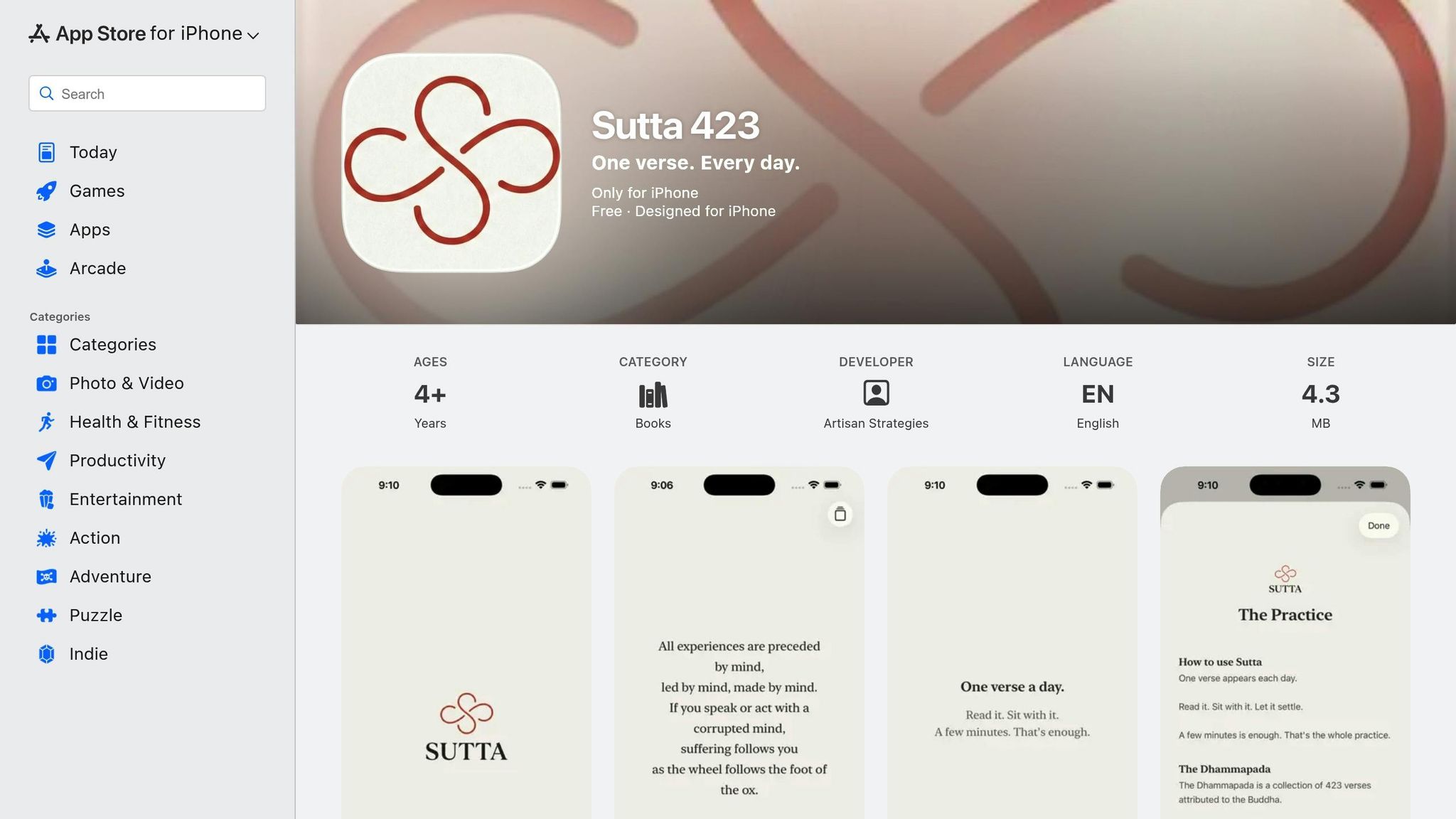
Sutta 423 is named after the 423 verses of the Dhammapada, one of the most cherished and widely read texts in Buddhism. The app offers a simple yet meaningful experience by delivering one verse each day.
Daily Verse Delivery
Every morning, Sutta 423 sends a single Dhammapada verse directly to your device. There’s no clutter - no feed, library, or archive to scroll through. It’s just today’s verse, ready for you to read and reflect on. This approach is perfect for modern life, offering a brief but focused moment of mindfulness.
Instead of adding to the noise of endless notifications, it provides a timeless teaching that has resonated for over two millennia. The simplicity of this daily delivery helps you avoid feeling overwhelmed, creating a calm and structured way to engage with the scripture.
A Journey Through the Dhammapada
The Dhammapada contains 423 verses, and Sutta 423 takes you through them one day at a time. In about 14 months, you’ll have completed the entire text - a steady, thoughtful journey through one of Buddhism’s most profound works.
2. Sariputta App
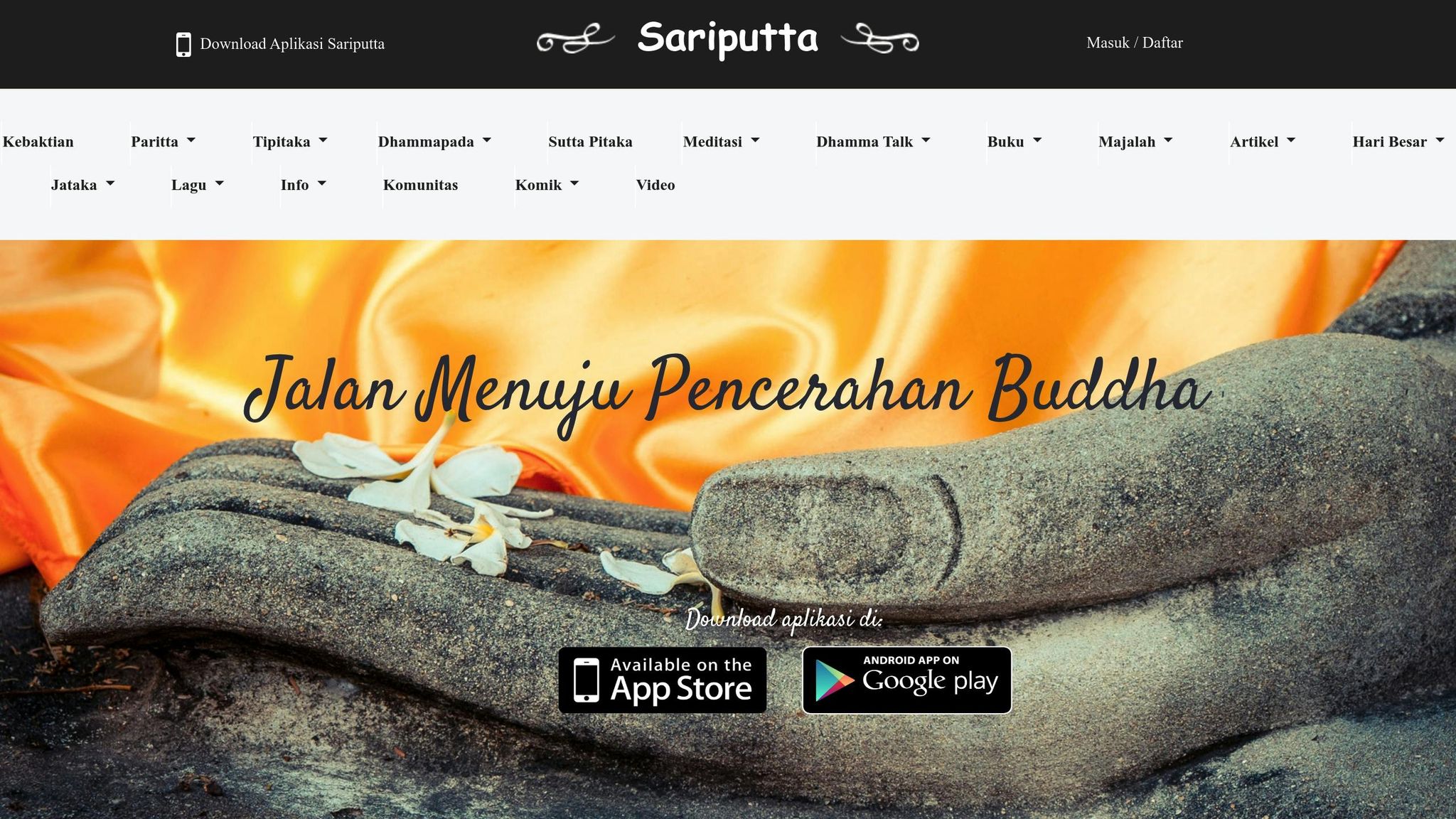
The Sariputta App offers a unique blend of text and traditional chanting, making the Dhammapada more engaging and accessible. Named after Sariputta, one of the Buddha's chief disciples, this app brings the ancient teachings to life with both visual and audio elements, creating an enriching experience for users.
Audio Chanting for a Deeper Connection
The app includes built-in audio features that pair verses with traditional chants, helping users grasp the correct pronunciation of Pali terms. Whether you're reading at home or listening on the go, the chants add a meaningful layer to your exploration of the text.
A Tool for Memorization and Study
By incorporating repeated exposure to chants, the Sariputta App supports memorization and fosters a stronger bond with the teachings. It’s a practical resource for those looking to deepen their understanding and connection to the Dhammapada.
3. Access to Insight (Dhammapada Web Resource)

Access to Insight brings ancient Theravada texts into modern daily practice. This digital library offers a vast collection of over 1,000 suttas from the Pali canon, including well-regarded translations of the Dhammapada - all free of charge [6][4]. With its extensive resources, the app supports users in integrating scripture into their everyday routines through curated readings and multimedia tools.
Daily Scripture Delivery Format
The app includes features like "Random sutta" and "Random article", making it easy to explore new teachings daily [2]. For those aiming to complete the Dhammapada in a structured way, users can read one of its 26 chapters each day, finishing the text in a month [4].
Integration of Audio Features
Though primarily focused on text, many translations are linked to online audio readings [2][7]. These audio options enhance accessibility, while additional tools like subject-specific indexes, simile references, and a Pali-English glossary provide deeper insights into the scriptures [5][2].
Support for Deeper Study
The app has received a 4.8/5 rating on the Apple App Store, with users praising its balance of scholarly rigor and accessibility [2]. Bhikkhu Bodhi highlights the value of repeated engagement with texts like the Dhammapada:
"The Dhammapada... yields its riches only through repeated study, sustained reflection, and most importantly, through the application of its principles to daily life. Thence it might be suggested to the reader in search of spiritual guidance that the Dhammapada be used as a manual for contemplation." [4]
Features such as bookmarks make it easy to revisit specific verses, while academic references further establish the app's credibility as a resource for both casual readers and serious students.
4. SuttaCentral (Dhammapada Web Resource)
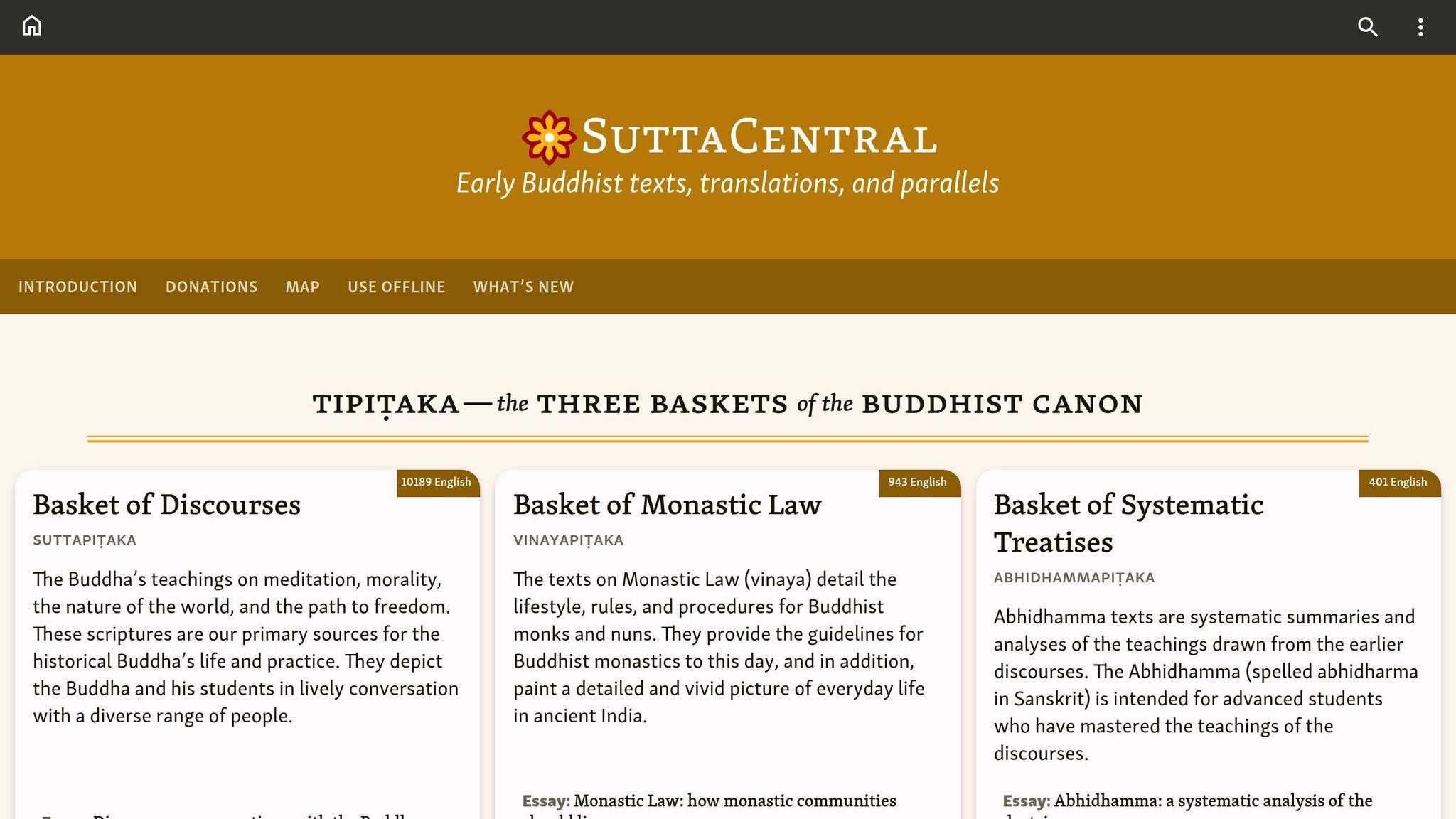
SuttaCentral is an online library dedicated to Early Buddhist Texts, offering the original Pali alongside translations by Bhikkhu Sujato. Through a collaboration with Reading Faithfully, the platform provides a "Sutta a Day" subscription service, making ancient teachings easily accessible in today's digital world. This blend of traditional scripture and modern communication methods opens up new ways to study and engage with Buddhist teachings.
Daily Scripture Delivery Format
The "Daily Sutta" service delivers short scripture passages through various channels, including email, RSS feeds, Reddit (/r/dailySutta), Facebook, Mastodon, Bluesky, Tumblr, and browser notifications. Each month focuses on a specific theme - like "Gods" or "Family" - allowing readers to immerse themselves in a particular Buddhist topic over 30 days. As Reading Faithfully describes:
Now you can get a short sutta delivered to your inbox every day.
This structured approach is especially helpful for Dhammapada readers aiming to complete the text in under a month [4].
Integration of Audio Features
SuttaCentral also offers audio functionality through its Voice feature, which converts written texts into spoken word. By clicking the speaker icon on any sutta card, users can listen to verses being read aloud. As SuttaCentral explains:
Voice makes SuttaCentral's texts and translations accessible to the visually impaired and the sighted. The suttas began as an oral transmission, and now they are an oral transmission again.
This feature not only honors the oral tradition of Buddhist teachings but also makes them more accessible to a wider audience, including those with visual impairments.
Tools for In-Depth Study
For those seeking a deeper understanding, SuttaCentral offers a segmented text view that places Pali and English side by side. It includes a Pali word lookup tool and a parallels feature, which shows connections like how verse 1 of the Dhammapada appears in 188 instances across Gāndhārī, Chinese, and Tibetan sources [8]. These tools cater to both casual readers and dedicated scholars, helping integrate scripture into daily life. Additionally, reading guides by Bhikkhu Sujato provide valuable context for understanding key teachings.
5. Anki (Spaced Repetition for Dhammapada Memorization)
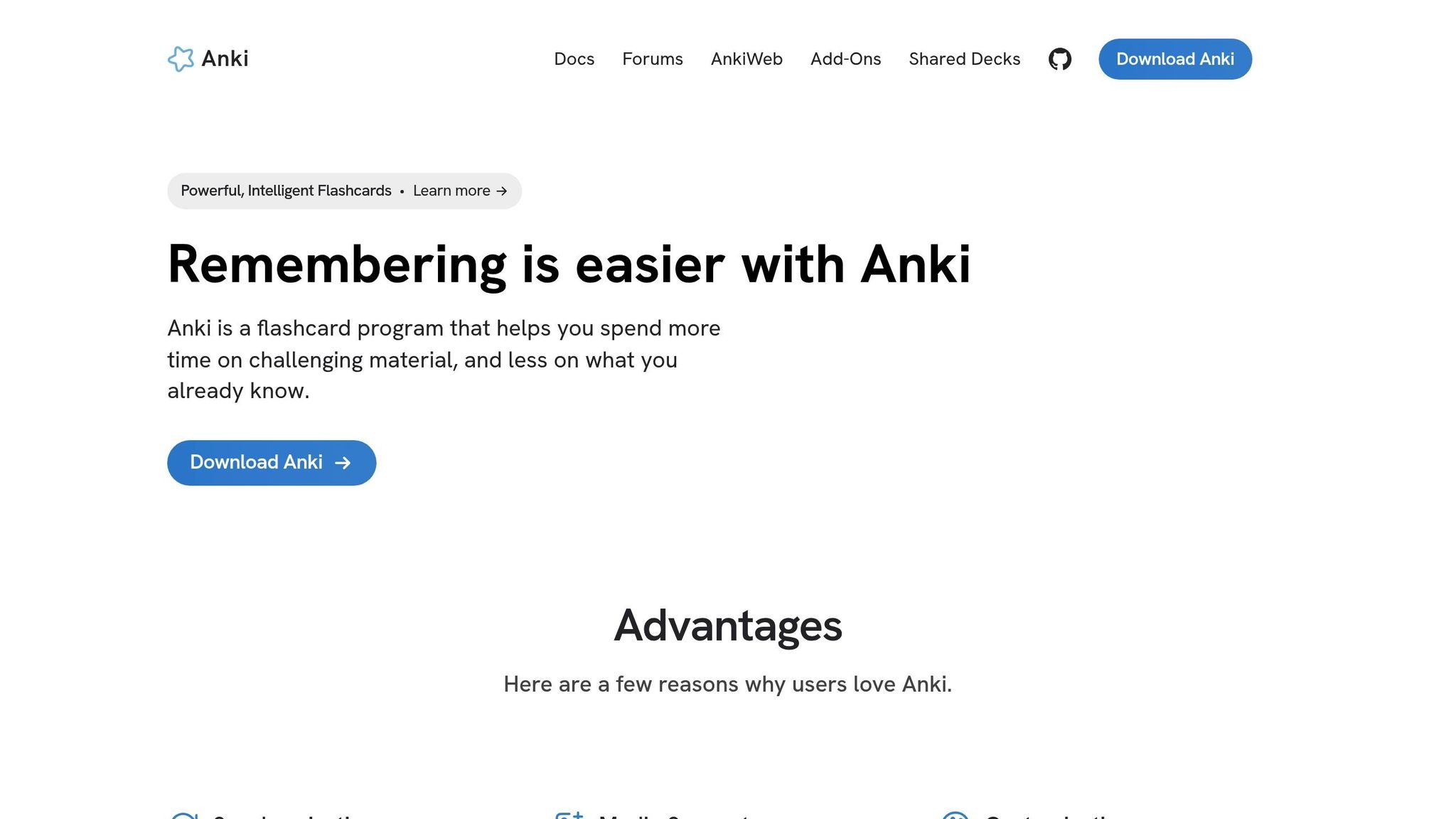
Anki is a powerful tool that uses spaced repetition to help you review material right when you're about to forget it. Its smart algorithm focuses on the cards you find most difficult, making it ideal for managing even large decks of content [9].
As Michael A. Nielsen, the author of Augmenting Long-term Memory, puts it:
"The single biggest change that Anki brings about is that it means memory is no longer a haphazard event, to be left to chance. Rather, it guarantees I will remember something, with minimal effort. That is, Anki makes memory a choice." [9]
Supporting Memorization and Deeper Study
Anki takes daily exposure to scripture and turns it into an active memorization process. It’s not just about reading the words anymore - it’s about truly absorbing them.
The app lets you create fully customizable flashcards. You can include Pāḷi text, English translations, chapter numbers, and even audio files to ensure proper pronunciation. A great tip is to organize your cards by chapter - start by suspending all cards and then unsuspend only the ones for the chapter you're focusing on. Before diving into your flashcards, read the chapter in both Pāḷi and a trusted English translation to deepen your understanding [10].
Anki offers two key card types that are particularly useful here. Basic notes are great for learning vocabulary, while Cloze deletion cards help you memorize specific parts of a verse. Plus, the free AnkiWeb service syncs your decks across devices, so you can study anywhere. For iOS users, there’s AnkiMobile, a paid app that also supports ongoing development [9].
Adding Audio and Chanting Features
Anki’s support for multimedia makes it a fantastic tool for memorizing the Dhammapada. You can include audio recordings of chants or Pāḷi pronunciation guides, adding an auditory layer to your study. This multimedia approach not only strengthens your memory but also helps preserve the oral traditions of early Buddhist teachings. Additionally, community-created add-ons let you extend the app’s functionality and even share your custom decks with other practitioners [9].
App Comparison Table
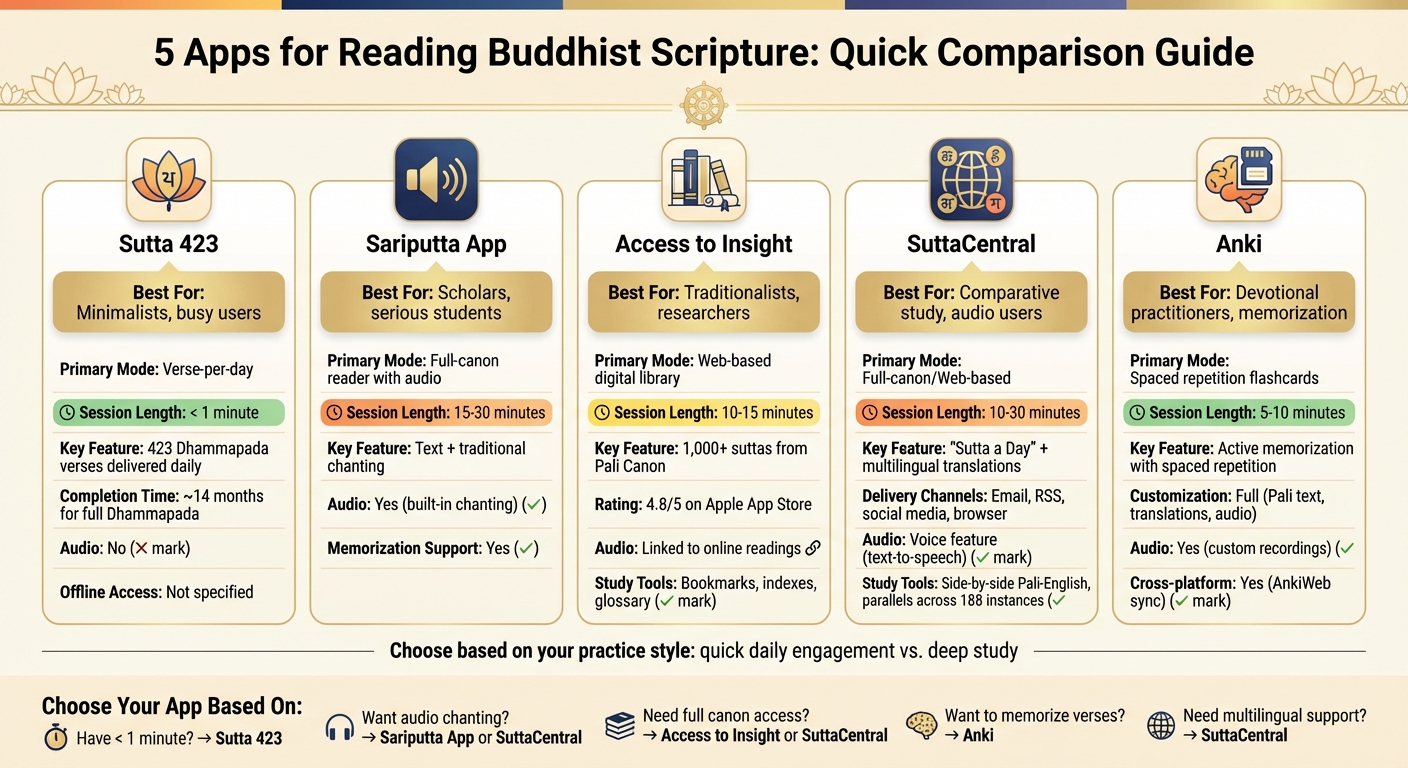
Each app brings its own approach to integrating Buddhist scripture into daily life. Your choice will depend on your goals, available time, and how you like to engage with the teachings.
Sutta 423 is perfect for those who value simplicity and consistency. It delivers one verse per day in under a minute - no need to scroll, search, or make decisions.
Sariputta App is a comprehensive mobile reference for the Pali Canon. It’s tailored for dedicated students and scholars who need to search, reference, and read extensive texts while on the go.
Access to Insight is a longstanding web resource focusing on the Dhammapada and the Pali Canon. It appeals to traditionalists and researchers who prefer a stable, library-like interface for in-depth study.
SuttaCentral offers a modern platform for Early Buddhist Texts, complete with offline access. It features multiple translations, comparative parallels, and an audio-optimized "Voice" project. The Tipiṭaka available here contains teachings from around 2,500 years ago, revered across all Buddhist schools [3].
Here’s a quick breakdown of how these resources cater to different needs and study habits:
| App/Resource | Primary Mode | Best Fit For | Typical Session |
|---|---|---|---|
| Sutta 423 | Verse-per-day | Minimalists, busy users | < 1 minute |
| Sariputta App | Full-canon reader | Scholars, serious students | 15–30 minutes |
| Access to Insight | Web-based | Traditionalists, researchers | 10–15 minutes |
| SuttaCentral | Full-canon / Web-based | Comparative study, audio users | 10–30 minutes |
| Anki | Memorization-focused | Devotional practitioners | 5–10 minutes |
Buddhist app development seems to be heading in two distinct directions: minimalist "verse-a-day" tools designed to counter digital distractions, and expansive, open-source platforms like SuttaCentral that serve as data hubs for other app creators [1][11]. This comparison underscores the variety of ways modern technology is enhancing scripture engagement, offering something for everyone.
Conclusion
In today’s world of constant digital noise, these apps bring the timeless teachings of the Buddha into the palm of your hand. They make it easier than ever to connect with ancient wisdom, cutting through distractions and simplifying access. For instance, Sutta 423 delivers a single verse each day, keeping things simple and focused. SuttaCentral caters to those looking for comprehensive access to the full canon, while Access to Insight offers a more traditional, library-like experience for in-depth study.
The choice of app depends on your practice style. If you prefer short, consistent engagement, a verse-per-day format is perfect. On the other hand, tools with advanced search capabilities are ideal for diving deeper into concepts like saṃsāra or bodhicitta. Offline access also comes in handy, especially during meditation retreats where internet use is limited.
Starting small is key. Incorporate brief, daily readings to build a habit that grows over time. Pick texts that align with your schedule - whether you have just a few minutes or a longer window for reflection. Simple techniques like the "Don’t Break the Chain" method can help you stay consistent with your practice [12].
"By putting a meditation app on your phone... you have at least taken a first step in recognizing an addiction to distraction." - Karen Maezen Miller, Zen priest [1]
The suttas, which began as an oral tradition over 2,500 years ago, have come full circle - they’re now accessible through your phone, ready to accompany you on your commute or fit right in your pocket. Choose the app that keeps distractions at bay and take that first step toward a deeper connection with the teachings.
FAQs
How do I choose the best app for reading Buddhist scripture based on my needs?
Choosing the right app really comes down to how you want to connect with Buddhist teachings. If your focus is on quick, daily inspiration, look for apps that provide features like short quotes, guided meditations, or brief scripture readings. On the other hand, if you're after a more structured experience, apps with complete suttas, offline libraries, and advanced search options might be a better fit.
For casual use, apps like Buddha Wisdom or Plum Village are great for daily mindfulness practices and guided meditations. If you’re interested in exploring key teachings at a moderate level, Sutta 423 offers a solid middle ground. For those seeking a deeper, more scholarly dive, consider apps such as Access to Insight or 84000 All Buddha’s Words, which provide extensive scripture collections, translations, and study tools.
Think about what you’re aiming to achieve - whether it’s maintaining daily mindfulness, occasional learning, or in-depth study - and pick an app that aligns with your goals. Features like offline access, high-quality translations, or added mindfulness tools can help you make the most of your experience.
What features do these apps offer to help memorize Buddhist texts?
These apps aim to make memorizing Buddhist texts both simpler and more engaging. Many come with digital mala tools that mimic the experience of bead-counting, complete with audible clicks and gentle vibrations. This feature helps users chant or repeat passages in a steady rhythm, improving retention. Additionally, some apps offer interactive options like highlighted verses, note-taking, and bookmarking, making it easier to revisit and personalize your study sessions.
For those focusing on daily practice, some apps deliver features like a “Daily Word of the Buddha” or brief Dhamma verses. These short, daily prompts help users build a consistent recall habit. Other tools include side-by-side Pāli-English views and built-in dictionaries, allowing users to quickly look up unfamiliar terms and deepen their understanding through context. By combining active engagement and structured repetition, these features are designed to make memorization more effective and enjoyable.
How do these apps help users build a consistent daily practice with Buddhist scriptures?
These apps simplify the process of establishing a regular scripture reading habit. They often deliver fresh content daily, such as a new sutta each morning or inspiring quotes and reminders to keep you engaged. Some apps even include guided reading plans that offer a clear, step-by-step approach to your practice.
A standout feature for consistency is offline access. Apps with entire libraries of suttas available for download let you read anytime - whether you're on a commute, attending a retreat, or in a location with limited internet access. Handy tools like bookmarks, search functions, and personalized notifications make it easier to stay organized and revisit passages that resonate with you.
With features like daily prompts, curated reading plans, and intuitive tools, these apps turn scripture reading into a reliable and meaningful part of your daily routine.
Related reading
- The ADHD Brain Dump Method That Actually Gets You Unstuck
- ADHD Decision Paralysis: How to Pick What to Do Right Now
- Best Buddhist Apps for Daily Practice in 2025
- Why "Just Start Small" Doesn't Work for ADHD (And What Does)
- Best Apps for ADHD Task Paralysis (Tested 2026)
Useful tools & services
A small daily scripture practice
Sutta 423 is our app for reflecting on one Dhammapada verse each day. Explore how it works and whether it suits your practice.
Explore Sutta 423These are products built by Artisan Strategies.