The ADHD Brain Dump Method That Actually Gets You Unstuck
Clear mental clutter with a 4-step ADHD brain dump: capture everything, remove low-priority items, group tasks, and schedule top actions.
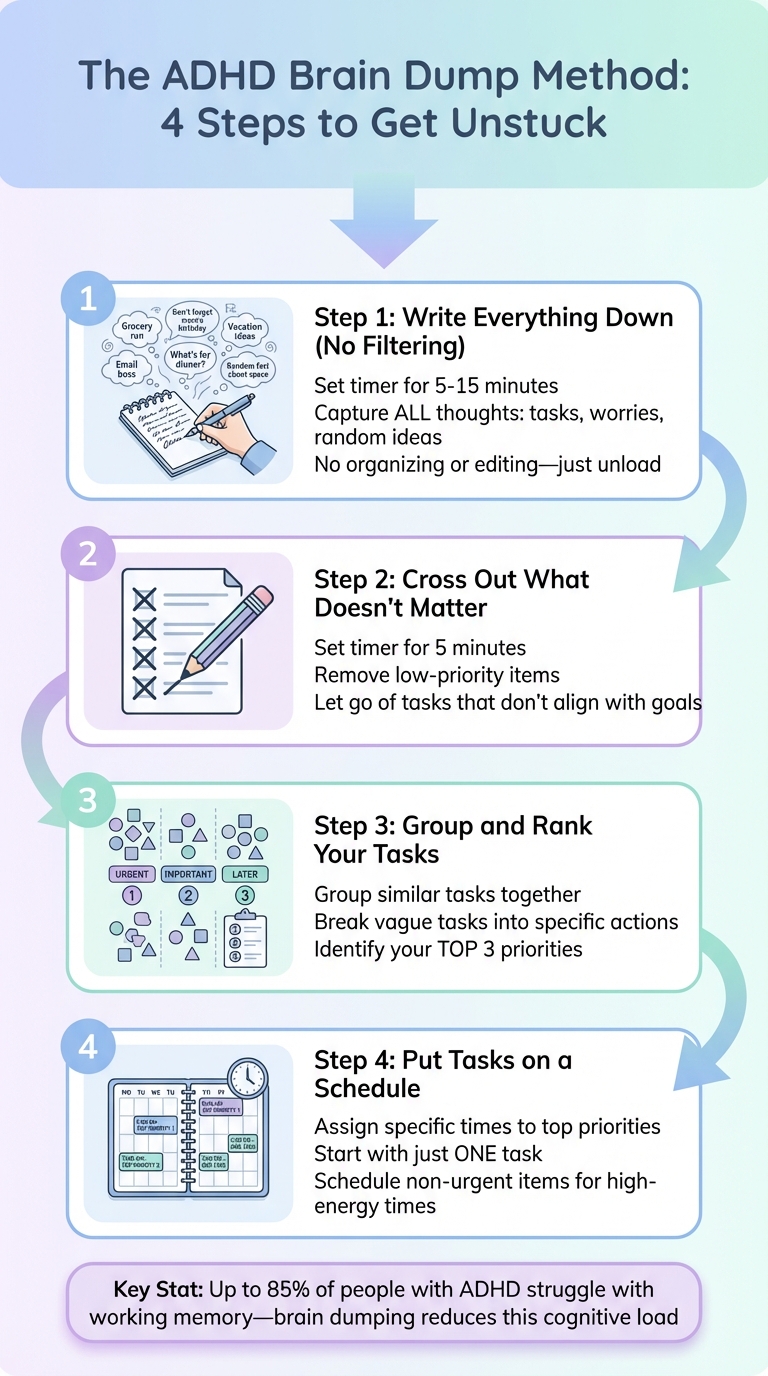
The ADHD Brain Dump Method is a simple way to clear mental clutter and regain focus. It works by offloading all your thoughts - tasks, worries, ideas - onto paper or a digital tool, reducing the strain on your working memory. This method is especially helpful for ADHD brains, which often struggle with task management and prioritization. Here's how it works:
-
Step 1: Write down everything on your mind without filtering or organizing.
-
Step 2: Cross out unimportant or low-priority items.
-
Step 3: Group similar tasks and rank them by priority.
-
Step 4: Schedule your top tasks to take action.
This process helps you break free from overwhelm by turning mental chaos into actionable steps. Tools like notebooks, sticky notes, or apps like Onsara can make this easier, with Onsara offering AI-powered task prioritization for ADHD users. Try this method for a week to see how it helps you manage tasks more effectively.
Why Brain Dumping Works for ADHD
How ADHD Affects Working Memory
If you have ADHD, your brain approaches tasks differently, often making everyday activities feel like a mountain to climb. The core struggle lies in executive functions - the mental processes that help with planning, organizing, and completing tasks [3][4]. When these processes falter, even simple routines can feel chaotic.
One major hurdle is working memory. This is the brain's ability to temporarily hold and manage information, and it’s a function that up to 85% of individuals with ADHD find challenging [2][5][12].
"Dr. Russell A. Barkley, a leading ADHD researcher, explains that individuals with ADHD struggle to hold information in their minds while performing other cognitive tasks. This creates a bottleneck that affects planning, organization, and task completion." [11]
When working memory is overloaded, you might forget instructions halfway through a task, lose track of where you are, or find multi-step tasks particularly difficult [2][5][6]. Many traditional productivity methods assume you can hold and juggle all this information internally, but for someone with ADHD, that’s rarely the case.
This is where brain dumping comes in. By externalizing your thoughts, you can clear the mental clutter and create space to focus on what truly matters.
Why Writing Things Down Helps
Brain dumping is effective because it takes the swirling chaos in your mind and translates it into something tangible - whether that’s on paper or a digital screen [8][9]. Instead of trying to mentally juggle everything, you create a visible list that organizes your thoughts and priorities [10][11].
By laying out tasks, you turn abstract mental clutter into clear, actionable steps [8][9]. This approach not only helps you break projects into manageable pieces but also allows you to focus on what’s important without the constant effort of remembering [7][10][11].
ADHD coach Jeff Copper explains it well: if you find it hard to organize and sequence multiple thoughts or tasks in your mind, brain dumping can be a game-changer [1]. It reduces the burden on your working memory, giving you the mental bandwidth to tackle tasks more effectively.
Feeling Overwhelmed? Try This 4-Step Brain Dump to Get Unstuck
How to Do an ADHD Brain Dump (4 Steps)
Clearing your mind and regaining focus can feel like a tall order, but these four steps make it manageable. Here's how to put the ADHD brain dump method into action.
Step 1: Write Everything Down (No Filtering)
Start by setting a timer for 5–15 minutes, then let your thoughts flow freely onto paper or a digital tool. The trick? Write down everything on your mind, no matter how random or trivial it seems.
"The essence of a brain dump lies in its unstructured nature. Unlike traditional to-do lists or calendars, a brain dump doesn't require sorting or categorizing thoughts as they arise. The goal is to capture everything that comes to mind, without judgment or immediate analysis."
Capture tasks, worries, random ideas, or even fleeting thoughts like "email Sarah" or "why is my car making that noise." Don't worry about organizing or editing - this isn't about perfection. Just let your brain unload.
Use whatever medium feels natural: a notebook, sticky notes, or a notes app on your phone. Keep writing until the timer goes off. The goal is to clear your mental clutter so you can focus better.
Step 2: Cross Out What Doesn't Matter
Now that your thoughts are out in the open, it's time to sift through them. Take a quick scan of your list and cross out anything that doesn’t really matter - those low-priority items or things that don’t align with your goals.
Set a timer for about 5 minutes to avoid overthinking. Be honest with yourself. Some items might be tasks you've been holding onto for no good reason or requests from others that you can let go of. Eliminating these frees up your energy for things that actually need your attention.
Step 3: Group and Rank Your Tasks
With the unnecessary clutter gone, organize what’s left. Group similar tasks together and break vague ones into actionable steps. For instance, instead of "clean the kitchen", write out specific actions like "empty the dishwasher", "wipe the counters", and "sweep the floor."
Next, identify your top three priorities. Look for tasks with upcoming deadlines or those that align with your personal goals. These are the ones to focus on first, while the rest can be scheduled for later.
Step 4: Put Your Top Tasks on a Schedule
Take your top priorities and assign them specific times in your day or week. Start small - pick just one task to tackle first. This helps you build momentum without feeling overwhelmed.
For non-urgent tasks, schedule them during times when your energy levels are highest. Even those less pressing items are more likely to get done this way.
The goal here isn’t to create a complicated system you’ll abandon in a few days. It’s about turning mental chaos into clarity. Once you complete that first scheduled task, you’ll feel a sense of accomplishment that makes it easier to keep going.
Tools That Make Brain Dumping Easier
The right tool can mean the difference between a brain dump that clears your mind and one that just adds to the chaos. Whether you prefer physical or digital tools, the goal is to bridge the gap between unloading your thoughts and taking actionable steps.
Physical tools like notebooks, Post-it notes, and whiteboards offer a hands-on way to organize your thoughts. Writing things down by hand helps with memory retention, and the tactile nature of these tools can make the process more engaging. ADHD coach Jeff Copper highlights the value of Post-it notes:
"What I find to be most effective is they actually write each idea on a Post-it. Post-it is really cool because you can move them around and you can have them all spread out." [1]
The ability to physically move tasks around can make it easier to see patterns, connections, and priorities - something that’s often harder to achieve with a screen.
Digital tools, on the other hand, offer their own set of advantages. They allow for quick capture, easy editing, and even voice input for those fleeting ideas. Many digital options also offer visual organization features and cross-platform syncing, so your brain dump is accessible wherever you go. The key is choosing tools that open quickly and let you capture your thoughts immediately, without unnecessary friction.
For those who want even more structure, some tools go a step further by analyzing your brain dump for you.
Using Onsara to Analyze Your Brain Dump
If you find yourself stuck after unloading all your thoughts - wondering, What do I actually do with this? - Onsara might be the tool for you. Designed specifically for people with ADHD, this macOS app tackles the decision-making stage, which can often feel overwhelming.
Onsara uses AI to analyze your brain dump and help you decide what to focus on right now. Instead of staring at a long, intimidating list, you get clear, actionable guidance. It’s not about organizing your tasks but about helping you make decisions, which is often the most challenging part for ADHD users. By reducing decision fatigue, Onsara makes it easier to move from planning to doing.
Comparing Different Brain Dump Tools
| Tool | Benefit for ADHD Users | Drawback |
|---|---|---|
| Onsara | AI-assisted prioritization to reduce overwhelm | Only available for macOS users |
| Paper | Tactile sorting with no digital distractions | Harder to organize and search |
| Digital Notes | Quick capture with easy editing and saving | Risk of digital distractions |
Getting Started with the Brain Dump Method
The brain dump method is effective because it’s straightforward, adaptable, and works with the way your ADHD brain operates. You don’t need a fancy planner or an elaborate system to begin - just grab whatever’s handy, whether it’s a notepad, a scrap of paper, or your phone, and jot down everything swirling in your mind. Don’t worry about organizing or filtering your thoughts at this stage - just let it all out.
Once you’ve unloaded your thoughts, follow the four steps: cross out unnecessary items, group similar tasks, and rank them by priority. This process helps clear up mental clutter and gives you a clearer picture of what needs your attention, reducing that overwhelming feeling.
Tailor the method to fit your routine. Some people find that a daily brain dump keeps them on track, while others prefer a weekly session or quick mini-dumps throughout the day when things feel chaotic. Experiment with different frequencies to see what works best for you. And whether you’re a fan of pen and paper or digital tools, the key is sticking to a system you’ll actually use. A simple, reliable approach beats a complicated one that gathers dust.
For help prioritizing tasks, tools like Onsara’s AI can reduce decision fatigue. Whether you lean on AI, sticky notes, or a plain notebook, the real magic lies in making the brain dump a regular habit.
Start small. Pick one area of your life - like your morning routine or work tasks - and try the method for a week. Pay attention to the changes it brings, then tweak the process to suit your needs. The goal isn’t to be perfect; it’s to make progress and find clarity when your thoughts feel as cluttered as an overloaded browser.
FAQs
How does the ADHD Brain Dump Method help improve focus?
The ADHD Brain Dump Method is a simple yet effective way to clear mental clutter and boost focus. By jotting down all the thoughts, tasks, and ideas swirling in your mind, you give yourself the chance to release that mental noise and create room for clearer thinking.
Once everything is on paper, it’s easier to spot your priorities and tackle tasks in a step-by-step manner. With fewer distractions and a clear roadmap, staying focused on what’s important becomes much more manageable.
What are the best tools to make the ADHD brain dump method more effective?
Using the right tools can make the ADHD brain dump process much easier and more productive. Tools like digital task managers - such as Notion or ClickUp - are great for organizing your thoughts into clear, manageable sections. If staying on track feels challenging, visual timers can help you manage your time without causing stress. Need to capture ideas in the moment? Voice-to-text apps let you quickly record your thoughts without skipping a beat. And for creating a calm, distraction-free space, white noise apps can work wonders. If you prefer a more organized method, try customizable templates designed specifically with ADHD in mind. These tools are all about cutting through the mental noise and helping you refocus.
Why do people with ADHD struggle with working memory?
People with ADHD often struggle with working memory, which involves juggling multiple pieces of information simultaneously. This can result in forgetfulness, misplacing tasks, or feeling completely overwhelmed.
These obstacles can make staying organized, sticking to plans, or finishing tasks feel like an uphill battle. It’s a frequent source of distractions and even task paralysis. However, with the right approaches, these challenges can be tackled and managed more effectively.
Related reading
- ADHD Decision Paralysis: How to Pick What to Do Right Now
- 5 Apps for Reading Buddhist Scripture Daily
- Best Buddhist Apps for Daily Practice in 2025
- Why "Just Start Small" Doesn't Work for ADHD (And What Does)
- Best Apps for ADHD Task Paralysis (Tested 2026)
Useful tools & services
Explore our tools for everyday work
Browse our focus app, PDF reader, and other products to find an option that fits your task.
Browse our productsThese are products built by Artisan Strategies.