How to Read the Dhammapada: A Beginner's Practice Guide
A practical beginner's guide to reading a classic Buddhist verse collection—pick a clear translation, build a short daily habit, and apply verses to modern life
The Dhammapada is a collection of 423 short verses that summarize the Buddha's teachings. It's practical, relatable, and perfect for daily reflection. This guide shows how to start reading it, choose the right translation, and apply its teachings to modern life.
Key Takeaways:
- Choose a clear translation: Bhikkhu Bodhi's version is highly recommended for its clarity and depth.
- Start small: Read one chapter (or even just a verse) daily. Most chapters take 3-6 minutes to read.
- Reflect and apply: Highlight verses that resonate with you and think about how they relate to your life.
- Daily habit: Tie reading to your routine - like during coffee or before bed. Consistency matters more than volume.
- Use apps: Tools like the Sutta 423 app can send you one verse a day, making it easy to stay consistent.
The Dhammapada isn’t just a book - it’s a guide for living with clarity and peace. Start small, stay consistent, and let its wisdom shape your daily life.

The Dhammapada - 1.Dichotomies | Buddha
Pick a Clear Translation
Selecting a clear and balanced translation is essential when diving into the Dhammapada. Avoid versions that rely on overly academic language or stray too far from the original meaning. Instead, look for translations that use straightforward, modern English and provide helpful explanatory notes for technical terms like kamma or Nibbana.
One way to find the right translation is to try the "Sample Chapter Test." Read the same chapter - such as Chapter 1: The Pairs - in several translations to see which style resonates most with you. Be wary of books that fail to faithfully convey the original meaning. Opt for translations by respected scholars or monastics, as their expertise ensures accuracy and depth. Choosing the right translation lays the foundation for a mindful and meaningful reading experience.
Start with Bhikkhu Bodhi's Translation
A highly recommended starting point is Bhikkhu Bodhi's translation, often paired with Acharya Buddharakkhita's interpretation. Bhikkhu Bodhi organizes the Dhammapada's 423 verses into four levels - immediate welfare, future well-being, the path to liberation, and the ultimate goal. This structure helps untangle seemingly contradictory verses, such as those that praise seeking heaven in one context while advising caution in another. His commentary bridges these gaps, presenting the text as a "scriptural kalyanamitta" (a spiritual friend) rather than just a historical document.
The translation’s clear language and doctrinal precision make it a great choice for daily reflection. Other respected options include Thanissaro Bhikkhu’s minimalist yet impactful version and Venerable Narada’s classic translation. Both are often freely available online or distributed as gifts from monasteries, making them accessible to a wide audience.
Read the Introduction First
Before diving into the verses, take the time to read the translator’s introduction. Think of it as your guide to understanding the text. The introduction explains the Dhammapada’s dual role as both a spiritual guide and a literary work, clarifies key terms, and outlines the translator’s approach - whether it prioritizes literal accuracy or poetic expression.
"The Dhammapada... yields its riches only through repeated study, sustained reflection, and most importantly, through the application of its principles to daily life. Thence it might be suggested to the reader in search of spiritual guidance that the Dhammapada be used as a manual for contemplation."
- Bhikkhu Bodhi, Buddhist Monk and Translator
This perspective shifts how you approach the text. The Dhammapada isn’t meant to be read once and shelved; it’s a manual for daily reflection. Consider reading a few verses or a chapter each day, reflecting on their meaning, and applying them to your life. With a reliable translation and a thoughtful introduction, you’re ready to cultivate a reading practice that brings the Dhammapada’s teachings into your daily routine.
Build a Daily Reading Habit
Once you've selected a clear and accessible translation, it's time to weave the Dhammapada into your daily life.
The Dhammapada is divided into 26 chapters with a total of 423 verses [13, 17], making it perfect for a quick daily practice. Most chapters take just 3 to 6 minutes to read [4], which means you could finish the entire text in under a month by reading one chapter a day [2]. This steady approach helps cultivate what many practitioners describe as a "habit and hunger" for the teachings - a manageable rhythm that keeps you engaged without feeling overwhelmed [3].
The process is straightforward: read a short chapter, take a moment to reflect, and move on. As ReadingFaithfully.org puts it, "There is always five minutes to read the Dhamma, no matter what your life is like" [2]. By sticking to this simple routine, you could complete the Dhammapada as many as 14 times in a year [2].
Read One Chapter Each Day
Dedicate time each day to reading one full chapter, whether in the morning, evening, or whenever it fits best into your routine. The key is consistency, not volume; engaging with the teachings regularly is far more impactful than trying to absorb too much at once [3]. If you happen to miss a day, just pick up where you left off - no need to stress about catching up.
To make this habit stick, tie your reading to an activity you already do daily. For instance, you could read during your morning coffee, lunch break, or as part of your bedtime wind-down [2].
For chapters that are longer than usual, a slight adjustment can help keep your practice on track.
Break Up Long Chapters
While most chapters take just a few minutes, Chapter 26 (Brāhmaṇa Vagga) is an exception, requiring about 11 minutes to read - nearly double the time of others [4]. To keep your routine manageable, consider splitting it over two days [2]. Similarly, Chapter 24 (Craving) takes around 7 minutes, so dividing it into smaller sections might be helpful if you're short on time [4].
On particularly hectic days, even reading a single verse can keep your practice alive. As ReadingFaithfully.org reminds us, "Even if you were only to read a single verse from the Dhammapada every day for the rest of your life, the benefits would be enormous" [3].
Focus on Key Verses
As you explore the Dhammapada, certain verses are bound to strike a chord with you. Each daily reading offers at least one verse that feels personal, sparking meaningful reflection and practice.
The Dhammapada is thoughtfully divided into chapters based on themes, making it a handy guide for tackling specific challenges. For instance, if distractions are troubling you, Chapter 3 on "The Mind" offers valuable insights. Struggling with patience? Chapter 17 on "Anger" provides practical advice to help you navigate those moments. This thematic structure makes it easier to differentiate between verses meant for everyday guidance and those pointing toward the ultimate goal of enlightenment. By tying your daily readings to personal reflection, you create a seamless link between ancient wisdom and your life today.
Return to Verses That Resonate
When a verse speaks to you, highlight it and revisit it often. A method like the "Almost Anthology" can help you quickly mark and return to the passages that stand out.
Bhikkhu Bodhi, a respected scholar and monk, emphasizes the importance of this approach:
"It yields its riches only through repeated study, sustained reflection, and most importantly, through the application of its principles to daily life" [2][6].
Similarly, Gil Fronsdal, founder of the Insight Meditation Center, shares his experience:
"Some passages I have reread many times until they revealed new understandings or insights" [7].
By identifying the verses that resonate most with you, you can integrate their lessons into your daily life, making their wisdom a practical tool.
Apply Teachings to Daily Situations
The Dhammapada truly comes alive when its teachings intersect with your everyday experiences. For instance, if you find yourself caught in an argument, you might recall this verse:
"There are those who do not realize that one day we all must die. But those who do realize this settle their quarrels" [2].
Feeling impatient? Verses 129–130 serve as a reminder of our shared humanity [5].
As you go about your day, think about how a verse might apply to what you're facing - whether it's staying focused, simplifying a decision, or finding patience with a challenging coworker. In doing so, the timeless wisdom of the Dhammapada becomes a practical companion for navigating modern life.
Use Sutta 423 for Daily Practice
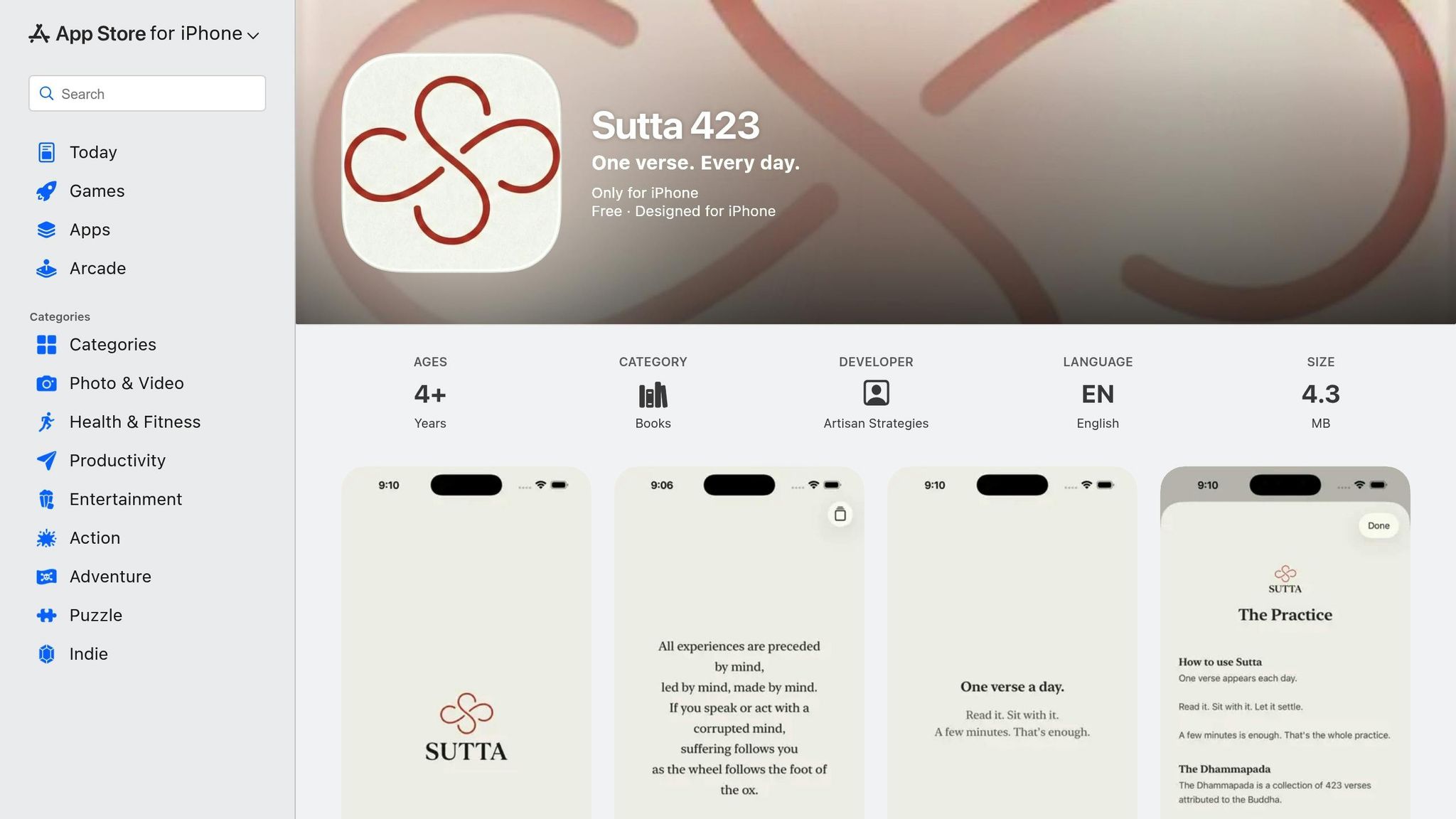
The Sutta 423 app provides a simple yet effective way to incorporate the teachings of the Dhammapada into your daily routine. With its structured approach, the app ensures you can engage with all 423 verses without feeling overwhelmed. It’s perfect for those who want to stay connected to the teachings in a manageable, consistent way.
One Verse Per Day
Every day, the app delivers a single verse to your device, requiring just a few minutes to read and reflect. This method avoids the overwhelm that can come from tackling too much at once, making it easier to stick with the practice. As ReadingFaithfully.org puts it:
"By establishing a practice that is totally possible, we painlessly build up the habit and begin to see directly the benefit of encountering the suttas every single day" [8].
Since the Dhammapada contains exactly 423 verses, this daily rhythm allows you to complete the entire text in just over a year. And the journey doesn’t stop there - you can restart the cycle, uncovering fresh insights with each repetition. This steady pace naturally encourages deeper reflection, helping you internalize the teachings over time.
Less Reading, More Depth
The app’s minimalist design encourages contemplation rather than consumption. Instead of rushing through chapters, you focus on how a single verse resonates with your current life. This approach prioritizes depth, enabling you to apply the teachings in meaningful ways. As a result, you’re not aiming to become a scholar but cultivating a daily habit that helps you handle stress, frustration, and distractions with clarity and calm [2]. It’s about creating space for transformation, one verse at a time.
Conclusion
You don’t need hours of study or advanced preparation to start reading the Dhammapada. Begin with a clear translation, like Bhikkhu Bodhi’s, and commit to reading just one chapter a day. Highlight verses that resonate with you. These small, consistent steps can lay a strong foundation for deepening your understanding and practice.
Transformation happens through repetition. By reading one chapter daily, you can complete all 423 verses in under a month - or revisit the text 14 times in a single year [2]. Each time through, new insights may emerge as your perspective shifts with life’s changes. What might seem abstract at first could feel deeply relevant when you’re navigating challenges or conflicts.
This steady approach also aligns with Sutta 423's wisdom about forming habits. Even reading one verse per day allows you to finish the text in just over a year, creating a rhythm that invites you to start again. Over time, the Dhammapada becomes more than a book - it becomes, as Bhikkhu Bodhi describes, a "scriptural kalyanamitta", or a spiritual companion you turn to daily, rather than something you read once and set aside [1].
The purpose isn’t to memorize every verse but to let the teachings influence how you handle stress, anger, or distractions. Bhikkhu Bodhi emphasizes that the text "yields its riches only through repeated study, sustained reflection, and most importantly, through the application of its principles to daily life" [2]. Think of this as an ongoing journey, not a task to complete. With daily engagement, the Dhammapada evolves from a simple reading into a lifelong guide.
FAQs
What is the best Dhammapada translation for beginners?
Choosing the right Dhammapada translation as a beginner means finding one that strikes a good balance between accuracy, clarity, and usefulness. Translations by scholars who work directly from the Pāli text are often the most reliable, as they stay closer to the original meaning. Popular choices include the works of Bhikkhu Bodhi and Thanissaro Bhikkhu, both praised for their precise yet approachable language. If you enjoy extra context, look for editions that include footnotes, glossaries, or historical background to deepen your understanding.
Think about how you like to engage with spiritual texts. Free online versions are perfect for quick daily reading, while printed editions can provide a more immersive and focused experience. For a smoother, more contemporary feel, Acharya Buddharakkhita’s translation is widely recommended for beginners. If learning Pāli pronunciation interests you, audio recitations can bring the verses to life and help with memorization.
Choosing a translation that matches your learning style and offers clear guidance can make your first steps with the Dhammapada both meaningful and enjoyable.
How can I make reading the Dhammapada a daily habit?
Incorporating the Dhammapada into your daily routine doesn’t have to be complicated. Carve out a consistent time each day - maybe while sipping your morning coffee, during a lunch break, or right before you wind down for bed. The beauty of the Dhammapada lies in its brevity; a single chapter or even just one verse takes only a few minutes to read. Afterward, take a moment to reflect or jot down a quick thought to enrich your understanding.
To stay aligned with the original teachings, pick a trustworthy translation. You might also find it helpful to use a checklist or an app to keep track of your progress. Remember, it’s not about how much time you spend but about showing up consistently - even a single verse each day can lead to meaningful insights over time.
How can I use the teachings of the Dhammapada to handle challenges in daily life?
The Dhammapada offers timeless lessons that are surprisingly relevant for tackling modern-day challenges. At its heart is a powerful idea: your thoughts shape your experiences. This simple yet profound teaching can help you pause, reflect, and respond with intention, even in stressful or difficult moments. Take, for example, the verse: “All that we are is the result of what we have thought.” Remembering this can guide you to replace impulsive, negative reactions with calm and deliberate actions.
Incorporating this wisdom into your daily routine is easier than you might think. Start your day by reading a single verse and reflecting on how it connects to something you're facing - whether that's financial stress, health worries, or feeling overwhelmed. Think of the Dhammapada as your daily companion, offering practical insights to bring more mindfulness, kindness, and strength into your life. To make it even simpler, you can use mobile apps to access verses, set reminders, or save passages that resonate with your current experiences. By weaving these teachings into your daily life, you'll cultivate a clearer, more focused mindset to navigate the complexities of modern living.
Related reading
- One Verse a Day: Why Less Buddhist Reading Leads to Deeper Practice
- Buddhist Mindfulness Without Meditation Apps: A Simpler Path
- Dhammapada verses explained
- Best Free Buddhist Apps for iPhone in 2026 (No Subscriptions)
- Morning Buddhist Practice: 5-Minute Routines for Busy Professionals
Useful tools & services
A small daily scripture practice
Sutta 423 is our app for reflecting on one Dhammapada verse each day. Explore how it works and whether it suits your practice.
Explore Sutta 423These are products built by Artisan Strategies.