Dhammapada verses explained
Master the mind: timeless verses show self-discipline, non-hatred, and letting go build calm and resilience.
The Dhammapada is a collection of 423 verses attributed to the Buddha, offering practical wisdom on mindfulness, self-discipline, and inner peace. It distills complex teachings into concise insights, making it accessible for both monastics and laypeople. Divided into 26 chapters, it addresses themes like the mind, heedfulness, and the path to liberation, with lessons that remain relevant today.
Key takeaways:
- Mind shapes experience: Thoughts lead to actions and outcomes. A disciplined mind fosters happiness, while negativity brings suffering.
- Non-hatred ends hatred: Retaliation fuels anger. Instead, respond with kindness and patience to break cycles of conflict.
- Inner peace through letting go: Craving and attachment lead to suffering. Recognizing impermanence helps achieve calm and clarity.
- Practical guidance: Avoid harm, do good, and purify the mind through meditation, empathy, and self-awareness.
The Dhammapada's timeless teachings provide tools to navigate life's challenges, from managing distractions to building resilience during uncertainty. Start small by reflecting on a single verse and applying it to your daily life.
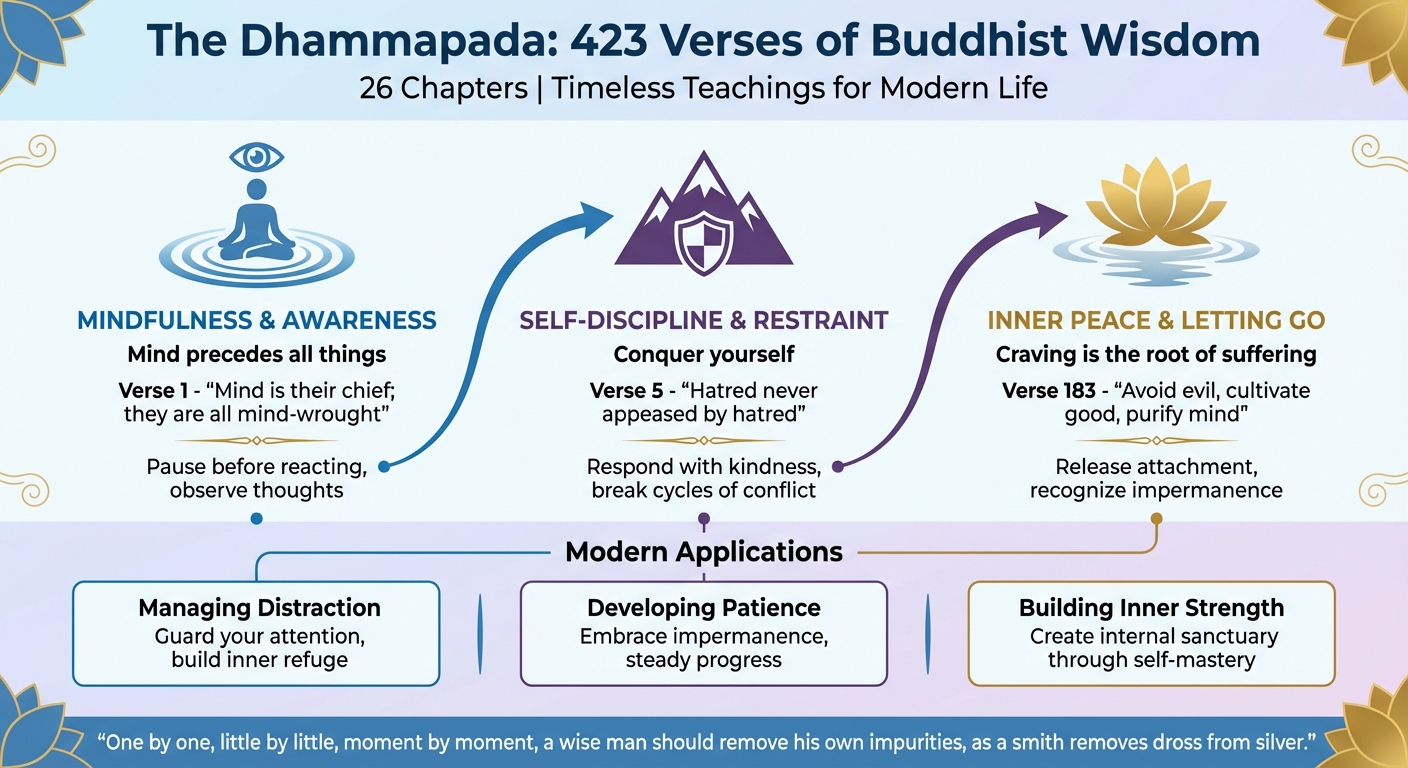
Main Themes in the Dhammapada
Mindfulness and Awareness
The Dhammapada places mindfulness (appamada) at the heart of spiritual growth, calling it the "path to the Deathless" [3]. It emphasizes that the mind is the starting point of all mental states [2] - every word and action stems from a thought. By becoming aware of your thoughts, you can prevent them from leading to suffering. The text contrasts heedfulness, which fosters vitality, with negligence, which leads to stagnation and decay. Mindfulness is like an inner watchtower, helping to calm a restless mind. In practical terms, this could mean pausing before responding to a frustrating message or catching yourself in the act of aimless scrolling.
Self-Discipline and Restraint
Mindfulness lays the groundwork for self-discipline, which sharpens your ability to stay vigilant. The Dhammapada frames self-discipline not as sheer force of will but as the art of mastering oneself. It teaches that personal purity and growth come from within [2][7]. Through effort, awareness, and self-control, you can build an inner strength that remains steady, no matter what external challenges arise. The text even suggests that conquering yourself is a greater achievement than any outward victory [2]. This mastery involves restraining your body, speech, and mind to avoid distractions and impulsive actions [4]. Such discipline creates a foundation for the calm and balanced life the Dhammapada advocates.
The Path to Inner Peace
The Dhammapada links inner peace to the ability to let go. It highlights that "hatred is never appeased by hatred in this world. By non-hatred alone is hatred appeased. This is a law eternal" [2]. The text identifies craving (tanha) as the root of suffering, likening it to a creeping vine that entangles those who live without awareness [9]. By cultivating self-discipline, you can loosen the grip of craving and move toward a state of calm. Recognizing the impermanence and dissatisfaction of all conditioned things [1] helps in uprooting desires that lead to restlessness. Letting go of destructive cravings is the key to true tranquility - a lesson that feels especially relevant in today’s fast-paced world. The Dhammapada also offers a guiding principle for ethical living: treat others as you would want to be treated, as all beings fear death and seek happiness [1].
Explanations of Key Verses
Verse 1: "Mind Precedes All Things"
The Dhammapada begins with a profound insight:
Mind precedes all mental states. Mind is their chief; they are all mind-wrought. [8]
This verse highlights how your thoughts shape your words, actions, and overall life. The Pali phrase Manopubbaṅgamā dhammā conveys a straightforward truth: a mind clouded by negativity leads to suffering, much like an ox pulling a heavy cart, while a pure mind nurtures lasting happiness, akin to a shadow that never leaves.
The focus here is on intention. Every action starts with a thought. As Lynn J. Kelly puts it:
We don't choose the cards we are dealt (heredity, place of birth, inherent intelligence), but we do choose how to play those cards. This is the only leverage we have on the direction our lives take. [11]
To apply this, take a closer look at your intentions. Ask yourself, "What sparked this thought?" This kind of self-awareness can reveal your true motives. A well-disciplined mind, strengthened through meditation, acts like a sturdy roof that shields against the "rain" of harmful emotions such as anger or greed. By observing your behavior without bias, you can ensure your actions align with the values you aim to uphold. This self-discipline becomes even more crucial when managing the distractions of modern life and sets the stage for navigating conflicts, as explored in later teachings.
Verse 5: "Hatred is Never Appeased by Hatred"
This verse introduces a timeless principle: hatred cannot be extinguished by more hatred but only by its opposite - non-hatred, often expressed as loving-kindness (metta). Clinging to thoughts like "he wronged me" or "she hurt me" only deepens resentment.
Instead of suppressing anger or ignoring it, this teaching offers a different approach: disrupt the cycle of retaliation. When you catch yourself replaying an old grievance, take a moment to pause. The Buddha illustrates this vividly:
He who checks rising anger as a charioteer checks a rolling chariot, him I call a true charioteer. Others only hold the reins. [12]
This idea of non-retaliation forms the foundation of Buddhist ethics. Whether you're dealing with a difficult coworker, a tense family situation, or even an online argument, the Dhammapada encourages countering negativity with its direct opposite. As it advises:
Overcome the angry by non-anger; overcome the wicked by goodness; overcome the miser by generosity; overcome the liar by truth. [12]
This isn't about being passive. It's about breaking the cycle that fuels suffering. By practicing non-hatred, you create the inner calm needed to handle conflict, even in the fast-paced and often tense environment of today's world.
Verse 183: "Do No Harm, Cultivate Good, Purify the Mind"
Verse 183 captures the essence of the Buddha's teachings in one concise guideline:
To avoid all evil, to cultivate good, and to cleanse one's mind - this is the teaching of the Buddhas. [2]
This three-part framework offers a practical guide for daily life, emphasizing that the mind shapes our experiences. Whether we find joy or pain depends on the quality of our thoughts.
The Dhammapada reinforces this sense of personal responsibility:
By oneself is evil done; by oneself is one defiled. By oneself is evil left undone; by oneself is one made pure. Purity and impurity depend on oneself; no one can purify another. [2]
Purification is a personal journey. No one else can do it for you. Progress comes gradually, like filling a pot drop by drop or refining silver bit by bit.
To live this teaching:
- Avoid harm by practicing empathy. Pause to consider others' perspectives before acting, and remember that even small negative habits can accumulate.
- Cultivate good by aligning your words and actions with kindness. Be generous and show respect to those who inspire wisdom.
- Purify your mind through regular meditation. This helps calm restless thoughts and clear away inner impurities like anger, greed, and delusion. Focus on improving yourself rather than judging others. As the Dhammapada says:
Meditation and wisdom go hand in hand; in fact, meditation is the practice of wisdom. [10]
A clear mind is key to finding peace. By incorporating these practices, you can reshape your inner world, creating balance, focus, and a stronger sense of purpose - qualities that are especially helpful in times of uncertainty.
Applying the Dhammapada to Modern Challenges
Managing Distraction and Overwhelm
The Dhammapada reminds us that our experiences are shaped by where we focus our attention, not by the external chaos around us. It describes the mind as "fickle" and "unsteady", much like a fish flailing out of water. This perfectly captures the modern struggle to stay focused when distractions - emails, notifications, endless scrolling - are constantly vying for our attention.
The solution lies in practicing heedfulness, or appamada, which means being "wide-awake among the sleepy." Instead of letting every digital impulse dictate our actions, we can consciously decide what truly deserves our attention. The text encourages us to build an inner refuge - an "island" that remains unshaken by external floods - through effort, discipline, and mindfulness.
How can you apply this? Start by examining your habits. If you instinctively reach for your phone, pause and ask yourself why. The Dhammapada likens this process to a fletcher straightening an arrow shaft - aligning your scattered thoughts with your deeper intentions. It's not just about willpower; it's about guarding your senses and cultivating awareness. This mindful approach not only reduces distractions but also helps you develop patience in a world that constantly demands speed.
Developing Patience in a Fast-Paced World
Mastering distractions is just one step toward achieving inner peace. In a society obsessed with instant results, the Dhammapada offers a counterbalance: the wisdom of impermanence. Recognizing that "all fabrications are inconstant" shifts our focus from chasing quick wins to nurturing steady, meaningful progress.
Everyday frustrations - like traffic jams, delayed projects, or tech glitches - test our patience. The Dhammapada uses the image of an "elephant in battle" enduring arrows without retaliation to illustrate the strength of a calm, measured response. Reacting with patience rather than irritation builds emotional resilience and keeps us grounded.
True patience also means letting go of comparisons. Instead of measuring your life against the curated perfection of social media, focus on your own "acts, done and undone." By cultivating a well-guarded mind and using the "sword of insight" to cut through anxious or envious thoughts, you can create space for a more deliberate and purposeful life. Heedfulness becomes your guide, allowing you to move forward with clarity even in a world that seems to demand constant acceleration.
Building Inner Strength During Uncertainty
The discipline that quiets distractions and fosters patience also helps us navigate uncertainty. When life feels unpredictable, the Dhammapada advises creating an internal sanctuary through self-mastery and mindfulness. It reminds us that the body is "mirage-like", highlighting the natural impermanence of all things. This understanding helps loosen our attachment to what we cannot control.
This perspective isn’t about pessimism - it’s about embracing reality. By releasing the expectation that life should always be stable, we free ourselves from unnecessary suffering. The Dhammapada emphasizes that we are the architects of our own lives; only through personal effort can we cultivate the resilience needed to face uncertainty.
Balancing emotional strength involves two key ideas: samvega - a deep awareness of life’s fragility - and pasada, the serenity that comes from seeing a way forward. Practically, this means fostering empathy by recognizing that all beings "fear violence and wish to live." This shared vulnerability encourages connection over competition. Through meditation and thoughtful reflection, you can repeatedly "straighten your mind", building a calm and steady refuge amid life’s turbulence.
Dhammapada Verses 183-185: The Teaching of the Buddhas
Conclusion
The Dhammapada, with its 423 verses dating back to the third century B.C.E., offers timeless wisdom for navigating modern life. Its teachings remind us that we are the architects of our own experiences, as highlighted by Thanissaro Bhikkhu:
The mind, through its actions (kamma), is the chief architect of one's happiness and suffering both in this life and beyond [13].
This isn't just lofty philosophy - it's a practical guide for handling stress, building resilience, and finding peace in a world filled with uncertainty. The Buddha's final words beautifully encapsulate the message of personal responsibility:
You are your own island you live on. You are your own refuge. Others are not your refuge. The Dhamma is your island. The Dhamma is your refuge [6].
In a world of constant digital distractions, workplace stress, and personal challenges, this reminder of inner stability feels especially relevant. By practicing mindfulness and self-discipline, you create a foundation of inner strength that no external force can shake.
The Dhammapada encourages gradual, practical application. You don't need to memorize all 423 verses or aim for enlightenment overnight. Instead, start small. The text advises:
One by one, little by little, moment by moment, a wise man should remove his own impurities, as a smith removes his dross from silver [2].
Choose a single verse that speaks to your current situation. For instance, in moments of conflict, reflect on this teaching:
Hatred never ends through hatred. By non-hate alone does it end. This is an ancient truth [5].
The real power of these teachings lies in living them. As the Buddha wisely noted:
Just like a blossom, bright colored & full of scent: a well-spoken word is fruitful when well carried out [13].
Take just one teaching and apply it to your day. Pause before reacting, pay attention to where your energy flows, or reflect on what truly matters. These small, mindful acts become the "island" of inner strength that helps you weather life's inevitable storms.
FAQs
How do I pick one Dhammapada verse to focus on?
When selecting a verse, think about what aligns with your current challenges or aspirations - whether it’s cultivating mindfulness, showing compassion, or strengthening self-discipline. Take the time to explore multiple verses, allowing one to naturally stand out and resonate with you. Using trusted translations can offer deeper clarity, helping you grasp the teachings more effectively. The key is to choose a verse that sparks introspection and encourages personal growth, making your practice more impactful.
What does “non-hatred ends hatred” look like in real life?
In everyday life, the idea that "non-hatred ends hatred" means choosing compassion, forgiveness, and patience instead of seeking revenge. For instance, forgiving someone who has hurt you or responding to anger with kindness can disrupt cycles of hostility. These choices not only bring a sense of inner peace but also contribute to building a more harmonious and understanding community, embodying the enduring truth that love is more powerful than retaliation.
How can I practice mindfulness when I’m constantly distracted?
Practicing mindfulness, even with distractions, is achievable by gently recognizing when your mind strays and redirecting your attention back to your focus point - like your breath or a mantra. Rather than battling distractions, treat them as chances to sharpen your awareness. Be patient and compassionate with yourself; every time your mind drifts, calmly guide it back. With time and consistency, this approach enhances mental clarity and helps you remain grounded, even in challenging moments.
Related reading
- How to Read the Dhammapada: A Beginner's Practice Guide
- One Verse a Day: Why Less Buddhist Reading Leads to Deeper Practice
- Buddhist Mindfulness Without Meditation Apps: A Simpler Path
- Best Free Buddhist Apps for iPhone in 2026 (No Subscriptions)
- Morning Buddhist Practice: 5-Minute Routines for Busy Professionals
Useful tools & services
A small daily scripture practice
Sutta 423 is our app for reflecting on one Dhammapada verse each day. Explore how it works and whether it suits your practice.
Explore Sutta 423These are products built by Artisan Strategies.