How to Build a Daily Scripture Habit (Without Adding Another App)
Build a daily scripture habit without apps using a printed Bible, a simple reading plan, set time/place, tracking, and short reflections.
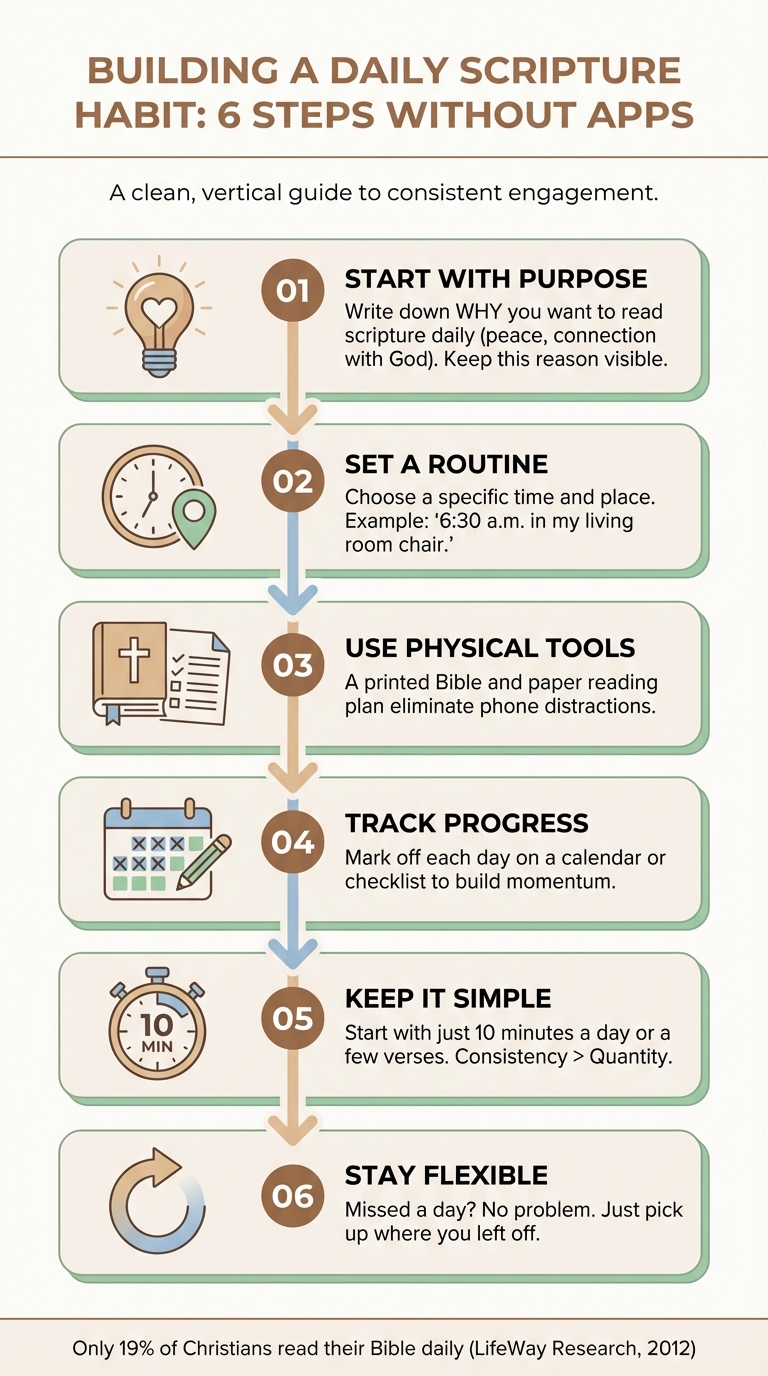
Want to read scripture daily without relying on an app? Here’s how:
- Start with purpose: Write down why you want to read scripture daily (e.g., peace, connection with God). Keep this reason visible as a reminder.
- Set a routine: Choose a specific time and place for your reading. For example, “6:30 a.m. in my living room chair.”
- Use physical tools: A printed Bible and a paper reading plan eliminate distractions from phones and apps.
- Track progress: Mark off each day on a calendar or checklist to build momentum and stay motivated.
- Keep it simple: Start with just 10 minutes a day or a few verses. Consistency is more important than quantity.
- Stay flexible: Missed a day? No problem - just pick up where you left off. Adjust your routine as needed to fit your life.
7 Tips to Help You make Bible Reading a Daily Habit
Set Your Foundation: Why, When, and Where
Building a habit of reading scripture doesn’t start with finding the perfect Bible or a flawless reading plan. It begins with three key decisions: why you’re doing this, when you’ll do it, and where you’ll sit down to read. These choices create the foundation that keeps you steady, even on days when motivation feels distant. Let’s dive into each step.
Write Down Your Reason
Before you crack open your Bible tomorrow morning, grab a pen and jot down your personal reason for reading scripture daily. What are you seeking? Wisdom? Peace? A closer connection with God? Identifying your "why" makes all the difference.
"When you know your 'why' - to grow closer to God, to gain wisdom, to be reminded of His promises - staying consistent becomes easier. You're not just checking off a task; you're seeking the heart of the One who loves you deeply." - Heather, Author and Bible Teacher [1]
Write this reason on a small card and keep it in the front cover of your Bible. On days when you’re tempted to skip, this reminder shifts your mindset from seeing it as a chore to recognizing it as an opportunity. As Deb Preston wisely points out, "If you don't know God's Word well, it's easy to be deceived when it comes to your faith" [6]. Your written purpose becomes a lifeline, especially during hectic or challenging weeks.
Pick a Set Time and Location
Combat indecision by choosing a specific time and place for your reading. This removes the daily guesswork. The key? Decide once, then stick to it.
Write this sentence and fill in the blanks: "I will read my Bible at [specific time] in [specific location]." For instance: "I will read my Bible at 6:15 a.m. in the armchair by the living room window." This simple commitment, known as an implementation intention, significantly boosts your likelihood of following through [4].
Paul Carter, Lead Pastor at Cornerstone Baptist Church, doesn’t mince words: "If you don't do it the same way, at the same time every day, it is highly unlikely that you will do it at all" [7]. Your brain thrives on habits. When you read in the same spot at the same time, it becomes second nature. Over time, the chair itself serves as a cue, signaling, "This is where I meet with God."
Choose a spot that’s quiet and comfortable, somewhere you’ll actually want to be. To make things even easier, leave your Bible open to the next day’s reading before bed. This small action removes a barrier and makes starting simpler when morning comes.
Track Your Progress on Paper
Seeing your progress can be incredibly motivating. Use a basic wall calendar or print a blank monthly grid. Hang it somewhere you’ll notice daily - near your coffee maker, on your bathroom mirror, or by your reading chair. Each day you complete your reading, draw a bold X over the date.
"Something simple like this [the 'Don't Break the Chain' method] or checking off a box after reading builds encouragement and momentum for your daily Bible reading." - Scott Slayton [8]
This approach works because it creates a visible streak that you won’t want to break. After a few days, those X’s form a chain. After a couple of weeks, you’ll see a satisfying pattern of consistency. The goal isn’t perfection - it’s about showing up often enough that the habit becomes part of your routine.
If you prefer, use your Bible’s table of contents or a small notebook to log your readings. The format doesn’t matter. What matters is making your progress visible, giving your brain that extra boost of satisfaction as you see what you’re accomplishing.
Build a Physical Scripture System
Once you've decided on the "why", "when", and "where" of your scripture reading habit, it’s time to create a system that supports it. This involves gathering the right tools to keep your daily reading focused and distraction-free.
Pick the Right Bible Format
Selecting the right Bible format is key to making your reading habit enjoyable and sustainable. Think about your reading style and setting. For instance, if you like to reflect and jot down thoughts as you read, a journaling Bible with wide, ruled margins might be perfect [11]. Dealing with eye strain? A large-print Bible with a 12-point font or bigger can make a world of difference [10].
The layout matters, too. Single-column Bibles, which mimic the look of standard paragraphs, are often easier to follow during longer reading sessions compared to traditional double-column layouts [11][12]. If you prefer taking notes, opt for a Bible with thicker paper to avoid ink bleeding through the pages [11][12].
"The goal is to develop a habit. We need to become consistent first. We can add more chapters or complexity later." - Reagan Rose, Founder, Redeeming Productivity [3]
Consider how and where you'll be reading. A heavier Bible might work well for home use, while a compact or thinline edition is better for reading on the go. Look for features like Smyth-sewn or lay-flat bindings, which allow the Bible to stay open without needing to hold it down [12]. Once you've chosen the right Bible, pairing it with a reading plan can streamline your daily practice.
Get a Printed Reading Plan
A printed reading plan takes the guesswork out of deciding what to read each day. You can download a free guide, such as the American Bible Society's Daily Bible Reading Guide [14], or use a checklist to track your progress through every book and chapter [13].
Choose a plan that fits your schedule - whether it's chronological, canonical, or blended - and keep it handy by tucking it into your Bible’s cover [5][13][15][16]. If a "Bible in a year" plan feels overwhelming, try a simpler approach, like reading two chapters a day [1][15].
"The goal of using a reading plan is not to be legalistic but rather to develop purposeful habits that get you into God's Word daily." - Erin Franklin, Production Editor, Lifeway Women [15]
As you read, mark off completed sections or note the date next to each chapter in your Bible’s table of contents [5][13]. This small act can provide a sense of progress and encourage consistency.
Use a Simple Reflection Method
Reflection is where scripture reading goes deeper. After each session, take a few minutes to jot down a key verse and your thoughts. This doesn’t have to be complicated - just note one verse that stood out, one observation about its meaning, and one way you can apply it in your life.
"I choose at least one verse every day from my reading and write it down. Then I write my prayer down too. This keeps me engaged and gives me a record to go back to." - Micah Maddox, Author and Bible Teacher [19]
If writing full sentences feels like too much, try the "jumping verse" method - simply record the verses that resonate most with you or seem especially relevant to your life [18]. You can also use highlighters or colored pencils to mark themes, repeated words, or attributes of God in your Bible [17]. The key is to keep it simple enough that you’ll stick with it daily, rather than creating a process so detailed that it becomes a chore.
Connect Scripture to Your Daily Routine
One of the simplest ways to make scripture reading a lasting habit is to tie it to something you already do every day. This approach, often called habit stacking, involves pairing a new habit with an existing one. For instance, you could decide, "Once the coffee starts brewing, I'll read a chapter," or "After breakfast, I'll open my Bible." The key is to choose a consistent morning cue to trigger your reading.
Link Reading to an Existing Habit
Find a daily activity that's already part of your routine and use it as a prompt for your scripture time. Many people find mornings work best since they're less likely to get distracted. You might read while sipping your first cup of coffee or before checking your phone. A helpful strategy is adopting a "No-Go" rule - deciding you won't do something, like scrolling through social media, until you've completed your reading.
"Good intentions without good plans are good for nothing. If you really want to develop the habit of daily Bible reading, you need to do more than just want it."
- Reagan Rose, Founder, Redeeming Productivity
The first moments of your morning often set the tone for the entire day. If reaching for your phone is your default, it can easily derail your plans. Instead, make a conscious effort to choose scripture as your first focus. Adjusting your environment to support this choice can make all the difference.
Set Up Your Space in Advance
Remove anything that might slow you down or distract you from reading. For example, leave your Bible open to the next passage on your favorite chair or table the night before, and keep a pen or pencil handy for notes or underlining. If your reading spot is the kitchen table, clear it ahead of time so it's ready for your Bible and coffee.
To stay focused, consider placing your phone in another room or setting it to "Do Not Disturb" during your reading time. Keeping a small notepad nearby can also be useful - not for deep reflections but to jot down random thoughts that might pop into your head while reading.
Start Small and Build Over Time
When it comes to building a habit, consistency matters more than how much you do. Just ten minutes a day can be more impactful than trying to cram an hour in sporadically. Start with a goal so small it feels manageable - whether that's a few verses, a paragraph, or one chapter. A 2012 LifeWay Research study found that only 19% of Christians read their Bible daily, with 47% of those who read less citing "never having enough time" as their main frustration[2]. The key isn't finding more time; it's starting small.
"It's better to spend 10 minutes reading the Bible daily than to spend an hour sporadically."
- Heather, Author and Bible Teacher, The Rescued Letters
As your habit becomes more ingrained, you can gradually increase your reading time. Tracking your progress on a physical calendar - marking an "X" for each day you read - can serve as a motivating visual reminder of how far you've come and encourage you to keep going.
Keep Your Habit Going Through Changes
Once you've built a solid daily routine, it's important to remember that life won't always stick to the plan. Work gets busier, schedules shift, and unexpected demands pop up. The trick to keeping your scripture habit alive during these times lies in staying flexible and bouncing back quickly.
Accept Missed Days and Start Again
Missing a day - or even a few - is completely normal. It doesn't mean you've failed or that you're doing something wrong. What truly matters is how quickly you pick yourself up and start again. Ken Braddy, Director of Sunday School at Lifeway, offers this encouragement:
"If you do miss a daily devotional time, don't label yourself a failure. Forgive yourself, recommit, and begin again." [20]
Trying to "catch up" by cramming in all the readings you've missed can actually backfire, making the process feel overwhelming. Instead, just pick up where you left off or start with today's reading. Studies suggest that consistently practicing a habit for 21 to 28 days is key to making it automatic [20]. So, the sooner you jump back in, the more momentum you'll keep.
Adjust for Busy Days
When life gets hectic, scaling back is better than skipping altogether. On those packed days, make a plan to keep it simple - read a single verse, reflect on a Psalm, or spend five minutes instead of your usual twenty. If sitting down to read isn't an option, try listening to scripture during your commute or while doing chores [1][13]. The goal is to keep the habit alive, even in a smaller way. Helen Rees from unhurriedspace.com puts it perfectly:
"If you miss one day for whatever reason, that's okay. But get on track the next day. Try not to miss two days in a row." [4]
This mindset helps you maintain consistency without adding unnecessary pressure.
Reevaluate and Adapt Your Routine
Every few months, take a moment to see if your routine still works for your current life. Maybe your morning reading time no longer fits because of a new job or changes at home. Don't hesitate to tweak your schedule, location, or even the Bible translation you're using. For example, during stressful times, switching to a more accessible translation can make the habit feel less daunting [9]. Life evolves, and your scripture habit should evolve with it. Adjusting your approach ensures that your practice stays steady, no matter what season you're in.
Conclusion: Building a Scripture Habit That Lasts
To make your daily scripture practice stick, focus on four key elements: purpose, physical tools, routine, and flexibility. A clear purpose turns scripture reading from a casual intention into a meaningful commitment.
Using physical tools - like a printed Bible, a journal, and a reading plan - helps you stay grounded and distraction-free. These items create a dedicated space where your attention remains fully on God's Word, free from the interruptions of digital devices.
Tie your scripture reading to an existing daily habit, such as sipping your morning coffee. This makes it easier to integrate into your routine. And when life gets hectic, remember that even a brief reading session can keep you on track. Consistency matters more than how much you read.
FAQs
How can I build a consistent daily scripture reading habit without using an app?
Building a regular scripture reading habit can be both simple and fulfilling, and you don’t need apps to make it work. One effective approach is to tie your reading time to something you already do every day - like sipping your morning coffee or relaxing before bed. Keeping a physical Bible, a printed reading plan, or a journal in a spot you see often, like your nightstand or kitchen counter, can gently nudge you to stay consistent.
Start small - reading just a few verses or spending five minutes with a passage can make the habit feel achievable. To stay motivated, use a notebook or a bookmark with checkboxes to track your progress. Watching your streak grow can be incredibly encouraging. You can also pair your reading with a short prayer, asking for focus and a stronger connection to scripture. Celebrate small wins along the way, whether it’s completing a chapter or sticking to your plan for 30 days straight. These little celebrations can make the journey more rewarding.
By tying scripture reading to your daily routine, relying on physical reminders, and setting realistic goals, you can build a lasting habit without relying on digital tools.
How can I reflect on scripture daily without feeling overwhelmed?
Reflecting on scripture doesn’t need to be overwhelming or take up a lot of time. You can start small by focusing on just one verse or a short passage each day. Spend a few quiet moments reading it, thinking about its meaning, and jotting down a quick thought in a journal. Writing it out by hand can help the message sink in and keeps the process straightforward.
To make this a regular habit, connect it to something you already do every day. For instance, you could keep your Bible next to the coffee maker or on your nightstand. Seeing it can serve as a gentle reminder to pause and reflect. Before you begin, consider saying a short prayer asking for guidance or a deeper connection to God’s Word - it can make the experience feel more personal and fulfilling.
Ask yourself one simple question: What is God saying to me today? Write down your thoughts in a sentence or even a quick doodle if that resonates with you. Wrap up with a brief prayer of thanks. By keeping the practice simple and consistent, you’ll stay connected without feeling like it’s a chore.
How can I keep up with my scripture reading when life gets busy?
When life gets busy, keeping scripture reading simple and adaptable can make all the difference. Try linking it to your daily routines. For instance, you could read a verse while your coffee brews, during a quick walk, or even aloud to your child at bedtime. Pairing scripture with a regular habit - like your first sip of coffee or locking the front door - can help it become a natural part of your day.
If your planned time doesn’t work out, don’t skip - adjust. Carry a small notebook, index cards, or a printed reading plan so you can read a verse or two whenever you find a moment. You might also recite a memorized verse while waiting in line or during a quiet pause in your day. This way, you stay connected to scripture without depending on digital tools.
Be gentle with yourself and focus on consistency rather than perfection. Even just a few intentional minutes each day can grow into a meaningful habit. And as life evolves, it’s okay to tweak your routine. Staying flexible will help you maintain your connection to God’s Word, no matter how packed your schedule gets.
Related reading
- How to Read the Dhammapada: A Beginner's Practice Guide
- One Verse a Day: Why Less Buddhist Reading Leads to Deeper Practice
- Buddhist Mindfulness Without Meditation Apps: A Simpler Path
- Daily meditation routine
- Dhammapada verses explained
Useful tools & services
Explore our tools for everyday work
Browse our focus app, PDF reader, and other products to find an option that fits your task.
Browse our productsThese are products built by Artisan Strategies.